10 Ambiguous Video Game Endings You're Getting Totally Wrong
Got more questions than answers? Think again.

The video game industry may be littered with cliché stories about gun-toting heroes saving the world from flesh-eating zombies and alien invasions, but there are some truly deep, meaningful tales told in this medium too.
From philosophical indie developers like Jonathan Blow all the way up to industry leaders like Hideo Kojima, the gaming world has been blessed with some marvellously creative and intellectual storytellers.
However, some of the greatest gaming tales tend to end ambiguously, to say the least. More than a few times, players have been left with an overwhelming sense of confusion after watching the final scenes of their favourite titles play out.
Hardcore gamers adore analysing and discussing ambiguous game endings in the tiniest detail, suggesting their own theories and explanations, and we're here to try and put the record straight on ten of the most ambiguous game endings in history.
10. Bloodborne
The Ending: Bloodborne actually has three different endings, but only one of them shows the true end to the story. In the 'Childhood's Beginning' ending, we see the player transformed into some kind of slug creature and picked up into the arms of the game's Plain Doll character, who says "Oh good Hunter" as the screen fades to black.
What You Missed: As the way to unlock the true ending is so obscure, many players never actually saw it, and even those who did see it didn't really understand what was going on.
To unlock the ending, you had to find and consume three special items and defeat the game's final secret boss, the Moon Presence.
A subtle part of the ending you might have missed is when the Moon Presence attempts to hug the Hunter, but recoils in horror. This is because, in consuming the special items, you have become a Great One. The Moon Presence despises the Great Ones and wants all of them dead for the Hunt to continue. However, in defeating it once and for all and becoming the only Great One left, you basically become God, able to bring in a brighter and better future.
9. Alan Wake

The Ending: At the end of the game, we see Alan sacrifice himself in order to save his wife, Alice. He dives into Cauldron Lake, where an ancient evil presence has been lurking. Alice emerges safely while Alan starts typing in an underwater cabin, saying that the lake is actually an 'ocean', in the game's cryptic final lines.
What You Missed: The answer to this ending can be found in the game's DLC, but many never played this extra content and were left perplexed by the game's ending.
In the downloadable episodes, we learn that Alan did actually defeat the dark presence, but his own mind has been fragmented in the process, leaving him trapped in a creation of his own imagination.
The two DLC episodes show Alan fighting back against a dark version of himself in order to try and return to reality. At the end of the second and final episode, Alan starts writing a book called 'Return', signifying his return back to the real world, where he will finally be reunited with Alice and his friends.
8. Inside
The Ending: The game's ending shows the boy, who the player has been controlling throughout the game, integrated into a giant blob creature, which then breaks out of a shadowy facility, killing some of its captors along the way, and finally escaping to freedom.
What You Missed: The game actually has a secret ending! In this hidden scene, we see the boy unplug some kind of mind control device. As he does so, he becomes uncontrollable by the player, symbolising his escape from your control.
The theme of the entire game is control. We think we're playing as a boy with free will in a world where everyone else is brainwashed, but really, the blob was in control of the kid all along, and by extension, the blob was also controlling us. The game provides no real motive for the player, who simply runs along to see what happens, doing exactly what the blob wants.
7. Monkey Island 2
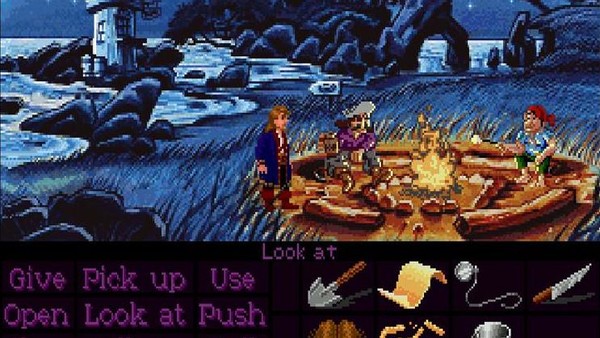
The Ending: Monkey Island 2 finishes with a famously confusing and amusing scene in which the hero and villain of the story, Guybrush Threepwood and LeChuck, are suddenly and mysteriously transformed into a couple of kids and seen playing around at a theme park, suggesting that the entire game's story was taking place in the minds of a pair of imaginative children.
What You Missed: Ron Gilbert made Monkey Island 2 and wasn't involved in the production of the third game, so we might never know what he truly intended for the story. However, in the game's canon, established in The Curse Of Monkey Island, we learn that the whole sequence at the end of Monkey Island 2 was just a trick from the villainous LeChuck.
LeChuck had put a curse on Guybrush to transform him into a child and was keeping him captive at his Carnival Of The Damned. Guybrush somehow escapes at the start of the third game and is later turned into a kid again, but manages to break the spell with a special cure.
A hint to this can be seen in the ending of the second game, where LeChuck's eyes briefly glow, symbolising the use of magic.
6. Final Fantasy X

The Ending: Final Fantasy X's ending is extremely drawn-out and complicated, showing one of the game's playable characters, Tidus, fading away after the final boss is defeated.
What You Missed: Final Fantasy fans have long debated the ending of this game and it remains a highly-discussed subject to this day. What you might have missed here is the explanation of exactly what Tidus is and where he comes from. In essence, Tidus never really existed in the same way as Yuna and the others. Tidus was the product of a dream by Yevon, the leader of the real Zanarkand.
When the real Zanarkand was destroyed in a war with Bevelle, Yevon decided to dream up a new Zanarkand, filled with people, including Tidus. These people were basically like the aeons in the rest of the game. They're real and physical, but only for as long as the Fayth are dreaming of them. Once the dream ends, they cease to be.
So, when Yu Yevon is defeated and stops dreaming, Tidus fades away too.
Simple.
5. Limbo

The Ending: At the end of Limbo, after a long and perilous journey through a mysterious world, we see the game's hero, a young boy, finally catch up with his sister, who suddenly looks up as he approaches.
What You Missed: If you wait until the credits finish, the main menu fades in on the same scene, but the boy and the girl have now disappeared, suggesting that they have 'moved on' to the next plane of existence. Both the boy and his sister are dead from the start, but only the boy has to endure the trials and tribulations of the limbo world.
This implies that the boy was somehow responsible for the kids' death and had to atone for his acts by travelling through a terrible world, being chased by spiders and diving over spiky pits along the way.
The scenes and enemies encountered along the way are memories and manifestations of the boy's life.
4. Braid

The Ending: The ending to Braid provides a major twist as we see that the princess we thought we were rescuing has actually been trying to flee our hero, Tim, the whole time. She was the one setting up puzzles and obstacles in an attempt to slow us down.
What You Missed: Many people only scratched the surface of the ending, assuming that Tim was a bad guy and he was stalking the princess, or perhaps that they'd been in a relationship and broken up.
This has been confirmed by the developer, Jonathan Blow, to be completely false. If you pay attention to all of the text throughout the game and especially during the ending, it's clear that game is actually an allegory for the development of the atomic bomb.
The best example of this is during the epilogue when the words "Now we're all sons of bitches" appear. This is a quote from Kenneth Bainbridge, who worked on the Manhattan Project. Tim represents a scientist, stopping at nothing in a pursuit of power, while the princess is the bomb, puzzling and confusing the scientist, and never quite falling neatly into his hands because she's simply far too powerful.
3. Shadow Of The Colossus

The Ending: Our hero, Wander, is suddenly weak and weary, with cloudy eyes and horns sprouting from his head. He turns into a shadowy beast and fights off some hunters, who manage to seal him away with a magical spell before escaping. Mono, the girl who has been asleep for the entire game, then wakes up and picks up a horned baby.
What You Missed: There's a lot you might have missed here. Essentially, in destroying the colossi throughout the game, you were actually liberating an ancient evil being named Dormin, who appeared to be a helpful guiding presence earlier on in your adventure. He manifests as the shadowy creature at the end and is sealed away once again.
The horned baby is Wander. Some part of him survived as a baby and you had to have played Ico to truly understand everything about the ending. In Ico, children are also born with horns, so it turns out that they were the descendants of Wander.
Mono, meanwhile, lives forever and grows bitter over time, going on to become the villainous Queen of Ico.
2. Final Fantasy VIII

The Ending: We see a lot of confusing imagery here as Squall is seemingly lost in some kind of time prison and starts to fade out of existence. We see a faceless version of the hero appear, until eventually he somehow makes his way back to the real world and is seeing kissing Rinoa and celebrating with his friends at the very end.
What You Missed: The faceless Squall symbolises Squall gradually losing his memories. In going back in time with Ultimecia and telling Edea about SeeD and Garden, Squall has essentially set all of the events of the game into motion, throwing him into a kind of limbo paradox.He's slowly fading out of existence, but tries to think about Rinoa and other important memories and events from his life in order to save himself.
In a brief but important scene that some players will have missed or misunderstood, we see Rinoa using a feather to contact Squall and help to bring him back to the real world. Throughout the game, Rinoa is associated with feathers and wings, all leading up to that final point. Without her help, Squall would probably have been lost forever.
1. Metal Gear Solid 2

The Ending: Raiden realises that his entire mission on the plant has been an experiment. It was all a simulation and everything he'd been told was more or less a lie.
He nevertheless proceeds to complete his mission by killing Solidus Snake, but what was it all for?
What You Missed: The key here is that the whole S3 (Selection for Societal Sanity) simulation was designed by The Patriots in order to see if someone could be controlled and influenced in the most extreme situations. And in killing Solidus, Raiden essentially proves them right. But the meaning of the game's ending goes a lot deeper than that.
During the ending, we see Solidus looking up and reaching out to the statue of George Washington. This is highly symbolic as Solidus was actually a US President who was disgusted by The Patriots' plans and wanted to bring back the liberty and freedom of American citizens that had been so important to Washington himself.
Solidus wasn't the evil terrorist he was made out to be, but Raiden, and the player, spend the entire game growing to hate him, again proving that the S3 plan is a complete success as people's motives can be completely controlled with lies and manipulation.