10 Classic Cartoons That Should Be Video Games
 Many cartoon intellectual properties have had game tie-ins over the years. Some were OK; and some were, shall we say, not realised in the most engaging or commercially successful ways possible. And yet, there still remain many worthwhile properties yet to be used to establish a franchise. So here we stand at a crossroads of opportunity: a time when video games can be created that are immensely satisfying in terms of graphics, sound, and story; and yet, a time when games sometimes seem to suffer from a paucity of compelling examinations of the moral conundrums that heroes should be going through in order to prove that they deserve the moniker. Games that, say, revisit the idealism of childhood and focus it through the lens of maturity to create something both old and new; and something, hopefully, that is more compelling than the original. Here, for your consideration, are 10 such properties that could arguably be the front runners for such a revisitation.
10. Mysterious Cities Of Gold
 Screening in 1982-3 in Japan and in the late 80's in the U.S., if there's one cartoon that seems to hold a special place in everyone's hearts, it's this one. And, in reflection, what's not to like? Three kids share friendship and adventure across South America, and while following personal quests discover great secrets left behind by ancient civilisations long destroyed. It's set in 1532, and so a student of history might recognise that it's a bit of a rich time for the area the series is set in; Peru was in a state of civil war, and the conquistador Pizarro turned up to conquer the Inca almost at the same time. Against this heady cultural backdrop, the children play out their individual and intertwined stories, while being pursued by greedy adults seeking brutish goals. Long time fans might be pleased to hear that 25 years on, three new seasons of the series are planned - with the first apparently ready to air at the time of writing. Sounds like the perfect opportunity for a quality story tie-in! How This Could Work: With proper treatment, it's a little hard to see how this wouldn't work. There are ready-given solutions to earnable/unlockable transport (the Solaris and the Golden Condor) which can also be used as plot elements. There are 6 more Cities of Gold to discover. Esteban still hasn't found his father. And, perhaps most importantly, what actually happens if even one of the Cities, which were built long ago to avert a catastrophic war, is properly activated without mishap or interference? The children all have different backgrounds, goals, and specialities. An all-ages game that includes conflict resolution, exploration and puzzle solving incorporating control of multiple characters or better yet, with multiplayer game elements seems like an obvious direction. The major difficulty may well be in providing moments of danger and anticipation that are believable within the story, yet won't scare off the playing audience.
9. Ulysses 31
 Mining the past for ideas is a rich vein indeed if you can actualise it by using the double whammy of a science fiction series based on the greek poet Homer's Odyssey. Ulysses 31 is that series, a French-Japanese production that aired around the world in the 1980s. The eponymous Ulysses, a starship captain of the 31st century, has earned the wrath of god-like beings by killing a monstrous creature that threatens a group of children that includes his son; and, cast adrift in an unfamiliar region of space, he spends his days searching for the domain of Hades so that he may revive his comatose crew and safely return to Earth. Ulysses has as companions his son Telemachus, his son's companion robot Nono, the alien girl Yumi, and the ship's computer Shirka. (This seems to be a direct translation to Japanese of the name Circe). They all have strengths to contribute to the success of the journey, plus Ulysses has some cool toys; a multi-function laser pistol/energy sword, an energy shield, and an anti-gravity belt. How This Could Work: A good example of a group dynamic with each character contributing their various strengths to achieving success in a game setting supports this idea. There exist possible directions for unlockable abilities and upgrades, as well as supporting source material that exists within the public domain. Surface exploration of discovered worlds and space battles are other elements that could be thrown in.
8. Space Pirate Captain Harlock
 A Leiji Matsumoto anime lensed through a U.S. production company, Space Pirate Captain Harlock is solid cartoon fare. Carrying themes of ineffectual government that cares little for the citizens it purports to represent, and an apparently straightforward alien invasion actually being a nightmare grey issue of refugees with no other option, Harlock is a protagonist who wants to do right in a world bereft of simple choices. It's also got a CGI animated movie in the works, so it's another that's ripe for revival by tie-in. How This Could Work: Alien conspiracy and invasion, driven by the desperation of its leader? Dystopian Earth government? Characters joining the system in order to try and effect change from within? Ragtag crew in a ship that runs a copy of the brain of the dead man who built it as an A.I.? Iconoclast leader who tries to do the right thing despite being termed an outlaw for it, and who also knows that each alien he kills brings the invading race closer to extinction? This property encapsulates all these concepts. The mission structure could be very rich, especially when other complex plot factors present in the series are considered.
7. Thundarr The Barbarian
 In the opening credits to Thundarr the Barbarian is depicted a disaster geek's wet dream; a planetary catastrophe shatters the moon, appears to tear away the ozone layer, and tsunamis, earthquakes and volcanoes wreak world-wide devastation. Man's civilisation cast in ruin is how the voice-over puts it - which is, let's face it, pretty poetic for a cartoon from 1980. Two thousand years after this ruination, the Earth is a much-changed place, where super-science and sorcery are often indistinguishable. In a bare-bones backstory, Thundarr escapes gladiatorial slavery like a fur-leotard-wearing Spartacus and finds both an energy blade weapon called the Sun Sword, and a couple of friends to adventure with; Ookla the Mok and Ariel the Sorceress. How This Could Work: Apart from the group dynamic and usual combat skill, attribute enhancement and spell trees, the beauty of this property is that much is unwritten, and the only limit to any game you might make is how much you can shoehorn on to the disc or cram in to the DLC. The characters travel widely in the series, the inhabitants of the world are hugely varied, and sometimes in the series plot devices such as spells are used to access new areas. Go nuts with it! In the first episode of the cartoon they're already climbing all over a magically animated Statue of Liberty like it's PS2 game night and they've lost their copy of Shadow of the Colossus let your imagination run wild from there.
6. Galactic Patrol Lensman
 Galactic Patrol Lensman is an anime based on E. E. Doc Smith's Lensman books. Ancient, warring alien races are locked in conflict, and gift selected beings with a psychic activation device known as the Lens, which they hope will help activate their potential to do good, drive off the aggressors and defend peace across the galaxy. The background information in the cartoon is a little thin on the ground compared to the books, though there are certainly enough examples of aliens and story to base a one-game instalment on; but within the books there's a wealth of source material on the technology and aliens involved in the story upon which to base more content. How This Could Work: There have been many games that construct emerging trees of psychic powers around the hero; this is another, though as yet is an untapped property. The Lensmen are not bound to act alone, so there is an interplay of mission choice versus possible team choice. And, of course, there's the little matter of a galaxy to save. There's plenty here to build on that would create a successful franchise.
5. Adventures Of The Galaxy Rangers
One of the 1980s cartoon properties to combine sci-fi and wild west themes was the Adventures of the Galaxy Rangers. Friendly aliens approach humanity with technology for interstellar travel, which is a bit of a nice change. The galaxy in general turns out to be whole lot less helpful than that very quickly, however. Space pirates, an evil empire, the wife of the cyborg protagonist kidnapped, and soon the Rangers have a full dance card. This was another series that examined some cloudy principles, including interdependent planetary economics, the effects of xenoculture, and character choices that would affect the lives of the people involved. How This Could Work: The archetypes of cyborg, super-soldier/gunslinger, psychic martial artist and eccentric hacker, combined with the usual skill tree options, form the basis of a workable model. The series has ally and enemy aliens, complete with idiosyncratic xenopsychologies. There is provision of not only main antagonists and player investment in their downfall, but also grey areas of choice interaction; such as rogues willing to cut quasi-beneficial deals, and alien races that have their own local interdependencies that incur secondary problems once interfered with.
4. The Guyver: Bio-Booster Armour
 Hey, wouldn't high school have been so much better if you had stumbled across a super-suit that gave you all sorts of awesome powers? Apparently not, especially for Sho Fukamachi, a 17-year-old who finds himself in just this sort of situation in the 1989 OVA, The Guyver: Bio-Booster Armour. What Sho finds out is that once this happens, your problems are far from over; you actually graduate to a bigger schoolyard, where the jerks have the strength of five elephants or the power to instantly burn a man alive. And the jerks still work in packs, but wedgies and FaceBullying have been replaced by the plan to skin you alive to get the armour back. Awesome. The series is based upon manga and has had quite a few permutations over the years, including two live-action movies. How This Could Work: The Guyver is a suit of organic power armour, gifting the wielder with enhanced senses, speed, and strength as well as in-built energy weapons, and extendable vibro-blades capable of cutting vehicles in two. In addition to these, it conceals in seconds by an automatic quick-costume-change. The protagonist is transfixed in the midst of characters who all hold more information than he does, and yet are unwilling to give him a run of straight answers. An evil corporation run by monsters regularly puts out hit contracts on the hero. For a play concept, think Spiderman without webs, in a fully destructible environment, and the archenemy is a massive organisation with no shortage of resources and muscle that it will not hesitate to throw at the player or the people he cares about.
3. The Zeta Project
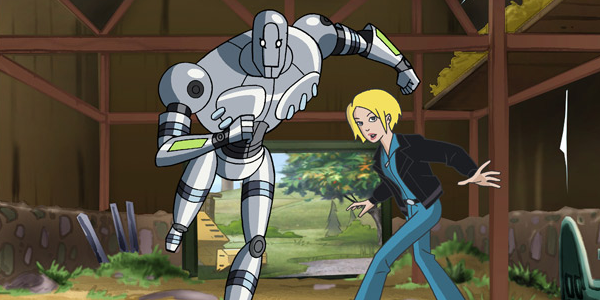 The Zeta Project is a two-season spinoff of the Batman Beyond television series, first airing in 2001. The main protagonist, Infiltration Unit Zeta, is an espionage and assassination droid with many advanced capabilities. This becomes a problem when he suffers an attack of conscience; his target is an innocent man. Zeta promptly rids himself of all weapons he carries, and vows to never kill. However, this means he is at odds with the government who created him for that purpose, and so begins his life on the run, searching for his creator and an explanation as to why he is. Along the way, he makes many allies, as he strives to improve the lives of those he encounters and protect them to the full extent of his power. This property asks you to make a game that possibly examines existentialism and the individual's relationship to the society he finds himself in, combined with the gritty cyberpunk edginess of the Batman Beyond setting and a hero who must build relationships and use problem solving to survive. It's not a usual concept, but it is one worth considering. How This Could Work: Zeta, being both robotic and an artificial intelligence, is easily fit in to a reward and upgrade schema. Any human companions are more difficult to reward, but they are also generally not in the thick of the action unless forced. The story of an individual trying to find his reason for being is pretty compelling, too. Also, Zeta has not disabled or discarded any of the espionage devices he holds that are nonlethal, he can still use a gun (just not to kill) and he's resistant to damage, so he's just an action hero of a different stripe. He also has many human allies that can be plot driver, asset and liability.
2. Star Blazers
 The American adaptation of a Japanese series, Star Blazers is a pretty big concept overall. An alien planet bombards Earth with radioactive meteorites until the only place relatively safe from the ruined and contaminated surface is underground. The realisation that mankind has a one-year time limit until the damage is beyond the technology of a friendly alien race to repair forces humanity to follow the plan these aliens give them; build a giant spaceship around an incredibly powerful piece of strange technology, and push that craft to the limits of its endurance to reach a distant world. Once there, the ship must immediately return, carrying a terraforming cargo, or all life on Earth is doomed. With strong themes of death and loss and sacrifice, an adult understanding of the strain of conflict, an ever-present threat of humanity's extinction and a caution against use of environmentally devastating weapons of war, Star Blazers carries such a story with ease. How This Could Work: If there's a mother of giant space battle concepts, it's this one. The Yamato regularly takes (and deals) colossal damage whilst running a defence against swarms of enemy fighters with banks of its own defensive guns as well as its own fighter craft. The Wave Motion Engine can be used for propulsion as well as staggering firepower. It's held together by a time-limited story arc. Crewing, research, resource harvesting, repair management and upgrades could feature strongly. However; in amongst the awesome destruction, smoke, flames and wreckage, it would be extremely important for the game to not lose the themes of the impact of conflict upon combatants, and the human cost of choosing to unleash annihilation upon other living beings.
1. Honourable Mentions
 No, that's not the name of a series you've never heard of, it's a realisation that some excellent properties have not been included in the list because they have had some sort of game produced in the past; and in some cases, that's almost twenty years ago. Which is a shame, because there are strong themes for good story in these series that deserve exploration and revitalisation in today's market. Some examples include:Exo Squad A racially diverse unit of battle robot pilots defend humanity against a peril of its own making a class of genetically engineered slave labour humans who want freedom and equality. Also explores the social perils of such unregulated genetic manipulation and cloning, while the entire solar system floods with pirates and rages with war. Lose the odious, clear-faced toy line designs and you could have a winner. Gargoyles Betrayed by their original human friends, the remnants of a shattered tribe of mythical monsters led by an alpha male named Goliath are cursed to remain as stone until the conditions of release from the spell are met. A thousand years later, a billionaire who seeks to exploit their powers uses his wealth to awaken them in the middle of New York City. Keith David and the Star Trek: Next Generation alumni to reprise their voice roles, please. DangerMouse - For those of you unfamiliar with the general brilliance of Britain's Cosgrove/Hall animation studio, suffice to say that this is one of their most enduring (and international) successes. Years before Wallace and Gromit, DangerMouse and his semi-competent assistant Penfold were navigating anthropomorphic adventures, thwarting the evil machinations of Baron Silas Greenback, the Terrible Toad. Slapstick gags combined with word play wrapped around jokes to create hilarious fun that everyone could enjoy. Did we miss any of your favourite classic cartoons that should be included here? Share your picks below,