10 Most Essential Japanese Video Games
Utterly phenomenal games everyone should play.

When it comes to video games, the Japanese gaming industry is responsible for taking things to the next level. We had the furtive likes of Atari blowing up with Pong and a slew of titles across the 70s, but after the gaming industry crash of 1983, video games as a worthwhile pastime went out the window.
It wasn't until Nintendo took a risk with the NES, shipping physical press stands and consoles to retailers for free - in an attempt to get people through the door - that the gaming industry we largely know today was born.
Injecting some much-needed creative and artistic flair to a medium crying out for care and attention, the likes of Mario and Zelda revitalised gaming and set it on a path that's still fascinating to engage with today.
With Nintendo and PlayStation both absolute titans of the industry - and plenty of third-party games flying the flag for Japan proudly - there are simply some Japanese video games everybody should play.
--
Note: We're talking individual games, not entire franchises, and a franchise can only appear once, just to keep things interesting.
Honourable Mentions: Silent Hill 2 & Resident Evil

Konami's answer to Resident Evil's more gung-ho, action-oriented approach to monsters and scares in general, Silent Hill was all about atmosphere. About caking the screen in fog, making it so you could barely tell what was coming your way... then shattering that tension in an instant when some ungodly horror broke through a window.

Resident Evil is also, obviously a MASSIVE deal, but its inception involves largely ditching Eastern horror and identity in favour of being massively influenced by George Romero's zombie movies.
If we're talking essential Japanese video games, Silent Hill and Resident Evil are in there, but as you'll see from the 10 I've chosen, swapping any of the following feels impossible.
10. Persona 4

Persona 5 might have the flash and panache, but Persona 4 was the first one to truly blow up worldwide, alongside having one of the better-paced stories in the franchise.
Seeing your custom-named hero arrive in Inaba to stay with their uncle Dojima, you're quickly thrust into a "hunt-the-serial-killer" plot, backed by a cocktail of awesome elements that make Persona as a series pop.
There's a phenomenal electro-jazz-pop score by returning composer Shoji Meguro, the time management side of gameplay means you have to juggle crime scenes and clues with nighttime excursions into demonic dungeons. High school life routinely inserts itself too, as exams come and go, your social circle expands, characters can be romanced or maybe you all decide to go away for the Summer.
Combat is again turn-based but snappier than ever, with a great cast, solid writing and some brilliant twists and turns keeping everything moving perfectly.
9. Super Metroid

Another franchise that sinks its hooks in deep, 2D Metroid might be on pause as Nintendo explore bringing back Metroid Prime first, but Super Metroid crystallised everything fans loved about the originals.
Arriving on SNES more confident than ever, this Metroid boasted a dark, synthetic score, incredible graphics and snappy, addictive action platforming. Its environment was more complex and rewarding than ever, helping birth the genre of "Metroidvanias" alongside the mighty Castlevania titles, thanks to item and ability-based world progression.
An essential game for anyone wanting to understand why Metroid is such a big deal, or where this approach to progression truly got perfected, as a full package, there's something endlessly recommendable about Super Metroid's entire presentation.
8. Dark Souls

What's a list on games that upended everything we thought we knew about game design without Dark Souls?
Yes, Demon's Souls came first, but if we're talking essential titles from entire franchises, it's the original Dark Souls by a country mile.
Hidetaka Mizayaki's ethos - inspired by reading illustrated books in other languages as a child - was to give you the building blocks of an intricate fiction, one item, weapon or boss at a time.
It resulted in a game that is brutally unforgiving, sure, but that had far more to it than just forcing Game Over screens. Dark Souls' persistent world, respawning enemies and trial n' error approach immediately instilled the idea that maybe there was more to everything than just some skeletons and a fire-breathing dragon.
Dark Souls would go on to revolutionise the very way we control action games; the very nature of how we fight bosses and manoeuvre around them. It's a hugely important title for multiple genres at once, and without Miyazaki's mind at the helm, none of it would've come together.
7. Dragon Quest VIII: Journey Of The Cursed King
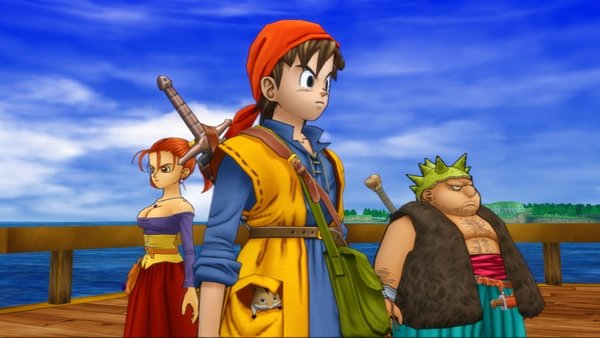
One of the most successful franchises in Japanese gaming history, Dragon Quest's popularity spread so far and wide, it spawned an urban myth that sequels are not allowed to release during the week, as too much of the Japanese population takes time off work at once.
While that was very much a fabrication (but an awesome one, in fairness), Dragon Quest itself is charm personified. Taking everything you love about Saturday morning cartoon ephemera visually, Akira Toriyama's art direction really came into its own with Journey of the Cursed King.
With Level-5 now masters of the craft and Dragon Quest 7 already being a firm fan favourite, Dragon Quest 8 executed on its JRPG formula to perfection. The story of a king turned into a goblin and the queen into a horse is the perfect setup for a cross-country adventure. Along the way you'll indulge in addictive level grinding, snappy combat, rewarding exploration and a super neat monster-capture mechanic expanded on from DQ V and VI.
Yes, Dragon Quest is formulaic but that's the point - this is the franchise that helped craft that formula in the first place, putting JRPGs on the map and further nailing its framework in a way very few get quite so right.
6. Yakuza 0

You can't talk about Japanese video games and not mention the Yakuza series.
A straight-up awesome mix of brawler gameplay with ludicrous plot twists, Yakuza 0 is arguably the best of the bunch. Filled with minigames that include old-school Sega classics alongside jaw-dropping fight choreography, the series has always been one of Japan's most popular IP for almost two decades.
In the West though, thanks largely to Yakuza 1 being marketed as an open-world crime game, it resigned Yakuza to "that game your friend is always telling you to play" (I should know, I was that friend). Western releases for each game lagged years behind their Eastern counterparts, to the point where Yakuza 5 was arriving on PS3 in December, 2015 worldwide, yet Japanese audiences had since played prequel Yakuza 0, and were just a year away from Yakuza 6.
Thankfully today those release dates have largely synched up, and following things like the Yakuza Collection finally bringing 3, 4 and 5 to Xbox for the first time in the series' history, a global audience can enjoy Sega's unique brand of arcady super-violence, twinned with stories and characters you'll remember for the rest of time.
5. Monster Hunter: World

Capcom's best-selling game of all time, if you've been a Monster Hunter fan since the beginning, you were just waiting for the devs to smooth over the edges and deliver something on newer hardware that would truly sing.
That time finally came in 2018, when after almost a decade staying away from home consoles, World arrived fully formed to dominate the sales charts.
As a base formula many had enjoyed on 3DS and even PSP over the years, Monster Hunter's core loop of taking down increasingly large beasts, knowing you'll then use specific parts like claws, teeth, hides, fur etc to make better gear, just keeps people coming back.
If a player drops into your game with an oversized katana made from the jawbone of a creature that wrecked you the previous week, it alone is a reason to stick around, fight alongside and see what else you can find.
Wearing creatures down through attrition, setting up traps, coordinating specials and actively riding the beasts around the map for the next stage of the fight, Monster Hunter: World is an exquisite multiplayer experience, and a totally recommendable single player one, too.
4. Metal Gear Solid

Metal Gear's very core ideology was a purposeful blend of "East-meets-West" ideologies and entertainment philosophies, but that's precisely why it's still so treasured.
With Hideo Kojima becoming a household name overnight, Metal Gear Solid upended how to even tell a story in video game form, ushering in over a decade of Hollywood-influenced cinematography, scene setting, voice acting and tone.
It's hard to put into words how mind-blowing and literally game-changing all of this was, but alongside a brilliant script loaded with memorable characters and plot twists, was the mainstreaming of the stealth genre.
MGS let you experiment with enemy A.I. in a genuinely playful manner. A slew of weapons and takedown methods kept things fresh on the 20th playthrough, but ultimately it's Hideo Kojima's vision of what video games could be, that will always be his lasting legacy.
3. Final Fantasy VII

For millions of gamers, FF VII was their first taste of Eastern mass media entertainment in various forms. The anime art direction for characters and world design, the mythological aspect of ancient forces doing battle once again, the idea of characters powering up to unleash special attacks, the sense of humour and everything in between.
It of course helped that Final Fantasy VII is a remarkably deep RPG, pioneering the "Materia" system that let you customise every character to find party makeups that differ from player to player. This game's opening "Bombing Run" section went down in history too, alongside a stellar soundtrack throughout, propelling you into discovering just what's happening with the mysterious warrior-gone-mad Sephiroth, and a planet beset by the evil Shinra Corporation.
It may have been remade with many key scenes changed, but the original Final Fantasy VII is gaming royalty for a reason.
2. The Legend Of Zelda: Ocarina Of Time

A tale of pure adventure inspired by creator Shigeru Miyamoto stumbling upon a cave while in a forest behind his hometown, yes you can point to the original Zelda or Link to the Past as must-plays, but that's after you've played the game changed it all.
Ocarina of Time has sumptuous music, fun boss design and a surprisingly weighty twist when Link accidentally dooms all of Hyrule and has to save it, but alongside you had Nintendo showing the world how combat could work in 3D.
Inventing "Z-targeting" so we could move "into" and away from enemies alongside jumping and strafing, this basic ruleset on how to engage enemies or juggle groups of foes is still implemented across the industry today.
As mentioned you have an archetypal fantasy adventure seeing a young elvish Hylian child saving the land one sword swipe and shield-deflect at a time. There are fairies to meet, skeletons to defeat, dungeons to explore, chests to open and one final evil menace to defeat at the end.
It might have been aped to death now, but there's nothing like your first playthrough of Ocarina of Time.
1. Super Mario 64

It is hard picking the most important Mario game that doubles as an essential window into what Japanese game development mentalities brought to the world. Whilst the original Super Mario Bros. is gaming royalty and Super Mario World is so insanely playable, Mario 64 edges it just by showing everyone how to even "do" 3D.
Where Ocarina would flesh out camera controls and targeting even more, the very idea of traversing a 3D space both horizontally and vertically, is something you have to experience through the lens of Mario 64.
It's not just that Mario's controls still have that perfect sense of weight, propulsion and kineticism today as back in 1996, but that the whole package is still so damn loveable. The secret collectibles, charming as hell music soundbites and score. The isometric camera framing so many expansive levels in ways that make you want to go everywhere.
There's a quality to Mario 64 that came directly from a team of creatives putting their all into breaking the mould, and what we got remains pure magic.