10 Amazing Games (With ABYSMAL Combat)
Which ten gaming greats only start whiffing when they get to the biffing?

Ever since players were tasked with blasting hordes of staccato-marching Space Invaders, fighting has been an integral part of video games. And given the medium's evolution over the five decades since, it's no surprise that gamers are spoiled for choice when it comes to inflicting digital violence.
Whether unloading Doom's iconic shotgun into the face of an unsuspecting Caceodemon or simultaneously hacking and blasting the robotic denizens of 2026's Pragmata, video games have long offered satisfying ways to lay the smackdown on foes both pixelated and polygonal. But not every game is made equal, and not every game gets it right when it comes to combat.
As the title of this article may indicate, each entrant on this list - whether via iffy shooting, irritating enemies, needless repetition or needless repetition - ensures its enemy encounters are more likely to induce sagging shoulders than pumped fists. Yet despite this setback through strong writing, excellent storytelling and impeccable atmosphere these games rise above their turgid battles to become experiences worth treasuring.
And few games offer an experience quite like the first game up for discussion...
10. Deadly Premonition

Like a raging fever that induces the sweetest dreams, Deadly Premonition is a manic trip that will have you cackling with delight and howling in anguish until you emerge on the other side, sweat soaked and desperate to tell others what you've seen. Unfortunately, it is also like a bad fever in that it's first few minutes will have you begging for it to be over as quickly as possible.
Deadly Premonition puts its worst foot forward in a combat-heavy opening section that feels like it was created by a developer whose sole experience of game design was watching a friend play Resident Evil 4 and thinking "I could do that!". As a result, combat apes Capcom's masterpiece while misunderstanding everything that made it great - the guns feel weak, enemies are woefully unresponsive to being shot, and there isn't a single memorable fight in the entire game (bar the barkingly mad boss battles, where the bosses' outlandish designs help paper over the kludgy combat).
Fortunately, once the opening is dealt with Deadly Premonition unravels a yarn so compelling it becomes impossible not to follow it. Developer SWERY's love letter to Twin Peaks successfully emulates the beguiling eccentricity of its inspiration, resulting in a mystery so compelling you'll be more than happy to put up with a few naff firefights to see how it ends.
Our advice? Switch the difficulty to 'easy', race through the combat and immerse yourself in one of gaming's most enthralling tales.
9. Indiana Jones and the Great Cirlce

Indy's latest adventure is undeniably his best since 1992's Fate of Atlantis (yes, including the movies). A rip-roaring, swashbuckling adventure that will leave fans of the fedora-donning archaeologist grinning from ear to ear, The Great Circle's accomplishments are all the more impressive when you consider how many mistakes it makes along the way. Stealth is laughably basic, the (mercifully brief) platforming sections struggle against the game's clunky control scheme, and as for the combat...
Fights in The Great Circle are settled in one of two ways, bullets or fisticuffs, and the first option is hampered by the very nature of the game. While going on a Rambo-esque killing spree may feel cathartic after failing one too many stealth attempts, mowing down enemies in a hail of bullets makes you feel less like Indiana Jones and more like...uh...nope, can't think of another action hero to finish that simile.
Which leaves the melee option, which is just one more half-baked ingredient thrown into The Great Circle's surprisingly delicious cake. Fights never really evolve beyond picking up the nearest object and playing whack-a-Nazi with it, with only the optional fight clubs dotted around the game providing any real challenge. Fortunately, as the above photo suggests, many of the fight locations and set-pieces are cinematic enough that you forget you're playing something simple enough that it makes pounding the attack button in Final Fight look like an actual martial art.
8. Like A Dragon: Pirate Yakuza in Hawaii

Pirate Yakuza in Hawaii is a great pirate game, but a terrible Yakuza one.
To clarify that last statement, the game's USP - its naval battles - are decent enough. Enjoyable, arcadey fun, the sea battles are a decent addition to the series' bloated list of side activities - more enjoyable than dialing a phone sex line, less fun than running a cabaret club (Yakuza games are nothing if not eclectic).
Unfortunately, when you're fighting on foot things take a dramatic turn for the worse. Continuing the trend started in Like A Dragon: Gaiden, combat encounters favour quantity over quality as you mow down dozens of enemies with minimal effort. Combined with the drastic reduction in Heat Actions (hilariously OTT super moves) compared to previous games, Pirate Yakuza's brawls are the dullest in the series' 20 year history.
And that's not even mentioning the boss battles, which continue Pirate Yakuza's baffling oversimplification of the series' combat. Far from being rigorous tests of mettle, each and every boss is a laughably basic brawl against an opponent with an absurdly limited moveset. Bosses in Pirate Yakuza act like trainees in their first day of wrestling camp - all punches, kicks and the odd signature move thrown out with no rhyme or reason. And that includes the final boss, modeled after real life professional wrestler Samoa Joe but with none of the latter's talent for putting together a satisfying fight.
7. Death Stranding

As a courier simulation, Kojima Productions' debut game excels. Whether wading through torrential rivers or engaging in a thrilling alpine ascent, delivering packages across Death Stranding's post-apocalyptic America is a uniquely addictive experience. The joys of mastering the environment and nailing the perfect route (or managing to scrape through an unexpectedly hairy delivery) ensure that Death Stranding will leave you with many a story to tell once your time with it is over.
Unfortunately, unless you embellish the truth then none of those stories will contain thrilling fight scenes.
Despite some memorable boss designs, Death Stranding's combat never gets the pulse racing. Every fight is hobbled by the fact that protagonist Sam Bridges is regularly carrying over 100kg of equipment, and moves at the speed that implies. To make things fair, Kojima Productions designed enemies to take this fact into account so that fights never become frustrating. However, this also means the combat never become exciting either, as every battle becomes a molasses-paced slog against lethargic enemies who trudge around the battlefield and telegraph their intent with the subtlety of, well, a Hideo Kojima script.
6. Mass Effect
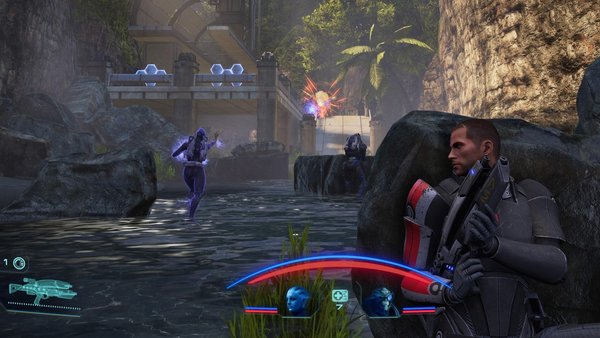
Before Mass Effect, developers BioWare were best known for the tactical, pause-heavy isometric combat of Baldur's Gate. While the developers would eventually learn how to deliver a great action game - to the point where Mass Effect 3's combat formed the backbone of a genuinely fantastic multiplayer experience - it's fair to say the first entry in the series felt like a (very) rough draft for what was to come.
The biggest offender in Mass Effect's rogues gallery of combat grievances is the game's infamously wonky physics engine. Biotic attacks would cause the player character to collapse like a rag doll, enemies would randomly speed towards the player like they'd been suddenly magnetized, and there was an almost total lack of feedback from any of the game's weapons (except on the rare occasions when the physics would wig out and cause enemies to blast into the stratosphere like vanquished members of Team Rocket).
When combined with the sort of decisions made by a team inexperienced in action game development (like having Shephard automatically melee enemies up close instead of shooting them, which was a bit of a pisser when you were trying to blast them with a shotgun), Mass Effect's combat is something to be endured rather than enjoyed. Fortunately, Bioware's writing team carried the load and delivered a fantastic story, filled with weighty decisions and charismatic characters (and also Kaidan).
5. The Witcher
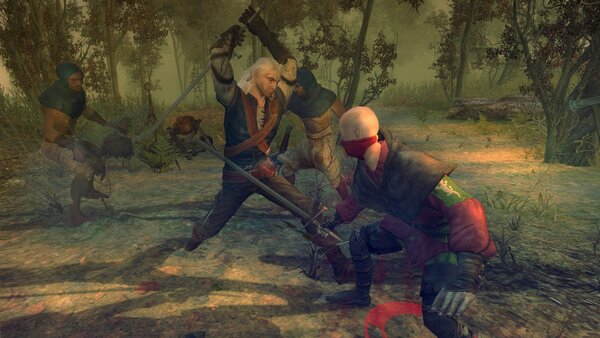
When discussing the combat in CD Projekt's 2007 RPG, it's hard to get past critic Ben "Yahtzee" Croshaw's description of the average battle - "You fight enemies by clicking on them once, and then if you're really advanced, clicking on them again".
Depressingly, that explanation isn't as reductive as it sounds. This writer's main memory of the combat involves the climactic battle against Azar Javed, the mage Geralt spends the majority of the game tracking down. Azar's demise came not at the hands of any brilliant strategy or outrageous feat of dexterity, but as the result of the left mouse button being monotonously clicked by an increasingly bored player. And thus ended the life of Azar Javed - a ruthless, bloodthirsty murderer reduced to the status of a particularly persistent pop-up ad.
However, much like Mass Effect before it The Witcher's writers ensured Geralt's maiden video game voyage was a largely successful one. While grimdark fantasies are ten-a-penny in these post Game of Thrones days, back in 2007 The Witcher's grimy, unpleasant world was, ironically, a breath of fresh air. Quests seldom had wholly happy endings, and heavy topics like racism were discussed with an eye-opening level of frankness that simply didn't exist back then.
Subsequent Witcher games would go on to improve the combat and further refine the writing to create one of the best trilogies in gaming, but it all started with one exceptionally rough diamond.
4. Alan Wake II

Finnish developers Remedy Entertainment are an easy company to root for. They make brilliantly weird games that marry stunning production values with lightning-in-a-bottle creativity, even though their idiosyncratic approach never meets with the sales success it deserves. But it has to be said that some of their wounds are self-inflicted, as is the case with Alan Wake II's desk-chewingly infuriating combat.
Alan Wake the Second suffers from an increasingly prevalent flaw in Remedy's output, which is its love for enemies that flit across the battlefield like X-Men's Nightcrawler on cocaine. In a survival horror game where ammo and health kits are at a premium, it is beyond infuriating to be constantly besieged enemies that warp out of your crosshairs and materialize in your personal space like a creepy wrestling fan at a hotel. Fighting these enemies is never entertaining, intimidating or terrifying - it's just deeply, deeply annoying.
To be clear, Alan Wake II is a stunning, bravura feat of writing and engineering that deserves to be experienced by anyone with the slightest interest in video games. But by the sacred elbow patches of Alan himself, play the game on easy if you want to enjoy it at its best.
3. Grand Theft Auto Trilogy

If there were an actual Video Game Hall of Fame then the original versions of Grand Theft Auto III, Vice City and San Andreas would deserve to be enshrined there, resting comfortably on plush silk cushions. And if you actually tried playing any of them in this day and age, you could use those cushions to muffle your screams of rage whenever their woefully inadequate game mechanics screwed you over.
The PS2-era GTA trilogy may have been milestones in the history of the medium but - as a recent Edge retrospective on Vice City explained - at the time it was clear that developers Rockstar were more interested in creating worlds to be explored rather than games to be enjoyed. Each game suffered from stringent mission design and unwieldy gunplay, resulting in many a failed mission due to dodgy lock-ons, strict time limits and woefully inept companions (I was following the damn train fine, Smoke - you're the one with the aim of a Stormtrooper in the middle of an absinthe binge).
Thankfully, the cities those missions took place in made up for any shortcomings in game design. San Andreas remains a staggeringly ambitious feat of worldbuilding, while few games before or since have nailed a period as definitively as Vice City (piloting your personal helicopter over a Miami beach lit by a neon pink sunset, while Toto's Africa plays in the background, is as close to a religious experience the medium can over).
2. Morrowind

Morrowind is a magnificently weird game. Weird both in the world it's set in (one of the least strange things about it is that the most common form of public transport is a species of gigantic insect), and the way it refuses to hold the player's hand. Much like the recent Gothic remake, Morrowind trusts the player to work out the majority of its systems for themselves and is all the better for it.
However, one of those systems is the combat - and that remains exasperating no matter how well you understand it. Despite being a first-person game, battles are decided on the roll of a dice working in the background. This means that, even when your character is clearly hitting what's in front of them, if the dice says you missed then your lucky sod of an opponent gets off scot-free. And while there's nothing new about RPGs deciding everything on the roll of a dice, in a real-time first-person adventure the disconnect between seeing your attacks land and being told you've missed never stops being aggravating.
Despite this, Morrowind is still worth exploring today. They literally don't make them like this anymore, as Bethesda themselves have spent the past two decades sanding off the rough edges of their products (ultimately resulting in the inoffensive pile of mush that was Starfield). A Morrowind remake with decent combat would, in the words of one of the minds behind Baldur's Gate 3, "sell like f***ing hotcakes".
1. Kid Icarus Uprising

The fact that 1986's Kid Icarus received a sequel 26 years later was surprising enough, but even more eyebrow-raising was the utterly insane control scheme it used.
Kid Icarus: Uprising's combat is split into two parts. The first half of each level takes the form of a rail shooter, where you maneuver angelic protagonist Pit around various obstacles while blasting vast and varied foes. It's terrific fun, and a great reminder of how satisfying the neglected genre can be when done right. Then the action moves to the ground and things get painful.
Literally.
Uprising's ground controls are, frankly, barking mad. Players are forced to hold the 3DS in one hand and control the camera while swiping the stylus with the other. Unsurprisingly, the strain of holding the console in one hand starts to tell, and before too long your aching wrist will be begging you to put the console down. Fortunately, by the time that happens you'll feel be grinning despite the pain.
You see, what makes Uprising worth battling through the pain for is its wonderful script. Characters constantly banter back and forth throughout the levels, making each level feel like an episode of the best animated show never made. Running jokes abound, the fourth wall is routinely shattered and everyone involved sounds like they're having the time of their lives.
Plus, each level takes around 20 minutes - long enough to nail the Saturday morning cartoon vibe, and also the length of time you'll be able to hold the 3DS before your wrist falls off. Peak level design!