10 Titles That Confirm Video Games Can Be Art
Ebert can stick these in his pipe and smoke 'em.
 As video games become a more prevalent form of entertainment around the world, people naturally start to have discussions pertaining to their artistic merit. For as long as theyve been around, video games have been seen by many people largely as time wasters with no redeeming value beyond entertaining ones self for a few hours. However, as the medium continues to evolve, this mindset has repeatedly been challenged, both by example and by video game players themselves. And as with all new and emerging mediums, those unfamiliar with it continually fail to grasp what makes them special to so many people. As a result, any claim of their artistic merit has been met with resistance. The most noteworthy recent criticism comes from legendary film critic Roger Ebert, who famously claimed that video games can not possibly be considered art . I, and many gamers, outright disagree with this statement. The heart of the debate lies in the definition of art, a topic whose definition continues to be debated to this very day. Despite numerous examples throughout history, the definition of art can hardly be agreed upon. Art means different things to different people, and that meaning informs its purpose, which in tern defines it. Basically, the very concept of art, something that seems so simple, is actually quite complicated when you reduce it down to its core nature. It also doesnt help matters that it is so very subjective. Something that appears to have zero artistic value for one may have substantial value for another. This only fuels the age old debate. For the purpose of this article, let me get this definition out of the way: art can be defined as creative expression, or creativity that expresses some aspect of the author or authors life philosophy, intentionally or not. This gives it purpose beyond the mere pleasure of experiencing its existence, thus giving it value. To use a film analogy, this is why we claim Inception is a work of art while Transformers: Revenge of the Fallen, despite also being a blockbuster action film, is often considered not. One has themes and meaning beyond the surface; the other is just robots beating on each other for entertainments sake. Enough about that though, this is about video games. Being a medium with its own unique tools and conventions, one has to consider different things in order to judge its artistic quality. All games have artistic aspects to them, such as the visuals, the music, etc. For video games, artistic value comes from the interaction between the player and the game, and how it comes together to create an experience that enhances the narrative in ways only it can. These are the games I would show to those who question the artistic power of video games; examples of what the medium can do when passionate people nail that creative spark. For authenticitys sake, Ill be regulating the list to games I have actually played, as I cant speak for a game Ive yet to experience, so I apologize ahead of time if this list feels like it is missing something. Some of these choices might surprise you, or you may even disagree completely, but I will do my best to explain my reasoning. With that disclaimer out of the way, I present you with 10 games that confirm video games are art.
10. Uncharted 2: Among Thieves (Naughty Dog)
 I know this one will appear controversial to many people. On the surface, Uncharted 2: Among Thieves appears to just be a well crafted action adventure game, which of course it is. But if you look deeper, you can see a game that perfects what it set out to do, which was to create a highly linear but insanely well paced thrilling adventure populated with well written characters and an exciting, logically structured story. Sure it may be silly, exaggerated, and, lets face it, unoriginal in its premise, but these aspects dont make it artless. Would anyone argue that the original Star Wars is not a work of art, despite meeting the exact same criteria? Of course not. Artistic quality lies not in the inspiration, but the execution, and Uncharted 2 is without a doubt a well executed game. It takes itself just serious enough to hit all the right dramatic notes without faltering while keeping things lighthearted and fast paced. However, dont think for a second that Uncharted 2 doesnt deal with some interesting themes. As the title suggests, the second chapter of the trilogy deals with a large cast of treasure hunters of various alliances, many of which may change without a moments notice. Back stabbings are thrown in rapid succession multiple times, and each character has their own reasons for taking part in the chase. Some do it for love, others for power, while some do it because they just cant do anything else. Naughty Dog took the old saying Honor Among Thieves and made it the central theme of Uncharted 2. Sure, its not exactly deep or explicitly presented, but it doesnt have to be. Amidst all the witty one-liners and absurd stunts lies genuine heart lacking in most of its competition across multiple mediums. Uncharted 2 may come off as mere fluff entertainment to some, but fluff has its artistic value just as much as anything else. Everything it does it does with so much creative energy it is impossible for me to not look at it as a work of art. Youd be hard pressed to find a more consistently exhilarating, entertaining, and yes, artistically valuable action game than Uncharted 2: Among Thieves.
9. Portal (Valve)
 It may have started out small, but that didn't stop Portal from becoming a powerhouse title. It's beauty lies in how effortlessly it blends the simple with the complex. You play a nameless test subject, awakened by an A.I. system named GLaDOS. and forced to undergo increasingly complicated tests involving a portal gun. As your successes continue to mount, GLaDOS's benign personality begins to fade, and she soon exhibits malevolent behavior. When the opportunity presents itself, you attempt to escape, but GLaDOS won't make that easy. As I said, Portal tells a simple story, but that is what makes it so charming. The story is told entirely through your actions and GLaDOS's dialogue, all of which varies from wickedly funny to legitimately threatening. GLaDOS has since gone on to be considered one of gaming's greatest villains, and you'd be hard pressed to find any gamer who disagrees. The character is so well written and acted by Ellen McLain, and her gradual decent into madness handled so perfectly, that she stands alongside other great evil computers like HAL 9000. Puzzles are challenging and rewarding, but never frustrating, and never feel ostracized from the context of the setting and story. Gameplay and story serve each other equally, unlike most games, which often prioritize one or the other. By working with each other, they combine to create a work of video game art worthy of hanging in a museum.
8. Flower (Thatgamecompany)
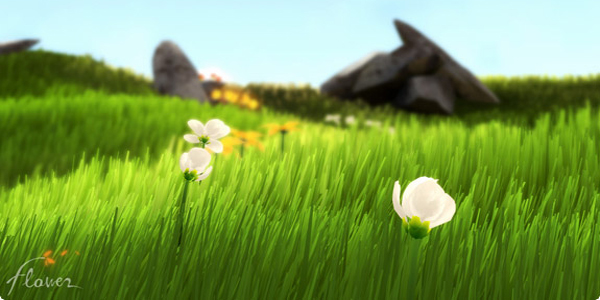 Flower is a soothing experience for the senses; an amalgamation of sight and sound that even the grouchiest person can't resist. Controlling the wind, you use the PS3 motion controller to blow a single flower petal across the landscape. The goal is to collect the petals of other flowers and eventually create an endless life-bringing stream of vibrant color. If that sounds very simple, that's because it is. Flower isn't meant to be complex or even very deep, instead prioritizing feelings and emotion above all else. More specifically, it is meant to generate positive feelings within. It also doesn't boast a narrative in the strictest sense, instead existing in a more subtle, abstract sense. There is no text or voice acting, just sight and sound working together to generate a feeling in the gamer as they play it, and Flower is incredibly good at doing this. While most levels do indeed feel uplifting and positive, some of the levels, such as those that take place in a violent thunderstorm, can actually feel quite frightening. This is a testament to the game's ability to create emotion within limitation. Of all the entries on this list, this one is most certainly the most obviously "artsy," as you feel like you are watching a painting come to life as you play it. The game also makes a statement about the conflict between natural and urban settings. The menu, displaying pots of whittled flowers within a drab and dull apartment, is a stark contrast to the vibrant and colorful fields of flowers that make up the levels. If anything, Flower is a profound reminder of the separation we've placed between ourselves and nature. Yet despite this, it never generates negative energy and doesn't wag its finger or talk down to us. It merely seeks to show us how important a part of our lives the natural world is, and it does it utilizing the power of video games.
7. Red Dead Redemption (Rockstar San Diego)
 The wild west was a time of violent and chaotic change; a shift between eras. The atmosphere of the era reflected that, populating it with outlaws, bootleggers, crooks, and swindlers. However, time only moves in one direction, and eventually the west died. But what happens to those left behind? Red Dead Redemption tells the tale of one such individual, John Marston, retired outlaw, husband, and father. As the flesh and blood of horse is gradually replaced by the steel and gas-powered automobile, John is forcibly drawn back into an increasingly unfamiliar world that threatens his very existence. Red Dead Redemption is a masterpiece, as good as any book or film of its genre. An epic spanning two countries and populated with so many great characters, big and small, it gave gamers their first chance to experience a true western. Rockstar's love of the genre bleeds through every pixel, demonstrating a clear affection for a genre that, until this point, hadn't had a universally praised video game adaptation. The world is vast and open, yet intimately detailed. Like many other open world games, especially Rockstar's Grand Theft Auto series, it risks obscuring its powerful narrative with its ambition. Unlike those titles, it never does; its open world design perfectly suited for the genre. It is without a doubt the best open world game up to this point. What really makes Red Dead Redemption a work of art is the story, its main protagonist, and the context. John, like all good western anti-heroes, is a deeply flawed and troubled man; his past a nightmare that fuels his pursuit for a stable life. He wants to make amends for his mistakes, but at the same time is an outlaw by his very nature. He no longer fits in this increasingly technological world, and it continually chews him up and spits him out. John can and does do horrible things, but the player understands his plight. We want to see him succeed, but the world won't let him. Red Dead Redemption deals with the dark side of the west, its destruction, and the people left behind. Its writing is smart, its themes are mature, and its subject matter is dark. However, like all Rockstar games, it never forgets to lighten the mood with a laugh. Red Dead Redemption is Rockstar at their best. It is the best open world game, the best western game by far, and one of the best games ever made, period.
6. Journey (Thatgamecompany)
 It should come as no surprise that the creative team behind Flower ended up on this list again. Their follow up, Journey, displays an incredible sense of wonder and enchantment. Playing as a nameless robed figure in an endless desert, you set on a journey exploring the ruins of a long forgotten and once-thriving civilization. Along the way you collect pieces of cloth which charge your scarf and allow you to briefly fly. You may even encounter fellow travelers and help each other, if you so desire. Like Flower, Journey is charmingly simplistic, but is an entirely different game. It has more of a narrative pushing things forward, but keeps it to a minimum, focusing more on atmosphere, of which Journey has plenty of. It immediately sweeps you off your feet with its sense of awe. The graphics are both minimalist and exquisite, making it one of the most visually astounding games ever made. You literally cannot tear you eyes way. The soundtrack, unsurprisingly, is a work of art in itself, fueling the already splendid visuals. Despite lacking the ballet-like movement of Flower, it's actually even more of a visual and auditory tour de force. Perhaps one of the most compelling aspects of Journey is the cooperative element. Unlike most games, which allow for instant connection and communication, Journey lacks both. Other players can randomly appear in your game, and if you wish, can assist you in that level. However, you cannot talk to each other through a microphone or text, relying only on self-generated musical notes. This changes the dynamic of cooperation completely. There is no competition, smack talking, or idle chit-chat, just pure connection through cooperation and exploration. You have no idea who is on the other side, and there is something extremely compelling about that idea. You'll never have played a game quite like Journey.
5. The Witcher 2: Assassins of Kings (CD Projekt RED)
 What do you get when you combine the explicit magic and monsters of Tolkien's The Lord of the Rings with the political intrigue and familial warfare of George R.R. Martin's A Song of Ice and Fire? You'd get The Witcher 2: Assassins of Kings. Playing as the witcher Geralt of Rivia, youll be thrust into an increasingly complicated plot of long-standing racism, rebellion, deceptive sorceresses, power hungry monarchs, and temporary alliances, all in the effort to prove your innocence in the slaying of a king. If there ever was a game that felt like playing a novel, it would be The Witcher 2. This is a game that doesn't hand hold or talk down, doesn't give you an easily deciphered tutorial mode at the beginning, or have the characters spout off obvious exposition as a means to orientating new players. Instead, it throws the player in head first and expects you to keep up. The lore and mythology, just as interesting as the best of the genre, is referred to casually and in passing, as characters talk to each other like real people. And the characters do feel like real people, all given relatable and believable motivations. Like many games these days, choice and morality play an intricate part in the narrative. Unlike the competition, however, its system is subtle and seemless, offering no morality measurement whatsoever. Instead of gaming the system, players are instead forced to act within the moment, and suffer the consequences. And unlike its competition, The Witcher 2 doesn't condone or condemn any one path, instead allowing the player to make up their own mind. There are no strict good guys and bad guys, making which ever path you take all the more difficult to choose. More than any other game, The Witcher 2 truly allows the player to explore their own morality. It is the narrative, however, that truly makes this a work of art. Choices actually matter and can lead to wildly different playthroughs. The game is full of dark and complex themes dealing with power, sexuality, the nature of war, and the lengths one will go to save the one they love. The Witcher 2 is a mature title for mature people; a work of art that treats it players like adults deserving of their attention and respect. And that, my friends, should be respected.
4. Mass Effect Trilogy (Bioware)
 One part hard sci-fi, one part fantasy epic, the Mass Effect Trilogy is bursting with artistic value that anyone can see, should they look hard enough. Part of the beauty of this series is that it is enjoyable on nearly all facets. Those looking for a thrilling science fiction epic will be right at home, while those who enjoy wrapping their heads around weighty topics such as free-will, artificial intelligence, and humanism will be thrown into a world that confronts these issues. However, what really makes the Mass Effect Trilogy special is the central theme of unity; of championing diversity amidst adversity. You, as Commander Shepard, are the embodiment of humanitys strength, but early on you recognize that even the most determined and headstrong man can not succeed on his own. Throughout all three games, you befriend individuals of all races and backgrounds, forming powerful bonds with even the most outlandish of people. And as Shepard, it is up to you to rally the races of the galaxy together to save it from utter destruction. Only through working together is survival possible. It is a powerful theme, so much so that I believe it is a large part of what makes the series so well loved. Mass Effect 2, the most popular entry of the series, focuses on this theme the most, showing how even the most impossible of odds can be met when diverse individuals come together. Rarely does anything have such a positive message at its core, which made the sudden backtracking of that message within the final 10 minutes of Mass Effect 3 so devastating to so many players. What solidifies Mass Effect as a piece of video game art is how, through character creation and interaction, the player is allowed to explore these themes themselves through the combination of player choice and relationship building. This is, of course, only possible through the medium of video games, and so demonstrates their power to explore important and potentially uncomfortable issues. At no point, however, do these issues take over the story. In fact, they emerge from the context of the story so seamlessly and naturally (save for the ending) that it enhances their power. Make no mistake, the Mass Effect Trilogy prioritizes entertainment, as most video games do, but it never forgets to weave relevant themes within the entertainment so that once you are done playing, you can properly reflect on the choices youve made. This is the core appeal of the franchise, and is the true reason why so many people love it, beyond the great characters and setting of course. You may have noticed that I have yet to talk about the art direction and visuals, but that is only because they speak for themselves. Every alien design, every piece of tech, and every world is lavishly detailed and full realized. The galaxy of Mass Effect is at once dangerous as it is attractive; a universe that you just want to fall into and live in. From the story to the writing, from the setting to the characters that inhabit it, the Mass Effect Trilogy, despite many stumblings along the way, is nirvana when it comes to artistic merit, and hopefully a big step for the video game industry.
3. Half-Life 2 (Valve)
 Yes, another Valve entry, but they know how to make quality games, which is no more evident in their masterpiece, Half-Life 2. Despite being a direct sequel to the original Half-Life, it tells an original story with only the necessary connections to its predecessor, allowing it to create its own identity. Gordon Freeman, having been left hanging at the end of the the original, suddenly finds himself on a train to City 17, currently occupied by the multidimensional Combine empire. It's not to long before he finds himself once again involved in a battle for survival, along with allies Barney Calhoun, Dr. Eli Vance, and his daughter Alyx. Like Portal, Half-Life 2 deftly combines gameplay and design with narrative and characters so well that the two are inseparable. Every entry on this list utilizes the elements natural to video games to tell a story, but perhaps none do it better than this. A video game in every way, it never breaks player immersion by using cutscenes, which, by their very nature, have more in common with film than video games. Instead, players are given control throughout the entirety of the game, and events play out in real time. It also is the best example of the implementation of the "silent protagonist," a practice that seems to be used less and less nowadays. Through silence, the player is able to literally take on the role of Gordon Freeman. Your voice is his voice; your actions are his actions. When characters speak to him, they are speaking to you. This allows the player to feel truly connected to the characters, especially the character of Alyx Vance. Before you know it, you find yourself talking back to the screen, responding to the inquiries of the characters yourself. Through the simple mechanic of removing the protagonist's voice, the player feels more in control and immersed in the role, and the journey becomes that much more personal and rewarding. It is for this demonstrable effect that Half-Life 2 is considered by so many to be one of the best games ever made. It is so effortlessly able to generate emotional investment from the player, all while telling an epic science fiction story that never forgets to keep the characters at the forefront. It is unmitigated gaming goodness, and without a doubt a work of art.
2. Shadow of the Colossus (Team Ico)
 Shadow of the Colossus is a game that even the staunchest supporters of the "video games aren't art" campaign have to concede to, its just that good. There is perhaps no game quite like it; a simple story of the depths a man will go for love, and the dangers it entails. As Wander, an empty terrain and 16 Colossi lie between you and the return of your lost love. This is easier said than done, as you will have to take out all16 Colossi, each more fearsome than the last, in order to make this possible. Shadow of the Colossus is one of those game you never forget, as it is so different from most video games. Most games would have smaller scale foes in between Colossi to lengthen the game and give it variety, but this game doesn't do that, nor should it. Wander starts from the alter, rides out to find the next Colossi, and kills it. Rinse and repeat. Variety comes from the different kinds of Colossi you fight. Some are lumbering giants whose steps shake the earth, while others reign the sky. With each new Colossi, you must adjust your strategy to defeat them. You'd think a game comprised entirely of boss battles wouldn't work, but Shadow of the Colossus excels in all departments. The Colossi themselves are a combination of awe and terror, and when you kill one, your victory is tainted by a feeling of sadness for killing such a unique and majestic beast. And with each victory, more of the mystery of their nature is revealed until the bittersweet conclusion leaves you slack jawed. Rarely is there a game so rich in tone. The empty terrain, normally something to complain about in games, actually adds to the atmosphere and leaves you feeling alone and isolated, while adding an air of mystery to the already mysterious plot. I must also mention the musical score, as it is one of the best scores I've ever heard in anything. It's at once somber and quiet as it is loud and bombastic, always matching the context of the scene perfectly. Shadow of the Colossus is one of the most unique and powerful games I've ever had the pleasure to experience, and is destined to become a classic.
1. Bioshock (Irrational Games)
 A man chooses; a slave obeys. A sudden airplane crash. A mysterious lighthouse in the middle of the Atlantic. A singular vision of paradise. These are the opening moments of Bioshock, and they have been seared into the brains of many gamers ever since they graced our screens 5 years ago. Suddenly you are introduced to Rapture, a seemingly beautiful underwater utopia founded by the ambitious Andrew Ryan on the principles of individual freedom. But when you actually explore within, you discover that all its beauty is superficial, and inside there is only the unrestrained ugliness of man. Bioshock is one of those games that every professed gamer should play at some point, and anyone who has played it will tell you that. Considered a masterpiece within the medium and one of the best examples of their artistic potential, Bioshock presents players with a unique setting, a disturbing atmosphere, compelling gameplay, stunning visuals, superb art design, and a fascinatingly deep story that asks profound philosophical and moral questions. It is what happens when game designers set out to do more than just entertain, but at the same time never forget that that is what it is supposed to do. The result is a game that is as entertaining as it is thought provoking. Its story gives players ideas and themes to think about while they fire bees from their hands. The fact that those two ideas can come together and still work is a testament to the power of video games. It knows it is a game, first and foremost, and uses the tools at its disposal to create a work of art only possible in the medium of video games. I could go on about how the game is actually a criticism of Ayn Rands (Andrew Ryan?) objectivist philosophy, or its use of Biblical symbolism (ADAM), or even how the twist at the end can actually be seen as a commentary on the relationship between game and gamer. But why should I when you should just experience it for yourself? If you havent played Bioshock yet, do so immediately. You wont regret it, and youll experience one of gamings crowning artistic achievements. There you have it, 10 games that demonstrate the artistic power of video games. Again, this list is compiled of only those games I have actually played, so if there is a game you feel is a piece of art, please feel free to let me know in the comments below, and thank you for reading!