10 Video Games That Secretly REWARD You For Cheating
Rules were made to be broken... or ignored entirely.

For as long a there have been video games, there have been cheats.
Cheat codes (a tool intended for developer use to gain weapons, ammo or invincibility for testing purposes), may be a distant pang of nostalgia for many of us, but that's only made players more creative in finding ways to break games for their benefit.
Whether you call them cheats, exploits, glitches - or even if they're built into the game - there are many techniques to circumvent playing a game the way its developers intended.
For some, it would be counterproductive to deliberately shorten a game, either by skipping sequences or trivializing its challenges. But no game is perfect for everyone, and these tricks and shortcuts can save a lot of headaches for repeat players slogging through their least favorite part of a game. And for many, the act of finding these quirks is the funnest part.
Whatever your reason, these are select cheats, exploits, glitches, tips, tricks and shortcuts that make your games drastically easier.
10. The Legend Of Zelda: Breath Of The Wild - Think Outside The Box

For some, Zelda's 'puzzle room' Shrines were a nice way to break up the usual act of exploration. For others, a sorry replacement for traditional dungeons that served as more of an annoyance. Fortunately, the easiest way to complete many of the shrines was not to do them at all.
Thanks to the game's robust mechanics and physics, players found so many possible exploits that finding ways to skip shrines became almost a game unto itself.
Walls can be bypassed with "shield jumps" - a technique where a player leaps into the air, shield surfs, then plants and detonates a bomb in midair to send them careening over barriers.
Alternatively, you can freeze an object in place with the stasis power, hit it to build up its momentum, then grab on and wait for it to launch you across the room. Does a motion-controlled Marble-Madness-like puzzle got you down? All it takes is a careful flick of the wrist to toss that ball right over the maze you were meant to navigate.
For players who can think abstractly, finding ways to skip the shrines comes more naturally than the puzzles themselves, meaning you net those oh-so rewarding treasure chests even faster.
9. Metal Gear Solid 3 - Let Nature Take Its Course

Metal Gear Solid 3 is full of wonderful systems that you almost never need to use. You can throw venomous snakes at enemies, blow up food storage buildings to weaken guards, plant bombs on unsuspecting foes - and skip an entire boss fight.
The End is a hundred-year-old sniper who spends most of his time sleeping, only perking up when his services are absolutely needed. The fight against him is one of the most protracted sequences in the game, requiring the player and The End to chase each other around three connecting arenas, find good cover, and trade shots before moving again.
It's a tense and interesting encounter, but at the same time, no one could really blame you for being bored by the lengthy game of cat-and-mouse.
Good thing, then, that the spectre of death isn't far behind the old man.
If the player saves and suspends their game during the battle, The End will simply die of old age after a week of not playing. Alternatively, you can just set your PS2's clock ahead a week to trick the whole system, thus bypassing this fight almost instantly.
Or, for the truly impatient, you can simply snipe him earlier in the game while he's asleep in his wheelchair, you monster.
8. Dark Souls - Git... This Sword
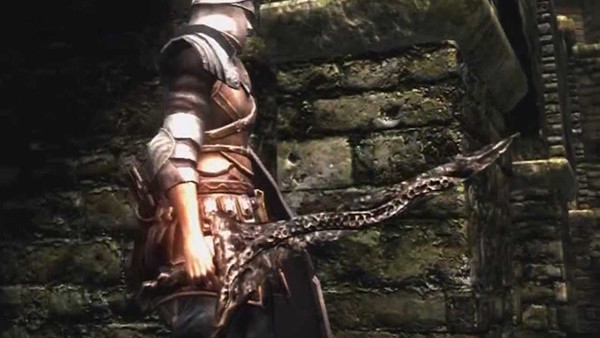
Dark Souls is a famously difficult game. All manner of punishing moments, rewarding challenges and gruelling hours put into learning everything.
...But what if you just don't feel like?
Well, early on in the game you come across a drake (small dragon) blocking your path, perched above a narrow bridge, periodically spraying it with flames.
What you're meant to do, is find a passage under the bridge and bypass the drake completely.
While down there though, you'll see its tail dangling ever so enticingly over the edge. So stock up on arrows, plant your feet, and start firing. Eventually the tail will break and you'll be rewarded with a SUPER powerful Drake Sword... which then trivializes the following several hours of the game.
On one hand, this makes it easy to not learn anything, then hit a major spike in difficulty once the enemies become strong enough to not care about your paltry little tail sword.
On the other, smart players can use this weapon as an opportunity to learn the game's systems in a less punishing way. Can't nail the timing of that parry? It's OK - one-shot it with this bad boy, down some Estus, and try again on the next guy.
It's a great get-out-of-jail-free card, allowing you to practice without constantly dying.
7. Elder Scrolls: Morrowind, Oblivion AND Skyrim - Three Specific Exploits

For longtime fans of The Elder Scrolls, breaking the games in your favor is practically as much a feature as it is a consequence of a janky, old game engine. And while the range of these exploits has narrowed over the years, it's hard to imagine a TES game without them.
Take the "soultrap glitch" in Morrowind, for example. By creating a spell that fortifies an attribute and targets an NPC, and casting it on themselves, the player can create constant-effect spells that, effectively, permanently increase their stats.
Just stand in place, cast a "Fortify Mercantile - 10 Points" on yourself 20 times, and never pay more than 1 gold for anything ever again.
Oblivion, meanwhile, has one of the more ridiculous exploits in the form of the "paintbrush glitch." For some reason, paintbrushes are unaffected by the game's physics engine, allowing the player to place them in mid-air. With enough paintbrushes, you can, essentially, create a staircase to scale any wall or mountain in the game.
Skyrim features one of the more famous examples in the "enchanting and alchemy loop." Basically, enchant an item to fortify your alchemy skill. Then, create a potion that fortifies your enchanting skill.
Rinse and repeat several times, and you can make a weapon that will easily one-shot just about anything in the game.
6. Super Smash Bros. Melee - Wavedashing

Discovered in Super Smash Bros. Melee, the "wavedash" was a technique that involved air-dodging diagonally into the ground, using the momentum to slide forward. What this does, essentially, is enable the player to move while the game still recognizes them as standing.
This allows the execution of combos that would normally not be possible while moving.
The move also takes a little while to wind up, offering an element of risk to help balance its versatility.
It was quickly adopted by the professional Smash community, becoming essential for competitive play. It was removed from the next two versions of the game, but added as an intentional feature in the newest edition, albeit tweaked. With a longer wind-up and less momentum, the technique now incurs a significant risk.
For this reason, Melee remains a mainstay of the competitive SSB esports scene.
5. Final Fantasy VI - Kill Almost Anything In Two Moves
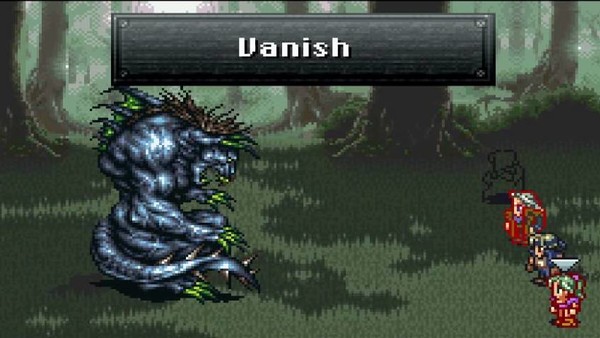
It's fairly standard for status-effect spells to be useless in the Final Fantasy series, outside of very specific circumstances. This is, understandably, most true for the Death spell. After all, there wouldn't be much of a game if you could just instantly kill anything with one spell, right? For this reason, most enemies have an inherent immunity to it.
Buffs, however, have always been extremely useful in the series. Among those is invisibility, which makes your characters immune to physical attacks but more susceptible to magic attacks. It's a classic trade-off of risk and reward. What a treat, then, that same effect applies to enemies too.
Cast vanish on your foe, making them immune to physical attacks, but weak to all magic. That's ALL magic, removing whatever immunity checks existed for the enemy. Then cast Death for an instant kill on just about any enemy in the game.
While the feature has been addressed to varying degrees of success in later releases, in the original SNES version, you could cheese your way through the nearly the entire game with this exploit.
4. Mario Kart 64 - High Risk, High Reward

Risky shortcuts are plentiful in the Mario Kart series. Sometimes they're intentional, designed by the developers. Other times, not as much. But regardless of intent, this is where the tradition started.
Rainbow Road is a mainstay in the Mario Kart games. Infamously dangerous, Rainbow Road is usually the peak challenge in the game, requiring racers to speed through a course with tight corners and no guard rails.
If you hit that turn too fast, into the void you go, watching your fellow racers blaze by while you wait for Lakitu to bail you out.
Within that dangerous territory, you'll find this shortcut. By turning left off the course at a certain spot, at a certain speed, and at a certain angle, you'll fall for about five seconds before landing on a much later portion of the track.
You have to be careful not to overshoot or undershoot the landing, but if you can pull this off once, the race will likely be yours.
3. Pokemon Red/Blue - Use Junk Data To Stock Up On Rare Items

Pokemon Red and Blue didn't just pave the way for an eventual video game juggernaut - it also featured one of the first exploits to be spread far and wide via the Internet.
Acquiring a MissingNo (short for "Missing Number") requires the player to follow a specific sequence of actions. First, the player must view the in-game tutorial for how to capture Pokemon. Second, use a Pokemon with the Fly technique to fast-travel to Cinnabar Island. Finally, use a Pokemon with the Surf move to travel up and down the eastern shore of the island. Eventually, a wild MissingNo will appear.
So what's so special about the MissingNo? Other than its glitchy appearance, not much. But as a consequence of encountering one, the item in your sixth item slot will be increased by 128, making the glitch an extremely effective method of farming rare items.
However, there are some unforseen consequences to exploiting this glitch. The in-game Hall of Fame will be permanently overwritten, erasing the public record of your achievements, in addition to other minor graphical glitches.
All things considered, it's a small price to pay for 128 rare candies.
2. Fable III - Money Can Literally Buy Happiness

Fable III took an interesting approach to the Light Side/Dark Side morality systems that were popular at the time. Aside from changes in physical appearance, access to different powers, etc., the system was tied to money.
After successfully overthrowing your brother, the King, you discover that the reason for his tyranny was to fund an army large enough to be able to defend against a looming outside threat. And when you became king, it becomes your problem.
As King, you'll frequently be presented with choices on how to rule your kingdom.
These essentially come down to choices between charity or profit - to build an orphanage or a brothel, for example. You want your people to be happy, but you also have to prepare for what will be a gruelling conflict.
Maybe ruling isn't so morally black and white, eh?
It easily can be, however. By investing early in the game's real-estate system - which allows you to buy almost any and every house and shop, gaining direct profit from rent and tax - you'll be richer than your brother's wildest dreams by the time you take the throne.
Throw that money around. Build that orphanage, build that school - hell, give everyone raises and eliminate taxes. By the end of the game, you'll be able to fund your grand army with no more than glorified pocket change.
1. Street Fighter II - An Accidental Feature Defines A Genre

It's hard to imagine now that two techniques that define the entire fighting game genre - cancels and combos - were a complete accident.
The original Street Fighter II was a much more slowly-paced game than we've come to expect from the series. Players would normally trade single blows back and forth while looking for an opportunity to use a high-damage special move.
That all changed when players discovered that, by cancelling a special attack during the wind-up of its animation, they could transition directly into a strike. By using this technique in rapid succession, they could chain together combinations of hits, without the usual pause in between that allowed their opponent to defend.
This became such a required technique among advanced players, that Capcom never looked back, implementing it as full feature in later editions of the game, in addition to increasing its overall speed.
Due to the popularity of those later editions, cancels and combos have been core fighting game mechanics ever since.