100 Things You Never Knew About Resident Evil
10. You Weren't Supposed To See This
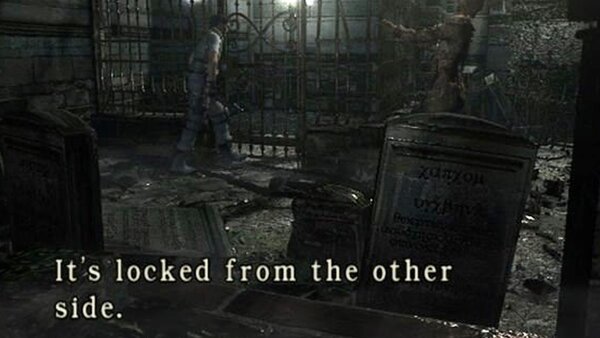
Adding a little bit of detail can make video games come alive and sometimes it doesn't really matter what that is. In a pre-HD world, you could write gibberish on your assets and not worry since nobody was ever going to be able to read them through the hazy, standard definition blur.
However, what then happens when the games get an HD remaster?
Resident Evil's 2002 remake has a few funny bits of text we were never meant to be seen. The herbicide item reads, amongst other things, "this house is danger" and "Code Veronica yoroshiku ne" which charmingly translates to "go easy on Code Veronica".
Also, inspecting the lighter shows you that is in fact a "lighter of lighter"... whatever that means.
Finally, upscaing the backgrounds also means it's easier to see the text on the gravestone in the back courtyard of the mansion which reads "χαπχομ υγχβηνλ". Translated from Greek to Latin characters, this says "Kapkom".
9. Dario Rosso

Resident Evil 3 Remake sometimes speeds along so fast you'd think it had something else it would rather be doing. The intro in particular is infamous for this, turning key moments and characters into blink-and-miss-it cameos.
One of these is Dario Rosso, the novelist extraordinaire who locks himself in a storage container in some vain effort to outlast the outbreak. In the original RE3 he's a man beset by panic, but in the remake that's been changed into paranoia and rage. He yells at Jill, climbs into the big tin box and shuts the doors, never to be seen again.
However, if you want to get a little more from Dario there are a couple of small easter eggs. If you wait around, he and Jill have a few back and forths, where he even says one of his legendary lines from the original game. If you shoot at the container with your precious few handgun bullets, he calls out for help:
"Stop that! She's trying to kill me! You're going to hear from my lawyer!
It might be a little late for lawyers, Dario.
8. Wreckage Of The Mad Experiment

Resident Evil's usage of old material occasionally also extends to it's music. In the case of RE 1.5, as previously established, plenty of the OST got moved around the final version of RE2. The N64 soundtrack of Resident Evil Zero did indeed get used, even though the shift to a different hardware generation meant remaking most of it (although the save theme for N64 is totally different, and well worth a listen).
One of the best pieces of Resident Evil music occurs frustratingly in just one room in the original Resident Evil 2 and it's a room that's very easy to miss. If the player uses the fingerprint scanner across both A and B playthroughs they can enter a room in the lab where the track "Wreckage Of The Mad Experiment" plays - a dark, twisted theme that perfectly represents Umbrella's willingness to laugh in the face of morality for their goals.
So then, it was perfect to be reused in The Umbrella Chronicles as "Live Evil", a rock theme that is heavily associated with Albert Wesker.
Another RE2 track that triumphantly returns in future games is Ada's Theme, which beautifully plays during Resident Evil 6. Which is probably the only time someone as described anything RE6 as "beautiful" in any way.
7. Split-Screen Outbreak

Resident Evil Outbreak is often described as "ahead of it's time" considering it was a multiplayer, co-operative, online Resident Evil game that was stuck on the PlayStation 2. Just a few years shy of Microsoft's Xbox Live, online gaming on consoles was barely in it's infancy. Moreover, many regions that saw the release of the first Outbreak didn't even have online functionality.
It's been a bugbear with the game ever since, and a barrier for entry for those who want to play the game "as intended" (and without having to worry about the terrible AI of your companions).
But as it turns out, at one stage Outbreak was supposed to be completely playable offline. In fact, it would've beaten RE5 to the punch of being the first split-screen Resi if things had gone as planned. There's footage shown in E3 2002 trailer that shows the Flashback scenario being played by four survivors on one system.
Presumably the feature was cut due to technical limitations and because of the game's budget. Outbreak, being a spin-off, was already working with way less than, say, a Resident Evil 4, which would explain how the massive scope of the game shrank over time. After all, this launch trailer also featured footage of the unreleased "A Day in Raccoon" scenario that was set in a spooky motel.
6. Wide-Eyed
Despite being quite cutting edge for video games at the time, the live action footage in Resident Evil has always been hilarious.
The faces and voices of all the characters in the game were provided by different people so Charlie Kraslavsky may not have provided Chris' dialogue but he brought the character to life in the live action opening and ending. He dropped a load of incredible information about his very brief time working on the original Biohazard with the late, great Phillip J. Reed in his book on Resident Evil.
There was apparently a disagreement between Capcom staff about whether or not Chris should have stubble which ultimately landed on a "yes" until the team saw Charlie's attempts to grow it and then changed their mind, as well as the tale of Chris' actor leaving the set to roll around in puddles and wet gravel to dirty his white shirt for the game's ending sequence.
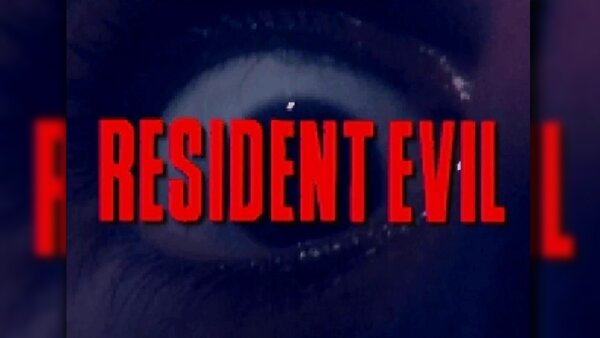
Perhaps the funniest is that it is, of course, his eye that is used as the title screen for the game. Kraslavsky recalls Japanese men telling him to open his eye "wider! Wider!" and him insisting that it was as wide as it went, in the end having to pull at the skin with his fingers to make the eye as wide as possible.
You'll never look at that title screen the same way again.
5. Where Is Raccoon City?

Raccoon City is often described as a "small, Midwestern town", which is in itself quite funny considering how much it seems to change shape and scope throughout the series. How many "small, Midwestern towns" have zoos and stadiums?
Regardless, "midwest" is about as far as Capcom have ever gone as to put it on a map. The S.D. Perry books decided to place it in Pennsylvania, which is particularly funny as that state isn't a part of the midwest at all. Still, things have been clearly deliberately left vague.
That said, whilst we can't identify where it is we do at least know some of it's inspirations. In his interview with Crimson-Head.com, RE3 director Kazuhiro Aoyama said that the version of Raccoon City he designed for that game drew inspiration from Boston and San Fransisco.
"Many American cities have wide, bright and open streets, but the back alleys are dim and oppressive, and even give a sense of life (for example San Francisco Chinatown)."
Of course neither Massachusetts nor California are midwest either, but these were purely inspiration.
4. Resident Evil 4 On Xbox

Much has been made of the long, winding and messy road to Resident Evil 4 with numerous versions cancelled along the way before Capcom arrived at the game that totally shook up in the industry. But even aside from it's creative struggles, just finding a home for the title nearly went completely differently.
Kevin Bachus, head of Xbox's third party relations, once recounted a story of a meeting with Shinji Mikami around Christmas 2000. The rumours were that Mikami-san was frustrated with developing for the PS2. With Microsoft's debut home system on the horizon, Bachus saw his chance to coerce Mikami-san to the green side of things. However, the meeting - which all took place in Japanese - fell apart very quickly when the father of Resident Evil asked Bachus and his interpreter what Xbox's creedo was and was dissatisfied with the answer.
Mikami-san ended the dinner abruptly, and Bachus chastised his interpreter for not delivering Xbox's vision of gaming as "considered to be art, much like film" (which, actually, sounds like something Mikami-san would've agreed with). He pursued a second chat with Mikami-san days later but by this time it was too late and Capcom had signed a deal with Nintendo which would, of course, become the de facto home for Biohazard for the generation - from the REmake to RE4.
Had this initial meeting gone well we could've seen a Christmas miracle and a very different world. As it stands, the original Xbox is the only home console released since 1996 that never had a Resident Evil game on it.
3. Paracelsus' Sword

The 2020 version of Resident Evil 3 ends with Jill taking a rail cannon into her hands and blasting away Nemesis like a true badass. It's an undeniably cool moment, no matter what you A. think of the game or B. think of the fact that the game ends with a weapon rather immaturely called "The Finger".
Give Nemesis the finger. We get it. Insert sarcastic laughter here.
What makes this sting more is that Resident Evil 3: Nemesis' rail gun was just so cool. A gigantic machine, so big that it was firmly rooted to the ground, players had to guide Nemesis' final metamorphosis into it's line of fire. The weapon was also called Paracelsus' Sword, a reference to a famous painting of the Swiss alchemist, astrologist and physician. Paracelsus is credited as the Father of toxicology, which is the study of harmful effects of chemicals on the human body. How apropos.
Thankfully, it wasn't the last we heard of ol' Paracel' as Resident Evil Resistance (ironically packaged with RE3 Remake) made a fun nod to the weapon with Ozwell E. Spencer's ability "Paracelsus Generator".
2. Resident Evil On NES
Resident Evil's infamous abandoned port to GameBoy Color sure is a sight to behold. Even if it was never going to work, it's impressive that someone tried.
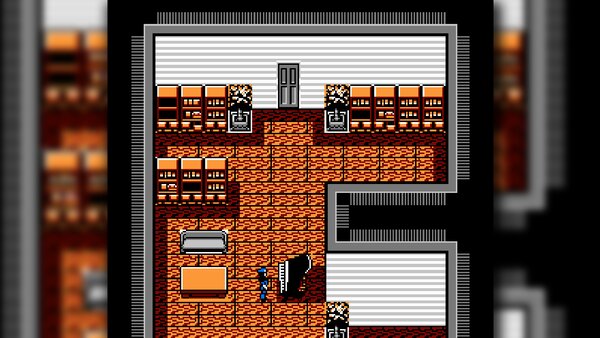
To a certain extent that's true of this entry too, which is an honest-to-goodness NES bootleg of the game... and it's surprisingly good.
First of all, a little context: China has had a long, complicated history with video games and imported works and never got the NES back in it's heyday. However, that didn't stop people from developing systems that could play NES cartridges and knock-offs as "educational hardware", especially since Nintendo's patents on the hardware expired in the mid-2000s. Chinese players who couldn't get their hands on the PlayStation version of Resident Evil, for example, could at least play a bootlegged version that somebody made for NES.
And this thing is impressive. Sure, it only features Jill's playthrough, is missing most of the bosses and doesn't quite have the same production value... but almost the entirety of the game is here in some form. The mansion is the same, the puzzles are the same, even the enemy layout is the same. The major change is the introduction of the Gaiden battle system rather than simply aiming and shooting from afar which, with the now giant hallways of the Spencer Mansion, means most enemies can absolutely be run past if you wanted to.
This is all to say it would be very few people's preferred way to play the classic Resident Evil, but the NES bootleg is a novelty whose existence is just so weird that it's hard not to love.
1. Remy

Resident Evil's #1 trivia fact is that the original game started like as a successor to the NES' Sweet Home but it's Resident Evil 7 that has the most striking similarities to it, perhaps in a bid to return to the truest root of Biohazard. This includes a group of documentary filmmakers going to a spooky home and then being attacked by monsters and ghosts.
Because, of course, a ghostly lady in Resident Evil's Beginning Hour demo was a big talking point of the game. Her appearance was not a guaranteed event and so, briefly, she became of hive of speculation.
But the ghost lady's origins go back to the start of RE7's development and Remy - as she was known for the longest time - was one of the game's earliest designed characters. The concept art sheet for the Bakers has twins and a servant that were cut along the way, but the "daughter" here is very different to the finished version of Zoe Baker. However, her role was very inconsistent.
Remy Baker was the daughter of Jack and Maguerite, an alternative form of the Grandmother and also Eveline all at different times. Her role as lead antagonist got steadily altered and diminished as the story took shape. What's wild is by this point in 2015, Remy had already been shown to the world in the VR Kitchen demo.
But eventually she found her true purpose as the corrupted wife of the protagonist and, eventually, became Mia Winters.
All's well that ends well?