100 Things You Never Knew About Resident Evil
20. Operation: Raccoon City's Weird Star Wars Link

The early 2010s were a weird time for Capcom. They were in the midst of a push to outsource titles in key franchises, despite the failure of the 2009 Bionic Commando game developed by Grin. It resulted in a cancelled Mega Man X project, the despised DMC reboot and the lukewarm at best Operation: Raccoon City.
The company briefly butted heads with developers Slant Six Studios, as the latter pitched a remake of Resident Evil 2 that the owners of the IP shot down. In fact, lots of development files and folders still make reference to this. Instead, Capcom wanted Slant Six to do something in the vein of their SOCOM series and, thus, ORC was born.
Perhaps the most bizarre tidbit from this production is that players who dug into the files of the PC version of Operation: Raccoon City found loading screens for a proposed Star Wars Battlefront 3. There had been rumours that Slant Six was going to work on a threequel to that series after Free Radical Design had closed, but nothing came to pass. Quite why these wound up in the final version of Operation: Raccoon City is anyone's guess.
19. Resident Evil Originally Had Ghosts

Unsurprisingly, the original Resident Evil's development went through many changes as the design team tried their hand at pushing horror in gaming forwards. Most people know that RE1 had two cut characters, one of which was at least partially a cyborg, but that's just the tip of the iceberg.
In an archived interview with REHorror, Shinji Mikami mentioned that the game's earliest drafts had ghosts in them rather than zombies but he started to muse on the fact that it was too generic. He thought other horror games were likely to use ghosts and he wanted to stand apart. Furthermore he recounted his experience watching the film The Exorcist and the lack of relief he had from being able to fight back. Mikami-san wanted to give players an enemy they would understand, be able to escape from or fight, and then the game would continue until the next encounter.
Zombies were the perfect fit and, at that point in pop culture, nobody was using them. It was Resident Evil that reignited the flame of the shuffling undead.
18. The Man Who Wrote The Book

Whilst some of the concepts began to take shape fast, the story of Resident Evil came together later. In fact, things wouldn't really click until Kenichi Iwao joined the team.
According to the man himself via an interview with Crimson-Head.com, Mikami-san's original story was about a team of soldiers trying to rescue a "good scientist" from a house full of monsters made by an "evil scientist". He also compared the game to Mega Man, which paints an entirely different picture of the scenario.
Whilst Mikami-san is rightfully credited for the game's direction, it was Iwao-san who steered the ship with his writing - inventing Umbrella and STARS, as well as writing all of the notes and files in the original RE1. Speaking to Gaming.Moe, Iwao-san also revealed that Wesker's resurrection after his apparent death in RE1 had always been the plan, despite him leaving Capcom shortly after Resident Evil's release.
He went on to SquareSoft to make Parasite Eve II though, so he just kept on serving up Ws.
17. The Man Who Who Would Be Chris

Being first revealed E3 2005, Resident Evil 5 still had a long development period before hitting store shelves in 2009. In fact, this is the longest time between a first reveal and final release in Resident Evil history.
Whilst some of the most basic ideas are down - Chris Redfield in bright, sunny Africa - there were a lot of changes to be made during those nearly four years. In 2007, Capcom dropped another trailer of Chris giving a monologue which isn't at all dissimilar to the one in the opening of the final game. Except, it would eventually be Roger Craig Smith who would read the lines as Chris. In the trailer, it was Kevin Dorman, who was ultimately recast due to scheduling conflicts with James Cameron's Avatar.
However, in an example of life working in mysterious ways, Dorman found himself getting a chance to play Chris ten years later in the CGI film Resident Evil Vendetta. Even though he's yet to play him in a game, the actor returned to the role in 2023's Death Island movie.
So in a funny sort of way, Resident Evil 5 gave us two great Chris Redfields.
16. Loading Screen Minigames

In the mid-90s, Namco got a tip of the hat for being clever enough to put some of their classic arcade games into their big PS1 titles - noticeably Ridge Racer and Tekken - for people to play whilst the real main event booted. It was a good way to entertain players whilst they waited, and Namco thought it was such a great idea that they decided to copyright "loading screen minigames". This is why it never became a more common occurrence.
In 2015, this patent ceased and it was suddenly something every developer could do without fear legal recompense. However, it never really took off.
A pair of games that did take advantage of this though were the Nintendo Switch ports of Resident Evil Revelations 1 and 2 in 2017.
Revelations features "Ghost Ship Panic", a simple shooter that uses cute pixellated versions of the game's beasties marching down the screen. Revelations 2's is perhaps the most charming however, as "Ghouls N' Homunculi" is a reskin of Capcom classic Ghosts N' Goblins featuring Barry in the lead role.
It's a shame we don't more weird additions like this when games get ported.
15. Chainsaw Maniac

There's no one way to advertise a video game and there's nothing stopping you doing it with another video game.
The Switch Revelations ports weren't the first time Capcom went retro with Resi as, in order to advertise the PS2 port of Resident Evil 4 in 2005, the company put together a little browser game based on the style of the Game and Watch handhelds from the 1980s.
"Chainsaw Maniac" was seen on adverising banners across the internet which took you to the cute little spin-off, moving a facsimile of Leon around a village and trying to take down as many so-called maniacs as possible. The game also had competitions attached to it, with prizes including a copy of RE4, one of the new sought-after chainsaw controllers and a very cool unique shirt for "Saddler's Saws".
This really should've been an unlockable in RE4 Remake but Capcom never asked us for our input, so...
14. Welcome To Raccoon City Was Hoping For The Best
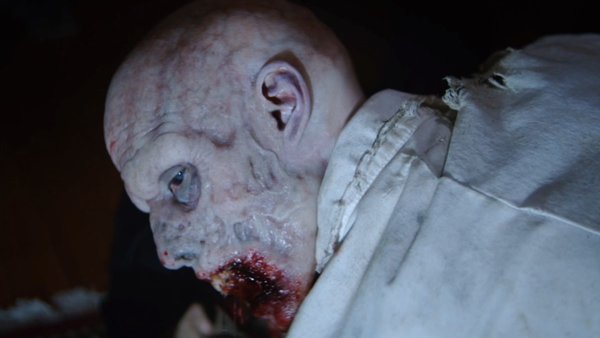
2021's Welcome to Raccoon City should've been so much better than it was. Under-budgeted and running at just over an hour and a half, it had the unenviable task of not just telling one Resident Evil story but two concurrently.
It's tricky business regardless, but there were other factors at play. Director Johannes Roberts has recounted a meeting with Constantin Film producer Jeremy Bolt three years before the film's release and that he wound up playing Resident Evil 2 Remake - which was brand new at the time - whilst writing the spec script. This means that the film's concept got approved either before or just in the wake of the release of RE2R. It might seem like an obvious thing to adapt now considering how massive that game became, but at the time it was quite the risk. Nobody knew that it would go on to perform as well as it did, commercially.
Sticking to their guns probably paid off on that front, as if REmake 2 had failed they would've found themselves adapting a game that nobody cared about which is a much harder sell. If nothing else the film had the recognisable visuals of the game's Raccoon City Police Department going for it.
It's just a shame it had so much stopping it from being, y'know, good.
13. Secret Tattoos
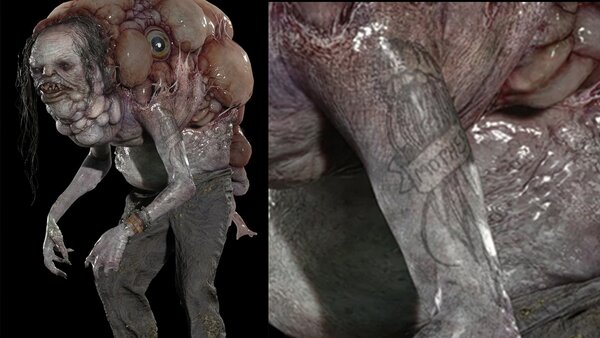
Most people know that Billy Coen's tribal tattoo, when looked at sideways, reads "Motherlove". This is another of the series' references to Queen, alongside "Made In Heaven" and "Let Me Live".
BUT Billy is not the only character with secrets relating to their tattoos. In fact, the secrets here are characters that you didn't perhaps expect to have tattoos at all.
Parker Luciani, Jill's parter in Resident Evil Revelations, usually has his arms totally covered. However, if you equip what's called his "beach" outfit you can see that he has an anchor on his left arm. Whilst this might just be part of the cosmetic (after all, an anchor seems pretty on-the-nose for a game set at sea), it's not like it's a joke costume. Also, the tattoo appears in the concept sketch for the outfit too.
Perhaps the most surprising though comes from Resident Evil Village's Moreau. If you inspect the poor fish man's second form in the character viewer, you can see he has a traditional "mother" tattoo. You could accuse Moreau of being a bit basic for having this, but at least he swapped out the classic heart for, uh, a jellyfish? Way to be on brand.
12. David Ford's Face
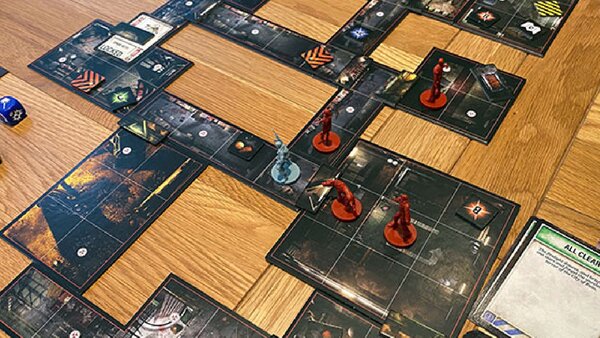
The Steamforged Games Resident Evil board games are perfect for Resi fans who also play love to game on the tabletop, and they're dripping with attention to detail and a deep love for the franchise. For example, the RE2 expansion "Retro Pack" (which features every card in the game reprinted to look more like the 1998 game) features a card of the Rebecca Chambers basketball outfit specifically 50 cards into the unshuffled deck - a nod to the 50 times the player has to search the desk to find the photo in the game.
In an episode of the First Aid Spray Podcast, lead designer of Resident Evil 3: The Board Game Sherwin Matthews lamented that Capcom turned down his request to create an expansion for the game called "Beginning of the End". This would've allowed players to play as UBCS mercenaries and RPD officers during the early days of the outbreak.
One of these characters would've been David Ford, an important name for RE loreheads as, through various notes across the games that feature the RPD, he tells the story of the downfall of the precinct. Since he only appears in files, nobody knows what David looks like. This expansion would've given him both character art and a miniature, meaning the first Capcom approved look at the character.
But they didn't approve it and so sadly it never came to be.
11. Code: Veronica Is Incredibly Important

There has always been a debate about whether or not Code: Veronica should be treated as a spin-off or, despite not falling into the naming convention, a mainline title. Whilst many wrongfully believe it was originally conceptualised as Resident Evil 3, there's still an argument that it deserves that elusive "numbered title" status.
Aside from fleshing out the Umbrella corporation and bringing Chris and Claire together, it also gave us the T-Veronica virus which would go on to be a huge player in the lore of Resident Evil.
The pathogen was extremely harmful to the infected, which is why Alexia Ashford needed to sit in suspended animation for 15 years with it, and why Darkside's Javier Hildalgo was going to the extreme lengths of replacing the ravaged organs of his infected daughter's body to keep her alive. That said, it was Resident Evil 6's Carla Radames that made it work. By editing the code and combining it with trace elements of the G-Virus found in Sherry Birkin's blood she was able to create the C-Virus (or "Crysalid Virus"): a mutagenic that allowed rapid transformation with very little drawback.
Of course, it's RE6 so this is all very poorly explained on-screen, but the long and short of it is that RE6 can't happen without Code: Veronica.
So, in retrospect, if you hate RE6 you might have a new reason to also hate Code: Veronica.