12 Mind-Blowing Facts About The Sega Mega Drive

The Mega Drive had wireless controllers!?

When the Mega Drive was released in Europe in 1990, it was pretty much an immediate smash hit, and a huge success story for Sega. In North America, where the console was known as the Genesis, it was a similar story, but not so much in the Orient. Japanese gamers much preferred Nintendo consoles, primarily because the system was a go-to machine for cracking RPG action, and even Sega's marketing ploy - built around superior processing - couldn't change that. Regardless, cracking the Western market was key to the console having such a lengthy tenure, only being discontinued as late as 1997 (even later, 1999, in North American markets). The system is one of the most-loved gaming devices around, and there's still a huge fan base for the machine today. Yes, people from all over the world sure loved the Mega Drive/Genesis, but Sega's smash hit is a lot deeper than simply offering Sonic The Hedgehog and a plethora of tip-top sports titles, there's a lot going on under the hood. This article looks at 12 slices of interesting fact, all wrapped up a cozy blanket of nostalgia. The Mega Drive has a rich and interesting history, far beyond the spiky blue mascot and trademark logo, as this journey through the lesser known and more hidden side of the machine shows.


12. It Was Sega's Last Great Hope

Due to the success Sega has experienced in both Europe and North America, a lot of gamers often forget that the corporation's main goal initially was to make a splash in their native Japan. Needless to say, this wasn't easy, especially with heavy competition coming from Nintendo, who experienced great success with the Family Computer (often shortened to Famicom). Released on the same day as the Famicom in 1983, the SG-1000 was Sega's great white hope for going head-to-head with Nintendo and dominating the market, but it wouldn't be nearly as successful as the competition. The SG-1000 did so badly that it would never see release outside of the Japanese market. Years later, the Sega Mega Drive - following on from the Master System, another console which failed to hit hard in Japan - was considered Sega's last ditch attempt. Yet again, Nintendo would triumph with the Super Famicom (SNES) in the 'Land Of The Rising Sun', which meant looking outside of their homeland was the only option for Sega.

11. South Americans Were The First To Embrace It

Incredibly, even though the Mega Drive was a hit in Europe and the Genesis did well in the US, South America was one of the biggest markets for Sega's new system. Several different variations were released in countries such as Brazil and Argentina, and the console often came in a unique white model, contrasting heavily with the edgier black used elsewhere. Eagle-eyed readers may notice a company name emblazoned on the casing of the machine, 'Tectoy'. That brand was the largest toy manufacturer in Brazil, and they sure loved Sega. In fact, Tectoy had such a fabulous relationship with the purveyors of the Mega Drive that they never really associated with Nintendo, or any other company for that matter. This meant that the Mega Drive ruled the roost in South America, giving them another market they could claim as their own. Shockingly, back in Japan, even other systems such as the TurboGrafx-16 were more popular than Sega's product.

10. The Console Had Online Capabilities In Japan

Quick question, how many people do you know who had internet access in their homes back in 1990? Not many, if any, but it's incredible to think that Sega manufactured their own modem, meaning that the Sega Mega Drive had - you guessed it - online capabilities. Honestly, that is simply mind-blowing - years before internet, even dial-up connections, would become commonplace in the home, there existed a console which enabled players to download games and play online. Perhaps not surprisingly, the concept would never make it outside of Japan, which is why it's rarely discussed on these shores. Obviously, playing games online, and even downloading full retail releases, is common practice nowadays, but in 1990 it must have seemed like people were one step away from living on space stations. It's unclear just how successful an experiment this was, but it just proves how ahead of the curve Sega could be.

9. Developers Are Still Making Games For It

For those in the know, the Mega Drive's hardware isn't a difficult machine to work around, which means skilled independent programmers are still releasing their own homebrew titles for consumer consumption. Even in 2015, there are numerous titles being developed for the Sega Mega Drive as people read this. Are they any good? Well, that's obviously up for debate, and the quality likely won't be anywhere close to the top titles gamers experienced from development houses back in the day, but it's nonetheless interesting that folks are still doing this kind of thing. It shows the continuing lure of Sega's beloved console, that people are still eager to make new games which live within the relatively modest capabilities of the machine. Even with awesome new consoles such as the PS4 and Xbox One, people still get a lot of joy out of booting up their original Mega Drive, and that's pretty cool.

8. 'Blast Processing' Wasn't Simply Hyperbole
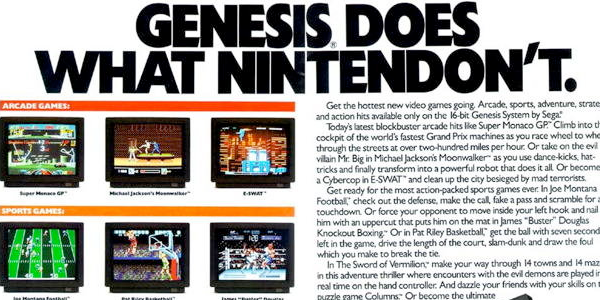
Wherever gamers turned in the early-90's, they would see advertising campaigns dedicated to telling them that the Sega Mega Drive or Genesis was the future, and Nintendo's SNES had been left in the dust by the excellent graphical power and speed Sega's machine was capable of. 'Blast Processing' is a term that's often ridiculed today as nothing more than a crude exercise in meaningless phrasing, designed only to sound cool and not actually meaning anything substantial. On the contrary, this attempt to talk up the processing power of the Mega Drive wasn't as silly as it first seemed. The gritty colour palette of the Mega Drive is often regarded as making it the more 'adult' of the consoles, certainly compared to the more cartoon-like SNES, but there can be no denying that Nintendo's system often looked better from a graphical perspective. Where Sega reigned supreme was with speed, Sonic The Hedgehog made Super Mario look painfully slow, something many gamers started to pick up on.

7. Sega Routinely Released New Versions Of The Hardware

Visit a friend's house, ask them to bust out their old Sega Mega Drive, and there's a good chance that it might look different to the one you have stuffed away in an old cupboard somewhere. This is because Sega as a company were continually tinkering with the machine, releasing a plethora of new versions onto the market. Often, these newer versions weren't even advertised to the general public, and the only way to tell them apart was by actually physically studying the consoles themselves. For example, some systems say things like, 'High Definition' on them, whereas others are without those words or feature some different coloured switches and adapter ports. It's pretty crazy that Sega did this, especially without advertising it. Nowadays, with products such as the iPhone, whenever there's even the slightest chance to the technology - even if it's only superficial - Apple are all over it, informing people why they must upgrade.

6. There Was A Huge Focus On Sports Games To Appeal To The American Market

Fairly soon after it became apparent than the company were destined to fail in Japan once again, failing to the vastly-preferred Nintendo corporation, someone under the Sega umbrella had the bright idea to focus on North America and Europe, looking to get a head start in those markets. One way of doing this was to differentiate the Mega Drive/Genesis from the SNES, a console fairly famous for a whole host of excellent RPG titles and shooters. Tact was changed, and the Mega Drive suddenly featured a heavy influx of sports games. The thinking behind this was that Western cultures would be far more interested in officially-branded sports titles, and that proved to be correct. Relatively quickly, series such as the NHL and Madden groups of games become wildly popular, cementing the Mega Drive as the go-to console if gamers wanted virtual sports.

5. Altered Beast Was The Original Headline Title, Not Sonic

Ah, Sonic The Hedgehog. That little blue son of a gun is timeless, and even though the franchise has went off the rails as the years have progressed, there's still something about firing up one of the classic era of Sonic games and unwinding that makes people giddy. It's pure nostalgia, and it doesn't hurt that the actual games themselves are pretty damn good. Stunningly, Sonic The Hedgehog, which became a packed-in game bundled with the system, wasn't the original marquee title for the Sega Mega Drive. Instead, it was Altered Beast, a fairly mundane-yet-still cult-like game which Sega felt proudly portrayed all the power of their new-fangled gaming device. Opening with the infamous voice clip, 'Rise from your grave', Altered Beast would eventually be replaced by Sonic as the bundled game, which proved to be a shrewd move.

4. EA Effectively Hacked The System

Today, Electronic Arts are a production house that pretty much exclusively focus on their annual draft of sports games, but that wasn't always the case. Sure, the company has had a hand in other genres over the years, but EA Sports is by far their biggest branch. EA also hold the distinction of being one company that a lot of gamers have a gripe with, feeling they distance themselves from actually tackling user issues head on. This isn't a new trend by any means, EA have always done things their own way, starting with the Mega Drive. Capitalising on a loophole in gaming law, EA started manufacturing their own brand of cartridges for use on the Mega Drive, cutting Sega out of the profits pretty much altogether. These units are best identified by the little yellow insert on the left hand side, which is ultimately pointless, but the huge sales of their sports games - along with other titles like Road Rash - enabled EA to cut a sizeable deal with Sega over the issue. Those cunning cats, up to their old tricks even then!

3. The Mega Drive Had The Same Processor As The Original Apple Mac

The Motorola 68000 is a device which won't mean much to a hell of a lot of people, but it was actually the main processing chip housed inside the Sega Mega Drive. Making things even more convoluted, the chip was the same one which would be featured inside the first Apple Macintosh home computers. Sega favoured the chip because of how user-friendly it was, making things much easier for developers to concentrate on actually building their games, instead of spending all their time figuring out how to make them work on this new hardware. That's the beauty of the Mega Drive, it was so easy to make games for that development houses considered working with the thing a pure joy. Who would have imagined that the Sega Mega Drive would have much in common with Apple, a company who have went from strength-to-strength. Meanwhile, Sega's popularity has dwindled substantially, certainly in the new generation of gaming, and the company now exclusively focus on software, staying out of the console wars.

2. Sega Released Wireless Controllers

When the Nintendo Wii was released, everyone and their grandmother marvelled over how amazing the wireless controllers were, suddenly forgetting that PC gamers had been using wire-free technology for years. Not only that, but the basic wireless mouse had been a staple of home computer usage for a long time. Even so, it became accepted that Nintendo were geniuses for taking away those little bits of cable. Even Nintendo themselves had offered wireless controllers before, mainly on the Gamecube, but they would be beaten hands down in this category by Sega, who released infra red powered pads as far back as the mid-1990's. The idea would never really catch on, people simply couldn't wrap their heads around it. Nowadays, wire-free peripherals are as common as the toothbrush in your bathroom, and really not considered much better technology! In other words, they're taken for granted, but in the 90's, this must have seemed like something from the future had landed in the here and now, gamers simply weren't ready for it.

1. Console Was Known As The Super Gam*Boy In Korea

To European users, the console was called the Mega Drive. For North Americans, it was the Genesis, and it was really that simple. Visit Korea however, and video game enthusiasts would be treated to a whole new level of bizarre - in the country, the Mega Drive/Genesis went by an entirely different name, one which would confuse everyone. Giving a little back story to this one, the relationship between Japan and Korea in the early-90's was a little frosty, to say the least. There were strict rules governing which products could transport between both nations, making the Mega Drive a hard sell. A compromise was drawn up, strangely leading to the machine being called the Super Gam*Boy, which would only remind Westerners of the Super Game Boy, a device enabling gamers to play Game boy titles (in colour) on their SNES consoles. The system was still successful in Korea, despite the name, and adds yet another twist in the tale to the history of Sega's historic slice of gaming goodness. What other strange and interesting facts do you know about the Sega Mega Drive/Genesis? Were you aware of any of the facts listed here? Let us know down in the comments section below!

Contributor

Lifelong wrestling, video game, music and sports obsessive who has been writing about his passions since childhood. Jamie started writing for WhatCulture in 2013, and has contributed thousands of articles and YouTube videos since then. He cut his teeth penning published pieces for top UK and European wrestling read Fighting Spirit Magazine (FSM), and also has extensive experience working within the wrestling biz as a manager and commentator for promotions like ICW on WWE Network and WCPW/Defiant since 2010. Further, Jamie also hosted the old Ministry Of Slam podcast, and has interviewed everyone from Steve Austin and Shawn Michaels to Bret Hart and Trish Stratus.