Switch 2: 10 GameCube Classics That MUST Be Added
Which GameCube classics deserve to be unpacked from Nintendo's purple box of delights?

While the Switch 2's inaugural year has not been an unqualified triumph (for every Pokopia-sized success there has been a Mario Kart World-shaped disappointment), there has been one indisputable highlight in the console's library
GameCube games are back!
For many of us who were there the first time round, the revelation that GameCube games would be playable on the Switch 2 was the highlight of the console's reveal. Indeed, playing through the three initial offerings was the highlight of the console's launch window - Wind Waker is still the most charming Zelda game ever made, the GameCube edition of Soul Calibur II is the best version of a fantastic fighter, and F-Zero GX lives up to 22 years of memories as the peak of futuristic racing games (sorry, Wipeout fans).
While Nintendo have done a fine job updating the Switch 2's list of GameCube titles with a mix of big hitters and oddball curios (Chibi Robo!), there are dozens more GameCube titles that deserve a second chance. This list will look at ten of the best - and weirdest - of said bunch, which brings us to our first entry...
10. Doshin The Giant

In 2005, game studio Ice-Pick Lodge released Pathologic into the world. A wilfully miserable, maddeningly obtuse yet utterly beguiling experience, PC Gamer UK summed the game up with the line, "It will definitely be someone's game of the year. It almost certainly won't be yours". It's a great line, and one that applies equally to Nintendo's Gamecube-exclusive kaiju-em-up.
Doshin The Giant sees players control the eponymous titan as he interacts with the human residents of his home island. Players can either look after the villagers by terraforming the island to suit their needs, or act out their Godzilla fantasies by flattening their homes and loved ones as Doshin's evil alter-ego, Jashin.
And that, put simply, is that.
While there is a story of sorts to follow, Doshin's simplistic gameplay means the game truly thrives as a chill-out simulator. Whether you're relaxing by taking care of the villagers or throwing them into active volcanoes, Doshin the Giant is a perfect fit in the podcast-gaming genre - something to tinker with while you listen to your favourite wrestling podcast, as a completely random example.
Like Pathologic, Doshin The Giant likely won't be your game of the year. But it's definitely worth taking the plunge to see if you do belong in that most exclusive of categories.
9. Donkey Kong: Jungle Beat

While some fans may be clamouring for the return of Donky Konga, licensing issues mean those desperate to revisit the days of DK bopping along to Losing My Religion will just have to dig their GameCubes out of storage. There is, however, one bongo-based game free from such restrictions - the hugely underrated Donkey Kong: Jungle Beat.
Jungle Beat saw GameCube owners control gaming's most famous ape via the console's sadly underutilized bongo peripheral. Tapping the left or right bongo would move DK in the respective direction, hitting them at the same time made him jump, and clapping saw DK literally slap his hands together like he was the Incredible Hulk.
Nintendo crafted a pleasingly visceral platformer out of this percussion-based control scheme, and one that has already been proven to work even without the equipment the game was built around. The 2010 Wii remaster showed that motion controls make an adequate substitute for bongo bashing. It would take some doing, but one can't wonder if the Switch 2's Joycons would provide an equally satisfactory replacement.
Really, the only downside for releasing Jungle Beat is that it'll make you long for the days when Donkey Kong games didn't have the endgame lopped off so it could be sold as DLC.
8. Star Fox: Assault
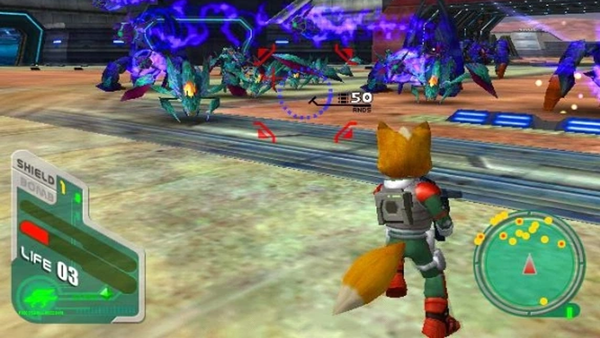
Like a thoughtful dominatrix, Star Fox Assault asks the player exactly how much pain they're willing to put up with for their pleasure.
That pain comes from Assault's infamous Third-Person Shooter sections. Throughout the game, series protagonist Fox McCloud steps outside his vehicle to take on the enemy on-foot. Unfortunately for him, and us, the good sir McCloud is about as adept at shooting as a real fox would be if you handed it a gun and told it to go ham on Jeremy Clarkson's chicken coop. These on-foot sections are a nightmare of skittish movement and unintuitive controls, and seem to serve no purpose other than to make you breathe a sigh of relief whenever you see Fox sitting inside a vehicle at the start of a level.
Fortunately, when that happens, the pleasure is more than worth the preceding agony.
Assault's excellent Arwing levels are genuinely worth the price of admission on their own. Controlling one of the series' signature starships is never anything less than a delight, and the levels that put you in the cockpit are some of the best in Star Fox's thirty-year history. Blasting giant butterflies, mutated nemeses and insect queens shows Nintendo's long-neglected series at its peak, and it's no exaggeration to say that Star Fox: Assault is worth playing for these moments alone.
7. Resident Evil 2

This is an admittedly unusual choice, as Resident Evil 2 on the GameCube was a port of the original PlayStation game. That said, with RE2 and it's siblings recently arriving on Steam and the PlayStation Store, it feels like only a matter of time before they make their way onto the Switch in some form.
Having recently replayed Capcom's 1998 classic on PS Plus, it's a delight to report that Resident Evil 2 still holds up as king of the old-school survival horrors. A pair of delightfully campy rollercoaster campaigns filled with iconic locations and unforgettable monsters, Resident Evil 2 still stands alongside the (equally fantastic) remake as an essential experience for horror fans.
And to address the elephant in the room - yes, the game does require you to get grip with tank controls (so called because they force you to move the player character like a tank, as opposed to modern gaming's more fluid control schemes). However, tank controls are very much the video game equivalent of changing a nappy - a straightforward feat of coordination that's somehow been blown out of all proportion in society's collective conscience.
All of which is to say that Resident Evil 2 is still great, and if you can't handle tank controls then you're going to find childcare an absolute nightmare.
6. Super Monkey Ball

Back in the day, famed music journalist Mick Wall once wrote about his time schlepping in the same recording company as The Police. Wall revealed that, internally, the band were seen as a joke - a bunch of punk wannabes whose producer kept banging on about their music needing to find "The Feel". Then The Police released Roxanne, and the joking stopped. Whatever "The Feel" was, Roxanne had it in spades.
Which brings us (finally) to Super Monkey Ball.
The original Super Monkey Ball was the surprise hit of the GameCube's launch line-up. Rolling ensconced simians across fantastical puzzle worlds turned out to be a surprisingly addictive experience, helped immeasurably by the game's pitch-perfect physics - the "feel" that allowed gamers to know precisely how the world would react to the slightest twitch of the joystick.
It's a feeling SEGA have been trying to recapture for over 20 years. Even Banana Mania - the 2021 remake of the SMBs 1 & 2 - failed to recreate the in-game physics that made the original entries sing. As such, if you want Monkey Ball in its purest, most perfect form, you need to go back to the source. Hopefully, said source will make its way to Switch Online before long.
5. Metal Gear Solid: The Twin Snakes

With owners of more powerful hardware enjoying a modernized version of Metal Gear Solid 3, it seems only fair that Nintendo fans get a Metal Gear remake of their own. Fortunately, the GameCube scratched that particular itch back in 2004 with Metal Gear Solid: The Twin Snakes.
A retelling of the first entry in the endearingly bonkers Metal Gear Solid saga, The Twin Snakes is a fascinating experiment in remaking a classic. Unlike last year's MGS Delta, which was a shot-for-shot remake of the third Metal Gear Solid, The Twin Snakes takes some liberties in its retelling of the original Metal Gear Solid. In this iteration, Snake is gifted powers far beyond his original incarnation, backflipping over missiles and enduring superheroic levels of punishment like a bandana-wearing Spider-Man. Cutscenes are also slathered in oh-so-noughties slo-mo, making Twin Snakes feel very much like a product of its time.
Snake's overpowered nature manifested in the gameplay as well, as The Twin Snakes endowed the son of Big Boss with mechanics taken from MGS 2. Chief among these was the ability to target enemies in first-person mode, a feature the original MGS' level design wasn't built to accommodate. The end result of this oversight means that some rooms in Twin Snakes can be cleared by using FPS mode to judiciously headshot every enemy from the entrance without taking a single step.
Fan reaction to these revisions, as you can imagine, was divisive. Nevertheless, these changes to the original formula make The Twin Snakes a fascinating slice of Metal Gear history, and one well worth experiencing as part of a subscription service.
4. Skies of Arcadia: Legends

With Skies of Arcadia: Legends, this list has now officially entered moon-on-a-stick territory. But damn it all if this isn't a tasty, tasty moon.
First released on the Dreamcast, Skies of Arcadia came out only months before SEGA's beautiful failure of a machine was officially discontinued. Fortunately, Arcadia ensured the console's owners had at least one reason to smile before hanging up their VMUs as it was one of the greatest JRPGs ever made - a status further reinforced when the game made its way to the GameCube in 2002 as Skies of Arcadia: Legends. This enhanced edition meant Nintendo fans received the best version of SEGA's aeronautical pirate saga, and those lucky few who got their hands on it experienced a journey filled with enough unforgettable moments to fill a photo album.
Given that Skies of Arcadia is obscenely priced on the second-hand market, a Switch Online release would be the perfect way to allow it to attain the popularity it deserves. It's truly baffling that SEGA have never returned Arcadia's halcyon shores, and the fact we aren't currently swimming in a sea of Arcadia spin-offs is yet more proof that this is the worst timeline.
3. Viewtiful Joe

"Henshin a-go-go, baby!"
If you've never played Capcom's sorely underrated brawler, the above phrase likely elicited nothing more than a puzzled head tilt and your local equivalent of "You wot, mate?" But for those who experienced the brutal ecstasy of Viewtiful Joe firsthand, the eponymous hero's signature battle cry likely evokes a mix of pain and pleasure.
Make no mistake, despite its Saturday Morning Anime aesthetic, Viewtiful Joe is an unforgiving monster of a game. Had it been released post-2011 it would have been labeled as the Dark Souls of beat-em-ups, but back in 2003 it was best described by the sound a controller makes when it's slammed against a desk after one failed boss attempt too many. But much like Miyazaki's masterpiece, Viewtiful Joe made a virtue of its difficulty.
By forcing players to engage with the game's combat system, Capcom ensured that anyone who beat Viewtiful Joe walked away with a genuine appreciation of what the developer pulled off. The game's self-consciously cinematic fights - where the player has to make use of silver-screen techniques such as slow-motion and zoom lens to avoid attacks and power up - make each fight feel like a silver screen brawl. You're not just fighting bad guys, you're directing and starring in your own action movie where each hard-won triumph makes you feel like James Cameron at the 1998 Academy Awards (minus the immediate backlash from your peers).
2. Eternal Darkness: Sanity's Requiem

If any one screenshot has come to identify Eternal Darkness, it's this one.
2002's GameCube-exclusive survival horror may be filled with nightmare demons, cosmic gods and scenes of good people meeting brutal ends, but its most well-known horrors are the ones that make the player question what's happening in the real world.
Silicon Knights' magnum opus became famous thanks to its brilliantly executed Sanity Meter. Whenever any of the game's dozen protagonists encounters an otherworldly horror or scene of horrific violence, the aforementioned meter begins to dip and the likelihood of the character losing their mind goes up. While some of these mental breaks made use of standard horror tropes - bleeding walls, moving statues, etc. - the best made the player think something was wrong with the game itself.
Some effects were relatively minor, like the volume slider turning itself all the way to zero on its own. Others were more drastic, such as the fake Blue Screen of Death that occasionally appeared, or the game suddenly inverting the controls. But by far the most well known trick was the one seen above, where the game would apparently delete all the players' save files. Seeing hours of effort go up in smoke generated a stomach-dropping horror entirely unique to Eternal Darkness, and it's a trick worth experiencing even when you're aware of it.
Like Carrie's hand rising from the grave, or the corpse standing up at the end of the original Saw, even when you know its coming you can still appreciate the brilliance of the moment.
1. Super Smash Bros Melee

In the years following Melee's debut, a meme developed among the Smash Bros community: No items, Fox only, Final Destination. It was meant to gently mock the competitive Melee scene, as the above ruleset eschews the chaos with which Smash Bros made its name. Final Destination is the game's most traditional arena, Fox is the game's most technical fighter, and "no items" - as the name suggests - does away with the battlefield-littering bric-a-brac that causes most of Smash Bros' signature messiness.
Here's the thing, though - the fact that Smash Bros even has a competitive scene is thanks to Melee's timelessly brilliant brawling.
Much like the legendary Street Fighter II, Smash Bros Melee took the foundations laid by its predecessor and used them to construct a masterpiece. Melee's higher pace, enlarged roster and adventurous arena designs evolved the formula of the N64 original into an experience that's just as joyful to dip into today as it was when it debuted fresh-faced and ready to take on the world in 2001 (Yes, Melee is 25 years old. And yes, that is time’s wingèd chariot hurrying near).
The fact that Melee's fans are still fighting to keep community events alive, despite Nintendo's best efforts, speaks volumes as to the ageless appeal of the GameCube's greatest fighting game (sorry, Soul Calibur II - you were an extremely worthy rival).