10 Horror Movie Trilogies That Have The WORST Endings
Blade? Hostel? Lost Boys? When it comes to most horror franchises, third time is not the charm.
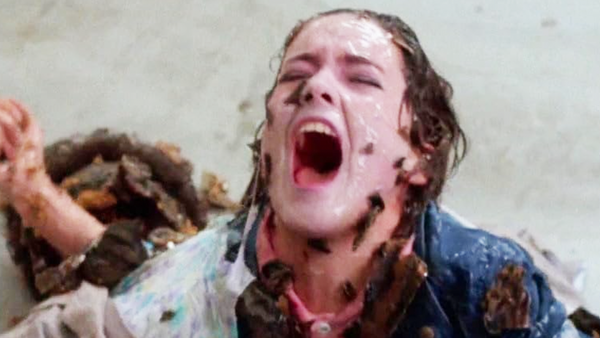
Horror seems to lend itself tooth and nail to franchise development more than any other genre out there. Hell, there are 13 Halloween movies, 9 Nightmare on Elm Streets, and 5 Terrifiers in the pipeline - and don't even get me started on Dracula. Nevertheless, while the promise of a first film is enough to inspire desire in audiences for more, the quality of sequels tends so often to decline, merely capitalising on the property without putting in the effort to make something worthwhile, and this goes doubly for trilogies.
It can be tricky to stick the landing on the third film if the second film has been bad, but even more so if it has been good. Horror sequels that are good enough (or make enough money) to warrant a third outing have a lot of work to do to make what so often wasn't imagined as a trilogy into one. Yet, in many cases there isn't even an attempt to develop characters or create a narrative through-line, with their production process spotty and ramshackle and often helmed by multiple different people, with multiple different studios.
Thus, third films frequently miss the mark and end their trilogy on downbeat, disappointing and downright awful terms. No matter where these franchises ended up in the future, these are 10 threequels that failed to satisfy fans, satiate critics or do themselves any justice whatsoever.
10. Hostel

Long before Eli Roth was making disastrous sci-fi video game adaptations, he was known as something of a splatter legend, helming the likes of Cabin Fever and, of course, Hostel. Roth helped make the sub-genre mainstream, delivering shock and gore that global audiences lapped up, despite dividing critics down the middle.
The first film plants itself in the place Americans fear most - rural Eastern Europe - and offers up some unsuspecting backpackers to an underground torture club. Part II returns to Slovakia with a new cast, more money and a few more elaborate set pieces. Despite not being as raw, surprising or inspired as the first, and killing off the first film's only survivor early on, it manages to put enough meat on the bone to sustain the series.
Enter Hostel: Part III. Roth has jumped ship and, recognising that yet another Slovakian nightmare might put audiences to sleep, new director-writer team Scott Spiegel and Michael D Weiss transplant the action to Vegas (with half the previous film's budget). Once again, there's no character continuity, and the direct-to-video vibe is strong from the outset, featuring a bunch of TV and no-name actors. The film feels more Saw than Hostel, with room after room of yawningly "creative" kills strung together on a string-and-Sellotape plot. Needless to say, this flaccid third entry killed the franchise for good.
9. The Addams Family

The Addams Family started way back in the 1930s, but for most of us who grew up singing rhymes about Uncle Fester's flatulence, the kooky clan really took a grip of pop culture in the '90s.
The 1992 horror comedy rounded up Anjelica Huston (Morticia), Raul Julia (Gomez) and Christopher Lloyd (Fester) in their prime, and introduced us to the goth icon Christina Ricci in her breakout role as Wednesday Addams. Its sequel, The Addams Family Values, served up more of the same, but this time with an even darker edge and a brilliant subplot with Wednesday and brother Pugsley (Jimmy Workman) at summer camp, taking on future Buffy star Mercedes McNab's bratty pre-teen Amanda Buckman.
However, with the third film - Addams Family Reunion - the wheels well and truly came off. Julia had died following the second film and, without him, all of the cast bar Carel Struycken and Christopher Hart's hand refused to return. Despite plugging a habitually high-energy Tim Curry into the Gomez role, and assembling a facsimile cast, the film failed on every front. The production was cheap, the script shaky and sending the gang to a bright, sunny country club for a family reunion is the last place we wanted to see this trilogy end.
8. Firefly Family

Rob Zombie is an infinitely better musician than he is a film director, helming nine films to date, most of which have lost money. But he started off in a good place, kicking off his Firefly family trilogy with House of 1000 Corpses.
The film features a group of teenagers stumbling upon the deranged and deformed Firefly family out in the sticks, who terrorise and torture the teens while lovingly calling back to Texas Chainsaw, Freaks and other classics. The combination of nostalgia, gore and the quirky family is what turned the film into a cult classic and paved the way for its follow-up: The Devil's Rejects. After an opening shootout, the film is spent with three of the family on the run from a zealous sheriff determined to end them at all costs. While not as strong as the first film, the alternative perspective, mounting action and closer look at the characters give something grisly to chew on.
Unfortunately, Zombie decided the film - which ends in a surely fatal, Butch Cassidy-style shootout - needed a sequel, and 3 From Hell was spawned. Sid Haig's ill health caused Zombie to kill off Spaulding - the films' best character - in the opening sequence, and from there it's a downhill slide into manic boredom. The remaining characters settle into type, exchanging insultingly bad lines while not having anything to do – and it’s a gasp of relief, not fear, when the 2-hour film finally ends.
7. The Cornetto Trilogy

Due to Edgar Wright and his stars' (Simon Pegg and Nick Frost) sublime comedy, and the blending of a multitude of genres, people often forget that the Cornetto Trilogy is horror at its core: Shaun of the Dead is a zombie movie, Hot Fuzz is a folk slasher and The World's End is an alien invasion apocalypse.
Paying homage to horror greats like Dawn of the Dead, The Wicker Man and They Live, the films find their unity through their cast, director and the Cornetto ice-creams depicted onscreen. Shaun of the Dead uses an irreverent approach to the zombie genre, telling a London-centric story that is equal parts comedy, heart, action and braaaaaiiiinns. Shooting off in another direction, Wright's follow-up Hot Fuzz takes a big city cop out to the country to face a cult of homely slashers, hell bent on goring anyone who besmirches the name of their beloved village.
The trilogy capper, then, had some big shoes to fill - and it didn't quite manage it. In The World's End a group of friends now in their forties embark on a pub crawl that inadvertently uncovers the fact that the people of their hometown have been replaced by aliens. The film ends on a literal apocalypse, as the aliens' departure triggers a cataclysmic global event. While the scope is admirable, this departure from the scale of the previous entries doesn't fit the trilogy's feel or trajectory, and leaves the third film looking like an extra limb.
6. Blade

The first real progenitor of the MCU, Blade brought the titular half-vampire anti-superhero onto our screens at the close of the 20th century, going hard on the violence and mayhem without an all-controlling studio to kowtow to. Stephen Norrington’s first film in the trilogy introduced Wesley Snipes as Blade - a sort of bloodsucking Shaft, whose trench coat and shades slotted in nicely with the too cool for school, late-‘90s cyber aesthetic that the Matrix helped kill.
Out to avenge his mother's death and put paid to the vampire plague once and for all, Blade faces down a host of big nasties in his first outing and lays the groundwork for Guillermo del Toro’s explosive sequel Blade II. While inferior to the first, the second helping is nonetheless admirably ambitious in its stunts and style (if not in character development). The series really could have gone anywhere from here, but unfortunately it went to producer-turned-director David S Goyer.
Blade: Trinity is juvenile and silly - something reflected in its 15 rating (down from 18 for the previous two) - and does the character and his universe no justice. The addition of an on-brand Ryan Reynolds and grim-faced Triple H to the roster hurt the film, but the real stake through the film's heart is the villain - Dominic Purcell's pouty, open-shirted, post-grunge version of Dracula. Blade killing the king of the vampires should have happened with a bang, not a yarled whimper.
5. Poltergeist
The Poltergeist series is one of the oft-overlooked classic in the ‘80s horror canon, thanks in part to its lack of a well-defined antagonist (a la Freddy, Michael or Jason), but also due to its disappointing trilogy closer.
The first film rode in on a wave of early-‘80s horror mania and benefitted greatly from a script penned by Tobe Hooper and Steven Spielberg, featuring the suburbanite Freeling family, a haunted house and a daughter - Carol Anne - abducted by ghosts. While the second film failed to match the quality of the first, it did expand the lore, pitting the central Freeling family against the spirit of apocalyptic cult preacher Kane (Julian Beck).
Several of the original cast refused to return for the third film and the death of Heather O'Rourke, who played Carol Anne, was a major challenge to production. This led to rewrites and re-shoots with a stand-in that just didn’t pan out. Despite setting up an impressively conceived demonic mirror world, the film’s Poltergeist-in-the-city premise is not strong enough to support its own weight. Reverend Kane (here played by Nathan Davis) proves lacklustre the second time around, and the lame script and laughable dialogue make even the film’s technical ingenuity difficult to enjoy.
4. Scream

Once upon a time, before the string of soft reboots, there was just Wes Craven's original Scream trilogy, three films that told the story of Sidney Prescott, a young woman who can't seem to shake her ghost-face killer. Reviving the slasher movie, the trilogy put a postmodern spin on the genre's conventions, calling attention to the gaps, inadequacies and glaring errors that fans had been shouting at the screen for decades.
Scream is set in Woodsboro, California, with Ghostface - a figure with a large knife, black cloak and Edvard Munch-inspired mask - picking off high schoolers one by one around our leading lady. Following the unmasking of a pair of Sidney's classmates, Scream 2 takes us with her to Windsor College, where a new Ghostface does much the same to her university classmates, before yet another pair of killers is revealed - one the mother of one of the first film's killers. So far, so convoluted; but that's kind of the point.
Scream 3 takes place around the Hollywood set of Stab, a film replicating Ghostface's killings for a mainstream movie audience. Wah-wah. While the movie brings back Sidney and a host of other familiar faces, it fails to pack the punch of the first two, feeling tired and familiar despite the uber-meta setup. To make matters worse, the film retcons the entire trilogy by having the newly introduced and deeply pathetic villain Roman revealed as Sidney's half-brother and the instigator of all the killings from the beginning...
3. Cube

Long before Saw or Escape Room, there was Cube. Vincenzo Natali's criminally underrated sci-fi horror series finds a series of unwitting and unwilling participants trapped in gigantic cube structures, where they pass from room to room without succumbing to the traps their mysterious corporate captors have set for them.
The first film was made on a shoestring budget and somehow still looks better than many of its blockbuster contemporaries, putting the grim industrial setting to good use as seven uniquely skilled individuals work together and against each other to find the way out without triggering spikes and acid traps and the like. Cube 2: Hypercube raises the stakes significantly, trapping a new group inside a four-dimensional tesseract whose traps are more metaphysical, distorting gravity, time, space and reality. This change in pace kept the series fresh and enabled it to revisit the formula without feeling repetitive.
But once you've raised the stakes so high, the only way to go is, well, back. Rather than escalate the action farther, Cube Zero operates as a prequel, taking us back to an early prototype of the cube, and offering the first real glimpse of the people controlling its function. While this is perhaps the best possible option for a series that didn't want to descend into absurdity, it is nonetheless a big step back, demystifying the other films and ending the trilogy on a bum note.
2. The Lost Boys

Joel Schumacher arguably did more for vampires with one film than Anne Rice did in 13 books, launching bloodsuckers out of the coffin and onto the beach with his eighties zeitgeist classic The Lost Boys. In the film, we are introduced to Kiefer Sutherland's trench-coated David, and his gang of partying, motorbiking, bridge-hanging creatures of the night, who feast on locals on the Californian coast, and face off against Corey Feldman and Jamison Newlander's nerdy vamp hunter Frog Brothers.
It took two decades for any kind of sequel to materialise, and it went straight to video. The Tribe takes place some years later, and follows a new brood of vampires, with one connection to the past - Edgar Frog (Feldman) returns to dish out some wisdom, shape some surfboards and stake some bloodsuckers. And the film was a hit amongst audiences (if not critics), with the DVD's success giving the green light to a third film.
Lost Boys: The Thirst once again crashed straight onto disc, but this time failed to make anything like the cash its predecessor had - and with good reason. Spoiling any good will the shaky sequel had stored up, The Thirst plants Edgar in a ridiculous plot that is way too big for him to handle. There's a DJ raising an army of rave vampires, Area 51 weaponry, a congress-level conspiracy and the off-screen dispatching of the first film's protagonist Sam Emerson.
Thou shalt not fall? Schumacher should have told the other guys.
1. I Spit On Your Grave (2010)

Of all the films that never should have been remade, let alone get a trilogy, it was I Spit on Your Grave. And yet, in 2010 Steven R Monroe brought us another look at the rape-revenge horror.
The first movie is a modernised re-tread of the original, with American novelist Jennifer Hills (Sarah Butler) taking an ill-fated trip to the South, where she is assaulted by a gang of hicks, and spends the rest of the film finding ever-more inventive ways to harm, torture and emasculate her assailants. Satisfying enough, for the right crowd. The sequel follows new protagonist Katie Carter (Jemma Dallender) as she is abducted to (you guessed it) Eastern Europe, and subjected to multiple brutal assaults. She escapes, tracks the men, and bloody, grotty violence ensues.
There wasn't call for a third film, from fans or critics, and yet I Spit on Your Grave III: Vengeance Is Mine surfaced a few years later. Representing one of the few occasions in which both departing from the formula and bringing back an original character is a bad idea, the film returns to Jennifer, now living as a sexual assault helpline operator and vigilante for scorned women. The film shows how Jennifer is unstable, psychotic and murderous, spiralling out of control in her attempt to see "justice" done. It's a damning indictment of any moral position the first film had, and an absolute flop of a conclusion to this already iffy trilogy.