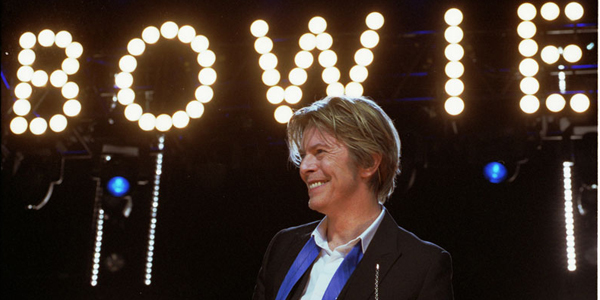
On January 11 2015, the world suddenly looked a very different place. After an unreported 18 month battle with cancer, the world awoke to the news that we'd all have to face life without David Bowie - something that, for a lot of people, they never thought they'd have to do. The man's boundless youth and enthusiasm let us tell ourselves that he was destined to live forever; now, sadly, that accolade remains only with his music. Unlike many, he slipped away from the cocaine-fuelled excesses of the 70s relatively unharmed. While his contemporaries receiving knighthoods and performed at opening ceremonies, Bowie elusively kept himself well out of the limelight for a couple of decades. The music he produced during this time has had its ups and downs, but Blackstar, released only 3 days before his death, has been met with unmitigated praise. The albums in David Bowie's catalogue number a quarter-century. Throughout this illustrious career, Bowie delved in and out of genres and styles, leaving his own indelible golden touch on each. He was never content to settle, and the chameleon-like way in which he adopted and dropped personas, collecting diverse scraps of popular culture, will likely never again be seen. So, from glam, to soul, to ambient soundscapes, here are the 10 very best albums of the now late, forever great, David Bowie.
10. Young Americans
http://www.youtube.com/watch?v=eeJDyIkzqKE 'The Man Who Sold the World' could easily have occupied this space, as could 'Let's Dance', and David Bowie's 'plastic soul' project wouldn't be responsible for a truly remarkable album until 'Station to Station'. However, for a Londoner to produce a good album in his first venture into American soul music is more than commendable. Not only is it a good album, but its two singles, 'Young Americans' and 'Fame', are two of Bowie's most catchy and powerful. One criticism of 'Young Americans' could be that, while he represents the genre more than adequately, Bowie does nothing new with it. This is true to an extent, but, for that reason, 'Fame' is perhaps the album's most interesting track. Its influences and sensibilities are traceable, but it doesn't sound quite like anything else. Possibly the greatest compliment is that Bowie's voice is up to the job. To tackle a genre whose greatest vocalists include Luther Vandross and Al Green shows that Bowie is rarely fazed.
9. Lodger
http://www.youtube.com/watch?v=KSl2g00AwCI For many, 'Lodger' is the forgotten album from the Berlin Trilogy. It was not accompanied by as memorable a single as "Heroes" (it helped that the album and the song shared the same title), and it has not (quite) received the same delayed critical acclaim as 'Low'. For some, however, 'Lodger' is the album which best represents Bowie's entire career. It is as rompish as 'Aladdin Sane', as scathing as 'Scary Monsters', and, at times, as unexpected as 'Low' (see 'African Night Flight'). The most immediate reward is 'Boys Keep Swinging', an upbeat, semi-ironic ode to masculinity. The rough-and-ready sound of the song was achieved, astonishingly, by the musicians swapping instruments: Dennis Davis (drums) took up the bass, while Tony Visconti (producer) slung the guitar around his neck. Few of Bowie's songs so forcefully command the use of the 'repeat' function. Given the pop feel of Bowie's immediately subsequent albums, the themes of travel and 'moving on' which are present in side one seem obvious clues as to the changing direction of his career. One can't help but think that he had it all planned out.
8. Diamond Dogs
https://www.youtube.com/watch?v=CvgqWO_TgP0 David Bowie famously terminated the persona of Ziggy Stardust in July of 1973 at the Hammersmith Odeon. While it is technically true that he performed once more as Ziggy that October, the Odeon gig was the iconic moment which signalled the end of the creation which launched him to fame. Bowie's next two personas would very much be re-workings of Ziggy; although in 'Diamond Dogs' Bowie began to experiment more with different sounds and styles. Thematics are arguably more important to this album than to any of Bowie's others; many of the songs were initially written for a stage adaptation of George Orwell's 1984. Having been denied the rights, Bowie worked the songs into a dirty, dystopian glam album which retains the theatrical feel of its original format. 'Diamond Dogs' has certainly received its fair share of criticism, mainly perhaps for the relative lacklustre of its second side. Track nine, '1984', is pure Broadway - perhaps enough to make some listeners cringe. David himself recorded the majority of the instrumentation, and without the rich and immersive sound of his usual motley crew, as the songwriting slackens we are left with rather fewer redeeming features. The album of course, has exceptional moments. 'Sweet Thing/Candidate/Sweet Thing (Reprise)' blends stagnation and opulence to perfectly describe and populate the dirty, corrupt universe of 'Diamond Dogs'. 'Rebel Rebel' remains one of Bowie's best ever singles, and its punchiness encapsulates why 'Diamond Dogs' can be such fun. The album is a mishmash of ideas, just about held together by a single thread. All the cogs were in place for Bowie's career to start twisting and turning through the unexpected.
7. "Heroes"
http://www.youtube.com/watch?v=Tgcc5V9Hu3g David Bowie's second Berlin album would belong here on the strength of its title track alone. It is impossibly beautiful, a masterpiece of production. The quotation marks on the album cover suggest irony, but the power of Bowie's voice proves the song's sincerity. Producer Tony Visconti set up three microphones: one at Bowie's mouth, one 20 feet away, and another 50 feet away. As the song progresses, Bowie's vocals become more and more distant and desperate to be heard. With the title track the undeniable highlight, what of the rest of the album? The Eno-inflected ambient tracks are strong, with 'Sense of Doubt' evoking the darkness of 'Low''s second side, while 'Moss Garden' takes a tranquil, zen-like turn. Of his three Berlin albums, "Heroes" feels the one most anchored to the great city. Much like 'Low''s 'Weeping Wall', "Heroes" , when at its best, manages to conjure up an atmosphere torn between East and West. 'Neukoln', for example, uses Middle Eastern scales and instrumentation to evoke the alienation of Turkish immigrants in Berlin. The rest of the songs on the album are perfectly fine. The guitars in 'Joe the Lion' are exciting, and 'Beauty and the Beast' is a snazzy opener, but Bowie's mid-range vocals lack the weight which make, say, 'Low', so compelling. 'Sons of the Silent Age' comes close to reaching the level of "Heroes"' predecessor; it is one of Bowie's biggest growers, and is interestingly reminiscent of 'Diamond Dogs'. Ultimately, it is just about fair that "Heroes" is remembered best for its cover and its title track, but it really is a good album.
6. Scary Monsters (And Super Creeps)
https://www.youtube.com/watch?v=NHywdqH3F6Y Following his Berlin Trilogy of 'Low', "Heroes" and 'Lodger', which represented forays into the new, everything changed once again for David Bowie. 'Scary Monsters' was to be written without the influence of his collaborators who had been so important to his sound -- meaning, therefore that the sound was to undergo another change. Bowie drafted in Robert Fripp of King Crimson, whose lead guitar slithers grandiosely through tracks such as 'It's No Game (Part 1)' and 'Teenage Wildlife'. Here we find a Bowie with true confidence in his vocals, despite the fact that they often sound paranoid and distant. As an album, this is one of Bowie's most political, with ample references and allusions to fascism. 'Scary Monsters' is an album which grapples with the past, ultimately shedding its shackles. The self-reference adorns the album with a holistic, backwards-looking feel, the zenith of which is Bowie's resurrection of the character Major Tom in 'Ashes to Ashes'. Bowie examines the path of his career during the 11 years between his invention of the character in 'Space Oddity' and its reintroduction. While the lyrics do delve into Bowie's drug addiction, the song also acts as the singer's termination of an era from which he felt he needed to depart. And depart he would, as his next album, 'Let's Dance', would be a foray into the pure mainstream. It is almost a cliché to say that 'Scary Monsters' was Bowie's last great album, but it is probably true.
5. Aladdin Sane
https://www.youtube.com/watch?v=q2y9inP4CqE David Bowie could have played it safe and milked Ziggy for all he was worth. He had a winning formula which had earned him fame at home and abroad, but he decided to stir things up a bit. Admittedly, the detour wasn't Bowie's most extreme -- the album cover, instantly iconic, is Ziggyesque, which was sure to put some listeners at ease, promise them they were in safe hands. However, 'Aladdin Sane''s scope is certainly wider than any of its predecessors in the Bowie canon. For the most part, the glam texture of Ziggy remains, while instrumentation and form diversify themselves to 'go native' in Bowie's new world of America. The paranoia of 'Diamond Dogs' was already beginning to trickle in ('Drive in Saturday' is as eerily dystopian as Bowie's following album), while the hedonism was truly gushing. The protagonist of 'Cracked Actor' is the album's most fascinating character, a washed-up Hollywood star deluded about the attractions of his waning fame, yet resigned to paying for his gratifications. The sound of 'Aladdin Sane' could not better reflect these themes of schizophrenia and debauchery in America. The rough harmonica and the dirty guitars immerse us in a world of trashy-glitz, taking us on a journey from the midwest to the Pacific. We've heard of the road movie, but 'Aladdin Sane' is a road album.
4. Hunky Dory
http://www.youtube.com/watch?v=YQTENuQYgjM For the most part, 'Hunky Dory' constitutes a natural transition from 'The Man Who Sold the World' to 'The Rise and Fall of Ziggy Stardust and the Spiders From Mars'. The hard sound of his previous album gives way to a relaxed backdrop of strings and piano (played by one Rick Wakeman), while the glam tendencies intermittently scratch at the door. 'Life on Mars' is the album's defining moment, possibly even Bowie's defining moment of the early 70s. It is a metaphorical, beautifully written song about a girl's pop culture escapism (not the first time Bowie would lend his lyricism to such critiques). These hallmarks (the glam of 'Queen Bitch', the cryptic lyrics) would all manifest themselves at different times throughout Bowie's later career. An expectant father, Bowie candidly lets us catch him at a time of hope, which is particularly endearing in 'Kooks'. In this ode to his son (now talented filmmaker Duncan Jones), Bowie warns him, 'Don't pick fights with the bullies or the cads, 'cause I'm not much cop at punching other people's dads'. For fans of Bowie's darker work, it is reassuring to hear him full of humour and sentimentality. On the whole, the first side is heartwarming, thanks mainly to its uncynical portrayal of childhood -- the depiction of a child's bedroom in 'Eight Line Poem' is particularly homely.
3. The Rise And Fall Of Ziggy Stardust And The Spiders From Mars
https://www.youtube.com/watch?v=XXq5VvYAI1Q The enduring image of Ziggy Stardust and the Spiders From Mars is, without a doubt, the onstage chemistry shared between David Bowie and Mick Ronson. The most television-friendly footage of Bowie's live performances is from the Ziggy era, and it is the sheer energy and sense of character that appealed to the youth of 1972. It is a concept album with a fairly straightforward narrative about a rock alien attempting to save the world from impending doom. The theatrical element of such a story is altogether more successful than in 'Diamond Dogs', so fulfilling in this case that it makes us wonder if theatrics are rock music's true goal. The answer, we soon find out, is 'yes'. 'Five Years' opens the album in an apocalyptic crescendo, examining the chaos that ensues in a world which knows its days are numbered. The steady drumbeat which opens and closes the track acts as the uncaring universe, while Earth appears and disappears in relative milliseconds. One of the great achievements of 'The Rise and Fall of Ziggy Stardust' is the album's attainment of a futuristic, otherworldly sound without the overuse of effects. This sound isn't omnipresent, but comes and goes at crucial moments to complement the album's themes. There is a fantastic moment during Ronson's solo in 'Moonage Daydream' when he plays the same guitar bend over and over again, evoking some kind of signal from another planet. As the album chillingly closes with 'Rock 'N' Roll Suicide', we come to realise that we have experienced a rare moment in music: the near-perfect execution of a majestically ambitious concept.
2. Station To Station
http://www.youtube.com/watch?v=8ARvX8E0Mmk 'Station to Station', recorded in 1975 in Los Angeles, features Bowie at his most confused and desperate as a result of his well-documented cocaine addiction. Perhaps this is an understatement - the lyrical themes in the title track are occult and downright bizarre. The backdrop to these oddities is a luxuriously smooth development of his funk sound which he experimented with in 'Young Americans'. The album transitions effortlessly from upbeat to pining, and back again, before being concluded by his tender cover of 'Wild is the Wind'. Drummer Dennis Davis and bassist George Murray must take credit for the rock-solid rhythm section which provides the foundation for the meandering 10-minute epic 'Station to Station'. The song builds from a minute of distant sounds evoking some dormant monster of transportation, into a crescendo of highly structured and rhythmic guitar and piano sounds. From here, the song bursts into infectious, progressive disco with Earl Slick's lead guitar going toe-to-toe with Bowie's mature yet volatile vocals. 'Golden Years' is altogether more straightforward, both musically and lyrically. Intended as a simple, glittery love song devoted to his wife Angela, one cannot help but detect more than a hint of irony. It is well known that Bowie was utterly disenfranchised with almost everything about his life, and his time in Los Angeles was the darkest of his life. A silence lingers for several seconds as the track ends, and the synth-piano which opens 'Word on a Wing' is an entirely different beast. The sound is more desperate and reflexive; the lyrics flirt with religion and occultism. The dark, all-questioning Bowie of 1975 was crying out for some kind of salvation, religious or non, and here he is reaching out to God. This begins tentatively, but culminates in the impassioned delivery of the lyric "Oh Lord, Lord, my prayer flies like a word on a wing". Powerful indeed. Side two seems to shed Bowie's cries for help, although the sound of 'TVC-15' and 'Stay' are extensions, perhaps even refinements, of what we have heard on side one. 'TVC-15' apparently tells the story of an incident in which Iggy Pop, having dropped a copious amount of acid, hallucinated that his television was eating his girlfriend. The technological paranoia is odd, yes, but not as dark as the album's earlier fare.
1. Low
https://www.youtube.com/watch?v=WsELFp6s-lo Punk in the United Kingdom circa 1977 was as prominent as any cultural movement. It was so of-the-moment that Bowie's avant-garde release bewildered fans and critics alike. It is true to say that side one contains punk sensibilities (most notably in 'Breaking Glass'), but the aesthetic is far more progressive and prismatic. Rather than acting as an ode to punk, 'Low' questions the movement by gradually transforming its sensibilities into something most of Bowie's audience had never heard before. Side one is at its most experimental between 'Sound and Vision' and 'Always Crashing in the Same Car' as guitar and synth are beautifully woven together by producer Tony Visconti. The cavernous snare sound was revolutionary, and its presence becomes crucial at moodier moments, of which there are plenty. Music rarely reaches moments so stirring as Bowie's pained cries, or Ricky Gardiner's ensuing guitar solo at the end of 'Always Crashing in the Same Car'. Side two draws ostensible influence from Krautrock and Brian Eno's ambient music, but Bowie's genius has always been in his eclecticism and willingness to run with sideways-thinking fledgling ideas. The instrumental half of the album is a journey in itself, meandering from the curious optimism of 'A New Career in a New Town', through the bleakness of 'Warszawa', to the disorientating lament of 'Weeping Wall'. The album draws to a longing and desperate end with Bowie's evocative saxophone in 'Subterraneans'. Despite the album's aesthetic shifts, 'Low' holds together perfectly as an individual entity, and represents perhaps Bowie's sharpest and most important turn from the mainstream.