10 Reasons Guns N' Roses Broke Up

How did the biggest band on the planet implode?
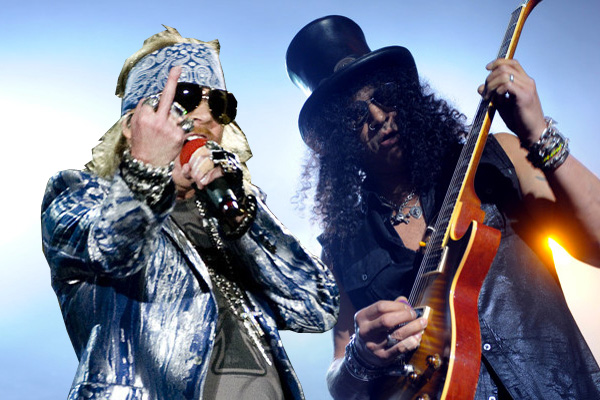
They were the biggest band in the world, one of the few bands that seemed almost untouchable from criticism and shifts in popular music. They survived the peak of the alternative music movement with barely the blink of an eye - Nirvana came and went while Guns N' Roses was still at the top. Yet the same year that alternative rock lost an icon, Guns N' Roses put out their final recording with guitarist Slash, and would then go on to release just one song between 1994 and 2008. How does a band that big just implode? It's something almost unparalleled in music. Yes, The Beatles broke up, and that's the reason for the qualifier in the previous sentence. Still, the fact that a band so dominant could just fall apart, then struggle with line-up changes for years, flirting with regaining success each time until another change in personnel set things back, is practically unthinkable. Why did it happen? What led to the classic era line-up (we can't even say original, as they never even made it to the recording studio) falling apart? Lets take a look at ten reasons why Guns N' Roses (and by this, we pretty much mean the Hall of Fame members) broke up.

10. Fighting Over Musical Direction

Even early on in the development of Guns N' Roses, musical direction was a sticking point. GN'R were never a band with a "sound" that was easy to identify beyond the distinctive voice of Axl Rose. This was mainly because stylistically, they ran the gamut from rock n' roll to hard rock to heavy metal and even punk (It's So Easy, for example). Axl Rose, who idolized Elton John and Freddie Mercury, wanted plenty of ballads in the mix. Slash, taking over for Tracie Guns, wanted hard rock songs. Duff brought the Punk element, and Izzy Stradlin' the classic rock vibe. While recording for Appetite for Destruction, Slash allegedly wanted nothing to do with the song that would go on to be GN'R's biggest hit, Sweet Child O' Mine. Right out of the gate, there were divisions, probably because, from day one, Guns N' Roses were a band that had endured multiple line-up changes. Guns early records (Appetite and Lies), however, had songs that had been written years earlier, when various members were with other bands. Even when the Use Your Illusion albums came out in 91, many of the songs had been around for years, some before Appetite. Tracks like Don't Cry and November Rain fell into that pile. After those albums, though, the vault ran dry, and the band's taste shifted. Rose was leaning towards ballads and electronic rock influenced by bands like Nine Inch Nails, while Slash wanted a straight rock album. One story has it that the guitarist went as far as tell Rose what words to sing. Yet even when a hard rock approach was a agreed on, nothing could get done, and by 1996, Slash had left the band, leaving just Duff, Dizzy Reed, and Rose as notable members - with Duff leaving shortly after.

9. A Struggle For Control

Guns N' Roses breaking up wasn't just about musical control, however - but control of the entire enterprise. As a business, GN'R was, and is, worth a lot of money. Merch sales. Licensing of songs in TV and films. Back catalog stuff. There's a whole whack of cash at play. An infamous story arose in the years following the breakup of the band that stated one night, Axl Rose refused to go on stage until Slash and Duff signed over the rights to the band's name, which they did. Could that really be true? Rose would point out in some late 2000s online chats that were this to be the case, he would be legally crucified, since the transfer of the rights to the name would have come under duress. He wasn't wrong. Duff's autobiography would also clarify that it wasn't Rose, but rather manager Doug Goldstein, who presented papers for Slash and Duff to sign, telling the pair that they were not in good shape, and that were one of them to die, no one wanted to wind up fighting someone's estate for the rights to continue the band. One way or another, they did sign over the name, and it did become a sticking point in later years. There were numerous lawsuits fired back and forth between Slash, Duff, and Axl during their years apart (claims and counterclaims), including Slash and Duff suing Rose in 2004 over "lost soundtrack opportunities." This lawsuit stated Rose wouldn't give the green light to license Guns music to numerous film projects. One of the movies in question? Death to Smoochy. Well, maybe that was the right call.

8. Egos

Lets face it: Axl Rose is a perfectionist who has historically taken years to produce work, and he has been that way since day one. Slash became a guitar god and one of the most recognizable guitar players of all time during his tenure with the band. Duff would go on to play with Jane's Addiction and Velvet Revolver (including the late Scott Weiland), and make a second fortune in the financial world. Izzy Stradlin... well he just never seemed to care. Steven Adler seemed to think he could do no wrong, and couldn't take responsibility for his actions (at least until a couple of rehab stints). There was a lot wrong with Guns N' Roses throughout its history, and egos had a lot to do with it. It's easy to finger Axl Rose as the source of all this, and while a good chunk of the blame can be laid at his feet, comments from band members outside of the classic Guns line-up seem to indicate he's easier to work with than some have claimed. Guns' last popular lead guitarist, DJ Ashba, stated Rose was a great guy to work with - but if you crossed him, he could also go all Kayne on you. So he just gets really annoying then? In any case, Slash's inability to compromise didn't make things any easier, and this was evidenced when his second major band, Velvet Revolver, couldn't make things work with Weiland after their second album. And when Corey Taylor of Slipknot fame was tapped to replace Weiland - well, that didn't work out either.

7. Michael Jackson

Here's a recent conspiracy theory for you: during the break-up years of the mid-90s, Michael Jackson was under siege, accused of fooling around with underage boys. Whether or not you believe the accusations in light of evidence released later that seemed to suggest at least one of the cases was an elaborate fraud, the fact is that at the time, pretty much everyone assumed Jackson was guilty, especially when he settled out of court. Slash, of course, was friends with Jackson, having appeared in the video for Black or White, and playing with him live in the early 90s. This allegedly infuriated Axl Rose, himself a victim of childhood molestation. According to former manager Doug Goldstein, speaking to the Brazilian edition of Rolling Stone in 2015, he said
When Axl found out Slash was going to play with Michael Jackson and that the payment was a big-screen TV, he was devastated. He thought Slash would support him and be against all abuse. From the point of view of Axl, that was the only problem. He could ignore the drugs and the alcohol, but could never the child abuse.
Slash would later state that he "didn't think" playing with Jackson had anything to do with Guns breaking up, and made it clear that he was not on good terms with Goldstein.

6. Perla Hudson
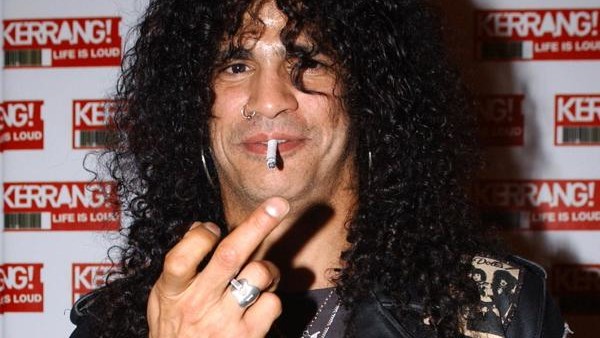
Perla Hudson is one of those rock n' roll groupie success stories. That's not a slight against her, it's just that she did start off as a groupie, and went on to wed the lead singer of the biggest band in the world. Hudson met Slash in 92, when she was just 17, and managed to sneak back stage at a Guns show. Her only interest in the guitarist? She had seen him on the cover of a magazine, and decided he was the guy for her. She wasn't even really a fan of the band's music at the time. Slash was still married to his first wife then, but Perla and Slash hit it off. Slash and Perla quickly became known as Sid and Nancy back stage, and not for any positive reasons: While Slash was already known for his partying, drugs, and alcohol issues, he now had someone enabling him. In her day job, Perla ran an escort service, something she openly admitted to. Despite rather volatile careers, the couple stuck together through thick and thin, eventually marrying in 2001, and staying the course until their recent divorce. Interestingly, the recent reunion between Axl and Slash didn't come about until after Perla was out of the picture.

5. The Other Yoko Factor

Paul Huge is probably not a common name to casual music fans, or even casual Guns N' Roses fans. Nor is Paul Tobias. Huge and Tobias are actually the same person, and played rhythm guitar for Guns N' Roses through most of the late 90s/early 2000s, until 2002, when Richard Fortus was brought on board. However, he is a longtime pal of GN'R singer Axl Rose - and he actually appeared much earlier in GN'R history, on the last recording to feature guitarist Slash. And there is the sticking point. See, in those years, Gilby Clarke was hanging around as Izzy Stradlin's replacement on rhythm guitar. Whether or not he was a full-fledged member is something fans were never clear on, but he filled in admirably during that time. So it was something of a power grab for Rose to then dismiss Clarke and bring in his pal Huge to play on GN'R's Sympathy for the Devil cover, which appeared in the 1994 film Interview with the Vampire, and was released as a single (it also appeared on the early 2000s Greatest Hits compilation). Slash was absolutely livid at the move.

4. Managers

Manager after manager after manager after manager. That has been the story of Guns N' Roses. Alan Niven was one of the first managers of band, and took the job when no one else would. "I knew what I was getting into: Half the band were smack addicts" he would later state. Next came Doug Goldstein, who may have sparked the breakup issue by dividing the band in the early 90s, after he seemingly placed himself in the Axl Rose camp and appeared more interested in managing Rose (who at the time might have been the only member not on drugs) rather than the rest of the band. At that point, the classic lineup was mostly done. Could it be saved, or reunited? Well, the managers that would follow were no help either. Doc McGhee, Merck Mercuriadis, Irving Azoff - while many attempted to reunite the original lineup, it seemed the more they pushed for it, the more stubborn Axl Rose became about the matter. In the end, Guns is now managed by Axl Rose's assistant, Beta Lebeis, who came into the picture as a nanny for Rose's former girlfriend Stephanie Seymour, and her son. Given where the band is at, she hasn't done any worse than the rest of the pack.

3. The Media Circus

The band addressed it in the Use Your Illusion II track Get In The Ring: the media. Always wanting to start s***. Printing lies and starting controversy. No doubt many of the targets of their ire didn't feel the same way, but there is no question that the constant media attention created a stressful environment for band members. Most bands do not start out expecting to become the biggest band in the world, and are ill prepared for the attention lavished upon them when they do hit it big. Guns N' Roses were no exception. Yes, they brought much of it on themselves - like guitarist Izzy Stradlin urinating in the aisle of a passenger jet, into a trash can, while seated among a group of senior citizens. The end result? Some members of the band wound up feuding through the press, mainly Axl and Slash towards the end of their relationship, and for nearly two decades afterwards (Axl's infamous comment calling Slash a "cancer" was reprinted for years). Others withdrew: Izzy Stradlin, who left the band in the early 90s, all but vanished from public life. Rose himself stopped doing press outside of rare interviews (Rolling Stone, Billboard, Jimmy Kimmel) and became known as the Howard Hughes of rock n' roll for a while, like Brian Wilson before him.

2. Drugs

Too much dancing with Mr. Brownstone. Too much drinking. Too much everything. Drugs nearly tore Guns N' Roses apart in the 80s, never mind the 90s. The band nearly broke up on stage at one point. That was 1989, opening for the Stones in L.A. Prior to Mr. Brownstone, Axl made the following statement:
I hate to do this on stage. But I tried every other f*cking way. And unless certain people in this band get their sh*t together, these will be the last Guns N' Roses shows you'll f*cking ever see. Cause I'm tired of too many people in this organization dancing with Mr. Goddamn Brownstone.
Slash, Izzy, and Steven in particular promised to get clean. They didn't. Thus drugs were the reason drummer Steven Adler was dismissed from the band. His drum work was so shaky at the initial Use Your Illusion sessions that it was barely usable. Still, drugs were ever-present for other members as well. Adler's firing seemed almost hypocritical in retrospect, but the reality is that he nearly kill himself with his habits. He wasn't alone. By 1993, only Axl Rose seemed to have managed to stay clean. According to Duff McKagan's autobiography, when his pancreas infamously exploded from alcohol abuse and landed him in hospital (at that point, doctors told him to either quit drinking or wind up dead), Rose was the only one to visit him, and was supportive in his efforts to get clean. The rest of the band? Well, they all struggled with their addictions individually, it seemed.

1. Their Own Success

It might seem cliche, but Guns N' Roses really were victims of their own success. And the excess that came with it. In Pretty Tied Up, Guns once wrote "once there was this rock n' roll band rollin, on the streets. Time went by and it became a joke. We just needed more and more fulfilling. Time went by and it all went up in smoke." That's pretty much Guns N' Roses summed up. Their excess allowed a bunch of kids in a rock band to have almost unlimited fame, power, and money at a time when they weren't ready for it. The money paid for the drugs, the money the band brought in as a whole meant the people around them simply wanted to ensure the train kept on rolling and the money kept on coming in. In reality, there was no one reason for the breakup of Guns N' Roses classic era lineup: it was simply a combination of some or all of the factors mentioned. Most of which were allowed to fester as a result of the band's success. Add your thoughts on the band and its history below!

Contributor
Contributor

Primarily covering the sport of MMA from Ontario, Canada, Jay Anderson has been writing for various publications covering sports, technology, and pop culture since 2001. Jay holds an Honours Bachelor of Arts degree in English from the University of Guelph, and a Certificate in Leadership Skills from Humber College.