10 Ways The Music Industry Owes John Hughes Big Time

Don't you forget about his legacy.
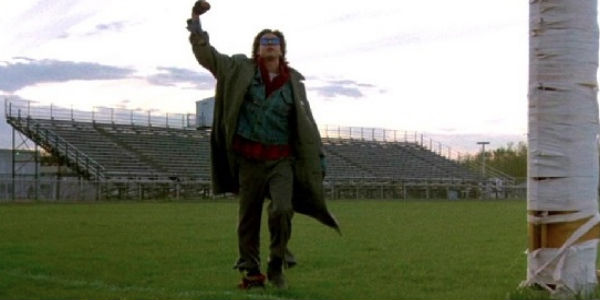
The eighties without John Hughes would be, in a word, unrecognizable. John Hughes defined an era by simply being so in touch with both it, and himself: acting as a conduit for both big music and big emotions, and let them shine through his utterly transparent films. It was clear that Hughes' heart was swollen with his own life's story, but completely open and susceptible to the feelings of others who weren't his age, though he was theirs (once). Equipped with a sheer sense of humanity and enormous capacity for empathy, he had his finger on the pulse of a younger generation that he could both relate to and learn from. While Hughes grew up loving the the sort of 60s pop music that informed 80s pop music, his progressive tastes and acute awareness of the musical landscape of the 80s gave him a certain eagle-eye vantage-point that can only look like prophecy for us on the ground. Being so well-connected to the very heart of pop-culture, and empowered by Hollywood's golden udder, he didn't waste a chance to shine a light on the various commercial wallflowers of the new-wave and post-punk movements, and give a chance to those who might never get one otherwise. On the other side of that transaction is a potentially huge and grateful fanbase that may never have encountered such great music otherwise. In short, music owes John Hughes big time.

10. Those Perfect Theme Songs

http://www.youtube.com/watch?v=ceeiNPv6hrU Nobody could pick a theme song quite like John Hughes, which makes sense, as a lot of his films begin simply as playlists. In a 2010 interview with Vanity Fair, Molly Ringwald described Hughes' typical screenwriting process, via a film ultimately never came to fruition called Lovecats, based on the Cure song of the same name: "I played this song for John, and he started writing a script, and he gave me a mix tape of what the soundtrack was gonna be. Which was pretty much Dave Brubeck, with the last song by Bob Dylan." http://www.youtube.com/watch?v=pqmTMiIMG74 But you can see how the origins of films like Weird Science and Pretty in Pink took place, with film titles originating in songs by Oingo Boingo and the Psychedelic Furs respectively. The latter film, it should be noted, is often ranked as having one of the greatest soundtracks of all time, and for good reason: with songs by the Smiths, New Order, OMD, INXS, as well as the title song by the Psychedelic Furs, which was re-recorded in a more pop-friendly manner for the film. One of Hughes' greatest film tropes is his use of theme songs, being both memorable in melody and pertinent lyrical content, a grasp on which only bolsters the strength of Hughes' voice across all mediums available to him. And while his songs often serve a narrative purpose, some are just plain catchy and enjoyable in a way that can totally be isolated from the film. Case in point: Lindsey Buckingham's "Holiday Road." The song serves as a franchise flagship, plot interlude, and just a great showcase for Fleetwood Mac's driving pop song-writing engine.

9. He's Directly Responsible For Some Of The Biggest Pop Hits Of The 80's
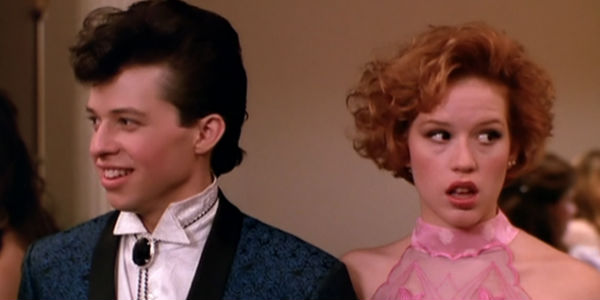
What would the decade be without songs like Simple Mind's "Don't You Forget About Me" or Orchestral Maneuvers in the Dark's "If You Leave" ? A much sadder (or perhaps happier) place, that's what. Hughes films were famous for lifting new and under-exposed songs to mainstream success, as well as for escorting lesser known bands to a place of newfound recognition. For new wave acts like Simple Minds and OMD, the songs they wrote for specific use in their respective Hughes films, were also each's only claim to mainstream chart success (at least in the U.S.). That being true, each has a body of truly quality work well-deserving of exploration. As far as songs not written for but appearing in Hughes films, they benefitted greatly from the Hughes bump, and in some cases found an untapped fanbase in countries yet unconquered. The Psychedelic Furs' "Pretty in Pink" originally appearing on their 1981 album Talk Talk Talk peaked at number 43 on the UK singles chart, whereas its saxophonier 1986 re-recording reached number 18 on the UK charts and 41 on the US charts. Just think, if not for the dateless girl with questionable fashion design skills, the U.S. may never have been graced with such a fantastic song - albeit one originally written about nipples and labias.

8. He Offered Real Exposure To Young Talent
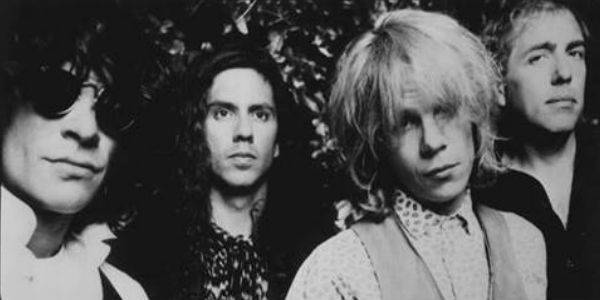
Case in point: The Rave-Ups. Molly Ringwald has expressed in interviews the amount of faith Hughes put into his young cast-members, and particularly Ringwald, who was clearly his muse for the decade. The Rave-Ups were a band that Ringwald turned Hughes onto, being a fan stemming from the fact that her sister was actually romantically-involved with one of the members. Ringwald - who can be seen toting a binder bearing the band's name in Sixteen Candles - invited Hughes to one of their shows, and shortly thereafter they were given a literal stage to play on during the club scene in Pretty in Pink. They can be seen playing "Positively Lost Me" and "Rave Up/Shut Up," which don't show up on the officially-released soundtrack, but are in fact awesome (and appear on their album Town and Country). Hughes films are quite often filled with obscure UK post-punk and two-tone bands, alongside the occasionally familiar name he tosses in for accessibility and generational gap-bridging's sake. But more often than not, Hughes seems more interested in offering exposure to great underrated talent, and to giving a chance to those who might not have any otherwise. That kind of integrity is rare in Hollywood, but you do see similar see that kind of one-upping in films by the Farrelly Brothers (who often showcase local and independent bands in their comedy soundtracks). Or in the modern Hughes homage (500) Days of Summer, which is how most of us discovered Temper Trap. Or like how the Shins' James Mercer owes as many dues to Zach Braff as the Flowerpot Men do to Ferris Bueller. If only Hollywood (and perhaps life in general) were more like Hughes. http://www.youtube.com/watch?v=AfdcbZxzKWc

7. The Breakfast Club Defined Sub-Culture Fashion
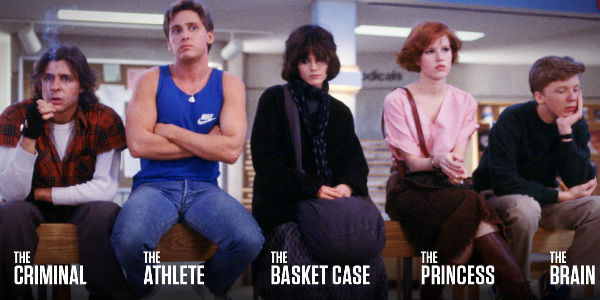
The Breakfast Club is represents every label an old xenophobic society can place on a young society that wears its heart on its sleeve, along with the fashion of its pertinent subculture. The film uses terms like"athlete" and "basketcase" and "criminal" to describe perhaps more familiar synonyms like "jock" (or "bro") and "goth" and "punk," terms which all come with a general dress code and pre-defined taste in music (according to a society of generalizers, of course). Which plays out something like: letterman jacket/Dave Matthews Band, all-black/the Cure, and mohawk-and-patchy-denim-vest/Sex Pistols. Without addressing these subcultures, the films presents high school as a microcosm for how society tends to divvy itself up (and how broadly), these teenage archetypes a boilerplate for judgement based on how something looks and behaves (and what it listens to), without so much as considering how it feels. The central message behind Breakfast Club is that we all deserve to fit in, regardless of pre-set labels. But if you should go the label route, there is a fantastic outfit waiting for you€especially if "criminal" is the look you're going for. (Of course, nowadays you risk being labeled a "hipster" for expressing affection towards John Hughes at any capacity€”in terms of film, fashion, or music - at which point you get the ol' "Ray Bans/Twin Shadow.")

6. Frank Zappa's Son Dated Molly Ringwald, Plays 'Simon' In Pretty In Pink
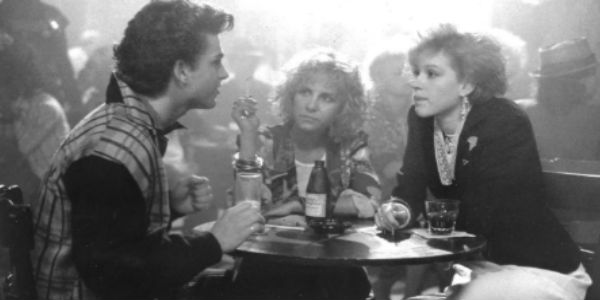
Another case of Molly Ringwald playing muse to Hughes is the big screen debut of Dweezil Zappa (i.e. the son of the Mother of Invention). Specifically in how he landed a part in Pretty in Pink alongside Ringwald, Zappa's flame in real life. Zappa is known by little else than for being one of the unfortunately-named offspring of Frank Zappa, and for a career in music playing his late father's material - which, at the very least, is more admirable than learning how to twerk. Zappa sort of has serendipity written all over him. And not just between his eyebrows. He was a MTV VJ briefly in the 80s, until he trash-talked the network on the Howard Stern Show. He also contributed a guitar solo to the Spinal Tap song "Break Like the Wind," which was later used as the theme for the Ben Stiller Show. He's acted and offered lead guitar sessions here and there, but his best possible association with music has to be playing Andie's friend Simon in Pretty In Pink, seen hanging around the record store she works at. Of course, it's not too surprising that Zappa should get a part in a movie where Ringwald makes nothing but terrible dating decisions.

5. The Beatles' "Twist and Shout" Charted Again, Thanks To Ferris

And you thought Ferris was just a malingering slacker. That iconic parade scene in which the film's protagonist leads a city block to sing the Beatles' rendition of "Twist and Shout" (originally written by Phil Medley and Bert Berns) helped give the song a chart comeback in an unexpected decade. The re-release of the song reached #23 in the singles charts. While the Beatles weren't necessary fading into obscurity, Paul McCartney wasn't particularly grateful for the bump or keen on the use of his recording in the film, saying, "I liked (the) film but they overdubbed some lousy brass on the stuff! If it had needed brass, we'd had stuck it on ourselves!" Hughes, for his part, grew up loving the Beatles while he himself was about Ferris's age. He said in an interview, "I ended up in a really big high school, and I didn't know anybody. But then The Beatles came along (and) changed my whole life." Hughes would go on to express his affinity for the Beatles, and particularly John Lennon, in Pretty in Pink, in the scene where Ducky (perhaps a stand-in for a younger Hughes in front of his bedroom mirror before school every day) lip synchs to John Lennon's "Love." Hughes has said, "My heroes were Dylan, John Lennon and Picasso, because they each moved their particular medium forward, and when they got to the point where they were comfortable, they always moved on." That sort of forward-thinking certainly explains his own progressiveness as a screenwriter and soundtrack curator.

4. The Dream Academy Gave Straight-Ahead Comedies Like Planes, Trains, And Automobiles and Ferris Bueller Moments of Sincere Beauty

http://www.youtube.com/watch?v=zhdk_44Gmew The Dream Academy are best known for their hugely-cathartic dream-folk anthem "Life in a Northern Town" - and for a signature sound consisting primarily of acoustic guitar, oboe, and synthesiser - but they are better know still for being musical proteges of Hughes, appearing in three times in two of his biggest films. In Ferris Bueller, they play an instrumental cover of the Smiths' "Please, Please, Please Let Me Get What I Want" in the scene where Ferris, Cameron, and Sloane visit the art gallery to appreciate the paintings. The music underlines the fact that these kids, in spite of their defiance towards conventional authority, actually are interested in cultural enlightenment. Just as long as it's by their terms. Another song by the Dream Academy, "Edge of Forever," appears towards the end of the film when Ferris and Sloane seal a day well accomplished with a kiss. In Planes, Trains, and Automobiles, their song "Power to Believe" shows up in the final scene where Steve Martin's character realizes John Candy's character wasn't so much of a problem as he was a desperate cause, and what ultimately compels him to inviting Candy back to his home for Thanksgiving. The greatest purpose Dream Academy serve in Hughes' films is the one Hughes does in spite of all pain and comic relief: to maintain that core of humanity central to us all.

3. Two Short-Lived Side-Projects Of Ex-Clash Mick Jones (B.A.D. And General Public) Appear On The Ferris Bueller Soundtrack
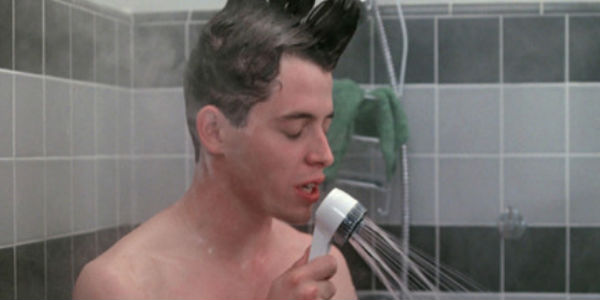
The 80s, like John Hughes films, are where punk and pop converged. And Hughes championed both accordingly, showcasing them hand-in-hand through his soundtracks. But no closer do the two worlds meet than on the Ferris Bueller soundtrack, on which two of Mick Jones' post-Clash musical projects show up to remind us that you are allowed to make an album like Sandinsta! if you want to. The song "Bad" from Big Audio Dynamite is a little closer to Jones' punk roots than anything, with the addition of some disjointed sampling and experimentation, whereas the fittingly-titled song "Taking the Day Off" by General Public is most definitely pop, even if it does come from a post-punk super-group consisting of the ex-Clash guitarist and members of the English Beat, Dexy's Midnight Runners, and the Specials. Hughes was very keen on the UK post-punk scene of the eighties, filling his movies with its best dissidents, including the original acts of the aforementioned super-group. For instance, hear both the Specials' "Little Bitch" and General Public's "Tenderness" in Sixteen Candles (along with Wham!, Kajagoogoo, David Bowie, and Billy Idol), and a remix of "Rotating Head" called "March of the Swivelheads" by the English Beat appears on the Ferris Bueller soundtrack. It was actually upon Hughes insistence that these types of bands define the Pretty in Pink soundtrack, as frequent Hughes director Howard Deutch was originally intending to drape theme music over the film. Thankfully that didn't happen, and the film is filled with music that much better supports the perspective of the film's teenage protagonists. http://www.youtube.com/watch?v=nmoHQ2DC3zo

2. Home Alone Has All The Christmas Music You'll Ever Need

http://www.youtube.com/watch?v=A8Nl4yPzE3U Home Alone is pre-teen angst at its finest, and from the finest authority on the subject. And in a certain light, Hughes' screenplays may not be very different from Kevin's traps... With Home Alone, and its well-conceived soundtrack included, Hughes seemed to be genuinely interested in producing a family-friendly holiday movie that could be welcomed into a family tradition Kevin McCallister (perhaps a stand-in for a much younger Hughes) often felt alienated from. But the unique charm of Home Alone is that its soundtrack is so loaded bookend to bookend with original aesthetically-seasonal compositions by John Williams, as well as hand-picked soundtrack inclusions by Hughes (e.g. "White Christmas" by the Drifters, "Rockin' Around the Christmas Tree" by Brenda Lee, "Run Rudolph Run" by Chuck Berry, "You're a Mean One, Mr. Grinch," etc.), you could enjoy the movie all the same with your eyes closed. Or while eating Christmas dinner in the other room. While most probably have a VHS tape of this post-80s Hughes classic lying around the house somewhere, the soundtrack has to be one of the few holiday CDs, even amongst just holiday movie soundtracks, that wouldn't be a redundant thing to go out and buy. Between Home Alone and Christmas Vacation, Hughes becomes a holiday institution late in December.

1. Oh Yeah ('Chick, Chicka-Chicka...')

http://www.youtube.com/watch?v=SU0Ypufo6BM Maybe this is equal parts a good and bad thing, but if it weren't for Hughes' seemingly arbitrary selection of this piece of Swiss electronica, we might never have been able to confidently describe the moon as "beautiful." That is by way of the culturally-pervasive and wholly tongue-in-cheek "Oh Yeah" by Yello. Which is also to say that the Simpsons' Duff Man would be without a theme song. While this song isn't the usual fare of what can be expected from a John Hughes soundtrack, it does effectively capture the comedic spirit of the film Ferris Bueller Bueller's Day Off, and has its subliminal underpinnings in the fact that it cues up as we first see Cameron's dad's precious luxury car, an object of material lust that is as meaningless as it ultimately becomes. Furthermore, Yello as a group is actually fronted by a millionaire heir/industrialist/professional gambler named Dieter Meier (who comes off as a sort of real-life Carter Pewterschmidt) - which Hughes must've known. After all, what better way to exaggerate decadent wealth than with the baritone gibberish of an eccentric millionaire with EDM tendencies. Unsurprisingly, if you check out any other songs in Yello's catalogue, you'll find that "Oh Yeah" isn't the only goofy one in the bunch. "Rubberbandman" contains some pretty far-fetched audio samples, and leans deep on Meier's ridiculous vocals. There are a few exceptions - for instance, "Vicious Games," which provides a sort of euro-disco foundation to some pretty lush guitar and vocal arrangements - but in most cases Yello is hard to take with a straight face. (Which is where the Dream Academy comes in.) http://www.youtube.com/watch?v=Bi6sgW_y7Uc Did you enjoy this article? Remember to share it, and leave a comment in the comments thread below.

Contributor
Contributor

Ryan is a song-writer (soundcloud.com/the-articles), music journalist, vinyl enthusiast, 80s pop-culturalist, and just kind of a vaudevillian person. Ryan is also available for hire. Email him at 505sandheartbreak@gmail.com with any kind of (non-sexual) work petitions.