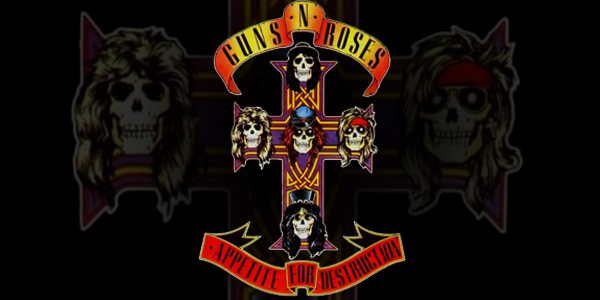
They were the epitome of sleaze rock at its very height, and managed to survive (by a few years, anyway) the wave of alternative rock that crested in the early nineties and was fueled by the breakthrough hit that was Nirvana's Nevermind. While every other 80s band not named Metallica was buried, they managed to have the biggest tour of 92-93. They were chock full on controversy and offensive to parents, teachers, and the PRMC, but that's what made them so entertaining - that, and the fact that while their run at the top was less than a decade, they were good enough to be the next coming of the Rolling Stones. Yes, Guns N' Roses showed up late for gigs, were often drunk on stage, started riots, and had, in their later years, a revolving door line-up (actually, they had that from the time the band parted ways with founding guitarist Traci Gunns and picked up some guy named Slash). They mixed up radio-unfriendly, lengthy ballads with straight up hard rock tunes, and by the mid-90s, when the band had basically imploded, lead singer Axl Rose was considered somewhere between Ted Bundy and the Devil for his supposed break up of the band and rock star prima donna behaviour (the former should not be completely laid at his feet: Bassist Duff McKagan nearly drank himself to death, and guitarist Slash was a drug and booze fueled train wreck himself; Rose, who sobered up first, opted to take control of a sinking ship for better or for worse). Their music, especially the hits, has stood the test of time however: Welcome to the Jungle. Paradise City. Sweet Child O' Mine. Patience. Don't Cry. November Rain. You Could Be Mine. Plus popular covers like Knockin' On Heaven's Door and Live and Let Die. They also had tracks that shocked - at least seven of which remain shocking today. Don't believe us? Then you're crazy - but lets hop aboard the night-train and take a look.
7. Get In The Ring
https://www.youtube.com/watch?v=obIwbUH6-uA Album: Use Your Illusion II (1991) Given the amount of drama off-stage that Guns N' Roses generated, it's not surprising that the media both adored and reviled them - that sort of critical bi-polar behaviour ensured that every music rag around sold ample copies when Guns were involved. So it's not surprising that the band lashed back at critics - but it was surprising that they did it in song, on one of the biggest releases of the early 90s, the second of the two Use Your Illusion albums, released simultaneously in 1991. To give you some appreciation of what a big event this was: fans lined up overnight to buy this album (see, once upon a time, people bought music in things called record stores). The albums debuted at #1 and #2 both in America and the U.K., and Use Your Illusion II included this little ditty, with personal shots being yelled out over roaring crowd noise (added in studio), including a dig at Spin Magazine chief Bob Guccione Jr. who was told "what, you pissed off because your Dad gets more P---- than you? F--- you, suck my f------ d---!" sometime after lines like "I've got a thought that would be nice/I'd like to crush your head tight in my vice!" Despite sounding like a live track, the song was never played live by the band.
6. Rocket Queen
https://www.youtube.com/watch?v=c7xQ04nlePM Album: Appetite for Destruction (1987) The story behind Rocket Queen is legendary: the song is basically about a prostitute, but that in itself is no big deal. The lyrics were claimed to be written for a friend of lead singer Axl Rose, reportedly Barbi Von Grief (she's linked to the song in the Appetite for Destruction liner notes), who was going to have a band called Rocket Queen. Various rumours have Rose supposedly aiming to be in the band with her, but her being too strung out to ever commit. However, the song also has a very aroused female making some obvious sexual moans, and that's where the shock comes in: See, fully committed to the realism of the song, Rose actually brought a girl into the studio, and had their sex session recorded. The girl? Then-drummer Steven Adler's on again, off again girlfriend Adriana Smith, who reportedly had a relationship with Rose as well. When Adler found out, he was furious, and Smith blamed years of alcohol and drug abuse over guilt from appearing on the track.
5. Pretty Tied Up
https://www.youtube.com/watch?v=8tHrBwLz0Ds Album: Use Your Illusion II (1991) "She's pretty tied up, hanging upside down/She's pretty tied up, and you can ride her." This little ditty from 1991's Use Your Illusion II would probably raise much more of a stink today then it did back when the album was released. Full of references to masochistic sex (I know this chick she lives down on Melrose/She ain't satisfied without some pain") and bondage, the song is based off an encounter founding rhythm guitarist Izzy Stradlin had with a dominatrix - who had a "big fat naked guy" with an "onion in his mouth" tied up with duct tape and wearing women's panties in her bedroom. Stradlin was shocked, and the song was born, with the sexual lyrics mixed in with foreboding lines about the implosion of a rock n' roll band (keep in mind, however, that the song was written well before the actual band began the breakup of its most notable line-up). Musically, the sitar heard at the beginning of the track was inspired by a makeshift sitar Stradlin created while high on heroin with lead guitarist Slash. And we wonder why the band fell apart.
4. Back Off B----
https://www.youtube.com/watch?v=HIFZaLEmmcA Album: Use Your Illusion I (1991) "Back off, back off b-----, down in the gutter, dyin' in the ditch." We can't count the number of times the word "b----" is uttered in this song (well, we could, but lets just say it's a lot). It would probably be considered misogynistic and inappropriate today, but at the time, it was a deep cut barely even noticed by the usual suspects when it came to censorship and attacking artists. It's rumoured to be about Axl Rose's mother, but that doesn't quite fit. It has also been attributed to his relationship with Stephanie Seymour, but they hadn't even met when the song was first written. Perhaps you just need to take the final lyrics literally: "Hey wha'd'ya think he's tryin' to say there, anyway? I think it's something each person's s'posed to take in their own special way F------ b----!"
3. Used To Love Her
https://www.youtube.com/watch?v=TXzr5Ip4vP0 Album: G N' R Lies (1988) Used to Love Her caused a surprising amount of fuss for a song the band labelled a joke right from the start. With the catchy chorus "I used to love her/but I had to kill her" the song became a favourite amongst fans of the band despite never having been released as a single, but many female fans (maybe fan is the wrong term) were offended by suggestion that someone kill a girlfriend they no longer loved. The jovial tune of the song clearly indicates that it's not to be taken seriously, but black humour is lost on many, and the band's reputation didn't help things. However, over the years the band claimed it was about a dog of lead singer Axl Rose who had to be put down - though this would contradict the story that it was written when Izzy Stradlin heard a song on the radio about a singer complaining about his ex, and decided to write Used to Love Her as a joke in relation to it. A song about a dead dog, or an ode to violence against women? You decide.
2. Look At Your Game, Girl
https://www.youtube.com/watch?v=RgfILrd8HjE Album: The Spaghetti Incident? (1993) Back in the 90s, Axl Rose was known to wear a shirt featuring a portrait of Charles Manson with the slogan "Charlie Don't Surf" emblazoned on it - a line taken from the movie Apocalypse Now, and referring to a different "Charlie" altogether. So perhaps we shouldn't have been surprised when, in 1993, Guns N' Roses released an album of cover songs that included a cover of a Charles Manson song. The uproar was intense. Guns were still a huge and controversial band at the time, and the idea that Manson would get royalties from an album that might sell millions was offensive to many. The song had been released originally on an album that was to help pay for his defence team, and the Guns cover, while unlisted on the album, brought a lot of anger back to the surface, especially with families of the Manson Family's victims. However, in December 1993, it was announced that Bartek Frykowski, who won a half-million dollar lawsuit against Manson over the death of his father, would receive Manson's share of the take - $62,000 for every million copies sold. Bartek's father was one of five victims killed by the Manson Family in 1969 in a single night (they were eventually convicted of seven murders). Coincidentally, Frykowski's own children were said to be fans of Guns N' Roses. Of the royalty situation at a news conference, Frykowski said "Even though this new situation cannot change the past, my hope is that something positive will emerge for the future." Yes, a hidden track on a Guns N' Roses album resulted in a news conference related to one of the most notorious cult figures in recent history.
1. One In A Million
https://www.youtube.com/watch?v=AdVdCI5avHI Album: G N 'R Lies (1998) One in a Million is probably the most racist song ever to appear on a multi-platinum album. Period. With lines like "immigrants and f------, they make no sense to me/they come to our country, and think they'll do as they please" and "Police and n-----, that's right, get out of my way/don't need to buy none of your gold chains today" it was bound to cause controversy, and came with a pre-printed apology of sorts in the liner notes to G N' R Lies (which was produced to look like a tabloid paper). The song was written by Axl Rose - marking the first time Rose wrote a Guns song on guitar, as he usually composed with a piano - and was played on by then lead guitarist Slash, who happens to be half black. Rose defended the song for several years, saying that it was a response to how he felt upon arriving in L.A. from a small town, being attacked in the past by police, and various other confrontations, including an attempted robbery of him by black suspects, but over time softened his stance, and considered taking the song off the album. He would address the song multiple times, which was continually used against the band in the press. "I'm on a fence with that song. It's a very powerful song. I feel, as far as artistic freedom and my responsibility to those beliefs, that the song should exist. That's the only reason I haven't pulled it off the shelves. Freedom and creativity should never be stifled. Had l known that people were going to get hurt because of this song, then I would have been wrong. I was definitely wrong in thinking that the public could handle it." And later, "We don't perform "One in a Million." I've only performed the song twice. I don't perform it, because I think it's too dangerous and I don't trust people with the song. I don't trust the audience with the song. I don't want to do "One in a Million" on stage and know that there's a lot of people out there in the crowd who are prejudiced and it's gonna help fuel their fire. It's enough to handle the fact that it's on a record and people use it for their own anthems for their own prejudiced-ness. I question myself every day. Should I pull it? Should I leave it? Do I leave it for the sake of artistic integrity? Do I pull it, do I censor myself? But wait, I'm against censorship. It's a really hard issue to constantly deal with. The only way to deal with it is to communicate about it. I don't like the damage that that song does, I don't like the prejudiced-ness, I don't like the way the song fuels people's prejudiced-ness, and that's a problem for me."
Primarily covering the sport of MMA from Ontario, Canada, Jay Anderson has been writing for various publications covering sports, technology, and pop culture since 2001. Jay holds an Honours Bachelor of Arts degree in English from the University of Guelph, and a Certificate in Leadership Skills from Humber College.