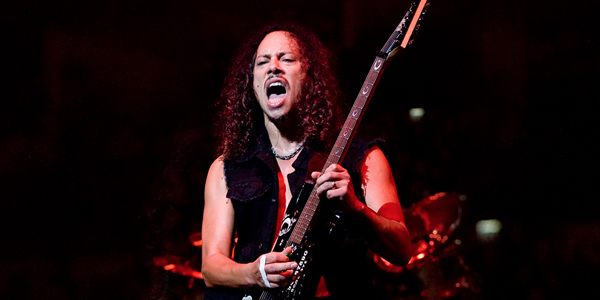
From the humbling beginnings the complete domination of the San Francisco Bay Area thrash scene to blowing up in ways nobody could have predicted and becoming a household name with a global fanbase of millions, Metallica have done it all. Sadly along the way they would lose one of their best friends and key songwriters in the messianic bassist Cliff Burton, however since those very furtive first days the other three members of the band - James Hetfield, Lars Ulrich and Kirk Hammett - have all stayed the course, embarking on this crazy genre-defining, risk-taking adventure together. Depending on your entry point over the years you may know them as one of The Big Four of thrash metal, 'those guys who wrote Enter Sandman', a group of Hawaiian shirt-wearing cigar-chompers who loved hard rock and blues, or just an ever-present behemoth of metal history. You'd be forgiven for thinking that due to his long-time tenure with the band, Kirk would have pigeonholed himself into a particular style of play over the years like other heavyweights in the genre like Slayer's Kerry King, and although he does have a bucketload of signature riffs and scales, it's only when you look over his entire body of work that a vast scope of influences and styles starts to emerge.
10. That Was Just Your Life
https://www.youtube.com/watch?v=9l19OATYF-c Following one of the most divisive albums in all of metal with St. Anger, it was over to 2008's Death Magnetic to 'prove' somewhat that the band could deliver a solid outing on the level of either the blues-tinged 90's material, or the thrashier work they'd built their name on. So come Magnetic's launch, fans sat with baited breath as that first song trickled in... the symbolic heartbeat coming out of the darkness showing the band were still going, then a fantastically tight riff that screamed Hetfield within the first few seconds. So far so very, very good. Then that buildup to the solo, everyone going hell for leather underneath as the vocals drop out and a few quick muted-string stabs set the stage for Hammett to come flying in - the resulting smattering of notes being exactly what every fan needed. For guitarists reading; try and forget how the piece itself is played and transport yourself back to that mindset before you studied such things - where you'd hear something and just be totally blown away. Metallica were back, and they weren't just hitting the the ground running, it was a Flash-like sprint right from the first song.
10. Enter Sandman
https://www.youtube.com/watch?v=CD-E-LDc384 The most potent - and off-putting to thousands - left-turn in the band's history is that severe swerve from ...And Justice For All's progressive thrash sound to that of the condensed five-minute hard rock songs that would come to make up The Black Album - and the band's mainstream image. Sandman may be their Sweet Child o' Mine in terms of it being 'that song' that's always on the radio, but forgoing modern-day pop-tripe, if a song can even get to the stature of being overplayed in the first place, chances are there's something worth listening to over and over again - especially when it comes to rock and metal. Hammett has mentioned that the solos on the Black Album pretty much "wrote themselves" due to the general vibe of what they were going for, along with the idea of taking the complex arrangements of their older work and shortening them, so it's no surprise that this solo is one of the quintessential rock opuses of our time. From the fiery intro that rockets out of the gate to the wah-pedalled double string-bends that would come to define Metallica's 90s work, Sandman has the perfect mixture of energetic playing and learned composition, shot from the fingers of a man who was at the top of his game.
9. Ride The Lightning
https://www.youtube.com/watch?v=YT516h7QwA4 Not too many outside of Metallica's fanbase know that Hammett was actually taught by Joe Satriani - a man who himself is easily one of the greatest guitarists in the world - and back when the band were writing their followup to the raucous Kill 'em All, Kirk would spend a lot of time with Satch, learning how to express his own style whilst also applying a huge number of complex arrangements and scales. You can feel it throughout all of Ride the Lightning, from the classically-tinged Fight Fire With Fire to the psychotically-fast intro to Trapped Under Ice that would connote older opening solo No Remorse, but it was with the title track that you could tell Hammett was constructing a future genre benchmark for all to see. Going outside standard conventions and taking the time to construct the solo from a number of different sections, it opens with a fantastically conceptual tapping section that mimics the narrative of the song i.e. the sound of someone being sent down for their crimes on an electric chair. As that buzz fades away there's some sliding octave chords that bed out the composition before the Hammett of old comes screaming in, leading to one of the most sonically awesome - and bedroom-imitated - sections in all of Metallica's discography; the final run of pull-offs that descend down the neck, with Lars thundering away on the drums underneath.
8. Wherever I May Roam
https://www.youtube.com/watch?v=cwPg8gJq_Kw Another cut from the band's masterwork Black Album, Roam was one of the first times - along with Nothing Else Matters - that Hetfield would tackle some more relatable subject matter than what had gone before. Although the song itself opens with a battering-ram assault of snare-smashes from Lars, its Kirk's innovate tapping section that really captivates when his defining part kicks in. If there's one thing The Ripper has always perfected across all the genres he's touched, it's dynamics. As we'll see more of in later entries, Hammett has always known how to blast through a spate of notes on the lower strings, only for something higher to launch in at just the right moment. Here it's a whole pedal's worth of wah-juice poured over some very tightly-picked notes as high bends elevate the entire composition immensely and the aforementioned tapping section keeps you right up there with it. Part of the fun when you get stuck into learning guitar is start dissecting how guys like Kirk made "those noises" you've previously listened to over and over. That moment you finally replicate something like this song's solo is a crowning achievement in itself, but to actually think it up and compose it from scratch in the first place? That's something truly unique.
7. Creeping Death
https://www.youtube.com/watch?v=UO_84C3fpuI A set-closer and one of the signature songs that defined Metallica over the years, Creeping Death is two parts ferocious riff and one part rollickingly-brilliant solo. As we noted with the Ride the Lightning solo Kirk loves to assemble his solos from an armoury of bulletproof licks, the combination of which always lends itself to greatness. Death's solo is meticulously crafted, but follows a couple of the same beats as that of Ride - those being a middle section where you're allowed to breath for a second, only for the final run of notes to be an exercise up and down the high E string. It even features the first on-record example of Kirk doing some sweep picking (a technique where you move between strings with your left hand as fast as you can strum with your right) as well as an element of pre-cognition near the end of the piece when a slower set of notes come in that these days are chanted along to by the millions worldwide. It's almost like he knew they were onto something special, even back then.
6. Master Of Puppets
https://www.youtube.com/watch?v=xnKhsTXoKCI Regularly voted the Greatest Metal Album of All Time, Metallica's magnum opus third album showcased the band at the apex of their thrash creativity, featuring not only some of Hetfield's most prolific lyrics, Lars' most furious skin-bashing and Hammett's tightest, occasionally experimental solos, but it was the last time Cliff Burton would join them - although his presence is felt throughout. Although instrumental Orion is a crowning achievement for metal composition, there are others that help show exactly why Metallica deserve their place at the top of the pile, with the title track being one of their most experimental both at the time and especially looking back. Which metal band these days would completely change their tempo to have a classical - almost operatic - section in the middle, only to then reintroduce the pace and keep going? It's these little touches that wouldn't have happened without Cliff, but they also make the song what it is, allowing for Kirk to capitalise on Hetfield's vocal yell of "Fix me!" as he starts by playing a repeated pattern that just by itself separates the men from the boys. From then on out it's total insanity on the neck, as a natural harmonic is pulled and strained to the point of sounding like it's trying to break free, only for Kirk to reign it it and bust out a really cool pattern that ascends up the neck. It's one of the fastest-sounding solos he's ever put together, and still wows crowds whenever he pulls it off.
5. Dyers Eve
https://www.youtube.com/watch?v=v6kb5fvv6_A Many metal fans like to debate the age-old Kirk Hammett vs. Dave Mustaine argument - being that the latter used to be in Metallica before the launch of their first album and then went on to form Megadeth - and although there's no doubt Mustaine can definitely play faster and has a more thrash-focused approach to his writing, the Dyers Eve solo is the one ace-in-the-hole that Hammett-defenders can throw up as one of his most accomplished works it's very hard to get right. Right from the off it's more deployment of the wah pedal, which to many lesser guitarists can just be an excuse to cover up some sloppy playing, here it adds a whole new sense of speed to the amount of notes being played, with each section building on the last to the point of just surrendering to how impossibly fast this part of the song is. The mid-solo break that explores the rest of the neck is only a slight reprieve from the otherwise high-pitched madness that makes up the other two slices of this perfect thrash-sandwich, as when everything kicks back in and Hammett dives into another crazy-fast tapping section it marks one of the high points on the whole album.
4. Fade To Black
https://www.youtube.com/watch?v=WEQnzs8wl6E It seems kind of crazy now following such things as the much-maligned Lou Reed-collaboration Lulu and an album with a full symphony orchestra, but thousands cried foul at the very inclusion of this track on Ride the Lightning way back in 1984. "How dare Metallica put a ballad on an album?!" they screamed, having previously been schooled in the wall-to-wall barrage of ferocity that was Kill 'em All, as even though Fade is a disparate tale about someone losing the will to carry on and eventually committing suicide, it was still a ballad in the loosest sense of the word. You think Metallica have been put through the wringer these days? Even back just following their debut they couldn't catch a break from fans who only wanted songs heavy enough to make your ears bleed. As we've mentioned with Hammett's overall approach to this album and his learned way of composing a solo, Fade to Black's is a masterclass in slow release, gradually building upon what's gone before until eventually a repeating pattern that escalates up the neck has you completely captivated. The pace is absolutely spot on, with each note ringing out like the righteous genre-definer it was born to be, and these days when the band play live this section tends to be extended or features Hetfield roaring over the top - easily being one of the greatest metal tracks of all time.
3. Battery
https://www.youtube.com/watch?v=IZ7Aif5aXlQ As we described with Wherever I May Roam, that notion of putting together a collection of lower notes only for a higher one to come screaming in is one of the things that makes Kirk's solos so identifiable, and nowhere is it more straight-up enjoyably horn-hand-throwing than when used in Battery. The song itself is easily one of the band's fastest and most pugnacious, with a core riff that sits in the history books alongside Slayer's Reign In Blood as something that's just metal incarnate. It makes sense that when the guys were putting this track together the solo was going to have to keep up the pace - and it doesn't disappoint one bit. Usually heralded in by Hetfield asking the crowd "How it feels to be alive?" before then shouting "Show me!" it's the perfect primer for the opening barrage of notes this starts with before the wah pedal kicks in and Kirk - who recorded this full of youthful exuberance and a sense of metal flag-waving purpose - sears through a frightening number of frets, not just keeping up with the preceding pace but redefining it.
2. One
https://www.youtube.com/watch?v=WM8bTdBs-cw These days using a tapping technique can be a cheap and easy way to make something sound far faster than it actually is, dazzling those who aren't aware of what's being done to create the sounds, and folding the arms of those that do. For One though, Kirk's opening series of tapped notes would go down in the genre as how you use them for maximum effect, first because of the sheer speed of the song, but also because it was the first taste a mainstream audience got of the band. Inspired and based on the novel 'Johnny Got His Gun' by Dalton Trumbo, both song and novel tell the story of a soldier whose limbs, face and ears are blown off - leaving him trapped inside his own mind. It's a truly terrifying concept that fascinated a young James Hetfield, and so following a beautifully acoustic intro and verse, a brutally heavy chorus reminds us of the weight of the subject matter before the buildup to the solo takes the cake. Conceptually the instrumental break that gives way to the solo is meant to represent this persons' descent into madness, so it's fitting that the abundance of notes that pleasurably assaults the listener should represent it. That's not to mention following this there's everything from scorching high bends to runs down the neck, and a perfect segue back into the other half of that chugging break that finishes everything in style.
1. The Unforgiven
https://www.youtube.com/watch?v=Ckom3gf57Yw A potentially controversial choice for the top spot, but judging by everything that makes this one up and the fact it's one of Kirk's personal favourites we think it's much deserved. Born out of Kirk being routinely hammered by new producer Bob Rock who hounded him for "not doing his homework" i.e. studying and practicing for his recording sessions, one day he was berating him in the studio, accusing him of not being ready, only for Kirk to bust out the flawless take they used on the record. It's got the perfect mix of his older academic approach to melodic writing, some stadium-sized crowd-wowing bends, and a feel throughout that lets anybody take a listen and come away with a newfound appreciation for Hammett as a player. Being endlessly anthemic it's one of his most fun to replicate, just as much as you can tell whenever he breaks it out live that Hammett is always having a blast playing. With so many separate licks comprising a piece that ebbs and flows before ending on some stylish, bluesy bends, there's nothing quite so well put together from every angle as this. What are your favourite solos? What would you swap out or take out altogether from our choices? Let us know in the comments!