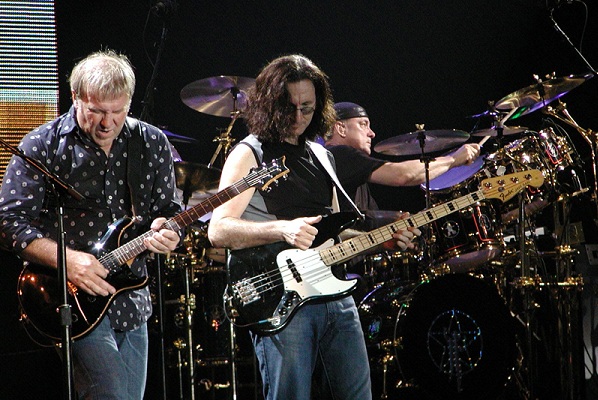
Theyre all over sixty years old, theyve had more consecutive gold or platinum albums than any band not named The Beatles or The Rolling Stones, and earlier this summer, they embarked on a sold-out tour to celebrate their fortieth anniversary making music together. Among active bands, only ZZ Top (the same three guys since 1969) have lasted longer than Rush in a single incarnation. The bands sustained success in the studio and on the stage is legendary. A great deal of that is owed to the unmatched musical prowess of drummer Neil Peart, guitarist Alex Lifeson, and singer/bassist/keyboardist Geddy Leethe Holy Triumvirate, as fans call them. But equally vital has been Rushs willingness to change their style over time, progressing through many different iterations of rock music and applying their own idiosyncratic sound to each. Over the course of Rushs twenty studio albums, some songs stand out as particularly important to the bands development. Join me on a chronological tour of the ten tracks that Ive noted as milestones in Rushs amazing career.
10. Working Man (Rush, 1974)
https://www.youtube.com/watch?v=iIGKlicb8n0 Before there was Neil Peart, there was John Rutsey. Rushs original drummer played with the band up through the release of their eponymous debut LP, which they put out on their own Moon Records label. In those days, Rush was heavily influenced by the bluesy hard-rock sounds of Cream and Led Zeppelin, with Lifeson doing his best Jimmy Page impressions on songs like Finding My Way and In the Mood and Lees wailing vocals smacking of a reedier, rawer Robert Plant. Lacking Pearts lyrical abilities and expansive array of toms and cymbals, Rush plays as a straightforward and rather unimportant rock album full of trivial love songs and tasty riffs. Its an important record in the Rush annals, though, because Working Man, the albums final track, got picked up and popularized by Cleveland DJ Donna Halper. The songs blue-collar lyrics found an audience in the Rust Belt city and Lifesons extended shredding heralded the coming of Rushs instrumental prowess. Working Man made Rush a modest commercial success, led to a label deal with Mercury Records, and is still a popular live selection by the band. John Rutsey never got to play Working Man in the United States, as he left the band before its first American tour due to complications from diabetes. Lee and Lifeson held auditions for his replacement and Peart got the job, forever altering Rushs fate.
9. 2112 (2112, 1976)
https://www.youtube.com/watch?v=AZm1_jtY1SQ Neil Pearts skill as a drummer was evident from the start and has defined Rushs sound ever since he arrived. But even more importantly, he took over from Lee as the bands primary lyricist and immediately began penning abstract, heady songs with strong fantasy and philosophy influences. 1974s Fly by Night offered a glimpse of this new style with songs like Anthem, By-Tor and the Snow Dog, and Rivendell, and the album was favorably reviewed. The bands follow-up effort Caress of Steel, though, veered off in such a sonically and lyrically incoherent direction that it nearly spelled the end of Rushs career. Bearing primary responsibility for Caress failure were its two fatally flawed epics, the 13-minute The Necromancer and the 19-minute, absurdly titled The Fountain of Lamneth. Rather than take Mercury Records direction and write more radio-friendly, Bad Company-esque songs, though, Rush doubled down and responded with 2112, arguably their most classic record. The centerpiece is the side-spanning title track, an Ayn Rand-inspired saga that tells the story of an anonymous man in a dystopian future who rediscovers the guitar. Lee, Lifeson, and Peart tie the songs seven parts together tightly and beautifully, filling it with rollicking drum fills, muscular guitar work, and Lees alternately plaintive and shrieking vocals (depending on whether hes playing the protagonist or the evil priests). Despite its prog trappings, 2112s punk-like message of individuality in the face of overwhelming pressure to conform to societal standards resonated with millions of listeners, serving as a vital breakthrough in the young bands career.
8. Cygnus X-1 (A Farewell To Kings/Hemispheres, 1977-78)
https://www.youtube.com/watch?v=wlNrQGmj6oQ After 2112s success, Rush could pretty much tell the label to trust their creative direction, and they moved into a period of intense progressive rock. Bands like Yes and Genesis became their primary influence, Pearts drum set grew to include chimes and bells, and Lee incorporated more and more synths into the music. The band recorded its next two albums, A Farewell to Kings and Hemispheres, in England, filling them with fantastical, self-indulgent songs. Also, they enjoyed performing in kimonos. The Cygnus X-1 duology, with its first part on Kings and its second on Hemispheres, is the epitome of Rushs lyrical and musical excess during this period. Book One: The Voyage tells the story of a space traveler who flies into a black hole and although it runs replete with excellent grooves, elements like the robot-voiced prologue and Lees Wicked Witch-esque screeching make it hard to take seriously. Book Two: Hemispheres is, if possible, even more ridiculous; it describes how the space traveler lands in the middle of a battle between Apollo and Dionysus over the soul of mankind. To be fair, it flows seamlessly for eighteen minutes and showcases the bands progression as composers, and the moment when the traveler arrives to stop the battle rings out with Rushs most triumphant chords ever. But had the band kept this up, they would have spiraled downward into their own minds and out of the public eye forever.
7. The Spirit Of Radio (Permanent Waves, 1980)
https://www.youtube.com/watch?v=jQUDiCiNlqQ Fortunately for posterity, Rush themselves were exhausted after making Hemispheres and resolved to try their hand at crafting shorter, more radio-friendly songs. The band began implementing new wave and reggae influences and honed their sprawling soundscape into tighter, edgier tracks. Peart also moved away from fantasy-based lyrics and turned his mind toward more humanistic themes, producing miniature think-pieces for the bands 1980 album Permanent Waves. The Spirit of Radio, one of Rushs most enduring songs, leads off that album with an iconic noodling Lifeson riff before launching its lament over the state of the corporatized airwaves. This is Rush at its most refinedits almost a pop song, with the only semblance of prog being the oddly-timed bridge. The highlight is the Police-esque breakdown at the end that leads into Lees warning of the SALESMEN who pervade the music industry, followed by a torrid Lifeson solo. The Spirit of Radio was Rushs greatest success to date, it proved that they could write catchy non-epic music, and it set the table for their masterpiece the following year.
6. Tom Sawyer (Moving Pictures, 1981)
https://www.youtube.com/watch?v=auLBLk4ibAk That masterpiece was Moving Pictures, which further focused and perfected the multifaceted arena rock sound Rush had built on Permanent Waves. Lees synths gained a greater presence but still left room for Lifesons brilliant and emotive guitar work, and Peart tied each song together with dexterous cymbal hits and perfect control over his drums. Really, I could have picked any one of the tracks on side one of this albumTom Sawyer, the muscle car-turned-song Red Barchetta, the famously tricky instrumental YYZ, and the bands melancholy take on fame, Limelightas the definitive Rush song of this period. Theyre all timeless hits and together comprise one of the strongest album sides ever. But Tom Sawyer rose above its fellows with its signature opening growl, its powerful riff, its infectious keyboard lick, and its heart-stopping drum fills. The lyrical painting of Mark Twains literary hero as a modern day warrior renders the song as inspirational as it is technical. Theres no better showcase of Rushs ability to combine their unequaled instrumental prowess with their formidable and accessible songwriting skills, and as such Tom Sawyer is the song for which Rush will be remembered centuries from now.
5. Subdivisions (Signals, 1982)
https://www.youtube.com/watch?v=EYYdQB0mkEU Rather than sticking with the arena rock aesthetic that brought them fame, though, Rush took a leap of faith with the next years Signals and leapt headlong into the 80s synth craze. They faced heavy criticism from some corners of their fan base for moving Lifesons guitars into the background, and Lees near-total abandonment of his high wail lent the band a more mature sound to go with Pearts continued movement toward thoughtful, worldly-wise lyrics. In hindsight, the radical shift ensured that Rush would not become a musical relic; the bands continued relevance has relied upon their willingness and ability to grow and change with the times. And they were still making amazing songs. Subdivisions probably ranks in their all-time top five, driven by dark synthesizer chords and an aching keyboard melody over Pearts reliably tight drumming and Lifesons atmospheric guitar work. The songs message struck at the heart of the misfits who comprised much of the bands core audience, empathizing with their dreams and the limits placed upon those dreams by the dreariness of suburbia. Mind you, Rush was singing about this almost thirty years before Arcade Fire devoted an entire album to the topic.
4. The Big Money (Power Windows, 1985)
https://www.youtube.com/watch?v=WQgu0MpnKq8 Signals was just the tip of what would be Rushs full immersion in the sounds of the 1980sLifesons icy guitar leads and echoing chords, Pearts fascination with electric drums, and Lees continued heavy use of synthesizers. They also got into the hair aspects of the decade, with Lee sporting a particularly disgusting mullet and then what can only be described as a raccoon pelt. Fans of so-called classic Rush (1976-1981) look upon this period with disdain, since by the time of 1987s Hold Your Fire very little of Rushs hard rock roots or prog rock heyday was audible in their music. That said, the band continued to fill arenas and sell records, with Power Windows the most successful of their efforts in the so-called synthesizer era. The Big Money, the first track off Power Windows, is representative of the 1980s Rush sound: the intro features a bevy of electric toms, layered brash synth hits, and huge, whammy-barred chords from Lifeson. Lee hops in with a jaunty bass line and sings cynically about the power of wealth in the Reagan-Thatcher years, and Rush has a formula for a successful song that doesnt compromise the bands musical abilities, but rather uses them in a different way than theyd been used five years before.
3. Stick It Out (Counterparts, 1993)
https://www.youtube.com/watch?v=GgzNbPVb3zs By the end of the 1980s, Rush once again started feeling fatigued with their sound and, beginning with 1989s Presto, made an effort to return to the guitar-driven songs that drove their initial success. Both Presto and 1991's Roll the Bones featured a gleaming pop-rock aesthetic, the keyboards dialed back to a shimmer in the background while Lifeson resumed his place in the musical spotlight. Tracks like The Pass, Dreamline, and Bravado showcase this turn-of-the decade Rush, with one foot stepping forward into the harder-rocking future but the other foot still rooted in the softer pop sensibilities the band had developed in the 80s. It wasnt until 1993s Counterparts that Rush finally shifted full-on into the heavier sound theyd been pursuing, and they were able to do so partially because of grunges rise. This is the style that has dominated Rushs music ever since, and Stick It Out, Counterparts lead single, was the standard bearer. Aggressive riffs, thudding bass lines, and Pearts relentless pounding set the stage for Lees foreboding vocal work on Pearts foreboding lyrics. Rush is in badass mode on Stick It Out, and they dominated the Modern Rock charts like badasses when the song and its accompanying album dropped, once again proving that the band is totally independent from the passage of time.
2. One Little Victory (Vapor Trails, 2002)
https://www.youtube.com/watch?v=rMYDuPWHFAo After 1996s Test for Echo, which is just an inferior version of Counterparts, tragedy struck the band: Peart lost his daughter and his wife in the span of less than a year. By 1998, Rush was on seemingly permanent hiatus and Peart was traveling the world on a motorcycle, trying to cope with the grief and find purpose and self-concept anew. The fact that he returned to Lee and Lifeson wanting to make more music is a remarkable testament to his character; the fact that the music they made was actually good is a remarkable testament to Rushs instrumental mastery and utter refusal to die. One Little Victory is the first track off the bands comeback effort, 2002s Vapor Trails, and right off the bat were treated to a frenetic Neil Peart beat that shouts to the world, IM BACK! Lee and Lifeson are right there with him, pumping out the same testosterone-laced riffs that defined Rushs 90s sound but adding the sonic manifestation of gritty determination to carry on rocking. After all, the three members of Rush were nearly fifty years old in 2002; they had to prove to the world and to themselves that they werent done yet.
1. The Garden (Clockwork Angels, 2012)
https://www.youtube.com/watch?v=1wztuqskio8 Sure enough, that determination has carried Rush through the past decade and a half, and theyve been rewarded for it with a recent wave of critical reappraisal and widespread popular acclaim to a level theyd never before achieved. A feature in the 2009 blockbuster I Love You, Man definitely helped, but its more so that the broader music community slowly began to regard Rushs longevity and continued technical expertise with long-overdue awe and respect. The worlds most successful cult band had, at long last, turned cool, and in 2013 they got the official Rock and Roll Hall of Fame stamp of approval. And theyre still plugging along. 2012s Clockwork Angels, Rushs first concept work since 2112, met nearly universal praise. Its final track, The Garden, serves as a statement of Pearts personal philosophy: The measure of a life is a measure of love and respect/The way you live, the gifts that you give/In the fullness of time, its the only return that you expect. Backed by a beautiful string ensemble, Lees voice quavers with age and wisdom but accordingly gains a sublime quality. Lifeson breaks out a stunning solo, and Peart as usual holds down an impeccable rhythm. After forty years together, the trios chemistry comes as automatically as breathing. Its absolutely astounding that Rush was able to fill arenas on its Clockwork Angels tour and play so much amazing new material in an age where virtually all of their 70s and 80s brethren have been reduced to legacy acts. Its even more astounding that on this summers R40 tour, the band was able to break out songs they hadnt played since their kimono days. Regardless of your opinion of their music, its undeniable that the bands versatility and excellence across five decades and countless musical styles has earned them a place in rocks most honored pantheon.