10 Places Most Likely To Harbour Alien Life
8. Enceladus
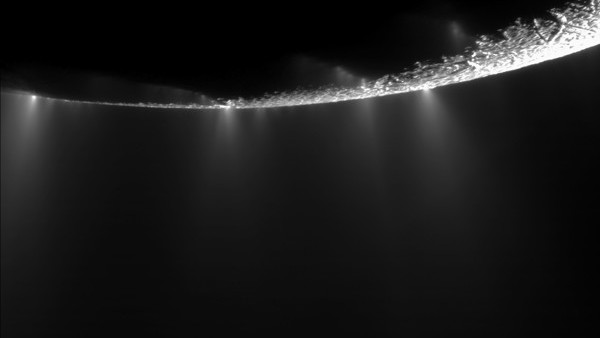
Enceladus is a tiny moon orbiting Saturn, barely the width of Arizona, but it has gotten astrobiologists all of a flutter recently due to one crucial element: Water.
Huge plumes of water vapour erupt from the moon's surface, misting out into space before falling back to the surface and beginning the cycle again. One of the great things about these plumes is that we don't have to land on Enceladus' surface to get a good idea of the kinds of materials that are present there. When the Cassini space probe flew through one of these plumes, it was able to detect the presence of organic molecules such as nitrogen, carbon and oxygen - all of which are required for life.
The speed at which these plumes are shot out of the moon's surface suggests that they originate from an underground ocean or reservoir, and the pressure required to fire out a plume of water at over 650 mph suggests some kind of geological activity that is responsible for melting water ice and firing it into space.
The presence of water in liquid and vapour form implies the existence of a water cycle, like the one here on Earth, that could easily circulate organic molecules and increasing the likelihood that, over time, they would form the building blocks of microbial life.