12 Strangest Things Spotted On Mars

Home to gorillas, monster crabs and a 15 metre phallus, Mars isn't the barren wasteland you once thought.

In November 2015, there was something of a media flurry over the above photo, which appears to depict an enormous mouse crossing the Martian horizon. The photo was snapped by NASA's Curiosity rover who has been pootling around the Red Planet taking pictures and playing in the dirt all on its own for four years now. However, this is far from the strangest photo that has been taken on the surface of our rocky next-door neighbour. It's all thanks to a phenomenon called pareidolia, which is when our brains spot familiar shapes in objects like clouds, shadows and indeed Martian rocks. It€™s unlikely that there€™s a monster Martian mouse wandering around up there but if there is, it might not be alone. In this article you€™ll see some of the weirdest photos that have been taken by NASA€™s rovers and satellites, which seem to depict a whole host of unlikely Martian inhabitants and artefacts. We might be only a few decades away from being able to send a manned mission to the Red Planet but it might be time to reconsider our plans. If these pictures are to be believed, it looks like there might already be no room at the inn.

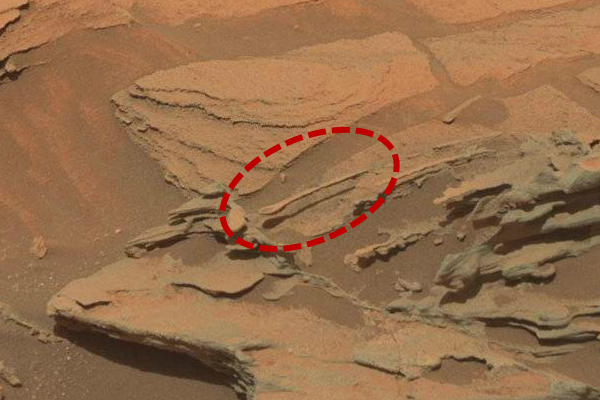
12. The Floating Spoon

If Martians use cooking utensils, one would assume that they're all high-tech, sci-fi ones. Forks that shoot lightning, knives that deflect blaster bolts, that kind of thing. It seemed like this might actually be the case in September 2015 when Curiosity spotted a spoon hovering just above the ground on a Martian hillside. There is of course a natural explanation for this bizarre image. The weaker gravity on Mars allows for rock formations that one would never expect to see on Earth. Under the right weathering conditions, a long spindly arm of rock like this could start to form on our own planet but it would likely snap under its own weight before reaching these proportions. So despite looking completely infeasible, everything going on in this photo is totally above board, according to expert geologists. Just your everyday rocky spoon jutting out from a cliff face.

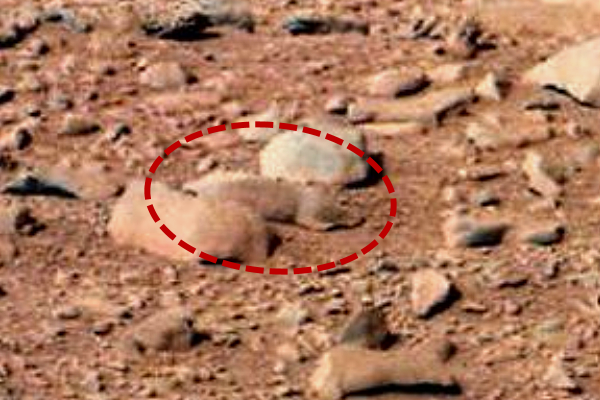
11. Gopher

And the award for cutest boulder in the universe goes to... This is an amazing case of pareidolia, transforming what is just another lump of rock into a sleepy rodent. There's a distinct eye, snout, front limb and maybe even an ear and stubby little tail. Of course, a few UFO fanatics attribute images like this to evidence of life on Mars. Some of them claim that this is in fact a squirrel, with the rock just in front being a big bushy tail that's been curled up on the floor. But, regardless of exactly which species of rodent it most resembles, let's all hope that this cute little guy really is a rock; a real life mammal would probably not fare well in an atmosphere that's 95% carbon dioxide. That's a heartbreaking image I'd rather not have.

10. Martian Woman

From the cute to the creepy, this photo is enough to send chills down your spine. Ufologists absolutely lost their minds when the Spirit rover sent us this spooky photo from Mars' Gusev crater. It appears to depict a humanoid figure (considered to be female by some alien enthusiasts) wandering down a hillside with one arm outstretched. Comparisons have been made with the gait of the alleged bigfoot captured on tape by Roger Patterson in 1967, although considering that there's very little evidence for the existence of an apeman in America's Pacific Northwest, the notion of one living 140 million miles away on Mars is surely ludicrous. As it turns out, this photo is indeed unlikely to be an actual Martian out for a morning stroll because NASA claim that the figure is only a few inches tall. So, unless the fabled "little green men" of Mars are even littler than we first thought, this is probably just another strange rock.

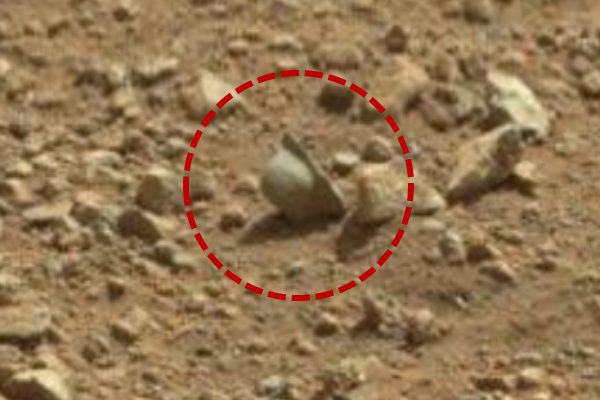
9. World War 1 Helmet

For argument's sake, let's pretend that there really are groups of extraterrestrials running around up there. It begs all kinds of questions. What do they look like? What do they eat? Do they wear hats? Fortunately, the latter was answered in April 2013 when Curiosity beamed back this photo that clearly depicts a World War 1 helmet (definitely not just another rock) abandoned in the dust. It seems that Martians like nothing more than re-enacting historical battles that took place amongst members of an intelligent, destructive species that lives on a whole different planet. To be fair, Mars is mostly just rocks and sand, so there's not a great deal else to do. Good luck to them.

8. Rock Face

Most of the strange rocks in this article are ridiculously difficult to spot amongst the rubble that's strewn across every surface of the planet but there are a select few that stick out like a sore thumb. This amazingly face-like boulder, for example, was spotted by another Mars rover called Opportunity in 2010 and it sure is convincing. The large features and full beard have lead some people to describe this object as a carving of an ancient god or Mesopotamian figurine. This, of course, is not the first face on Mars that's circulated the media. It seems like they're ten to a penny. Why is that? Time for some science. When it comes to pareidolia, one thing we're particularly brilliant at spotting is things that resemble faces. "The Man in the Moon" and the 1998 "Face on Mars" are excellent examples. This is all thanks to a special area of the brain called the fusiform gyrus, whose sole job is to spot faces and work out whether they're new or familiar. Interestingly, for people with particular jobs or interests, the fusiform face area seems to be able to adapt to identifying other stimuli, given a certain level of expertise. For example, when a pro chess player analyses the placement of pieces on a board, there is notable activation in the fusiform gyrus. There is also some evidence to suggest that farmers use the fusiform area to identify their cattle. So, depending on who you are and how you spend your time, you could find yourself picking out all sorts of shapes from a rocky Martian landscape. Bearded faces are just the beginning.

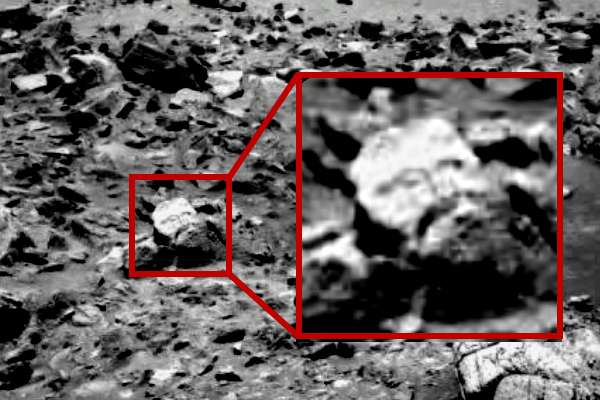
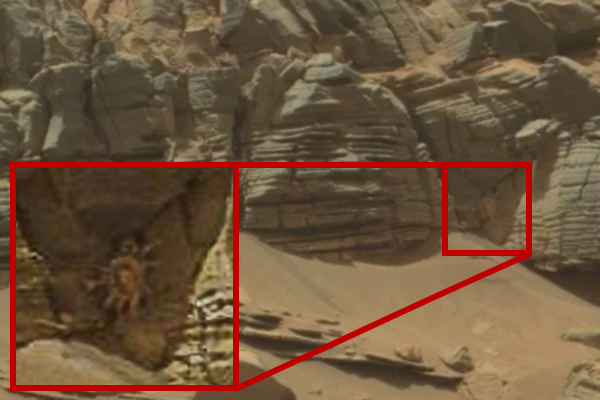
7. Monster Crab

At first glance, this picture is absolutely horrifying. In this enhanced photo, there definitely appears to be some sort of creepy crawly lurking in that crevice. The weird spindly limbs and brighter hue suggest that this might genuinely not be some old rock like the others we have looked at so far. However, there is a reasonable explanation for what we're seeing here. The issue with some of these strange Martian artefacts is that they appear way off in the distance of their respective photos and so keen eyed ufologists do the classic CSI "zoom and enhance" to make things a little clearer. The problem is that if you pump up the contrast on almost any photo, you're going to end up with some pretty strange looking features if you're not careful. Edges become very well defined but so do areas that were never edges in the first place. In this instance, the blurry smudge of the original photo is ironically a much better depiction of that cliff face. Bizarrely, you can actually make things even more confusing with a bit of well-meant photo enhancement.

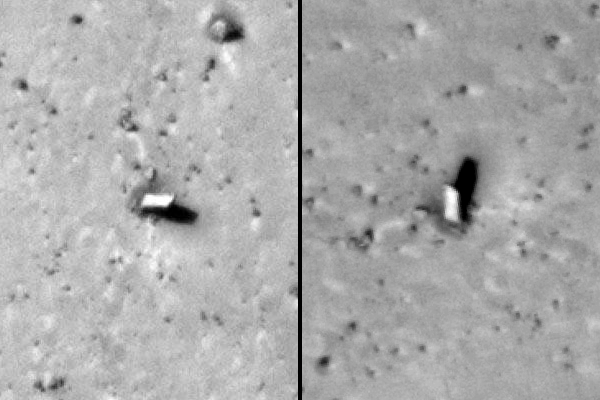
6. Monolith

This unusual object was snapped by the Mars Reconnaissance Orbiter in July 2008. Shown here from two angles, it appears to be a tall, thin structure jutting out of the ground in an otherwise empty part of the Martian surface. The fact that it stands so straight and thin in the middle of nowhere gives it a rather artificial appearance. In fact, it's not unlike the black monolith that appears in Kubrik's 2001: A Space Odyssey. Evidence of a lost civilisation perhaps? NASA, of course, state that this is not some kind of obelisk built by the Martians but a natural phenomenon. They theorise that the object fell from a nearby cliff and became embedded in the ground on impact. There are in fact a few of these monoliths dotted around the solar system, which may be evidence for the fact that this is something that occurs naturally (unless there are intelligent aliens building these things all over the place). Buzz Aldrin, the second man to step off Armstrong's lunar lander, appeared on American cable network C-SPAN in 2009 and mentioned a similar natural object on Phobos, one of Mars' two moons. But I refute all suggestions that this wasn't put there by an extraterrestrial; I like to think it's a cenotaph that was erected in memory of the fallen soldier who once wore that World War 1 helmet. Lest we forget.

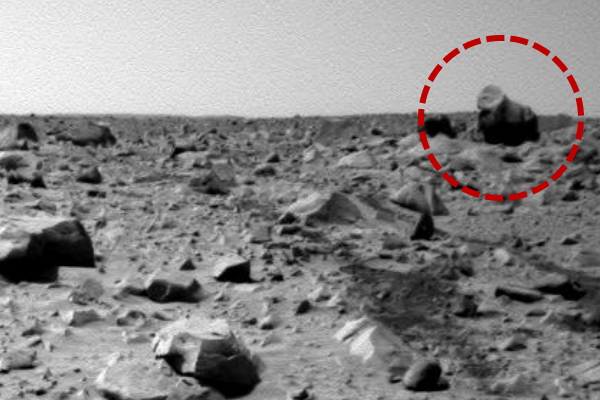
5. Gorilla

Move over, Earth. Mars is the new Planet of the Apes. Anyone who says this isn't one of the greatest lookalike rocks ever photographed is a barefaced liar. This thing looks so much a like a gorilla that it's easier to believe someone just photoshopped an actual great ape onto a Martian landscape and just started circulating the image round the web, claiming it was straight from NASA. However, this picture, which was taken by the Spirit rover in summer of 2003, has genuinely had nothing added to it at all. Interestingly, many of the photos produced by Mars rovers are taken using stereo cameras, meaning two slightly different images are captured by adjacent apertures. The images can then be combined in a way that mimics human binocular vision to build a 3D model of what we're seeing. It is this technique and the discovery of additional photos taken from another angle that allow us to conclude that there are no Martian gorillas out there; just strange rocks. That doesn't sway some ufologists however. But thinking about it logically, what would be the odds that a real life Martian creature had happened to evolve to look exactly like something from our own planet? Clearly the UFO hunters are doing it all wrong; that rock in the foreground is probably more likely to be intelligent life.

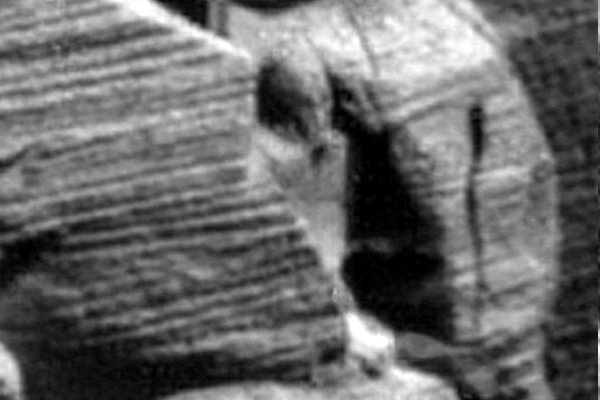
4. Egyptian Statue

This thing looks pretty odd, sitting in the side of a 12 metre cliff with its apparent eyes, nose and chin. It was photographed on 7th May 2007 by the Opportunity rover and has been reposted on the blogs and news sites numerous times since then. The fact that it somewhat resembles an Ancient Egyptian carving or sarcophagus sits really well with certain ufologists who believe there are proven links between alien activity and the ancient world. There are wild claims that UFOs and their ET inhabitants helped humanity construct the pyramids of Giza. Alleged support for this comes in the form of a few hieroglyphics that appear to depict alien spacecraft. However, that's all conjecture of course. There is absolutely no evidence to suggest that Mars has any links with Egyptian pyramids whatsoever...

3. Pyramid

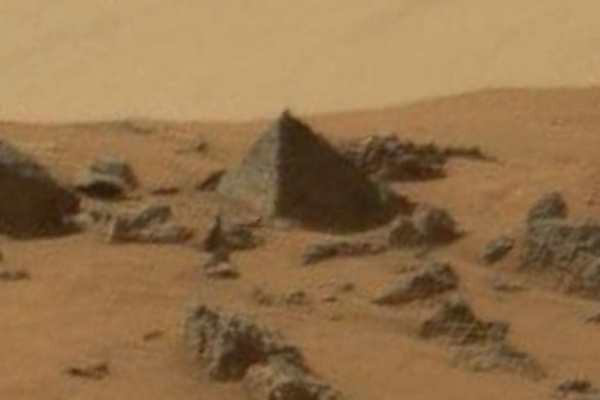
Scratch that. This is a pyramid photographed on Mars by the Curiosity rover, coincidentally 8 years to the day after Opportunity spotted the Egyptian sarcophagus elsewhere on the planet. It certainly appears to be the same shape as something from Giza, if a little blurry, but sceptics had other ideas when ufologists started getting excited about the possibility of Martian buildings. For starters, the object in the image is only a few inches tall. If that's the only experience the Martians have in pyramid building, they certainly managed to up their game when they visited Earth and helped us build one that clocks in at 450 feet. Of course, size isn't everything and there's no reason to discount something as being extraterrestrial simply because it doesn't tower over its surroundings. However, the nail in the coffin is that a wider shot of this landscape reveals an area absolutely littered with rubble and scree. The pyramid becomes a needle in a haystack of very similar boulders with sharp edges, pointy corners and flat faces. It becomes immediately apparent that the pyramid is just one of hundreds or thousands of similar rocks in the area but just happened to have a little more symmetry than its neighbours. Sadly, that's not quite evidence of an intelligent builder.

2. Reptile

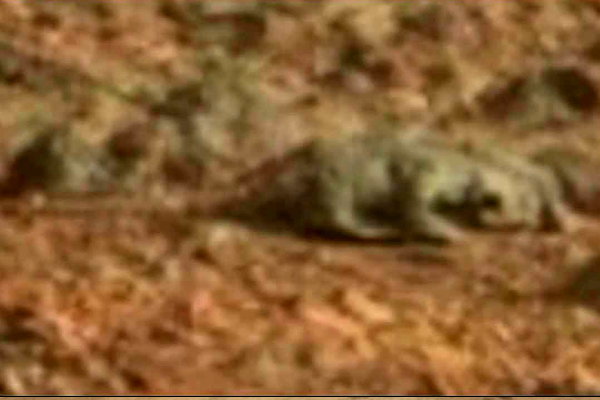
This is more like it; surely it's much more believable that Mars would be home to creatures like this, which don't quite match up with anything from Earth. If there were multicellular lifeforms scuttling around up there, they would surely look something like this rather than a silverback gorilla. This image is another that looks like it could be the work of photoshop but aside from a bit of reasonable enhancement, this is exactly what was captured by Curiosity in a 2012 photo. The creature seems to have two limbs on its right side, a long tail, a closed eye and some form of strange trunk, beak or hooked snout. Whether it's dead or sleeping is anyone's guess (the correct answer is neither because it's a rock). When NASA were made aware of this alleged Martian critter, they made a point of announcing their lack of intention to turn the rover around and investigate. To be fair, it would apparently have cost them millions of dollars so, you know, it's an acceptable response.

1. Juvenile Phallic Graffiti

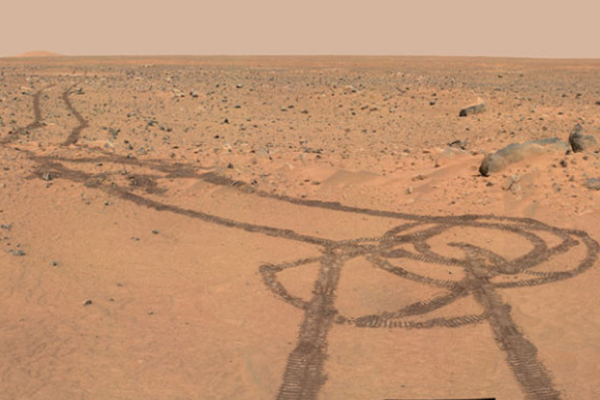
What is there to say here? Whether or not this was intentional, it's hard to know whether to applaud or berate the NASA scientist who managed to draw what is quite clearly a 15 metre (50 foot) penis in the tracks of Curiosity. What we're dealing with here is a planet in our solar system that has never had a single human being set foot on it and yet we've still managed to draw a massive dick in the sand, as though a 14-year-old schoolboy won a competition to pilot the rover for fifteen minutes. Curiosity has made some fantastic discoveries in its time but this photo alone will be quite the legacy to look back on. Let's just hope and pray that a Martian doesn't stumble across it. That would be a very interesting kind of first contact. Want to write for WhatCulture Science? Click here to find out how you could get paid to write about what you love.Does science make you feel things? Like us on Facebook or follow us on Twitter for more brain tingles.

 
First Posted On: 
Contributor

Peter Austin initially joined WhatCulture as an occasional contributor to our Film, Gaming and Science sections, but made the mistake of telling us that he'd been making videos in his bedroom for over a decade. Since then he's been a vital member of our YouTube team and routinely sets the standard for smart-casual wear in the office.