7 Things We've Learnt About Pluto Since New Horizons

Remember the Pluto flyby? That was just the beginning.

Remember back in 2015 when everybody suddenly went a bit bonkers for Pluto? Well, that was only the beginning of the story and, although the hype has somewhat settled down, the New Horizons probe continues to beam the latest news from deep space back to those boffins at NASA. As the rest of the world fell in love with the shining heart of Pluto, and shared pictures of the distant dwarf planet on social media, scientists were impatiently waiting for the detailed reams of data that would pour back to Earth over the coming months, just waiting to be interpreted. From this, we've managed to piece together an incredibly detailed picture of an object that is over 4.6 billion miles away, and it has become apparent that Pluto is much more surprising and complex than anybody had previously thought.

7. Pluto€™s Mysterious Floating Hills

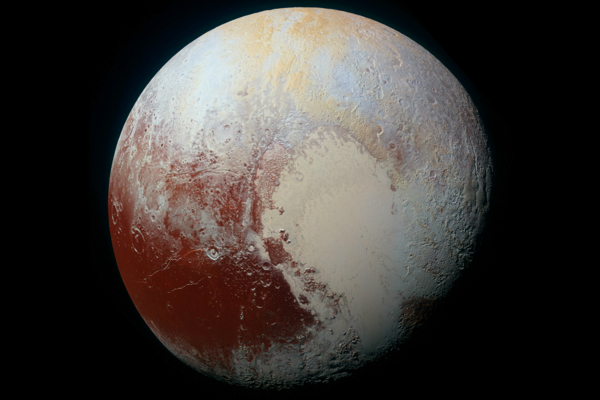
It turns out that Pluto's famous heart is one of the most interesting things about it. Informally named Sputnik Planum, the area is essentially an enormous icy plane around 1,000 miles across and is surrounded by a dramatic border of mountains. The ice, however, is not as we know it here on Earth. Due to Pluto's frankly chilly surface temperatures (somewhere in the region of -230°C), many of the elements that exist on Earth as a liquid or even a gas, are frozen into solids of different densities. On these great planes, mountains of water ice "float" on a sea of frozen nitrogen. Because water ice is less dense than nitrogen ice, scientists think that these enormous icebergs cruise around the heart after breaking away from the highlands around the edge. This means that Pluto's heart is not a static frozen wasteland but a constantly shifting and changing frozen wasteland, with the ice flowing around in a similar fashion to glaciers here on Earth. To get a really good look, check out this super high-resolution image of the ice planes of Pluto.

6. Charon Has Been Surprising

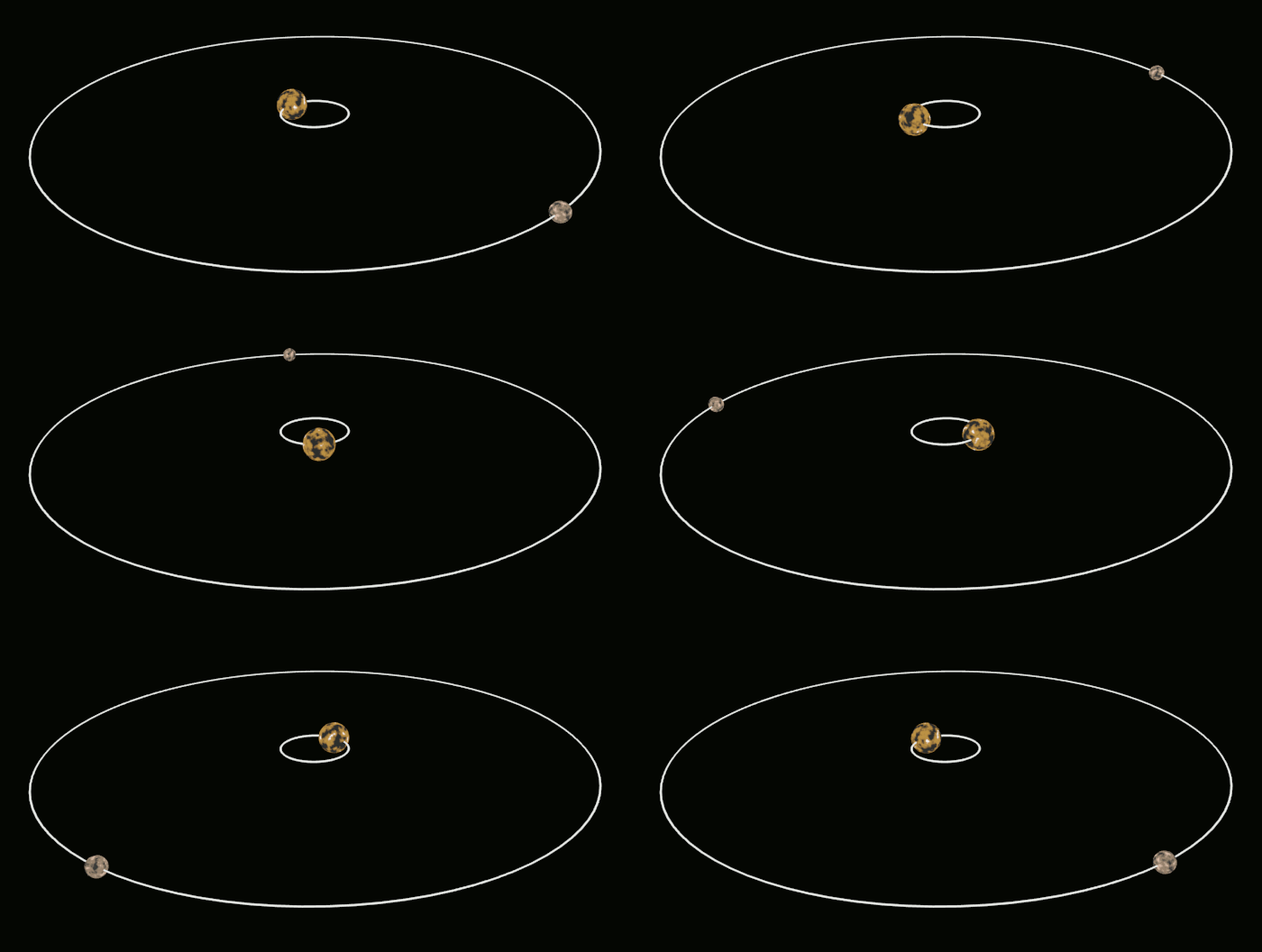
Pluto's largest moon, Charon, has proved to be just as interesting as its host. There is actually debate as to whether Charon is a moon at all, or whether it is another dwarf planet, locked in a binary orbit with Pluto. The moon doesn't strictly orbit Pluto as the barycentre (the centre of orbit) lies beyond the dwarf planet's surface - the two bodies actually orbit a common point, as can be seen in this animation. Charon's surface is slashed across by an enormous canyon that encircles the entire planet, making it four times bigger than the Grand Canyon in the United States. The large dark area at the northern polar region has been informally named "Mordor" by those jokers at NASA. To be fair, it is pretty difficult to walk into. One of the most puzzling features of the moon's surface is the "mountain in a moat". This large mountain surrounded by a circular ditch looks simple enough, but the scientists have literally no idea what it is or what could have caused it. Charon, with its canyons, impossible mountains and signs of geological activity, has turned out to be an unexpected highlight of the flyby. New Horizons team member, Bonnie Buratti has said €œTo tell you the truth, Charon looks more like I would have expected Pluto to look.€ Take a virtual flyby of the supermoon in the video below. https://www.youtube.com/watch?v=lrMBzJcvtt0

5. Its Other Moons Are Just Plain Weird
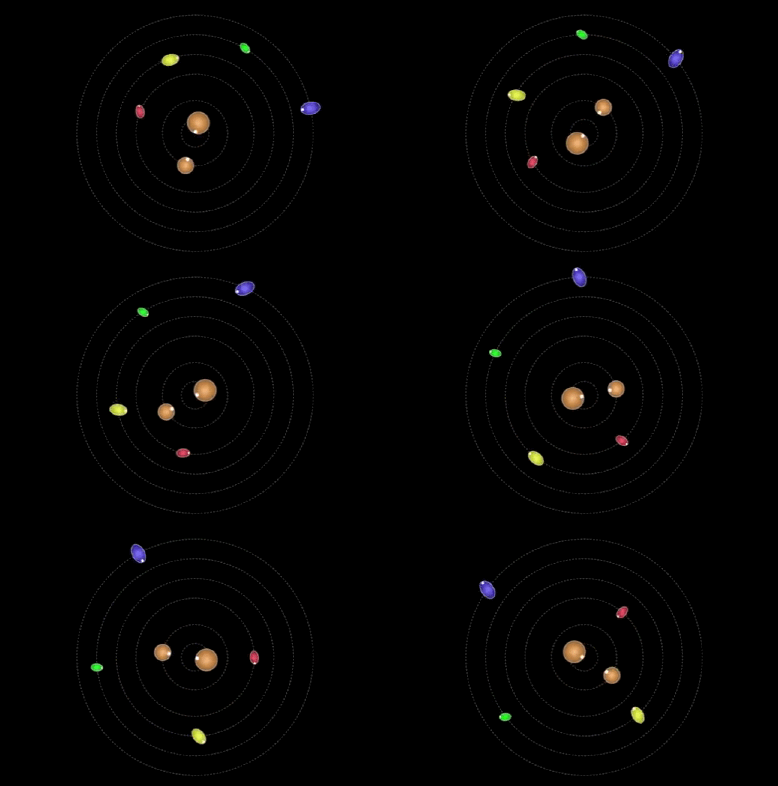
Aside from Charon, Pluto has four much smaller, much weirder moons: Styx, Nix, Kerberos and Hydra. These moons are a chaotic mess of shapes and sizes, spinning at all sorts of speeds and directions. Hydra, for example, spins 89 times for every orbit it makes around Pluto. These pill-shaped moons are odd, as it is more often the case that a planet's moons will have settled down into a synchronous orbit, with its orbit and spin taking the same length of time - this means that just one side will always face its host planet. Earth's moon is like this, which is why its surface always looks the same from our vantage point. Scientists reckon that it is the influence of the mighty Charon that is preventing Pluto's other moons from settling down. Its greater gravitational field exerts a strong torque on the other bodies and keeps them spinning like tops. It's also thought that their movements could be due to collisions with other smaller moons at some point in Pluto's history. It's likely that Pluto once had many more moons that kept crashing into one another. Indeed, scientists thought that we would discover lots of smaller moons left over from these collisions during the New Horizons flyby, but it turns out that the ones we discovered from Earth are all little Pluto has to offer.

4. It Has Blue Skies

When New Horizons looked back after passing by the little dwarf planet, we learnt something that made it seem just that little be closer to home: The sky is blue on Pluto. The blue sky here on Earth is caused by the nitrogen in the atmosphere scattering the blue part of the visible light spectrum. But, as we've just learnt, much of the nitrogen is on the surface of Pluto is solid, so why the blue skies? The haze that surrounds Pluto is made up of something called tholins. These form when the ultraviolet rays from the sun break down and ionize nitrogen and methane. These particles are actually red, giving Pluto its characteristic red hue, but they still scatter blue light in the same way. The way the sun breaks down methane molecules in the atmosphere at different altitudes creates those odd "layers" that are visible in the picture. Pluto's atmosphere extends way off into space, much much further than Earth's, and it even forms a tail behind it as it is blown by solar winds. Sadly, scientists reckon that, if a human were to stand on the surface, Pluto's skies would be mainly dark, but for a small blue circle around the sun.

3. It Has Frozen Volcanoes

New Horizons recently beamed back some detailed photos of something that seems to belong in the world of sci-fi: Cold volcanoes. These cryovolcanoes are the first of their kind to be discovered in the solar system. They work exactly like a volcano here on Earth, except that, instead of spewing out hot, molten lava, the cryovolcanoes erupt with a volatile slush of water ice, frozen nitrogen, ammonia and methane. These things are huge too, reaching over three miles high, 100 miles wide and with a depression in the middle spanning 35 miles. Although we didn't catch them erupting, it sounds like it would be pretty spectacular if it did. As the Earth's volcanoes are powered by the molten magma in its hot mantle, the presence of these ice volcanoes might indicate some kind of subterranean ocean of water or liquid nitrogen beneath the surface of Pluto.

2. It Has Loads Of Types Of Ice

Speaking of ice, Pluto certainly has a lot of it, but not as we Earthlings would know it. In the same way that Eskimos supposedly have lots of words for snow (they don't) and the British have lots of words for rain (they do), a local on Pluto might have hundreds of words for different types of ice. On Pluto, as we know, pretty much everything is solid. That is, in the same way that rock is solid on Earth. It is thought that Pluto is geologically active, but instead of molten rock created under intense pressure like on Earth, Pluto is a kind of "opposite land" where the tectonic plates cruise around on freezing cold flowing solids. There are also a vast array of types of ice, forming the vibrant hues of the surface. The heart shines out with its covering of snowy frozen carbon monoxide, contrasting with the rusty red of water ice, mixed up with those tholins that we mentioned earlier. The various ices might even sublimate in the atmosphere and fall as snow. On Pluto you might go ice climbing on nitrogen or have a snowball fight with methane. Makes our one type of snow look rather boring, doesn't it?

1. So What€™s Next?

Despite the fact that New Horizons' moment in the spotlight is months behind us now, the brave little probe is still chugging along in outer space. Pluto was the main focus of the mission, but since we've still got a probe out there and can still communicate with it, it would be a crying shame not to make the most of the opportunity to explore the deepest, darkest parts of the solar system. As the probe flies deeper into the Kuiper Belt, NASA will point its instruments at objects of interest. The one they've got their hearts set on at the moment is called 2014 MU 69 and the experts reckon that it has a lot to do with the formation of Pluto itself. New Horizons has enough battery power on board to last it for the next 20 years or so, so we'll have plenty of opportunity to explore the furthest reaches of the solar system. Who knows, by then we might even be taking our own first steps on alien worlds. Want to write for WhatCulture Science? Click here to find out how you could get paid to write about what you love.Hey, you. Yeah, you. You want some more science? Like us on Facebook or follow us on Twitter for your next fix.

In this post: 
Pluto
 
Posted On: 
Contributor
Contributor

Writer. Raconteur. Gardeners' World Enthusiast.