9 Jolly Nursery Rhymes With Deeply Disturbing Meanings
Just your friendly neighbourhood article, swinging by to ruin your childhood.
 The sweet melodic tones of the charming nursery rhymes you sung during your childhood as you skipped round the playground are probably still on the tip of your tongue. As you joyously laughed and played with your friends, chanting ring around the rosy or lady bird lady bird, nothing could ruin that beautiful image of your blissful youth. Nothing. Nothing... until you actually look into what these cute tales of insects and flowers actually mean; they say ignorance is bliss, and it truly is when it comes to the meaning behind the nursery rhyme. While some help children learn the art of counting, rhythm, or are just total nonsense (hickory dickory what?), we have managed to compile a list of nursery rhymes that are troubling from the first lyric, and will make you see lady birds and church bells in an entirely different light. Still reeling from finding out Santa isnt real and fairies dont live at the bottom of your garden? Well that is nothing compared to what you are about to find out about your favourite play time jingle; that they were all in fact tales of woe and despair. Oh, and death, a whole load of death.
9. Three Blind Mice
 YouTube
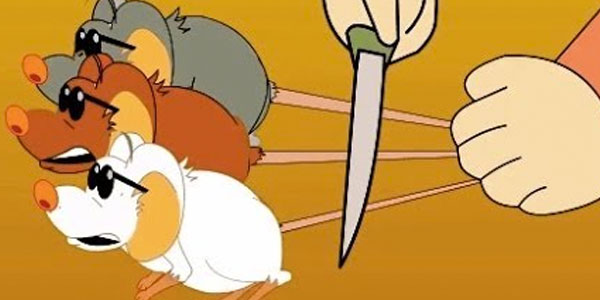
Three blind mice, Three blind mice, See how they run, See how they run! They all ran after, The farmer's wife, She cut off their tails, With a carving knife, Did you ever see, Such a sight in your life, As three blind mice?In this role play of despair the three blind mice are reference to the three nobleman who adhered to the protestant faith during the reign of Mary I, and were therefore convicted against plotting against the queen, who is represented by the farmers wife. To be fair she didnt actually have them dismembered and blinded like the rhyme suggests - they just burnt at the stake, so no biggy.
8. Here We Go Round The Mulberry Bush

Here we go 'round the mulberry bush, The mulberry bush, the mulberry bush. Here we go 'round the mulberry bush, So early in the morning.You thought this was just a catchy tune for children to skip around small shrubbery to? Nope. Local historian R.S Duncan suggests that the song originated from female prisoners at HMP Wakefield. A sprig was taken from Hatfield Hall in Stanley, Wakefield, which grew into a fully mature mulberry tree around which prisoners exercised in the moonlight.
7. Ring a Ring o' Roses
 Michael Wolgemut / Public Domain
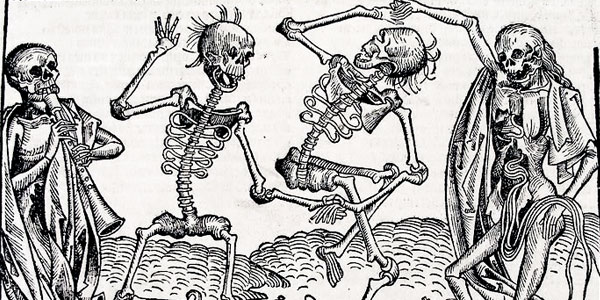
Ring-a-Ring o'Rosies, A Pocket full of Posies, "A-tishoo! A-tishoo!", We all fall Down!Commonly thought to be about circling a rose bush, its actually to about the bubonic plague. The symptoms of the plague were a rosy red rash in the shape of a ring on the skin, and another was sneezing. People filled pockets and pouches with sweet smelling herbs (posies) as they believed the disease was transmitted by bad smells. The plague was estimated to have killed 75-200 million people in the years 1346-53, but good to know such a merry jingle came from it. So, y'know... silver linings.
6. London Bridge Is Falling Down
 Wikipedia
London Bridge is falling down, Falling down, falling down. London Bridge is falling down, My fair lady.Not only the lengthiest of the nursery rhymes, but one with the most theories behind it. They range from the Vikings to Henry VIII, however one that really stood out was - and wait for it - the child sacrifices theory. Yup, if things arent getting twisted enough we are throwing the burying of, perhaps even alive, children in the foundations of the bridge into the mix. This idea was first advanced by Alice Bertha Gomme in The Traditional Games of England, Scotland and Ireland (1894-1898). Its based around the idea that the bridge would collapse unless the body of a human sacrifice was buried at its foundations (however, where Alice got that this had to be a child from remains unsure...). The line Set a man to watch all night, Watch all night, watch all night is reference to this human sacrifice, who can forever watch over the bridge. There is no archaeological evidence to support this theory however, so its either one of the greatest cover ups in history or Alice has some deep rooted childhood issues she needs to work through.
5. Oranges And Lemons

"Oranges and lemons" say the bells of St. Clement's, "You owe me five farthings" say the bells of St. Martin's, "When will you pay me?" say the bells of Old Bailey, "When I grow rich" say the bells of Shoreditch, "When will that be?" say the bells of Stepney, "I do not know" say the great bells of Bow, "Here comes a candle to light you to bed, Here comes a chopper to chop off your head, Chip chop chip chop - the last man's dead."As charming as this rhyme begins, the nasty turn at the end is more than just childs play. The great bells of bow were used to time the executions at Newgate prison, which for many years were carried out by means of beheading. The poor soul awaiting execution would be kept on death row, and was informed by the warder the night before execution, hence here comes a candle to light you to bed. Executions commenced when the bells all started chiming, which in this rhyme is represented by the chit chat these bells seem to be enjoying, and finished when the bells stopped.
4. Ladybird, Ladybird Fly Away Home
 YouTube
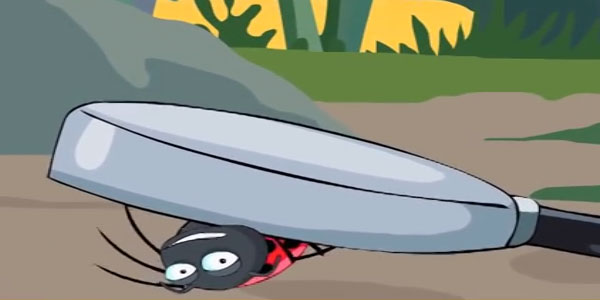
Ladybug ladybug fly away home, Your house in on fire and your children are gone, All except one and that's little Ann, For she crept under the frying pan.Even though this one is immediately a little darker than the rest, discussing little red bugs houses being set alight, the real meaning behind it is even worse. As you can probably guess from what is trending, someone meets a sticky end, or in this case is burnt. Ladybird is a derivative of the catholic term for our lady, and was believed to be used as a warning to Catholics who refused to attend protestant services as required by the act of uniformity (1559). The law disallowed priests to both say mass and attend it, therefore Mass was therefore held in secret in open fields. If caught, priests were subject to either being burnt at the stake or hung drawn and quartered.
3. See-Saw Margery Daw
 Wikipedia
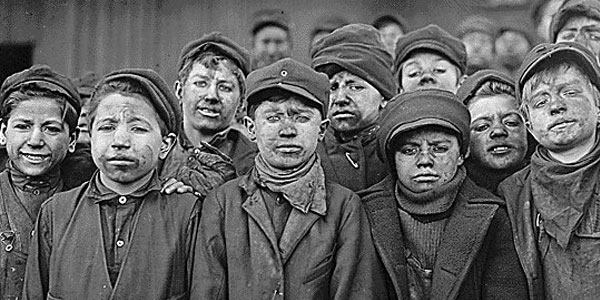
Seesaw Margery Daw, Johnny shall have a new master, He shall earn but a penny a day, Because he can't work any faster.See-Saw Margery Daw is originally believed to be about the use of child labour in the work houses during the Victorian period - children who had to live on minor work for pittance. As if the ethical work issues here arent enough, its thought that the rhyme relates to this matter as it was a taunt used by children against one another, implying that their families didnt earn enough money and were destined for the work house. Play nicely now, children.
2. Jack And Jill
Jack and Jill went up the hill to fetch a pail of water, Jack fell down and broke his crown, And Jill came tumbling after.So, onto adultery we go. The small English town of Kilmersdon claims that this is about a couple in 1697 who used to sneak up a hill for some hanky panky. Long story short; sordid affair, Jill gets pregnant, Jack dies from falling on a rock and subsequently caving his skull in (didnt break a literal crown he accessorised with) and Jill then dies from childbirth.
1. Mary, Mary Quite Contrary

Mary Mary quite contrary, How does your garden grow? With silver bells and cockle shells And pretty maids all in a row.And now for the most deceiving of the lot; Mary, Mary Quite Contrary, quite contrary indeed. With silver bells and cockle shells conjuring pretty images of delicately arranged gardens and good looking maids it is all a lie. Queen Mary I is again the menace of this nursery rhyme, with the silver bells, cockle shells, and maids are actually all just instruments of torture and death. Silver bells are thumbscrews; cockleshells were attached to the genitals and maids where a device used to behead people - actually called The Maiden. The garden is to give the allusion of graveyards, which were increasing in size with those who dared comply with the protestant faith. Well thats that, sorry everyone. Now that weve turned your childhood on its head were going to go break the news to some children that the Easter bunny got mowed down in a hit and run, just to stay in the spirit of things.