10 Things Arsenal Want You To Forget About Arsene Wenger
Arsene Wenger is the longest-serving manager in the Premier League and that doesn't happen without some headaches.
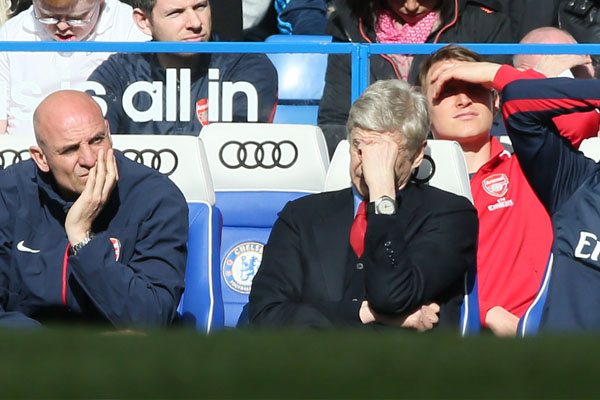 Alastair Grant/AP/Press Association ImagesArsene Wenger is the Premier Leagues longest-serving manager with 18 seasons under his belt at Arsenal, and while that near-two-decade tenure has brought success and silverware, it has also brought grief and despair. Wenger has won five FA Cups and three Premier League crowns during his time with the Gunners, was inducted into the English Football Hall of Fame in 2006 and has three times been named Premier League Manager of the Season. But hes also been called a specialist in failure by Chelsea manager Jose Mourinho, been involved in public spats with Sir Alex Ferguson, and once oversaw Arsenals heaviest-ever defeat since 1896. His transfer dealings have been called into question; hes seen star players leave for title rivals and has presided over a trophy drought that would put the Sahara desert to shame. No, things have not always gone swimmingly for the Frenchman and while there have been more than a few Champagne moments to celebrate, Wenger has suffered his fair-share of disappointments since 1996. When we look back on the veteran managers illustrious career years from now, we may well need to omit one or two unflattering statistics from the eulogies. With that in mind, here we take a look at 10 Things Arsenal Want You To Forget About Arsene Wenger.
10. Losing Star Players To Manchester City
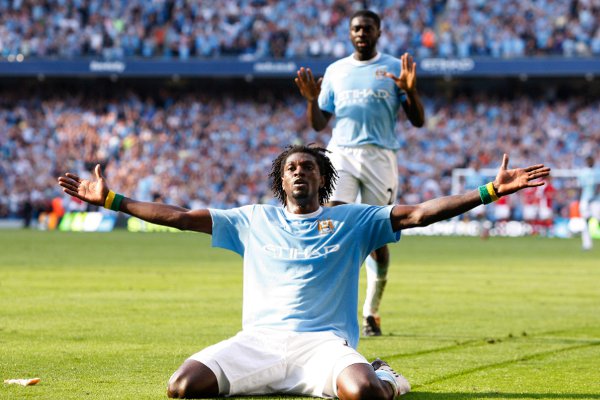 Jon Super/AP/Press Association ImagesOver the years, Arsenal have lost several star players to Manchester City under Arsene Wenger's watch. And while the likes of Paul Dickov, Niall Quinn and David Seaman left for the Sky Blues amicably and toward the end of their careers in the nineties and early noughties, some crucial players have been allowed to join the Citizens. Kolo Toure, for example, was a key member of the Gunners's 'Invincible' squad, and helped Arsenal reach the 2006 Champions League final, but left for City in 2011. As did Samir Nasri - one of Wenger's best midfielders at the time - while in the summer of 2008, Emmanuel Adebayor was allowed to move to Eastlands. He infamously came back to haunt Wenger with a controversial goal celebration (above). Because of these departures, Arsenal gained the unwanted reputation of being a 'selling club' with rivals fans mocking them for being City's 'feeder side'. In 2007, when Gabriel Heinze wanted to leave Manchester United for Liverpool, United outright refused to sell to their rivals. This is not a strength Arsene Wenger has had as Arsenal manager, and both he and Gunners fans have paid for it by watching on with anguish as some of the club's best players have moved on to their foes.
9. His Historic Lack Of Spending
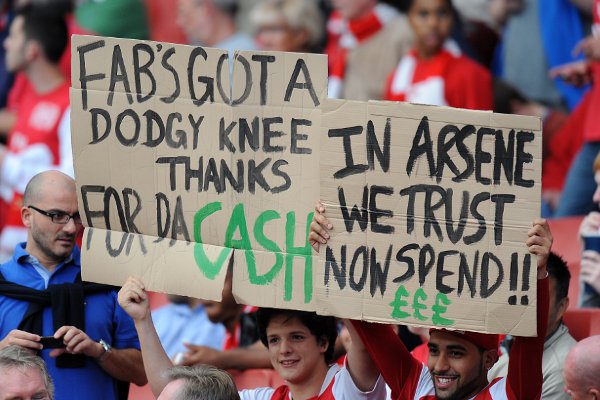 Tony Marshall/EMPICS SportArsenal may well be about to spend £35 million this week on Barcelona star Alexis Sanchez, and yes, £42.4 million was spent on Mesut Ozil last summer, but it's only recently that Arsene Wenger has started to spend the cash to bring big players to the club. The Frenchman has been notoriously frugal throughout his career as Arsenal manager, much to the frustration of fans. Wenger once drew the ire from his own fans when he claimed finishing second was good enough for the club, while rivals such as Chelsea and Manchester City were splashing the cash and improving their side. Such a comment would have been unheard of coming from Sir Alex Ferguson, and many started to question Wenger's ambition. For years the Gunners failed to sign world class players - the likes of Luis Suarez, Yohan Cabaye and Gonzalo Higuain were pursued but not captured, all because Wenger refused to dig deep enough into his pockets to cough up the change necessary to complete the deals. Fortunately for Arsenal and their fans, this is a mentality that appears to be on the way out at the Emirates as Wenger has finally started signing 'marquee players', but his frugal approach to previous transfer targets is definitely something the club would want you to forget about Arsene Wenger.
8. Pizzagate
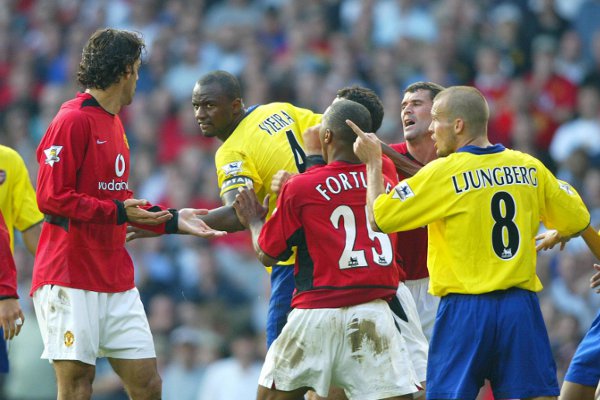 Martin Rickett/PA Archive/Press Association ImagesAnother sorry chapter in Arsenal's history came in 2004 following an incident that has since become known as 'The Battle of the Buffet', 'The Battle of Old Trafford' and, simply, 'Pizzagate'. Whatever you wish to call it, it was a disgraceful moment for the club, and for manager Arsene Wenger. Arsenal's 'Invincibles' had just been introduced to mortality with United putting to the sword the Gunners' 49-game undefeated streak with a 2-0 win at Old Trafford. The match was marred by bad officiating, diving claims and a furious bust-up during and after the game - both on and off the field. Hostilities started when Wayne Rooney went down under an innocuous Sol Campbell challenge to win his side a penalty, which Ruud van Nistelrooy converted in the 73rd minute. Rooney wrapped up victory in the 90th minute. At full-time, Campbell refused to shake Rooney's hand, and Wenger called Nistelrooy a cheat as he headed to the dressing room. A furious Sir Alex Ferguson then came out to confront the Frenchman, only to be pelted with pizza by Cesc Fabregas. Wenger was hauled before the FA over charges of improper conduct, as both he and the club's reputation was dragged through the muck.
7. Lack Of Authority Over David Dein Departure
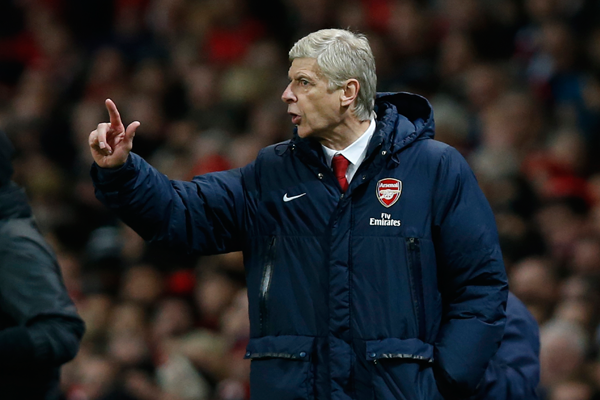 Sang Tan/AP/Press Association ImagesUpon his arrival at Arsenal in 1996, Arsene Wenger forged a close working relationship with vice-chairman David Dein. The two were a formidable partnership, and helped bring the likes of Sol Campbell and Marc Overmars to the club. In 2007, Dein was suddenly ousted from the Gunners after supporting the advances of American businessman Stan Kroenke while others opposed the move. It was perhaps no coincidence that a sudden cessation in transfer dealings occurred soon after Dein's departure, with Wenger failing to land his targets while at the same time being unable to keep hold of the players he did have. Wenger suddenly looked lost after Dein left, and should have taken a much firmer stance in ensuring he didn't leave. An 'either he stays or I go' approach might have sufficed, but instead the Frenchman either failed or refused to exercise any authority on the situation. Had Wenger done more to keep hold of Dein, the likes of Robin van Persie, Samir Nasri and co. might still be at the club today. Regrettably, it is poor decision making and indecision that will blight Wenger's copybook when we look back on his career years from now.
6. Ignoring British Players
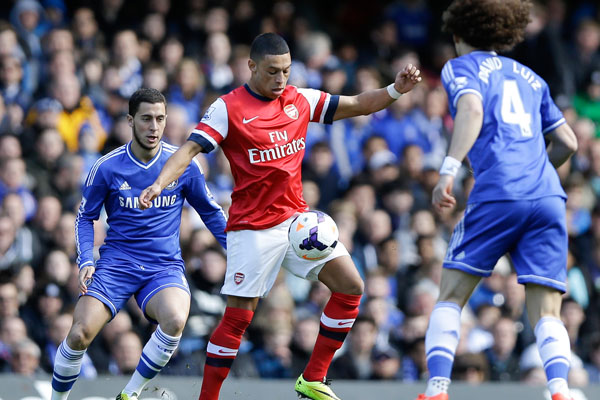 Kirsty Wigglesworth/AP/Press Association ImagesBack in 2006, Arsene Wenger received criticism for ignoring British players. In a Champions League game with Real Madrid that year, Wenger played a starting XI consisting entirely of foreigners, and it had quickly become apparent that in the 10 years he had been at the club at the time, he cared very little about player's nationalities. He even once said:
"I try to choose the best player and I think my pride in my career is not to have chosen someone because of his passport."However, Wenger's reliability on foreign players cost him. It seemed as though a lot of the stars he had imported from across Europe were more inclined to leave the club the second a better offer came in, with the likes of Emmanuel Adebayor, Samir Nasri and Gael Clichy having their heads turned by the money at Manchester City. It is only relatively recently that Wenger has started to invest his faith in British talent, with his squad today consisting of the likes of Alex Oxlade-Chamberlain (above), Theo Walcott, Jack Wilshere and Aaron Ramsey. These group of players who grew up either supporting Arsenal or watching them play are much more likely to stick around for longer, and Wenger's inability to realise this resulted in instability at the club between 2005-12.
5. The 8-2 Defeat To Manchester United
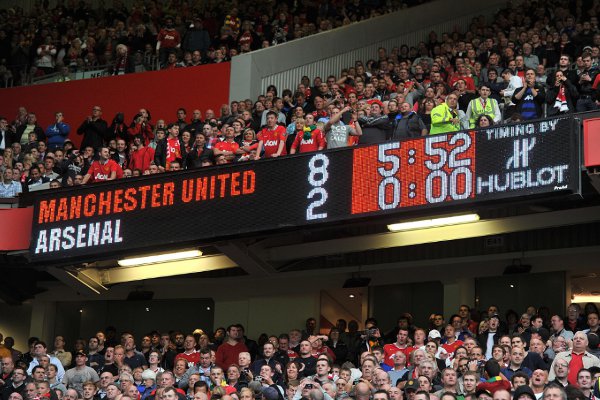 Martin Rickett/PA Archive/Press Association ImagesHas there been a more harrowing defeat in Arsenal's recent history? The above scoreboard will bring back many a bad memory for Arsenal fans, and is one they, and Arsene Wenger, are likely to have attempted to repress. It was August 2011 and Wenger had been forced into ending out a patched-up side against the Red Devils due to injury.Still, even that could not excuse the mauling that followed. Danny Welbeck, Ashley Young and Wayne Rooney had put United into a commanding 3-0 lead after just 40 minutes before Theo Walcott pulled one back to give the half-time score a slightly more respectable look. However, 20 minutes after the restart, Rooney struck again, Luis Nani added another, Ji Sung-Park made it a white-wash, Rooney completed his hat-trick for seven and Young made it eight. Even Robin van Persie's goal for the Gunners wasn't considered consolatory. It was Arsenal's worst defeat since 1896, and the lowest point of Arsene Wenger's career to date. The result brutally underlined the sheer gulf if class between the two sides at the time, and highlighted Arsenal's weaknesses for all to see. Wenger had failed to replace Cesc Fabregas and Samir Nasri prior to this thrashing, and had he not allowed his side to become so weak in the summer prior, this hiding may well have been avoided.
4. His Dubious Transfer Dealings
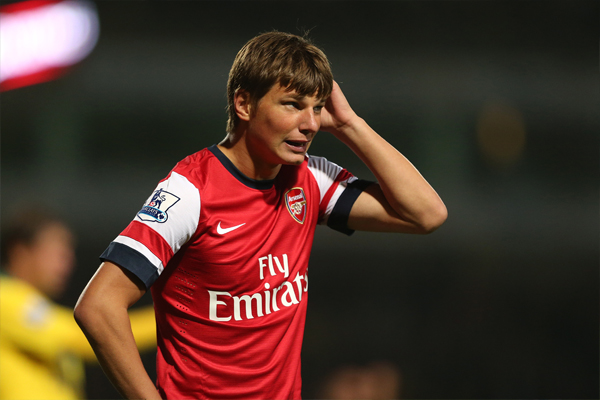 Stephen Pond/EMPICS SportLike so many Premier League managers, Arsene Wenger's career has been blighted by bizarre transfer dealings over the years. To be fair to Wenger, even the likes of Sir Alex Ferguson have been found guilty of getting it hideously wrong in the transfer market in the past, but some of the Frenchman's signings have been truly dire. Like Sebastien Squillaci. Pascal Cygan. Francis Jeffers. Park Chu-Young. The list is nearly endless. But perhaps his worst signing of the lot was Andrei Arshavin. Until the signing of Mesut Ozil last summer, Arshavin was the club's record transfer signing, but he completely failed to deliver on his potential, hitting a double-figure goal tally in the Premier League only once in his four seasons at the club. He was eventually loaned to Zenit and left on a free transfer last year, and it remains unclear what Wenger ever saw in him in the first place. So poor was Arshavin that when he arrived at the Emirates, he did so for an undisclosed fee. When it was reported that fee was £15 million, Arsenal refused to admit they paid that much for the Russian, and continue to do so.
3. Allowing Contracts To Run Down
 SCOTT HEPPELL/AP/Press Association ImagesOne of the biggest sources of frustration for fans when it comes to Arsene Wenger is the Frenchman's baffling acceptance of letting the contracts of star players run down into their final 12 months before opening talks of a renewal. The most notable example of this is Robin van Persie who, entering the final season of his deal at the Emirates, held the club to ransom in 2012 when he announced he would not be staying at the Gunners. Knowing that they could lose him for nothing in 2013, Wenger was begrudgingly forced to sell the Dutchman to Manchester United two years ago. There have been other examples. Unforgivably, Samir Nasri did the exact same thing to Arsenal just one year prior to RVP's situation, and engineered a move to Man City with just one year left on his deal too. Wenger's inability to learn from that mistake probably cost him van Persie, and he might even have been able to get a bigger fee for the strikers' sale had he still had a few years left to go on his deal. Wenger's career at Arsenal has been littered with controversial player exits. Edu, Mathieu Flamini and Robet Pires all left the club for free following disputes. These are facts that will probably be omitted from the eulogies when Wenger retires from football management in the future.
2. The Birmingham Catastrophe
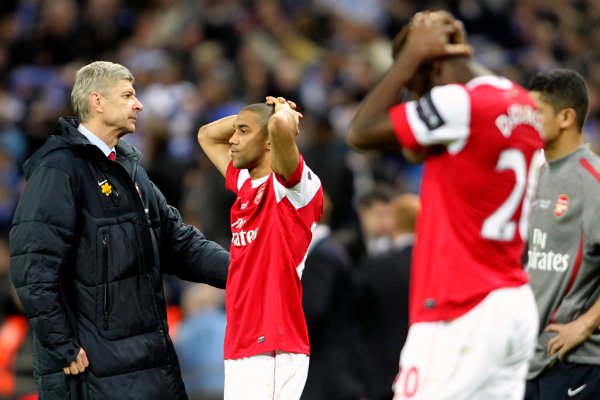 Simon Dawson/AP/Press Association ImagesArsenal's 8-2 hiding against Manchester United was a game to forget. Their 2-1 defeat to Birmingham was worse. It was February 2011, and the Gunners had entered a sixth season without winning a trophy. However, they were presented with a golden opportunity to end the drought when they faced Premier League strugglers Birmingham City in the League Cup final. Birmingham would go on to finish 18th and be relegated into the Championship three months after this game, yet Alex McLeish's side sprung the most almighty surprise here at Wembley. Arsenal experienced their first moment of panic on the half-hour mark when Nikola Žigi opened the scoring for City, though Robin van Persie restored parity 11 minutes later. Despite this, the Gunners failed to make their dominance count. Samir Nasri, Andrei Arshavin and Nicklas Bendtner were all denied by Ben Foster, and their profligacy in front of goal was punished on the 89 minute mark when Obafemi Martins capitalised on a misunderstanding between Gunners goalkeeper Wojciech Szczesny and defender Laurent Koscielny to strike the late blow that extended Arsenal's wait for a trophy into another year. This was a game Arsenal really should have won, and it was the best chance Wenger ever had of ending the crippling trophy drought that until this year hung over the club like a thundercloud. Yet he was unable to mastermind a way past the Premier League's basement boys, and wrote another ignominious chapter into Arsenal's history books.
1. The Nine Year Trophy Drought
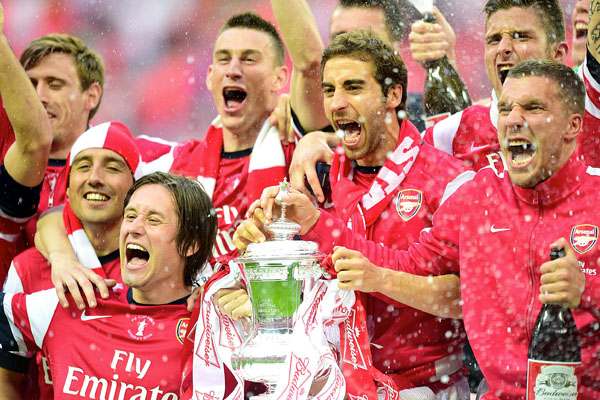 Adam Davy/EMPICS SportArsenal's failure to beat lowly Birmingham City in 2011 meant the club's wait for silverware carried on, and ended up stretching into an agonising NINTH season this year. Mercifully, and to the huge relief of Gunners fans everywhere, the Londoners' barren run came to an end this summer when Arsenal beat Hull City to lift the FA Cup. The outpouring of joy was there for all to see as almost a decade of pent-up frustration came flooding out of Arsenal's players and fans as the Gunners hoisted an elusive piece of silverware high above their heads and popped open the Champagne. And ten years from now, when people start asking about the distinct lack of silver in Arsenal's trophy cabinet between 2005-2014, perhaps officials will tell them the trophies were 'away for cleaning' during that period. It's better than admitting the truth.