20 Greatest Brazilian Players Of All Time
The Golden Squad's most important ever sons.
 DUSAN VRANIC/AP/Press Association ImagesWith a World Cup record that is the envy of literally every country on the planet, the only country to compete at every World Cup finals and virtually always amongst the tournament favourites, Brazil are indisputably the greatest international football team of them all. Even their unmatched 5 World Cup wins could easily have been more with the Brazilians the best team in both 1950 and 1998 right up until the final. The former gave the country their greatest footballing disappointment as they failed to win in front of a home crowd of over 200,000 in Rio's legendary Maracana stadium. Now the World Cup has returned to Brazil and the hosts have started like they mean to banish the ghosts of 1950 for good. But how do Neymar, Oscar and company shape up against the samba stars of yesteryear? Let's take a look at the greatest Brazilian football talents of 84 years of World Cup competition.
20. Gilmar
 PA Photos/PA Archive/Press Association ImagesBeating USA '94 hero Taffarel to the spot of Brazil's greatest hero between the sticks is "Pele's goalkeeper" Gilmar, who played alongside the legendary forward and a bunch of other Brazil greats in the 1960s Santos team widely regarded as the greatest club team in Brazilian history. With Gilmar as their last line of defence, Santos won five Brazilian Championships in a row between 1961 and 65, and both the Libertadores Cup and Intercontinental Cup in 1962 and 63. With Gilmar in goal, the national team went through a thirteen match unbeaten streak at the World Cup, through both their wins in 1958 and 62 and the opening game in 1966. No other player has kept goal for successive World Cup wins. In Sweden in 1958, Gilmar did not concede at all until the semi-final against the host nation, while his famous save against Spain's Marti Verges ensured progress from the group in 1962. Known for his unruffled calm and confidence, Gilmar was one of the game's gentlemen who never received a yellow card.
19. Roberto Carlos
 PAUL WHITE/AP/Press Association ImagesIn 2002 a FIFA-run public vote determined the all time World Cup Dream Team, on which were three Brazilians, two of which are yet to come on this list, but the third is the famous left back whose incredibly powerful shot saw him dubbed "El Hombre Bala", the Bullet Man. Roberto Carlos played for the Selecao in the 1998, 2002 and 2006 World Cups, winning one and making it to the final in another. In all, Roberto Carlos played 125 times for Brazil, scoring 11 goals including his incredible banana shot free kick against France in 1997. At club level he enjoyed his greatest success in a lucrative 11 year spell as one of Real Madrid's galacticos. In 584 games for the Meringues, Roberto Carlos won La Liga 4 times and the Champions League 3 times, becoming one of the club's most decorated players. Roberto Carlos retired in 2012 after brief spells in Turkey, Russia and back in Brazil. He is remembered as one of the greatest attacking full backs there has been.
18. Ronaldinho
 Ricardo Mazalan/AP/Press Association ImagesThe only player on this list still playing, Ronaldinho's good form with club Atletico Mineiro meant that the 34 year old came very close to a World Cup call up again this time around, having last year lead Atletico to their first Copa Libertadores title and beat Neymar to the South American Player of the Year award. This latest success is just one final chapter in a glittering career for the gifted forward. While at Paris St-Germain Ronaldinho emerged as a global star during the 2002 World Cup in which he formed part of a lethal forward trio alongside Ronaldo and Rivaldo. Particularly remembered for the curling 40 yard free kick that proved the winning goal in the quarter-final against England, Ronaldinho was one of four players from the winning Brazil side to make the tournament's All Star Team. Joining Barcelona in 2003, Ronaldinho became the Catalan club's biggest star in a five year spell that saw him scoring 94 goals in 207 games and winning La Liga twice and the Champions League once. Ronaldinho was named FIFA World Player of the Year in 2004 and 2005 and won the prestigious Ballon d'Or in 2005.
17. Vava
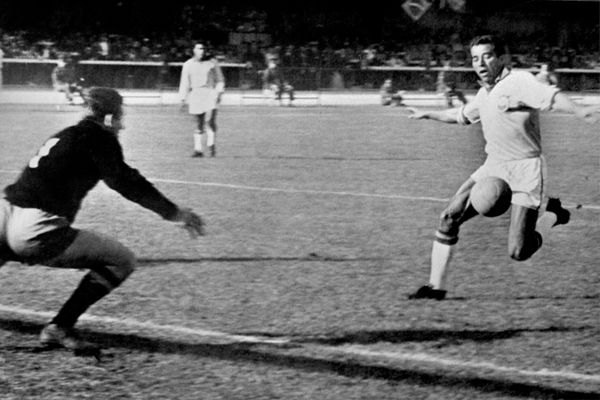 /AP/Press Association ImagesA big centre forward popularly known as "Peito de Aco", Steel Chest, Vava was renowned for his goalscoring ability and he certainly lived up to his reputation for the national team. Despite only playing 20 times for the Selecao, he managed 15 goals in that time and important goals they were too. In 1958 Vava scored 5 times as Brazil triumphed in Sweden, including a brace in the final against the hosts that saw Brazil go from 1-0 down to 2-1 ahead (eventually winning 5-2). After impressing in this tournament, Vava secured a move to Europe, playing for three seasons with Atletico Madrid where he scored regularly, but lost his Brazil place. Returning to his country in time for the 1962 finals in Chile, Vava also returned to the national team at just the right time. Not scoring any goals in the group matches, Vava, in the absence of Pele, became the key goal scorer in the knock out phase and ended the tournament with the Golden Boot (shared with five other players) and a place in the tournament's Dream Team. A goal in the final against Czechoslovakia makes Vava one of just four players to score in the final of two World Cups and the only one to score in successive finals.
16. Djalma Santos
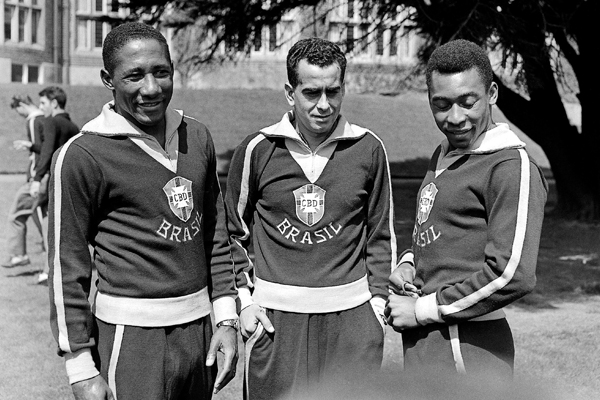 S&>/S&> and Barratts/EMPICS SportFew right backs can be deserving of a place on a list like this where three time World Cup finalist Cafu misses out, but Djalma Santos, often thought Brazil's most capable defensive talent, is one man that is deserving of that honour. Santos played the best years of his over twenty year club career with Palmeiras in Sao Paulo, winning the 1960 and 1967 Brazilian Championship, but is best remembered for his World Cup heroics. Playing 98 times for Brazil and featuring in four successive World Cups, Santos was always the defensive rock on which the great Brazil forwards could build on in attack. In 1954 he scored from the penalty spot in Brazil's quarter final defeat to the highly fancied Hungarians and was the only Brazil player in the tournament's Best XI. For the next two World Cups Santos continued to star as Brazil won back to back triumphs. Santos' appearances in the All-Star XI of the tournament in both 1958 and 1962 make him one of just two players in three World Cup All Star selections (the other being Franz Beckenbauer), a feat not even Pele could match.
15. Rivaldo
 Matthew Ashton/EMPICS SportAfter his career wound down in Greece, Uzbekistan and back in Brazil, one of the true Brazil greats of our time retired for good this summer. As part of a supremely gifted, skillful forward trio with Ronaldo and Ronaldinho, Rivaldo was one of the stars of Brazil's 2002 World Cup triumph (albeit somewhat damaging his reputation with his ridiculous face clutching dive against Turkey) and also came in between those other two legendary players as Barcelona's Brazil star. Although he would go on to win the 2003 Champions League with Milan, Rivaldo enjoyed the best years of his career as a Barca player, winning La Liga in 1998 and 1999 and the 1999 Fifa World Player of the Year and Ballon d'Or awards. A regular goal scorer for Brazil, Rivaldo scored 34 times in a 74 game international career across 10 years. At the 1998 World Cup he scored two crucial goals in the quarter-final against Denmark, and scored at the same stage against England in 2002. In all, Rivaldo managed 8 World Cup goals in two tournaments, featuring as part of the All-Star Team in both 1998 and 2002.
14. Rivelino
 Peter Robinson/EMPICS SportFor all that they have won the World Cup 5 times, the 1970 team is still perceived as standing head and shoulders above all other Brazil sides. Even among a team packed with such gifted individuals, however, there are some that stand out as inspirations to the later generations of Brazil stars and left midfielder Rivelino is one of them. If for no other reason, Rivelino deserves his place on this list for his signature trick, the "flip flap", a dribbling feint that has been borrowed by every great attacking Brazil player ever since from Ronaldo to Ronaldinho, Romario to Robinho. Rivelino was one of the most gifted players of his time, known as "O Rei do Parque" (the King of the Park) in his time at Sao Paulo's Corinthians before becoming the key man in the great Fluminense team of the 1970s, but it was the World Cup for which he will be remembered. Rivelino announced himself with a thundering free kick against Czechoslovakia in the 1970 group stage and went on to be one of five Brazilians voted into the tournament's Dream Team. He went on to be the country's top scorer in 1974 as they were knocked out by Johann Cruyff's Dutch.
13. Tostao
 Peter Robinson/EMPICS SportThe abundance of midfield talent alongside Rivelino in that all conquering 1970 team called for a redeployment of some of the era's other Brazilian greats, in particular free-scoring Tostao, who had played in the centre of the park during the Selecao's disappointing campaign in England in 1966, was redeployed as a centre forward alongside Pele. Playing for Cruzeiro in Belo Horizonte the midfielder dubbed "The Little Coin" scored 249 goals in 378 games from 1964-71 (still the club's record goalscorer) so the move forward made perfect sense. As centre forward Tostao played a key part in Brazil's 1970 success, scoring twice in the 4-2 quarter final victory over Peru and continuing to play the creative part that he had in the centre of midfield. In all he managed 32 goals in 54 caps before a detached retina caused him to retire at the early age of 27, robbing Brazilian football of one of its greatest talents.
12. Socrates
 Peter Robinson/EMPICS SportAn intellectual who was active in leftist politics, opposing the country's military government, and trained as a medical doctor during his playing career, Dr. Socrates was much more than simply a footballer, but he was still one of the great players of his time. A technically accomplished playmaker who set up goals as easily as he scored them, Socrates was the captain and the heart of the attacking, skillful Brazil team of the 1980s, during the 24 year gap between the country's third and fourth world title. Enjoying his greatest club success with Corinthians, Socrates scored 172 times in 297 games and won the Sao Paulo state championship three times. Socrates scored Brazil's first goal of the 1982 World Cup as the team raced to win their first four matches in the first two rounds of the tournament. He scored again in the crucial game against eventual champions Italy, but, in a game dubbed the Sarria Stadium Tragedy, the Italians greater defensive organisation won out against Socrates and his team's skills. It was the same story four years later when Socrates missed the opening penalty in a quarter final shoot out loss to France. Bizarrely, this Brazilian great came out of retirement after 15 years to play one game for non-league Yorkshire club Garforth Town in 2004.
11. Carlos Alberto Torres
 AP/Press Association ImagesOne of the most inspirational figures in Brazilian football history, Carlos Alberto was the captain that lifted the trophy in 1970, leading the greatest World Cup team of all. Part of the hugely successful 1960s Santos line up alongside Pele, right back Carlos Alberto was renowned for his great reading of the game and distribution of the ball, starting many of both club and country's moves from the back. A surprising omission from the failing 1966 squad and missing out on the 1974 tournament through injury, 1970 was Carlos Alberto's only World Cup, but with his defensive solidity, creative passing and inspirational leadership, he certainly made his mark on the tournament. Carlos Alberto was named in the 1970 World Cup's Dream Team and, perhaps more impressively, was part of the Team of the 20th Century announced for the 1998 World Cup (one of four Brazilians).
10. Romario
 DENNIS PAQUIN/AP/Press Association ImagesThe 1994 World Cup team was not a vintage Brazil side compared to the fluid attacking brilliance of the 1980s team, but it managed what Brazil teams throughout the 70s and 80s could not: being crowned World Champions. Part of that was down to the fact that the team had at least one outstanding talent in prolific striker Romario. One of the highest goalscorers of all time across a career that saw him enjoy success in various periods with three Rio clubs, Flamengo, Vasco da Gama and Fluminense, as well as in Australia, the Middle East and the United States, Romario enjoyed his best years in Europe. 127 goals in 142 games for PSV Eindhoven (winning three Dutch league titles) led to two seasons with Johann Cruyff's Barcelona Dream Team in which he scored 39 in 65, winning La Liga and making it to the Champions League final. With 55 goals in 70 caps Romario is Brazil's third highest all time goalscorer. Injury meant that he barely featured in 1990, but in 1994 he made the difference with five goals and the Golden Ball for player of the tournament. A 1999 FIFA internet poll for Player of the Century placed Romario at 5th and in 2002 he was named in FIFA's all time World Cup Dream Team.
9. Gerson
 Peter Robinson/EMPICS SportComing from a football family, his father and uncle both played professionally, Gerson grew up around the legends of Brazil's 1950s team, but would go on to outstrip most of them as the playmaker at the heart of the great 1970 World Cup side. Having established himself as the key player in the centre of the Flamengo team in the early 1960s, Gerson moved Botafogo in 1963 and played alongside some of the greatest Brazilian players of all in a team that won multiple Rio state championships and briefly rivaled Pele's Sao Paulo based Santos as the nation's top team. His finest hour, though, was the 1970 World Cup. Even amongst such a team of iconic stars it was Gerson that pulled the strings and orchestrated all the play as the brain of the Brazil team. Pele, naturally, walked away with the tournament's Golden Ball, but the Silver Ball awarded to Gerson as the second best player in the tournament is a tribute to how important he was to the team.
8. Nilton Santos
 AP/Press Association ImagesAs Gerson was arriving at Botafogo, one of the club's greatest ever heroes was winding down his career there. Left back Nilton Santos spent every year of a career that ran from 1948-1964 with the Rio club, playing 723 times for them (still a club record). A strong defensive presence, Nilton is nevertheless best known as one of the first full backs to enjoy participating in attacking play like a winger in the manner of his distant successor Roberto Carlos. During the opening game of the 1958 World Cup against Austria Nilton scored a famous goal in which he picked the ball up in defence and ran past practically the whole Austrian team to score. The journalists that selected that years World Cup Dream Team picked six Brazilians, including an all Brazil defence in which Nilton was the standout player. He would go on to feature in the 1962 team as Brazil retained their title.
7. Leonidas
 AP/Press Association ImagesThe original Brazil World Cup hero, so-called Black Diamond Leonidas da Silva defied the racial prejudices of the 1930s to become the star of the blossoming national side. After winning back to back Rio championships with Vasco da Gama and Botafogo, Leonidas' 1936 move to the white elitist Flamengo was a sign of the acceptance of black stars in the top Brazilian clubs. Leonidas repaid that faith with 153 goals in 149 games for the Big Mengo in a career that saw him score an impressive total of 516 club goals in 574 games. The prolific striker played in 19 games for the national team including the 1934 and 38 World Cups, scoring 21 goals. In 1938 Leonidas was the first of seven Brazil players to win the Golden Ball as player of the tournament and the first of 5 Brazilians to win the Golden Boot as top scorer. Leonidas scored 5 times to take Brazil to the semi-finals, whereupon his manager rested him for the game against eventual champions Italy. The Italians won and Leonidas returned to score twice more in the third place playoff. More than this, though, he also gifted the world the bicycle kick, which was so unseen when Leonidas fired one in during the 1938 tournament that the referee wasn't even sure if it was legal.
6. Zico
 Peter Robinson/EMPICS SportDescribed by Pele as: "the one player that came closest to me", described by fans as "the White Pele", Zico was perhaps the finest player in the world in the early 1980s, a goalscoring and creative attacking midfielder who embodied the attacking flair of the sadly unsuccessful 1982 Brazil team. The star of Flamengo during their Golden Age, Zico scored 123 times in 212 games in his first spell at the club, winning 7 state championships, 4 Brazilian national championships and the Copa Libertadores in 1981. Unfortunately, despite the obvious talent of Zico and his teammates, Brazil never quite managed to triumph in his era, finishing 3rd in 1978, reaching the second group stage in 1982 and losing the quarter final on penalties in 1986. Despite this, however, Zico finished third top scorer with 4 and was named in the tournament Dream Team in 1982. With 48 goals overall, he is Brazil's fourth top scorer. World Soccer named Zico World Player of the Year in 1981 and 1983 and he finished 14th on the FIFA Player of the Century list. Finishing his playing career in Japan, where he became known as "The God of Soccer", Zico managed the Japan national team to the 2006 World Cup. He is now working as a consultant with the Brazil team.
5. Ronaldo
 JASPER JUINEN/AP/Press Association ImagesThe finest Brazil player of the 21st century, Ronaldo's career may have had some ups and downs through injury, fluctuating weight and the mysterious circumstances surrounding the 1998 World Cup Final, but it was much more full of success, goals and glory that saw the star striker truly earn the nickname "The Phenomenon". As a 17 year old the young Ronaldo was an unused sub when Brazil won the 1994 World Cup, but he would not be on the sidelines of success for long. After the tournament he moved to PSV Eindhoven, scored 54 times in 57 games in two years and moved to Barcelona where he won the European Golden Shoe for Europe's top scoring striker after 47 goals in 49 games. He won the FIFA World Player of the Year award in 1996, 1997 and again in 2002 and the Ballon d'Or in 1997 and 2002. The star player going into the 1998 tournament, Ronaldo was the best player in the competition right up to the final, with 4 goals and 3 assists before the strange circumstances and disastrous performance of the final. Four years later he returned to fitness just at the right time, scoring 8 goals (the most of any player in a single World Cup since 1970) as Brazil won the title. He won the 1998 Golden Ball and the runner up award, the Silver Ball, in 2002. Even with Miroslav Klose's goal last week, Ronaldo remains the joint highest World Cup scorer of all time with 15 goals.
4. Didi
 AP/Press Association ImagesAfter the disappointments of 1938 and, in particular, 1950, Brazil were finally crowned World Champions in 1958 and the star was a young man from Rio whose leg had very nearly been amputated from an infection as a teenager: Waldyr Pereira, better known as Didi. While a teenage Pele emerged as the player to watch in future, it was this technically accomplished, driven creative midfielder who made the victory happen. Another star of the great Botafogo team of the 1950s, Didi won the Rio state championship before a post-World Cup move to Real Madrid. Rivalry with club icon Alfredo di Stefano limited his playing time there, but Didi still played an essential part in the last two of Real's run of five back to back European Cup wins. A return to Botafogo and more state titles followed. After impressing in the group stage of the 1954 World Cup, Didi played a part in the bad tempered brawl against Hungary known as The Battle of Berne. In 1958 he returned to win the Golden Ball as player of the tournament and played a central part in Brazil's successful defence of the title in 1962. He was named at 19, the fourth Brazilian, on FIFA's Player of the Century list.
3. Zizinho
 YoutubeThe previous time Brazil hosted the World Cup expectations were naturally high for a home win and those expectations were based around home star Zizinho, the flying winger in a free flowing attacking team. A complete forward, capable of running with the ball and shooting with both feet, Zizinho had won multiple state championships with Flamengo in the era where there had been no World Cup due to the Second World War. With Zizinho's skills alongside centre forward Ademir's goals, Brazil were easily the best team through most of the 1950 tournament, scoring freely with 21 goals to Uruguay's 13 going into the final game. Their previous matches had been won 7-1 and 6-1, so the final defeat to Uruguay came as a huge shock. Zizinho's quality was honoured with the Golden Ball award, but he declined call-ups to play in 1954 and 58. The FIFA Player of the Century list had Zizinho as the fifth Brazilian, while a poll in 2000 named him as the 4th greatest Brazilian player of the 20th century. The top three? Zico and our next two entries.
2. Garrincha
 S&>/S&> and Barratts/EMPICS SportThe impoverished son of an alcoholic, always smaller than average and born with a deformed spine, one leg shorter than the other and both legs bowed, the young Manuel Francisco dos Santos had very few advantages in early life but was a naturally gifted footballer. Already married and a father by the time he signed a professional deal with Botafogo at the age of 20, the supremely skilled winger used his inventive skills to bring glory to club and country. Known as "Alegri do Povo", the Joy of the People, Garrincha was enormously popular with Brazilian fans in a way no player had ever been before and few have been since. He was known for his carefree, joyous attitude and a playing style that delighted in dribbling tricks and feints that left opposition defenders humiliated. At the same time he suffered in his relationship with his father, an increasing drink problem of his own and his many mistresses and children. His style of play was occasionally branded as "irresponsible" meaning it took a while before he broke into the Brazil team during the 1958 World Cup. When he did play though, against the highly fancied Soviet Union in the first round, he lit up the tournament and helped Brazil to a win, securing a place in the tournament Dream Team. Four years later, with Pele injured, Garrincha was the team's indisputable star as Brazil retained their title and he was awarded the Golden Ball.
1. Pele
 AP/Press Association ImagesQuite simply the greatest exponent of what he called the "Jogo Bonito" that there has ever been, it would be churlish and contradictory for a list like this not to accept that Pele, for all that he is the blandly obvious choice, is also the indisputable only option for number 1. FIFA's Player of the Century, the International Olympic Committee's Athlete of the Century, named by Time Magazine amongst the 100 Most Influential People of the Century (the only Brazilian on the list), and the highest scorer both for the Brazil national team and at club level, Pele's records speak for themselves. As the star of the Santos team, Pele won 10 Sao Paulo state championships, 5 Brazilian championships, and the Copa Libertadores and Intercontinental Cup twice, while he personally scored over 600 times. In his entire career Pele managed 1281 goals in 1363 games (a Guinness World Record as the highest scoring player ever in world football). Meanwhile, for the national team he netted 77 times in 92 games. Making his debut at the age of 16, Pele burst onto the scene as a 17 year old star at the 1958 World Cup, scoring 6 times and winning the Silver Ball as the tournament's second best player. 12 years later, he would go one better and be named the 1970 World Cup's worthy Golden Ball winner. The greatest player of all starring in the greatest team of all? Quite probably. It is near impossible to narrow down all the Brazilian greats to a list of 20, so anybody looking for the likes of Jairzinho, Kaka Ademir, Luis Pereira, Bebeto, Arthur Freidenreich, Cafu, or Falcao vent your frustration in the comments below.