10 Best Comic Book TV Shows Of The Decade
In a truly revolutionary decade for comic book TV, which shows stood out among the rest?

It's been quite the decade for comic book inspired television.
It's hard to believe there was ever a time when the world wasn't overrun with costume-clad superheroes, but before 2010 that's kind of what it felt like (well, as far as television was concerned at least). Yes, even though the appeal of comic book films were at an all-time high in the first decade of the century (due to the success of The Dark Knight and the early days of the MCU), the truth is that heroes never really had that kind of revolution on the small screen.
When this decade began, the long-running Smallville was about to bid us farewell and superhero shows were something of a rarity. But it didn't take long for that to change because, in a matter of years, one CW series changed everything and kicked off what is now known as the Arrowverse, while Marvel would venture into its own world of TV heroes through network television as well as launching its own R-rated shared universe on Netflix.
This decade has witnessed a renaissance of comic book TV and, as a result, we have more superhero shows than we can even count. But with the end of the decade upon us, let's take a look back at the best that it had to offer.
10. Supergirl

Supergirl made history with its debut on CBS by becoming the first female-led superhero series since Lynda Carter's classic Wonder Woman. Centered on Superman's cousin, it tells the story of how Kara Zor-El eventually made it to Earth after her pod got knocked off-course and, after years in hiding, stepped into the light as National City's saviour: Supergirl.
Though the show remained a phenomenon throughout its first season, its move to The CW resulted in it being talked about a little bit less. However, one thing that didn't suffer from less exposure was the narratives because, for the most part, Supergirl has been one of the Arrowverse's most consistent shows.
Granted, some of its dialogue occasionally lets it down, but it thrives on its strong, emotionally-driven storylines that always manage to reflect some of the real world's issues. Sure, it may not be quite as heroic as it once was, but it did reach new storytelling heights in its fourth season which, if anything, suggests that its continued evolution is actually a good thing. Melissa Benoist is also nothing short of a triumph in the titular role, bringing the character to life with ease.
What allows Supergirl to stand out in a very crowded landscape are its rather traditional superhero values. There's just an overwhelming sense of triumph about it that is reminiscent of classic superhero films/TV shows.
9. Jessica Jones

Jessica Jones had the seemingly impossible task of attempting to follow in the footsteps of the universally-acclaimed Daredevil and continuing the Netflix/Marvel saga as it slowly built towards The Defenders crossover. Yet somehow it shattered any and all expectations that had been set and, in many people's eyes, even managed to eclipse its predecessor in terms of plot and story.
The series focused on the eponymous private detective and followed her story as she attempted to run from her past - or more specifically the villainous Killgrave. A mysterious thriller, the show's greatest strengths lay in its stunning aesthetic, as it employed elements of noir while mixing in realism and the grittiness that made Daredevil so successful to produce something that was both a gripping mystery and a visually impressive presentation.
It was all capped off by stunningly powerful performances from Krysten Ritter and David Tennant.
Jessica Jones struggled to maintain its unbelievably high standard as both its second and third season failed to live up to expectations (the latter of which ended Netflix's Marvel shows on a rather disappointing note), but the strength of the first season earns the show a rightful place on this list.
8. DC's Legends Of Tomorrow

There's an irony in the fact that the show nobody wanted to love is now the one that nobody wants to hate, but that's Legends of Tomorrow for you.
Initially little more than a vehicle for some of the Arrowverse's most beloved supporting characters, the first season's fantasy-heavy time-travel plot took a little time to get off the ground, with many feeling that it just didn't get the balance between its elements right. As admittedly decent as it was, it was that criticism that ultimately saved the show, because it prompted a major shift towards comedy in the second season. Legends has never looked back.
A wacky, over-the-top, balls-to-the-walls pantomime, Legends of Tomorrow hasn't taken itself too seriously since that Season 1 finale. Embracing the sheer lunacy of its concept, the tongue-in-cheek series welcomes anything that should seem too out-there and somehow manages to make it even more out-there, and yet we as viewers find it totally plausible.
It's no longer the Arrowverse's answer to Doctor Who, nor is it just a cheap way of incorporating 'B characters' into a plot. No, Legends has grown into its own monster entirely. Like Sara Lance, Mick Rory, Martin Stein, Ray Palmer and the rest of the Legends, it's an outcast and/or misfit. More than that, it's fully aware of how utterly ridiculous it is and it thrives on being so.
Without a doubt the most consistent and enjoyable of the Arrowverse shows, Legends of Tomorrow continues to catch us all off-guard, and it's nothing short of a hoot.
7. Watchmen

The latest arrival on this list, HBO's Watchmen is something of a strange beast. A comic book show in perhaps name alone, it is indeed based on Alan Moore and Dave Gibbons' iconic comic series of the same name but, though it serves as a sequel, the Damon Lindelof series is considered a remix of sorts in that it takes place decades after that well-known story. Still, it expands upon the original comic in unique and surprising ways, as it tackles thought-provoking real world elements such as systemic and systematic racism in America.
The show is set in an alternate reality and centers on the rise of a white supremacist group by the name of the Seventh Kavalry, who subsequently attack and kill countless Tulsa police officers in a bid to make a statement. The surviving police officers then take on superhero-like costumes to protect their identities and, more importantly, their loved ones.
One of these officers is Angela Abar a.k.a. Sister Night - a role that allows Regina King to deliver a career-best performance.
Watchmen isn't for the feint of heart and is probably more of an acquired taste than anything else. It's surprising, confounding and, at times, even baffling, but it's also incredibly gripping and compelling and manages to use Moore and Gibbons' legendary work to create a piece of television that simply must be appreciated.
6. Gotham
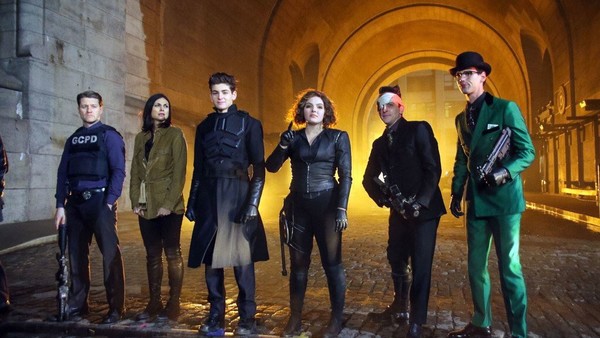
Initially a grim Batman prequel (à la Smallville), Gotham arrived on our screens all the way back in 2014 - just as the classic superhero TV format was being resurrected by the Arrowverse. But it didn't bother joining in on the trend, and instead attempted to forge its own destiny by being the most batsh*t comic book show you've ever seen.
A show that often threw everything at the wall just to see what stuck, it kicked off on the night in which Bruce Wayne's parents were killed. From there, it grew into a compelling crime-drama that was part-procedural and part-origin story for the Dark Knight. It ended up giving us unique variations of Bruce, Alfred, Selina Kyle, Penguin, Edward Nygma, Barbara Kean, Lee Thompkins, Harvey Bullock and, most of all, Jim Gordon - who battled the corruption in the GCPD on his rise to the top.
Some purist Bat-fans didn't take too kindly to all the re-writing that the show was doing to the Batman mythology but, like, come on - haven't they ever heard of Elseworlds? Once you got over that, the show itself becomes oddly compelling. This writer uses the term 'oddly' because everything about Gotham is unapologetically odd - and that's where its charm lies.
From its exceptional ability for long-form storytelling to Cameron Monaghan's chilling rendition of two pre-Joker Jokers, Gotham put a unique spin on the tales of the Batman, and its original interpretation of No Man's Land allowed it to end on a high.
5. Marvel's Agent Carter

Directly tied to the Marvel Cinematic Universe, Agent Carter followed the adventures of the formidable Peggy Carter (who had previously been introduced in Captain America: The First Avenger) in the lead-up to her founding the MCU's leading super-spy organisation, S.H.I.E.L.D.
What set this series apart from other MCU products was undoubtedly its period setting, as it grounded the super-powered universe in the era of the 1940s and, in the process, paved the way for a surprisingly authentic story that highlighted the struggles women endured in the workplace. But that would only serve as a stepping stone for Peggy - who took it upon herself to battle and defeat the patriarchy that attempted to get in her way as she grieved the loss of her beloved Steve.
She only went and pulled it off while saving the bloody world, didn't she?
Though Season 2 would take the show in an unexpected (but still compelling) direction, on the whole Agent Carter succeeded in highlighting Peggy's richness as a character and ultimately reminded us why Steve fell so madly in love with her. In doing so, it gave Hayley Atwell a well-earned chance to shine.
Peggy knew her worth all along and, after Agent Carter, there wasn't a single person who didn't. Shame on ABC for cancelling it.
4. Young Justice

When you think about it, it's rather odd that Young Justice kicked off near the beginning of the decade and only completed its third season at the end of it, but that's just an example of the power of this show because it could defy anything - even cancellation!
In many ways 'the-little-show-that-could', the animated series told the story of how some of DC's most iconic sidekicks were determined to break out and become their own superheroes. And over the course of the show's initial run, it allowed us to see how all of them grow as both people and heroes.
What set Young Justice apart from other animated shows in its genre was the fact that it didn't embark on the typical seasons full of villain-of-the-week adventures and instead adopted a long-form storytelling method that didn't just run across the first season, but the show's two-season run and eventual revival. Moreover, its strong characterizations and unique spins on popular storylines made it one of the most beloved animated shows, if not TV shows in general, of all time.
Young Justice did exactly what the legendary Batman: The Animated Series had done years before it in that it pushed boundaries and made so many realize that animated comic book shows can be far superior to their live-action counterparts. With it now back on our screens just before the end of the decade, we should all be prepared for it to do the same throughout the next one.
3. The Flash

It's hard to believe there was ever a time when The Flash wasn't speeding his way up and down our screens every week because, in all honesty, it's hard to remember that time. In the five years that it has been on the air, the show has achieved an enormous amount of success - most of which it managed to accomplish in its first season - all while introducing droves of people to a new light-hearted fragment of the Arrowverse.
Focusing on DC Comics' iconic Scarlet Speedster, the show follows CSI Barry Allen (who had previously been introduced on Arrow) as he evolves from helpless hero to superhero after being struck by lightning. A curse at first, he soon sees things differently and, gifted with speed and spurred on by his mother's unsolved murder, he becomes The Flash - the hero that Central City desperately needs.
The Flash has been the most successful of all the Arrowverse shows, and it's really easy to see why. Though it has struggled to maintain the momentum of its phenomenal first season, it remains one of the most enjoyable shows on television (due to the fact that its villain-of-the-week offerings are almost always a lot of fun) and always attempts to remain as comic-accurate as possible - something Arrow could have learned a great deal from.
But most of all, its always carried by a strong leading performance from the endearing Grant Gustin - who has, no doubt, been one of the Arrowverse's MVPs over this past decade.
2. Arrow

The show that single-handedly reinvigorated the superhero television genre, it's impossible to talk about Arrow without acknowledging what it has given the world. Like Oliver Queen himself, the show was originally a one-man army shooting arrows into its competition on a weekly basis, but its success saw it grow into something much greater, as it spawned the most complex shared universe in TV (and probably film) history.
Centred on DC Comics' Green Arrow, it promised to be a more grounded and gritty reinvention of the character's story and, for the most part, succeeded in being just that as Oliver Queen returned from five years on a hellish island determined to right the wrongs of his father and unleash hell on the criminals of Star City.
The show's run was far from perfect, as it often wasted potentially brilliant storylines and focused far too much on in-your-face supporting characters, but its first two seasons were as close to it as superhero TV could get. And, after a lot of ups and downs in between, its final season looks set to finally recapture those epic heights - allowing it to go out on the high it deserves.
Moreover it delivered some outstanding adventures over its eight-year run as the Emerald Archer faced off against the likes of Dark Archer and Deathstroke, while cast members like Stephen Amell and Katie Cassidy carried it through even the most questionable of storylines.
Perhaps not the most consistent comic book show of the decade, Arrow is without a doubt, the most important.
1. Daredevil

A dark, grim and unnerving adaptation of the Marvel Comics character, Netflix's Daredevil felt incredibly true to form right from the offset. Taking a more realistic approach than anything else in its genre, it remained incredibly grounded throughout its three-season run, as blind lawyer Matt Murdock reined down bloody hell upon the corrupt criminals in Hell's Kitchen as the vigilante known as Daredevil.
Being a streaming service show, it benefited from the lack of restrictions as it wasn't afraid to show us the disturbing side of crime-fighting via violent deaths, malicious attacks and highly-physical fight scenes - all of which set it apart visually from its less-physical counterparts. This allowed it to delve into areas that we normally wouldn't see explored in a superhero show, highlighting what criminals like Wilson Fisk were willing to do to remain in control.
Murdock's arc always remained a compelling one, as through a series of confessions, we're reminded that he struggles with his burden of being judge and jury because he knows that sometimes the law isn't foolproof. And it's that inner conflict that incites his dominance over Fisk and, later, The Hand.
Anchored by a strong performance from Charlie Cox and a stunning turn from Vincent D'Onofrio as the Kingpin himself, Daredevil started off on an immense high that it never quite achieved again. But it did come close multiple times throughout its subsequent seasons and always delivered compelling character-driven drama and the best fight scenes the genre has ever seen.
-
Which of this decade's comic book shows was your favourite? Tell us in the comment section below.
You'll Never Get 100% On This Arrowverse Quiz
