10 Doctor Who Mysteries That Will NEVER Be Answered
“Doctor Who?” isn’t the only question we’re all still asking…

There’s a famous thought experiment called Schrödinger's cat, which states that if you put a cat in a box with some poison and come back to it an hour later, the cat is (in a sense) both alive and dead.
Sounds like something Missy would do, right?
Doctor Who’s unanswered mysteries work in much the same way. We might speculate what happened to so and so, or whether that thing really did happen the way we imagined. But if the theories we come up with are just as credible as each other, we can never know for sure which one is correct.
Some questions do have a definite answer. What is Bad Wolf? Who is Missy? What’s the Flux? However, where things like the Doctor’s name or origins are concerned, there’s no one explanation that’s going to appease everyone. Sometimes it’s best to just let fans make their own minds up.
And frankly, we wouldn’t have it any other way. Indeed, the open-ended nature of these mysteries is what makes them so compelling.
The show does occasionally revisit seemingly-forgotten plot threads (like Ace and Tegan in The Power of the Doctor). But more often than not, if a question goes unanswered, or a mystery unsolved, it’s probably going to stay that way…
10. Who Was Jim The Fish?

Like the Singing Towers of Darillium, many of the adventures contained within River Song’s diary have subsequently been elaborated upon.
The crash of the Byzantium, which received its first mention in Silence in the Library, was eventually depicted two years later in The Time of Angels/Flesh and Stone. Meanwhile, two accounts of the picnic at Asgard exist in prose, taking place with either the Tenth or Eleventh Doctor.
But one diary entry yet to make it to screen is the Doctor and River’s encounter with Jim the Fish – an aquatic ally who remains shrouded in mystery.
Jim was first alluded to in Series 6 opener The Impossible Astronaut, ultimately serving to highlight the age difference between the older and younger Eleventh Doctors more than anything else (the older has met Jim, the younger has not). But as Doctor Who fans, we need answers!
Was Jim an actual fish, a fish-human hybrid, or something else entirely? All we’re told is that he’s “still building his dam”, which suggests something slightly more sophisticated than your average pet goldfish.
As if to rub salt in the wound, the only other time the character is referenced is in The Husbands of River Song, when Flemming remarks that “We all know Jim the Fish!”. Erm, do we?
After 12 years and still no concrete answers, it feels like the mystery of Jim's importance will never be addressed. Cod-damnit!
9. Was The Osgood That Died Human Or Zygon?

If you’re going to introduce a new villain, one way to quickly convince the audience of their evilness is to have them kill a much-loved character.
The trouble is, in the process, you lose a much-loved character.
That was the corner Steven Moffat wrote himself into when he had Missy kill Osgood in Death in Heaven. Or so it seemed. After all, following the events of The Day of the Doctor, there were two Osgoods knocking about: one human, one Zygon.
The suggestion that it was the Zygon Osgood rather than the human Osgood that had met her end first appeared in a 2014 issue of Doctor Who Magazine, but was immediately shot down by Moffat:
"Nah. If it had been a Zygon, she wouldn’t have been killed so easily.”
In reality, sequel story The Zygon Invasion/The Zygon Inversion was in active development by this point, with the mystery of which Osgood died forming a major plot thread. By the end, we were still none the wiser.
In retrospect, it’s quite right that we never learn the truth. After all, it’s what Osgood represents, rather than what she is, that’s important. As Osgood states in The Zygon Invasion, “I am the peace. I am human and Zygon."
Schrödinger’s cat? More like Schrödinger's Osgood.
8. What Was The Watcher?

In the Fourth Doctor's swansong Logopolis, the Doctor and his companions are stalked by a being known only as the Watcher.
Appearing everywhere from the streets of Logopolis to Barnet Bypass, this ghost-like figure is eventually revealed to have been the Doctor the whole time.
Except, what does that actually mean?
The generally-accepted explanation is that the Watcher was a nascent version of the Fifth Doctor – a premonition to warn the Fourth Doctor that his time is nearly up. Similar to how Ood Sigma appears to the Tenth Doctor.
Certainly, the Watcher played a vital role in the regeneration, merging with the Fourth Doctor to create the Fifth. But can we really consider it “the Doctor” in its own right? After all, it’s very much presented as a separate entity, existing in parallel to the Doctor’s timeline rather than being part of it (more like the Valeyard than the War Doctor).
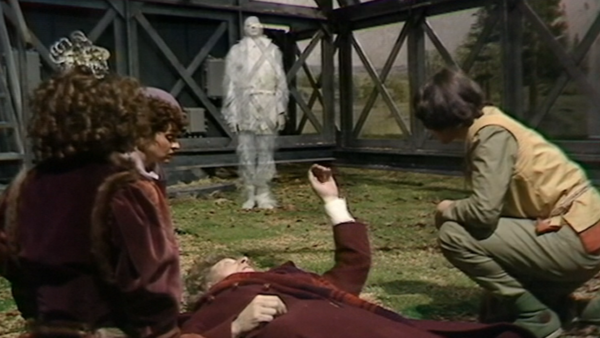
Putting the question of the Watcher’s identity aside, there’s also the matter of how it came into being, and why. No other handover has played out in this way, and no other Doctor has had their own Watcher. Why? What was it about the Fourth Doctor that merited this special treatment, other than the fact that he was played by Tom Baker?
In short, we don’t truly know what the Watcher was, where it came from, or why it actually existed. Like so many things about regeneration, it seems destined to remain a mystery.
7. What Happened To Harmony Shoal?

The lack of a full series in 2016 meant that options for long-form storytelling were limited. There was, however, one thing connecting the two episodes that bookended this gap year: their antagonists.
There’s some debate as to what exactly this mysterious collective was called. In The Husbands of River Song, it was referred to as the Shoal of the Winter Harmony, while in The Return of Doctor Mysterio, it went by the much more concise Harmony Shoal.
And the questions don’t stop there.
At the end of Doctor Mysterio, a Shoal member is shown to have hijacked a UNIT soldier. Viewers could've been forgiven for thinking that this plot thread would be picked up in Series 10, but ultimately it was left dangling.
So what did happen next? Was this mole swiftly dealt with, or did it successfully manage to infiltrate UNIT? Is there a whole follow-up invasion that we never witnessed? Is it only a matter of time until Harmony Shoal gets its own Big Finish boxset?!
Either way, enough time has passed that a TV rematch is now almost definitely off the table.
6. Did Pete’s World Have A Doctor?

Pete’s World, the parallel universe visited by the Doctor in Series 2, is a reflection of our own world, complete with analogues of Pete, Jackie, Rose, and Mickey. As we later learn, it even has its own Harriet Jones and Yvonne Hartman.
By all accounts, it should also have its own Doctor. Yet this doesn’t seem to be the case. How come?
In story terms, another Doctor would certainly have complicated things. Had a Doctor been present in Pete’s World all along, the events of Rise of the Cybermen/The Age of Steel probably wouldn’t have even taken place. Everything would've been fixed before the opening titles rolled, rendering our Doctor, and the story as a whole, pretty much redundant.
But supposing there was a Doctor in Pete’s World at some point, what were they like, what happened to them, and did they even look like David Tennant? Rose was a dog, so nothing’s off the table!
Or perhaps, like Mickey’s twin Ricky, the Doctor of Pete’s World went by a different name entirely.
Whatever the case, this Doctor-shaped gap would eventually be filled by the Metacrisis Doctor in Journey’s End. But as Billie Piper has since admitted, he’s no match for the real thing.
Was there a Doctor in Pete’s World all along? Is he still out there? Appropriately, for such an elusive character, we still can't be sure.
5. Who Were The Doctor's Family?

If you thought the Doctor was difficult to pin down, you should try tracking their family tree.
The show’s central character has always claimed to have relatives, but the only one we’ve ever met onscreen is his granddaughter, Susan. And even her status is unverified. Could she have been the Time Lord President’s daughter, “stolen” by the Doctor when he left Gallifrey, as alluded to in Hell Bent?
Assuming Susan was the Doctor’s real granddaughter, the Doctor must have had children too. Indeed, the Tenth Doctor asserted to both Rose and Donna that he had, at one point, been a father. The Tenth Doctor also let slip that he’d once had a brother, while the Thirteenth Doctor made passing references to sisters – and seven grandmothers.
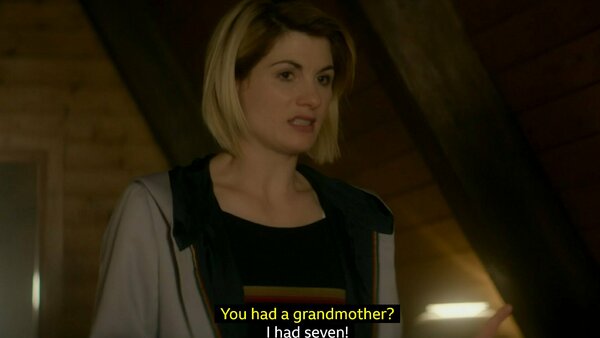
The one thing we can say for sure is that any relatives of the Doctor are now long gone. However, their influence is still felt. “I carry them with me,” the Doctor tells Yaz in The Woman Who Fell To Earth. “So even though they're gone from the world, they're never gone from me.”
Of course, the Doctor’s real family is the friends they make along the way. Even so, we can’t help but wonder who those original descendants and ancestors were.
4. Did The Doctor Push The Half-Face Man?

One of the most striking moments in Deep Breath is the climactic showdown between the newly-regenerated Twelfth Doctor and his inaugural adversary, the Half-Face Man.
Part of the reason this scene sticks in the memory is because of its ambiguous ending. We know how it ends – with the Half-Face Man atop the spire of Big Ben – but not how he got there. Did he jump, or was he pushed?
Well, in typically mysterious Moff fashion, the episode refuses to tell us.
The Doctor and the Half-Face Man are at loggerheads, and the only way out is for one of them to deviate from their “basic programming.” For the Half-Face Man, this means suicide. For the Doctor, it means murder.
The more tantalising outcome is for the Doctor to have pushed the Half-Face Man – a moment that is shockingly uncharacteristic, and yet totally in keeping with the more ‘means to an end’ approach of this new incarnation.
The suggestion that the Half-Face Man simply yeeted himself onto Big Ben is, by comparison, pretty underwhelming. Though there’s always the possibility that the Doctor talked him into self-destruction, thus keeping his hands clean.
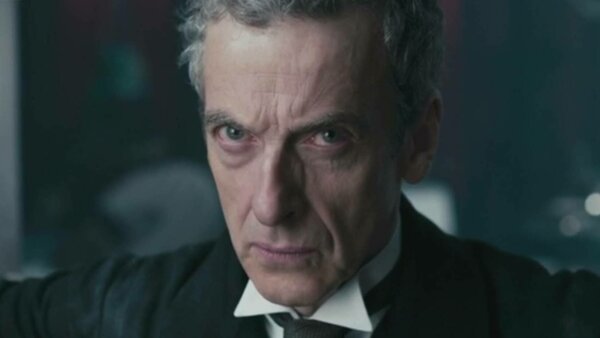
That final, haunting, fourth wall-breaking shot of the Doctor certainly seems to suggest some involvement. But we’ll never know for sure.
3. Where Does The Doctor Really Come From?

The Doctor’s past really is the gift that keeps on giving. You can add bits to their backstory here and there, but there’s always more to discover.
Nowhere has this been more evident than in recent years, with the Timeless Child storyline giving the show’s protagonist the most concrete backstory they’ve ever had, while still leaving plenty of wiggle room.
We learnt that the Doctor wasn’t really from Gallifrey, and had lived multiple other lives prior to the ones we knew about. We were shown the Doctor's original form, and even met her adoptive mother, Tecteun.
And yet, in introducing all this lore, showrunner Chris Chibnall left us with more questions than answers. After contemplating whether to open the fob watch containing her hidden memories at the end of Series 13, the Doctor chose to instead bury it deep inside the TARDIS, somewhere she can never find it.
As far as the Timeless Child itself is concerned, we know even less. What species was she? Who were her original parents or guardians, prior to Tecteun? And where was she really from? Where did that purple portal lead?
With future showrunners under no obligation to continue their predecessors' stories (even Chibnall believes RTD will "ignore" the Timeless Child), these mysteries aren't likely to be answered anytime soon.
2. Why Did The Sixth Doctor Look Like Maxil?

Doctor Who is littered with examples of guest actors going on to play more prominent roles.
If these characters are sufficiently different from one another – as was the case for Karen Gillan, when she made the leap from soothsayer to Amy Pond – the connection can go unacknowledged. But if the two characters do look similar, an explanation is usually contrived (hence why Adeola and Martha Jones were cousins, for example).
Likewise, the Twelfth Doctor’s resemblance to the man he’d saved from Vesuvius' eruption wasn’t a coincidence, but rather a deliberate move on the part of his subconscious, to remind him to save people.
So why on Gallifrey did the Sixth Doctor adopt the likeness of Time Lord Commander Maxil, a character also played by Colin Baker?
Was a similar force at play, with the Doctor’s subconscious helping to select his new face? If so, Maxil is a puzzling choice. He caused nothing but trouble for the Fifth Doctor, even going as far as to shoot him with a staser!
Perhaps the Doctor was trying to tell himself how not to behave. But even that’s a bit of a reach. Alternatively, could Maxil have been the Sixth Doctor all along, in some other guise? They certainly have a similar temperament.
We’ll probably never know for sure. And just as well!
1. What Is The Doctor’s Name?

It’s the age-old question, hidden in plain sight for 60 years. It’s also the question that, more than any other on this list, can never, ever be answered.
Aside from a few references here and there – for instance, Ian Chesterton remarking that “If we knew his name we might have a clue to all this” – classic Who, and the beginning of the revived series, had little to say on the matter.
But then, Steven Moffat came along, and the Doctor's name became a much bigger deal.
We met another character who knew what it was, in the form of River Song. Then, as the 50th anniversary approached, speculation surrounding the Doctor’s name reached an all-time high, and for a moment, it seemed like it might finally be revealed in an episode literally titled "The Name of the Doctor".
In the end, this turned out to be a sneaky bit of misdirection to lead us back round to the title ‘Doctor’, and what that stands for: the promise to never be cruel, and never be cowardly.
Still, the question remains, and it always will. We all know, deep down, that any answer would be a massive anticlimax. But that doesn’t stop us asking:
Doctor Who?
Watch Next
Doctor Who Quiz: What Do You Know About The Doctor?
