10 Kids Cartoons Featuring LGBTQ+ Characters
Take that, censorship!

It wasn't too long ago that even a whiff of queer content in children's entertainment could get a censor or a ban, forcing shows to drive up their age ratings over completely innocent depictions of non-heterosexual love, deeming any LGBTQ+ representation as "too adult" for "sensitive young minds".
However, in the past decade, there have been leaps and bounds made in representation for the queer community, the most prominent of which can be found in the cartoons that were so against even acknowledging queer people exist.
Especially now, when the rise in representation in media and victories for the queer community across the world are met with horrific amounts of resistance in certain countries, having this kind of media teach kids about love and acceptance is a big win for humanity as a whole.
So here's a list of ten cartoons marketed towards kids and teens that are, for all intents and purposes, presenting young people with likely the first queer characters they'll get to know.
This list doesn't include anime, since the number of queer characters in popular anime marketed mostly towards all ages could fill its own list.
10. Star Vs. The Forces Of Evil

This was a comparatively small moment, but was important for the time it came out and what it represented.
Not more than a few years ago, the Disney channel was notorious for blocking open queer representation in their shows - one instance in particular related to the popular cartoon, Gravity Falls, to be touched on later in this list.
So when this background couple was seen smooching in one of their more popular titles, Star Vs. The Forces Of Evil, people started talking, with this being the first same-sex kiss appearing on an all-ages cartoon on Disney, one that was explicitly romantic within the context of the episode. There were also some other same-sex couples seen later in more background shots, but this was the most visible.
It was seemingly enough for Disney to pull the episode from their site at the time of release.
More recently on the program, implications, but no outright confirmations, have been made towards characters being bisexual (or pansexual), with characters such as Jackie Lynn Thomas seemingly having a girlfriend onscreen, and Star herself expressing interest in and attraction towards both male and female characters in the show.
9. Clarence

Clarence was one of those odd yet endearing shows with a unique style that captured something special about being a kid, with Clarence and his friends finding adventures in the most mundane of activities and things quickly becoming outlandish and surreal when these weirdly voiced and oddly shaped children found something to interest them.
One of these children, with a very square head, is Jeff Randell, who - apart from seemingly being the only kid voiced by and sounding like an actual kid among them - has a secret that is revealed in one of the show's episodes:
He has six toes.
Also he has two moms, but that's just normal.
Jeff's moms are a loving and concerned pair, their personalities contrasting and complementing each other. Sue is a soft, free-spirited, artistic seeming woman who wears flowing shirts and dresses, while EJ is a more straightfoward, grounded sort, often dressing in more butch or masculine outfits, such as suit jackets or polo shirts.
Visually, they match many familiar but not altogether inaccurate stereotypes of lesbian women, and in the show are treated with little fanfare - something to be admired about a show with quirky kids on cartoonish, outlandish adventures.
8. The Loud House

The Loud House is a uniquely styled, enjoyably dynamic and fun show centred on the shenanigans of middle child Lincoln Loud, who is one of eleven siblings, and is the only boy living with ten sisters and his parents.
It's genuine and chaotic fun, with Lincoln getting into trouble with either his many sisters or his best friend, Clyde McBride. It is through Clyde that the show made earlier strides towards queer representation, with one episode introducing his parents, Howard and Harold, who are loving and doting (and slightly overbearing), dropping him off at the titular Loud house for a sleepover.
Not much later in the series, one of Lincoln's sisters, cool kid Luna, is revealed to be crushing on a girl at her school, Sam, and they would later have a sort-of-date on a town-wide "quest" in which they get to know each other better.
The way these relationships are portrayed is open and honest, and they fit naturally into the show's usual shenanigans, which is commendable, especially in the face of the usual loud, conservative backlash towards these portrayals in kids shows.
7. Arthur

It's not likely that people past the younger age demographic of this classic children's cartoon are still watching this show (unless they happen to catch it alongside a younger family member), but they'll have heard of the kerfuffle surrounding the announcement of a gay wedding taking place in the show's soft and friendly anthropomorphic animal universe.
This isn't the first time Arthur has come under fire for actually following through with its message of inclusiveness and neighbourliness. A while back now, a spinoff of the show, Postcards From Buster, featuring Arthur's best friend, bunny Buster Baxter, who travels parts of North America and visits real children to learn about where they live.
One of the episodes happened to feature a family with two moms, something that angered homophobic conservatives and had them clutching their pearls more than a decade before the 2019 gay wedding episode.
It's good to know that a pleasant show that's both entertaining and educational for young kids doesn't buckle against the pressures of bigotry where it matters.
6. Gravity Falls

Gravity Falls has an especially colourful background on this list, not only because it had two of its characters get together romantically in a way that was hilarious yet completely heartfelt, but also because creator Alex Hirsch and other storyboard artists on the show revealed how Disney actively censored LGBTQ+ representation that they attempted to get into the show in earlier episodes.
The end of the series sees hilarious and incompetent Sheriff Blubs and Deputy Durland admitting they're in love, to the delight of all, but the rest of the series also employs subtle hints towards queer characters, such as Tyler Cutebiker, a pleasant and flamboyant man whose catchphrase, "Get em!" is often employed in earlier episodes to cheer on the exploits of big, hairy, Manly Dan.

The instance of overt censorship, however, is when Disney vetoed the appearance of two grandmas falling in love in the episode "Love God", as well as the initial design choice of having Love God, a cherub disguised as a folk singer, bear the transgender symbol on a pendant around his neck.
They did, however, squeak by on Mabel wearing a rainbow sweater, as if in direct protest to Disney's decisions against representation.
5. The Legend Of Korra
The Legend of Korra is one of the more recognisable entries on this list, since while mainly marketed towards children, it had the benefit of a large following of teens and adults as a result of its sequel status to the original masterpiece that is the Last Airbender series.
This following was what made this particular pairing shake up the internet, when in 2014, the series ended with the titular avatar Korra and one of her team Avatar friends Asami walk into the spirit world together, looking into each other's eyes in a gesture that had little subtlety. After it aired, creators Bryan Konietzko and Michael Dante Dimartino got on social media to confirm that the two were officially a couple, but that censorship prevented them from showing or mentioning it explicitly.
2014 may not seem that long ago now, but at the time, shows were kept on a tight leash when it came to LGBTQ+ characters, so having the protagonist of a major franchise series get together with her female "best friend", both of them confirmed bi after previously dating the same boy, was groundbreaking, and led the charge, in many ways, for later portrayals of such couples.
4. Adventure Time
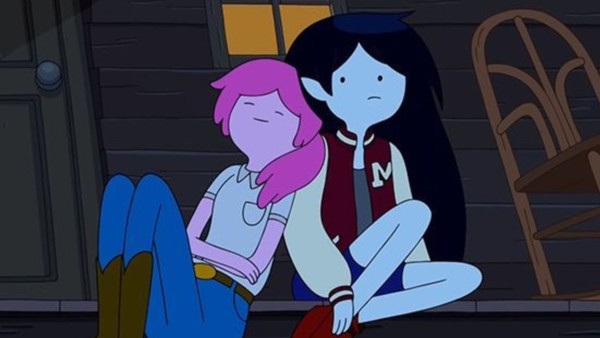
Adventure Time is a special sort of show, one that most agree was the face of cartoons of the new decade, its unique style and mix of surreal creepy post-apocalyptic yet pastel, colourful fun locales in the Land of Ooo catching the attention of most viewers throughout the years.
Though the main team of Jake the dog and Finn the human are fantastic protagonists, a lot of the interesting stories come from the show's extended, recurring cast, including the characters of Princess Bubblegum - a mature and pleasant but surprisingly grey-moral scientist who rules the Bubblegum Kingdom - and Marceline the Vampire Queen, a cool, fun-loving musician and 1,000 year old half-demon vampire who sucks the colour red out of objects rather than blood.
Due to their long history of friendship later revealed in the show, many saw what seemed to be more romantic nuances underneath, with both spending time as young women and then making sacrifices for each other later on despite a long period of estrangement between them.
It all comes to a head during the finale, where the two seal their bond with a kiss and pursue a relationship as the Land of Ooo recovers from war.
3. She-Ra And The Princesses Of Power
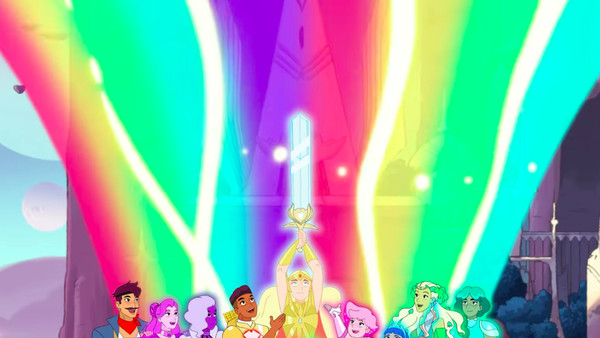
Creator Noelle Stevenson is no stranger to queer representation in her works, with Eisner Award nominated webcomic (to be turned into a movie) Nimona featuring romantic tension between its major villain and his nemesis hero, so there was a lot hinting that this would be much the same in her modern Netflix adaptation of the classic cartoon She-Ra.
The new title, She-Ra and the Princesses of Power, is a fun and colourful romp for kids, yet surprisingly deep and nuanced in its world-building and storytelling in ways that haven't been seen since Avatar: The Last Airbender, with the complex relationship of love yet clashing ideologies between hero Adora and villain Catra forming the solid central conflict.
It's also overtly playing off gender stereotypes in a way that does the original series proud, with the added bonus of casually dropped queer couples and characters such as princesses Netossa and Spinnerella, as well as Bow, one of the three protagonists and one of Adora's best friends, having two dads, and openly crushing on characters such as swashbuckling pirate captain Sea Hawk.
The Season 1 finale rainbow that forms when all the princesses of power come together isn't at all subtle, either.
2. Voltron: Legendary Defender
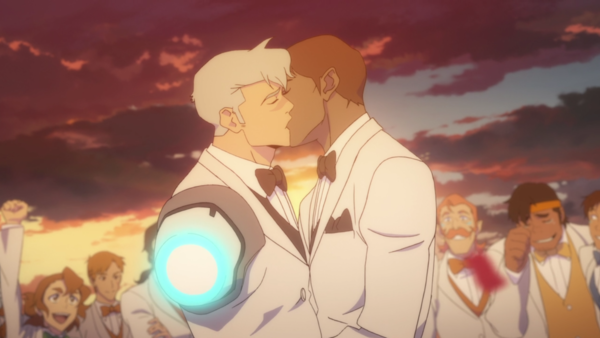
Netflix's reboot of a classic cartoon, Voltron: Legendary Defender, had a lot going for it, with excellent characters and writing and stunning anime-esque animation keeping the action cartoon fresh and exciting.
No single character was the "main" character of this show, with the ensemble cast of Voltron's Paladins each having equal importance.
A fan-favourite, however, was Takashi Shirogane, or Shiro, the eldest of the team and a seasoned fighter and leader, the Black Paladin (of Voltron's head, the Black Lion) whose level-headedness yet friendly and supportive demeanour got him the fandom nickname of "Space Dad".
So popular was he that when originally, the creators intended for him to die early on, he stayed; first as the leader of the Paladins, losing that role briefly, and then becoming a commanding officer of the battleship Atlas, when Voltron joined earth's forces in fighting the Galra Empire.
It's later revealed that Shiro once had a significant other named Adam, who died defending the Earth from Galra invasion. The final scene of the entire series features Shiro marrying fellow Atlas crewmember Curtis, in what is considered the first gay male marriage, and second same-sex marriage (the first appearing later on this list), in all-ages Western cartoon history.
1. Steven Universe

In Steven Universe, the titular Steven, a half-gem half-human kid who's part of the earth-defending Crystal Gems, finds out over the course of the series about his powers and his mysterious mother - a gem who "died" in order for him to be born.
With what seemed like benign, pastel alien fun times at first, the show's trajectory suddenly turned far more intriguing when it's revealed that one of Steven's guardians, a put-together competent Crystal Gem named Garnet, is actually two smaller gems combined, constantly "fused" together due to their devotion to one another. Their relationship is touched on further into the story, eventually culminating in a musical episode surrounding their Earth-style wedding - the first same-sex wedding ever to be aired on a children's cartoon show.
Pearl, one of the Crystal Gems, an over-protective perfectionist, is revealed to have been in love with Steven's mother, Rose Quartz, whose death continues to affect Pearl throughout the show.
Showrunner Rebecca Sugar hasn't been shy about her pushes towards queer rep and obstacles she ran into, but her continuing efforts have led the way for such representation in future shows, while her own remains a steadfast reminder of what love can really accomplish.
How Well Do You Know Adventure Time?
