10 Most Fearsome Alien Races In Star Trek
Some of the new civilizations Starfleet encountered were pretty terrifying...

Star Trek was dreamed up by Gene Roddenberry as a vision of a futuristic utopia, free from the struggles and strife of the turbulent 1960s. All races under the sun would come together and explore the far reaches of the galaxy in harmony, putting aside their differences and embracing their connections.
It was also an opportunity to dream up all manner of scary monsters and have them chase William Shatner around a cheap set. Intergalactic peace is all well and good, but if you’re looking to keep a TV show running, you need a little conflict - and nothing says conflict like the lurid beasts which populate the Trek universe.
From cunning strategists to noble but deadly hunters and balls of pure evil energy, the franchise has had more than its share of richly detailed alien species, all of whom naturally come with their own mythology and history.
Some, it must be said, are daft: they’ve aged badly, or they were dumb ideas to begin with. But others have cemented themselves as recurring villains or threats to the continuing safety of StarFleet.
10. Hirogens

A species whose entire existence and civilisation was built around the practise of hunting, the Hirogens were one of the most purely violent aliens ever featured in the Star Trek universe. They weren’t the most violent creature ever to appear, but their sheer lust for the chase makes them especially frightening.
The Hirogen had little respect and zero empathy for other species, treating them only as potential quarries for the next hunting expedition. They were no mindless killers, though: the ritualistic nature of their revered hunts required them to study their prey scientifically, ensuring the methodology of the kill was appropriately selected for the victim in question.
The unerring focus on hunting almost led to their downfall, as the Hirogens took to entertaining themselves with hologramatic simulations of potential victims. To up the challenge, the holograms were programmed to learn and adapt, eventually turning the tables on their erstwhile hunters.
The Hirogen were pushed back, but as a race they have what it takes to be a particular threat to the galaxy, with a proliferation of technology and weaponry, along with an innate bloodlust and understanding of hunting techniques.
9. Talosians

The Talosians were used sparingly in The Original Series, but their particular quirk was clever and original enough to leave quite the lasting impact. Their bulging foreheads and dashing cloaks give them an archetypal alien supergenius look, but their way of life and their methodology is particularly fiendish.
After a nuclear holocaust laid waste to their planet, the surviving Talosians, buried under the rubble, were forced to harness their psychic abilities (hence the big old heads). They learned to summon convincing illusions, which passed the time for a while, but soon became a little boring and predictable.
From there, their pleasure was derived from luring space travellers to their homeworld, where they would beguile the lost souls with their incredibly real conjurings.
The Talosians, it seemed, had no real malice to what they did, but could easily snap the brains of any of their human subjects. They end up assisting Spock et al in their reappearance later in The Original Series - but if they wanted to, they have the power to wipe out just about everyone through sheer mind trickery.
8. Nausicaans
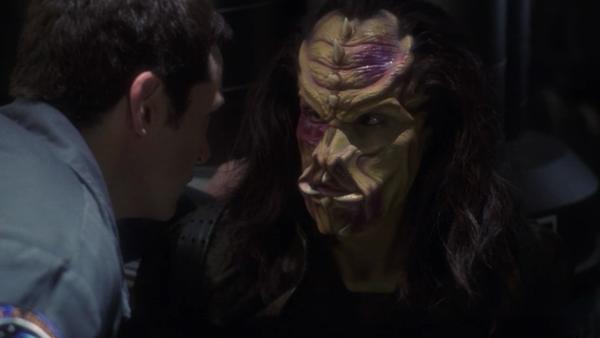
The physically imposing Nausicaans stood about two meters in height, and boasted a ghastly, bony visage, making them look half wild pig, half professional wrestler. They were not an advanced race, choosing to settle conflicts with brute strength rather than technological superiority, but as Picard was to discover, you didn’t want to get into a disagreement with them.
The Nausicaans were essentially space pirates, attacking and raiding freighters across the reaches of the galaxy. Once this trade dried up, their imposing appearance made them a common choice for bodyguard or mercenary work.
Most notably, a group of Nausicaans stabbed a young Picard through the heart after a disagreement over a game of Dom-jot. Their weapon of choice, the Nausicaan sword, is a nasty, jagged thing, and Picard would have been a goner had a nearby medical facility not quickly cooked him up an artificial heart.
The Nausicaans appeared across four iterations of Star Trek, and while they were always a cool and imposing species, it sometimes seemed that there was more to come from this particular alien race. Perhaps the rebooted Picard will have the opportunity to settle scores with his old foe.
7. Cardassians

A war hungry race first seen in The Next Generation, the highly dangerous and ever untrustworthy Cardassians became one of ‘90s Star Trek’s most dastardly species. They may have a name like a reality TV family, but for three generations of Trek, they were perhaps the galaxy’s greatest threat.
Their debut sees a peace treaty between the Cardassian nation and the United Federation of Planets severed, and while the Cardassians aren’t exactly to blame for this, they’re more than happy to run with the ball once the truce is over. They attack and annex various under defended planets, resulting in substantial territory.
By the time Deep Space Nine comes around, the Cardassian empire is starting to crumble, but the individual characters come to the fore, culminating with 1993 episode “Duet”, regarded as one of the series’ finest ever moments.
The tale of the Cardassians is almost tragic - they’re conquerors who didn’t quite know what to do with the spoils of war. They’re capable of great atrocities as we learn in Deep Space Nine, but they’re depicted with such detail that they can’t be dismissed as simple stock baddies.
6. Jem'Hadar

A spiky race specifically engineered for military purposes, the Jem’Hadar comprised the bulk of Dominion’s forces, making the villainous force one of the most powerful organisations in the galaxy.
Bred in birthing chambers, the Jem'Hadar reached full maturity in three days, by which point they were primed for a life of violent servitude. They require no sleep, deriving their energy from a suspicious powdery white drug, to which they are kept addicted by their scheming overlords.
As fighters, they had essentially no weaknesses: strong, strategically gifted, endlessly loyal to Dominion’s Founders. They were happy to lay down their lives for the cause, which was just as well: no Jem'Hadar ever lived to the age of thirty. Their motto - “Victory is life” - demonstrates succinctly their limitless dedication to the cause.
The Jem'Hadar are a tragic species, never allotted the chance to be anything other than killers, soldiers for someone else’s war. They’re tough as they come, and the carnage inflicted by their troops is nothing to be taken lightly, but they never had a choice in the matter.
5. Klingons
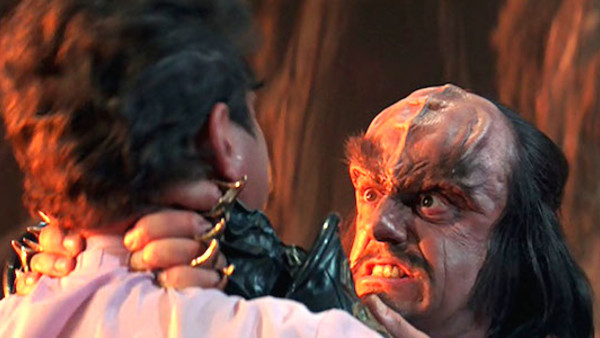
Perhaps Star Trek’s most famous alien race (give or take a Vulcan), the Klingon species has gone through significant changes over the course of the series. As the Klingon culture and way of life has been expanded and further examined, more sympathetic elements of the wrinkly headed creatures have been revealed - though the Klingons remain a species you would not want to mess with.
Early depictions of Klingons were pretty crass - there was little depth to them other than a propensity towards scheming and general oafish wrongdoing. The design was iconic from the off, but their early appearances were none too thrilling.
By the time the first film rolled around, things were changing. The Klingons adopted elements of Japanese feudal culture, and from there they were redesigned as a proud, honourable warrior race. A Klingon language was developed; The Next Generation even introduced a Klingon member of StarFleet.
The evolution of the Klingon race is an admirable example of the writers taking something base and reductive and expanding it into a fully believable species. Even with the addition of principles and honour, though, you still don’t want to get on the wrong side of them.
4. Crystalline Entity

A ravenous, all-consuming creature floating malevolently around the galaxy, the Crystalline Entity has one of the highest body counts in the Star Trek universe. Its only aim is to feed, and it does so by stripping planets of all their resources, obliterating all life forms present and future for years to come.
The Entity makes its debut in The Next Generation episode “Datalore”, wherein evil android and Data lookalike Lore has teamed with the nasty cloud in the interest of self preservation. That the Entity is able to actively scheme with other life forms is strange, but only serves to make it more frightening.
The Entity continues its rampage in “Silicon Avatar”, destroying colonies and ships alike, until the Enterprise crew are finally able to defeat the monstrosity with a gravitational pulse.
The Crystalline Entity - incidentally one of the show’s first CGI creations - does not appear again in the series, but the (admittedly non-canonic) novels detail further encounters with the villainous creatures. Perhaps they were used sparingly due to the technological constraints of the time, but in terms of pure destructive power, the Entity’s planet devouring MO takes some beating.
3. Romulans

Created by writer Paul Schneider, the Romulans were designed as a thought experiment: what if the ancient Romans had been around in the days of space flight? One of the most iconic and longest serving antagonists in the Star Trek universe, there are scarier creatures than the Romulans, but few with the ability to cause so much organised chaos.
Believed to be of a similar origin to the Vulcans, the Romulans retain all the logic and know-how of their pointy eared brethren, but add incredible militaristic intelligence and a hunger for war. In their first appearance, 1966’s “Balance of Terror”, an early classic episode, they go head to head with the Enterprise in a deep space shootout, cementing themselves as one of the most credible threats to Kirk and co in the galaxy.
Since then they’ve reappeared as antagonists in most iterations of Star Trek, on screen and in print, and have cemented themselves as one of the richest and most destructive creatures in the wider Trek universe. The new Picard show has a heavy Romulan focus, showing how much life there is in these 50 plus year old inventions.
2. The Borg

By sheer definition, it’s tempting to declare the Borg the ultimate reason to be fearful in the Star Trek universe. A cybernetic hive mind, unfeeling, unbendable, unerringly focussed on its mission. With the ability to assimilate the very essence of all life, all species across the reaches of space, there are essentially no limits to the Borg’s power. Resistance, as they say, is futile.
Probably the most iconic antagonist of The Next Generation, the Borg represented a threat unlike any the Enterprise crew had come across before. They waste no time cementing themselves in this position - by their second appearance, they had successfully assimilated Captain Picard (briefly, anyway).
By the time the First Contact film came out, the Borg had been designated a Queen, less a true monarch than an avatar speaking for the collective. This received a mixed reaction from fans of Borg Classic, but as a focal point for the film and as a visual, the tendril-headed Alice Krige worked well.
With so much power at their fingertips, it’s surprising that the Borg didn’t manage to assimilate all existing life. It seems technology is just as unreliable in the 24th century.
1. Xindi
One of the more physically repellent creations in the Star Trek universe, the Xindi is a collective of five subspecies who evolved on the planet Xindus. Ranging from the humanoid Xindi-primate to the fish-like Xindi-aquatic (i.e: it’s just a fish), the five disparate alien races (with a sixth avian version being long extinct) lived in constant conflict on their home planet.
The reptilian strand was the most gruesome looking as well as the most aggressive - hoarders of weapons, they were militaristic, often pushing for the invasion of earth. They tended to side with the insectoids, who were similarly prone to rash decision making, though lacked the physical build of their scaly brethren.
All Xindi are more than capable of violence, though, as evidenced by the Xindi civil war, a century-long conflict which led to the complete eradication of the avian subspecies, which was blown to bits at the culmination of a desperate play by the reptilians.
One of the most deeply considered alien races in all of Star Trek, the Xindi weren’t always a threat to humanity, but their constant warring made them huge threats to each other.