10 Reasons Why Ricky Gervais And Stephen Merchant Are Such Good Writers
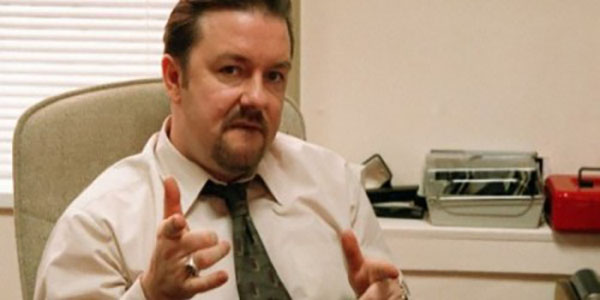 David Brent has finally achieved his dream: he and his band, Foregone Conclusion, will play a couple of "low-key" gigs in October next month. Brent is officially a rock-star; but to many, he's already one of the finest sitcom characters of all time. And the character will forever be synonymous with Ricky Gervais. The same Ricky Gervais who's released books, presented chat shows, stinted as a radio DJ and appeared in countless Hollywood films, probably still gets asked to do the dance. To much of the public, there's no line between the two: Brent is an extension of Ricky's media personality, and when watching Gervais on-screen in 'Stardust', 'Ghost Town' or 'Night at the Museum', you generally expect a "weeeellllll..." to pour from his mouth, before a witty retort. Ricky Gervais is a much-underrated actor though. Really. But in this article, I'll focussing on something that's not really discussed much in relation to him: I'll be discussing why he and his writing partner, Stephen Merchant, are head and shoulders above nearly every other sitcom writer to emerge from 21st Century Britain. In my opinion, of course.
10. Gervais Doesn't Hog The Best Lines
 Let's attack a common criticism of Ricky Gervais head on, and get it out the way early on: is Ricky Gervais an arrogant, self-centred comedian? Well, he's the lead role in a lot of his projects, but he's not actually intended to be the funniest character in any of them. David Brent is someone who thinks he's funny; if you want to find the likeable, witty bloke in 'The Office', you'll find him sat at Tim's (Martin Freeman) desk. Andy Millman in 'Extras' is a straight man for the likes of Sean "Barry" Williamson, Darren Lamb and a constellation of guest stars to bounce off. And Derek is barely a comedy character at all. The cocky act that Gervais uses really just is an act. And because of this, it hits you hard when he makes you cry. In fact, for a comedian considered arrogant, Gervais puts himself in positions to make other actors look good. Just look at the scene in 'The Office' when Brent's trying to explain a self-evaluation form to Big Keith. The moments where Neil and Finchy take it in turns to dig at him. The joke is nearly always on Gervais's character, just like the joke's on Basil Fawlty, Arkwright, Del Boy or even Brian Potter. It's a classic British sitcom trait for the leading man or woman, and something that Gervais and Merchant picked up on straight away in their writing.
9. They Always Pick The Perfect Path To Take Their Shows Down
Pick a show, any show, that you stopped watching or you don't like as much as you did. It might be that it evolved so far away from what you liked about it, that it lost its centre and its roots ('Skins', 'Heroes', 'Lost'). It might be that it went on so long, it was badly revived/spin-offed, or that it became predictable or cliched ('Only Fools', 'Friends', 'Open All Hours'). More often or not, there's a love story with the lead character. More often or not, it culminates in the final episode. But Gervais and Merchant don't play by the rules in this sense. Nothing has time to grow old or stale, as nothing outlives the two series + specials mark; Brent's had more screen time in short appearances that took him out of his comfort zone ('The Office' , 'Equality Street'), but with each new appearance, it takes nothing away from his previous swansong. Frankly, it's a relief that Andy didn't end up with Maggie/reappeared as a face in 2010's TV culture, because we need breathing space from these characters. It's the reason Michael McIntyre's not considered a credible comedian anymore, why Harry Hill will always be the guy off TV Burp, and why it's really okay to switch over if you see 'Only Fools and Horses' on Gold. And whilst 'Derek' ended beautifully, you know there's a million and one places Gervais could take him. And you know he'll pick absolutely the right one.8. They Don't Write To Please Anyone But Themselves
 As Andy Millman once said, the best things are auteured. ("Ha... turd.") It's true of a lot of art, and in the case of Gerchant (or Mervais if you prefer), their creative vision is completely undiluted. 'The Office' was so different because no one interfered: we can't know for certain, but don't you think 'Extras' is a skewed documentary of how Gervais and Merchant could've ended up? Either way, there's something brilliantly satisfying about the small details and layers that no one else notices in comedy, from the punchline of the "Dave" joke in 'Only Fools' at Rodney's wedding, to the serial killer surnames of 'Gavin and Stacey's characters. You only get that when a creative team are left alone to come up with ideas that please themselves, and perhaps no one pleases themselves more than Gervais, who was quite willing not to film 'The Office' if it wasn't exactly what he wanted it to be. When writers are left to their own devices, they can create something that feels free and unforced. 'The Office' is like a good book that you invest time and effort with, and in time, it rewards you back. You feel a greater connection to the writing for it, and it stands up to repeated viewings. There's a reason some comedians have a limited shelf life.
7. Their Characters Are Believable
 The David Brent that's appeared on YouTube in 2013 is exactly the same David Brent that appeared in the very first episode of 'The Office'. There has been progression for the character, but Gervais was born to play him: he was always a classic television character, from Day 1. But it's not just Gervais and Merchant who seem to just "get it" right away; everyone in their shows is believable. They're caricatures, sure, because it's a comedy, but we all know a bloke at work who's a glorified milk-monitor. We can accept that Barry probably gets depression over his lack of work. Johnny Depp and Orlando Bloom are probably divas off-screen, and we all like to think we wouldn't take crap, like Karl Pilkington's character in 'Derek'. And the fact that Gervais and Merchant set their work in the real world, with real people, real situations and real emotions, only draws us closer to the likes of Brent.
6. They're Not Afraid To Laugh At Jokes In-Show
 Don't get me wrong, I'm a big 'Friends' fan (you have to be in our house, we've got the box set; it's like E4 never cancelled it). But there's something I've always wondered about; why is it that no one laughs at Chandler's genuinely funny jokes? It's the same with a lot of shows, a lot of really good shows, actually. And not just comedies. But another blurring of fourth wall in 'Extras' is that Andy actually laughs at Maggie. The final joke ("I want to go somewhere where no one knows who I am..." "What about Hollywood?") is actually very witty, and it deserves to be rewarded with some kind of laughter, not just a tut and a frown. It's the same in 'The Office' when Brent finally makes Wernham Hogg laugh in the Christmas special, or when Dawn laughs at Tim's jokes. It's so much cleaner than a laughter track. It again makes the show more realistic. And if it means we get to hear Ricky's brilliant laugh, it's worth it.
5. They Comment On Society
 There's a reason why David Brent was so relevant, and why he's still perfect to star in YouTube videos. He's an epitome of 21st Century British culture, in that he's obsessed with fame and being famous. It's the same with Andy Millman. But a lot of Ricky Gervais's work is relevant to society in other ways; there's usually a conflict in his shows about the differing opinions people have about religion, and 'Derek' is an analysis on how we view old and disabled people. There are scenes in 'Extras' where the pair tell us that the grass isn't greener when you're famous, and 'The Office' probes the topic of offence, when Brent tells a racist joke or nicknames start spreading around the office. It's one thing to produce a television programme that makes people laugh, but 'The Office' and 'Extras' are products of a culture and a way of thinking. These shows are commentaries about the boom of celebrity culture and the internet, and when people look back on them for years to come, they'll see not just what made us laugh back then but what was going on in society, just like 'Dad's Army' or 'Blackadder'.
4. They Write Without Running Gags Or Catchphrases
 Because it's so easy to fall back on the same line to make someone laugh. It's the same with a laughter track that cues you when to join in. Andy Millman commented in 'Extras' that catchphrases were a cheap laugh, and to take nothing away from the shows that use them, 'The Office' etc are ambitious not to recycle the same lines of dialogue. Brent is a character that is so well-rounded, so brilliantly consistent, that if you want to impersonate him, you might do "a Brent moment", rather like you would with Alan Partridge, Mark Corrigan or Norman Stanley Fletcher. These characters can't rely on a fall-back joke, and that's not only more exciting, it makes for more realistic television. It's not that "I don't believe it", "How you doing?" and "I'm free!" aren't funny. It's that catchphrases can sometimes sum up a character in a single line of dialogue, and Brent, Andy, Tim, Derek, Darren, Gareth, Dawn and Barry are such brilliant characters, they don't need to be boxed like that. Comedy is all around us, and Gervais and Merchant capture that perfectly.
3. They Blur The Lines Between Genres
 I don't know about anyone else, but when I first watched 'The Office', I didn't realise it was a sitcom. It was partly the subtlety of the humour, partly the format. The same format's used in 'Derek', and it's brilliant because it gives one-to-ones with characters that you wouldn't usually see, and you get moments like the "People see me, and they see the suit, and they go: "you're not fooling anyone", they know I'm rock and roll through and through" speech. But it's not just the fly-on-the-wall format, it's the blurring of comedy with drama. 'Derek' is a prime example; here, Gervais has the balls to write something that's both funny and touching in equal part, but something that makes you think. The fact that he and Merchant don't want to stay with one tone throughout is not only ambitious, it's refreshing, especially given the tragic themes of their work. And that's without mentioning how Gervais has turned the "YouTube guitar tutorial" genre on its head. Is there anything that man can't do?
2. It's Brilliantly Heartbreaking
 Good comedies make you laugh, but great comedies make you cry. Like when Blackadder and Baldrick go over the top or when Del Boy's all alone after Rodney's wedding. Gervais and Merchant don't just include these moments, they specialise in them. It's possibly Ricky Gervais's finest moment when David Brent's made redundant, to take a laughable figure that everyone thinks is an idiot, and to write and act in that scene. 'Extras' has its moments too, again with the last scene, but even just moments when Andy's so disappointed with 'When the Whistle Blows'. 'Life's Too Short' was subtly poignant too, and don't get me started on 'Derek'. I well up just thinking about that final episode. It's a gift that not many writers have, to be able to switch between such extreme emotions. But it's almost as if these shows are anti-comedies; shows that don't focus on what's funny in life, but what's really sad. They just happen to also be hilarious.
1. We Relate To The Fundamental Trait In Gervais's Characters
 If you take each of the lead characters from the big three - David Brent, Andy Millman and Derek Noakes - they all have one thing in common. They just want to be loved: Brent by his workforce, Andy by his public and Derek by a father figure. And this is something that we all have in common: we just want to be loved by someone. We feel for these characters, not because we're similar to them, but because it's a basic human trait to want affection. We reciprocate it, because deep down, Gervais's characters might be smug, cocky or idiotic, but they're vulnerable. This is essentially why Gervais and Merchant are such good writers; they can create characters who crave attention or alienate their friends, and we still like them. We still feel for them. And we rewatch these shows over again, seeing them in a new light, and taking them slightly differently to how we did last time. Why do you think Gervais and Merchant are so good though? Which are your favourite characters? What are your favourite moments from 'The Office', 'Extras', 'Life's Too Short' and 'Derek'? Please comment below!