10 Things We Learned From Twin Peaks: The Return Part 5
Black boxes and black comedy.

Mark Frost broached the idea of returning to Twin Peaks with David Lynch in 2012, inspired and challenged by the prestige drama heirs to their groundbreaking throne. Those first meetings were, by all accounts, interesting and fruitful. It took several, however, for the co-creators to find a way back into the story.
The irony of the original series finale is that it was conceived as a highlight reel of cliffhangers intended to persuade ABC to pick up a third season. The longer time marched on, the harder it become to pick up the the thread. It had been torn by the duration Cooper spent in the Black Lodge; it was no longer possible to run with the original idea of a Garland Briggs-helmed rescue mission. The doppelgänger had spent too much time in the real world. There was too much scope for him to commit terrible deeds.
In that sense, the arc of Dale Cooper as Dougie Jones is ingenious. The idea of Dale Cooper was dead. He had to be reborn.
Derided in some quarters for its broad comedic strokes, the almost unbearable pathos of Part 5's protracted last scene has humanised this bastardised version of Dale Cooper. You might not believe those around him can remain oblivious. You might not buy that coffee has the inherent ability to tap into the human soul. But you cannot deny how much you desperately want Cooper to return to the world.
In an indefinable sensory assault, that might be the point.
10. The Scariest Things Are That Which We Cannot See

The opening scene sees Tammie Baird's Lorraine lament the botched assassination job on Dougie Jones in a terrified panic.
"She's a worrier," one of the goons says. The camera cuts to her office, her face twisted in a fearful grimace, her fingers digging into her nails. She agonises over the message she needs to send, nostrils flared, her hair as frayed as her nerves. She dials a number on her Blackberry. We then cut to an as-yet unknown location signposted by a lightbulb. More electricity. The message is received by a mysterious black device decorated only by two LEDs. They flicker - in red, naturally - but there is no response.
Lynch has added a Blackberry smartphone to his list of utterly mundane items (ceiling fans, videocameras ) rendered completely terrifying in his hands.
We know from the premiere that Jeffries wants Mr. C dead. We know from Part 3 that attempts on the decoy, Dougie Jones, failed. What we don't know is why Jeffries wants the doppelgänger dead - though a choice use of understated dialogue quickly led us (but didn't tell us; the sign of advanced storytelling) to a bizarre conclusion.
Recasting isn't new to the Twin Peaks universe, though Lynch resisted the temptation (and reiterated the theme of duality) by creating a second Sheriff Truman. Harry Goaz (Deputy Andy Brennan) let slip that David Bowie was slated to appear before his death, but didn't film his scenes. Then again: respectfully, how would he know? Scene partner dialogue was kept from every actor. It can be reasonably inferred that an earth-shattering cameo wasn't the topic of choice in the make-up chair.
If not Bowie, then who? Tim Roth has yet to appear. The Little Man From Another Place is now a tree. Garland Briggs and BOB have appeared via computer trickery. It's borderline impossible to predict at this point.
9. The Comedy Of Twin Peaks, Part 1: Gallows Humour

The humour in The Return has ranged from dark, to offbeat, to unfortunately broad. The scene in which Lucy Brennan flew off her desk chair at the sight of Sheriff Frank Truman using a mobile phone didn't put much fish in anybody's percolator, but it was the exception. Much of The Return has been a riot, the funniest stuff taking place in South Dakota.
Jane Adams' Constance Talbot continued that grand tradition in a black comedy masterclass easily as funny and macabre as its spiritual predecessor. In her autopsy report, she struggles to comprehend the cause of death. "Cause of death. Took me a while, but I think somebody cut this man's head off."
Hers is an altogether different strain of sarcasm to Miguel Ferrer's Albert Rosenfield.
The already brilliant material is elevated by Adams, who is perfectly cast. Such glibly nihilistic stuff should not emanate from such a sweet, doe-eyed face. "Here's the headline. Actually, I just gave you the headline." Adams puts that slightly lesser bit over the top by feigning to corpse.
The scene does serve a purpose beyond the gallows humour. Talbot discovers a ring inside of Briggs' stomach, inscribed "To Dougie, With Love, Janey-E." It's clear that Mr. C is setting Dougie up to take the fall - what isn't clear is why it took fifteen attempts.
8. We Have Frank Silva (And Yet More Nightmare Fuel)

The relationship between Special Agent Dale Cooper and BOB was and remains complicated.
In contrast to the possession of - or collaboration with - Leland Palmer, BOB found his way back into the outside world using Cooper's doppelgänger. Lynch subsequently underscored that this was separate to the Leland possession, waters muddied by the reflection of BOB in the mirror in the original series finale, itself a reflection of the reveal of Laura Palmer's killer.
Those waters are muddied yet further - or diluted - when Mr. C gazes back at himself in his prison cell. We flashback to the last scene of the original series, as Cooper's doppelgänger smashes his forehead into the mirror. We then cut back to 2014, The reflection begins to alter its form, almost imperceptibly. Mr. C's nose elongates. His lips narrow. A flash of grey appears in his hairline. Just before the image snaps back into its original form, we are left with a grotesque and perfectly executed special effect of BOB and Mr. C sharing the same face - a horrifying Black Lodge chimera.
"You're still with me," Mr. C states. "That's good." The dialogue is interesting here. "With" suggests a certain collaboration, eschewing the sci-fi possession leanings of the divisive episode 16.
"Still" is equally intriguing. Agent Phillip Jeffries, or an entity impersonating him, told Mr. C in the premiere that he wants to be "with" BOB again. There is a war going on for BOB's affections.
7. The Comedy Of Twin Peaks, Part 2: Way Broad

For all its groundbreaking surreality, Lynch has indulged in genre tropes thus far in The Return. We've seen two canoodling lovebirds shredded by some unspeakable horror in the premiere. And now we have bore witness to Sheriff Frank Truman: henpecked husband.
The scene is salvaged by two things. As heard in their brief phone call, Harry Truman is bravely battling an undisclosed illness. It's a small, good thing, David Lynch refusing to retcon Harry as a result of the actor's non-anticipation. It would be convenient to ostensibly write the character out - it's still heartbreaking that Michael Ontkean didn't return - but Lynch has kept the actor in his thoughts and in doing so has recreated the effect of Twin Peaks as a real, lived-in place. Lucy's comedic stylings were broad in the extreme in Part 4 - but here, heard only over the phone, she is her hilarious, metaphysically-fascinated self. Robert Forster is magnificent, responding to his wife's "Why aren't you in your office?" nag with a forthright, deadpanned "Because I'm here."
But Candy Clark's performance as Doris is going to take some getting used to. The character is meant to be annoying, that much is clear. Her gesticulations and rising inflection, though, don't gel naturally with the offbeat tone elsewhere. It all feels a bit forced.
"You're impossible!" is how she finishes her rant. The irony is that her character is too impossible for the ironic jab to land.
6. The Labyrinthine Cast Reveals Itself More Fully

We are introduced to yet more new characters in Part 5.
Early standouts are Robert Knepper and Jim Belushi as casino bosses Rodney and Bradley Mitchum. Knepper is an unhinged force, collapsing into a wheeze of laughter after punching Supervisor Burns in the face under the mistaken accusation of collusion with Mr. Jackpots. "You're f*ckin' fired" he says, after kicking his stomach to a pulp. Belushi is more understated but no less terrifying in his controlled threats. "Leave town. Don't ever come back," he practically whispers, as ominous drones are heard in the background.
Caleb Landry Jones plays Steven Burnett, an the on-the-nose surname for his tweaker burnout. As exaggerated as his performance is, there is somehow an ambiguity to it. It's hard to gauge if there is a kindhearted, oblivious soul lurking within the pale shell, or if his meth-head enabler is more sinister, more insidious in his control over his wife Becky, played with a knowing weariness by Amanda Seyfried.
Becky is a woman in trouble, the parallels to Laura Palmer both clear in her drug use and subtle in Lynch's carefully considered production. The pattern on the headrest of Steven's car is reminiscent of the Red Room curtains.
Into what Becky is being drawn is similarly arcane.
5. The Old Dale Cooper Is Surfacing...
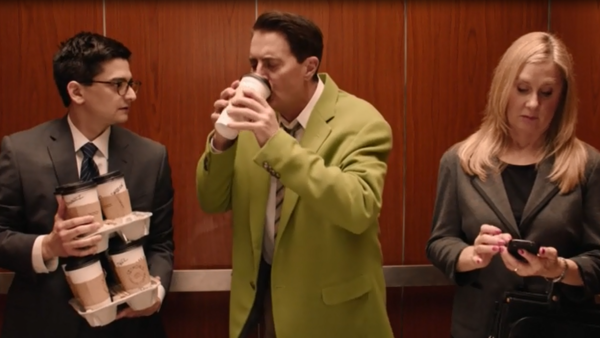
The Peaks fandom is split on Dale Cooper's arc.
Suspension of disbelief is hard; the man known to his family and colleagues as Dougie Jones exists in a borderline catatonic state, his misadventures precariously hovering over the line of plausibility. His wife Janey-E goes some way to assuaging the audience in her brief scenes with him. "Dougie, you're acting weird as sh*t," she says, breaking the self-reflexive housewife facade. She also alludes to this being a recurrence of some known "episodes". It's the barest hint of reassurance, but really, it's all MacLachlan needs to pull off the trick. His acting is easily the best of his career. If this quality is sustained and gradually escalated, as it is here, it might be among the best of anyone's career.
Harder still to bear is the near total absence of the Special Agent, whose boyish wonder and goodness is needed now more than ever, in a deeply troubled real world and a TV landscape overpopulated by the antihero.
The beauty in this storyline is in how masterfully Lynch and Frost have written around the quarter century cliffhanger. Cooper almost has to be an unrecognisable, broken husk in order to convey the awesome power of the Black Lodge. A halfhearted, two episode arc would both dilute that and any dramatic heft.
The return to his self is paved with some heartwarming and comedic moments hinting at the goodness within. The sight of Sonny Jim reduces him to tears - was he mourning a life not lived, or a young life undermined by a grotesque approximation of a father figure?
4. The Comedy Of Twin Peaks, Part 3: From Psychiatrist To Con Artist
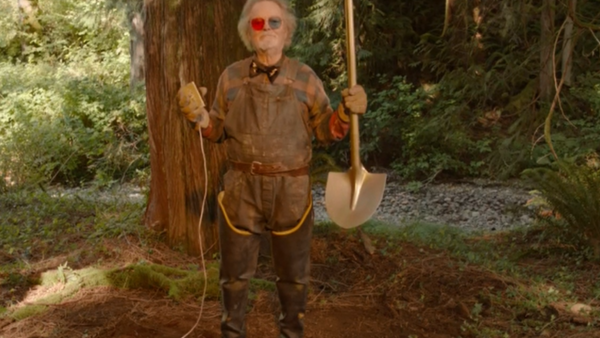
We now have a firm (and, eventually, satisfactory) answer to one of the more tangential mysteries posed in The Return: why is Dr. Lawrence Jacoby spray painting shovels gold?
When 7 o' clock strikes - that number permeates (haunts?) the entirety of Part 5 - Jacoby lives streams the conspiracy theory rantings of a libertarian nutjob. "We're sinking down deep in the mud - and the f*cks are at it again! The same vast, global corporate conspiracy! Let's see what they're cooking up for us today." We then cut to Jerry Horne, roasting a bone in the woodland air. "I know what I'll be cooking up." There's something indefinably hilarious about the concept and execution of Jerry Horne: Massive Pothead.
For a while, it's difficult to gauge how we're meant to receive this. We cut once more to Nadine Hurley, still patched up, nodding in approval at Jacoby's near-parodic environmental gripes. The mind briefly wanders to Mark Frost's ultra-politicised Twitter feed and reels at the thought of The Return acting as a thinly-veiled platform for his other passion...
...until Jacoby reveals the ruse. He plays a commercial advertising some glorified shovels - the coat of gold spray paint somehow enabling you to "shovel your way out of the sh*t!" for the low price of $29.99. "That's right!"
3. We Now Know Of A Fifth (And Sixth) Location

We pay a visit to the Pentagon in Arlington, Virginia towards the end of part 5.
There, Colonel Davis, played with instant gravitas by Ernie Hudson, learns from a subordinate (Cindy) that Garland Briggs' prints have been found in South Dakota. This is apparently the sixteenth such wild goose chase on which the military has been led. Only this time, the waterfowl has been decapitated by Mr. C and sliced up and sent up by Constance Talbot.
The Briggs storyline is intoxicating in its mystery. Sheriff's Deputy Bobby Briggs confirmed that Dale Cooper/Mr. C was the last person to see Major Briggs alive before he perished in a fire days after the events of the original series. All evidence points to Briggs being the John Doe found decapitated in South Dakota. Did he fake his own death, coded by the MAYDAY protocol at the close of The Secret History Of Twin Peaks? Did Mr. C use the fire as a cover to keep Briggs' body on ice, purely to toy with the intelligence services of the United States? We know that BOB was "eager for fun".
We also learned that the mysterious device on the receiving end of Lorraine's message is situated in Buenos Aires, Argentina - a location introduced to Twin Peaks lore in Fire Walk With Me. It was the site of Special Agent Phillip Jeffries' disappearance, and where he presumably remains.
2. Correction: Richard Horne Is The Scariest Thing

Echoes of Lynch's earlier work reverberate around The Return.
We've seen and heard the industrial aesthetic and harrowing sound design of Eraserhead. The disparate but interconnected plots of Mulholland Drive serve as the guiding narrative. The fractured psyche, first explored in Lost Highway, remains Lynch's preferred overarching theme.
We have now been introduced to the spiritual offspring of Blue Velvet's Frank Booth (and the presumed biological offspring of a to be determined branch of the Horne family tree) in Richard Horne. Like Frank, he is almost impossibly repugnant. He smokes bang in front of a No Smoking sign at the Roadhouse. He hands the Sheriff's station mole - the Log Lady skeptic - a huge wedge of cash concealed in a cigarette packet.
He then - in broad view of everybody - strangles and threatens to rape a woman unfortunate enough to ask for a light. It's shocking, uncomfortable stuff, played out in front of a Red Room-esque curtain and strobed backdrop. "Do you wanna f*ck me, Charlotte? Do you wanna f*ck? I'm gonna laugh when I f*ck you, b*tch!" The material is much in the over-the-top vein of Blue Velvet's criminal underbelly. Eamon Farren's Richard Horne renders it utterly menacing; his sharp, angular features cast him, phrenologically, as a handsome sociopath.
The echoes of the Black Lodge are intriguing. Whose offspring is Richard? Did Mr. C pay one last visit to Audrey before removing himself from the grid? Two Coopers. Two sons? More duality...
1. ...But The Old Dale Cooper Is Also A Long Way From Home
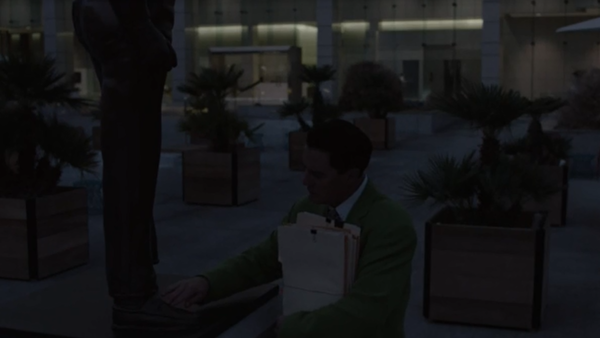
The final scene of Part 5 disrupts the pattern formed in the previous four parts in that the credits roll over the image of Dale Cooper plaintively touching the foot of a statue outside his office building.
The figure is decked out in a Sheriff's hat, its armed hand ready to aim. Its meaning may present itself in time. But as Johnny Jewel's Windswept played on the soundtrack (again, the melody was Badalamenti's stock in trade, but purposefully orchestrated by an unfamiliar composer to reinforce Cooper's alienation), its haunting saxophone and minor key evoking feelings of elusive belonging, it was impossible not to project Harry Truman's face onto the bronze.
This followed an episode where Cooper took baby steps towards recovering both his humanity and his identity. Something within him - or illuminated for him - led him to deduce that colleague Anthony Sinclair (played with a subtle, domineering menace by Tom Sizemore) is on the take. "He's lying," Cooper said, channelling the preternaturally gifted agent of the original series pilot.
Still, it feels hopeless; Cooper is alone, embracing the statue as dusk settles. He has been there for hours, unable to reconcile his place in the world nor articulate the dormant memories within him.
It was heartbreaking.