10 TV Villains Who Stole The Show
The best worst villains on the telly.

Much like in real life, on TV it’s more fun to be the bad guy. As the hero of a TV series, you’re responsible for driving the narrative forward, doing what’s right, and saving the day. It’s hard work, and quite frankly not always all that rewarding.
As the villain? Well, the world is your oyster. You get the cooler clothes, the better dialogue, sometimes a lair or an evil laugh. You don’t have to take anyone else’s feelings or concerns into consideration - you can do what you want, basically.
Sure, in due course you’ll be bested by the stalwart hero and likely either imprisoned or jailed (or in some instances you’ll learn the error of your ways and embark on a redemptive arc). But while it lasts, it’s a blast.
The best baddies can quite easily become the main reason we watch a TV show. Whether we’re directly rooting for them or just enjoying their evil deeds before they get their inevitable comeuppance, long form telly has become the medium of the villain, whether we’re gaining an insight into their behaviour, or simply getting a kick out of them.
10. Cartman (South Park)

When we first meet Eric Cartman, he’s a foul mouthed little fat kid with big dreams and delusions of grandeur. He’s crass and annoying, spoiled and demanding, but he’s not a villain. He has redemptive qualities and mitigating circumstances, too: his home life is hardly the happiest, and on occasion has saved the world.
Something changed around season five - specifically, the classic episode Scott Tenorman Must Die. Cartman enters into a feud with the titular older kid, and as the prank war escalates, Cartman takes the nuclear option of murdering Tenorman’s parents and feeding them to him. From there, Cartman is a vessel of limitless darkness. He attempts genocide, he infects his friend with AIDS, he carries out further murders, all the while remaining in the body of a small child.
This of course served only to make Cartman a more beloved comic creation, and his status in South Park is that of an astonishingly accomplished super villain. He’s sometimes described as the show’s antihero, but really he’s a full fledged monster, and all the funnier for it.
9. Nina Myers (24)

There’s no more deplorable villain than the traitor. An outspoken baddie who makes no bones about their evil schemes? That’s one thing. But to lurk in plain sight until the moment finally comes that you launch your ploy? That’s hard to forgive.
The reveal of Nina Myers as a mole inside CTU was perhaps the biggest shock in the first season of 24, which, for a show based predominantly around heavy doses of shocks, is really going some. An information broker willing to sell government secrets to the highest bidder, Myers is ultimately a nihilist, allied to no one and believing in little other than her own increasing wealth. She clearly enjoys her work, though, taunting Jack after killing his wife, and later gaining a presidential pardon for the murder of Bauer which she is yet to commit.
Sarah Clarke was left in the dark as to her character’s double agent status until late in the filming of the first season, adding great believability to Nina’s turn. There would be flashier enemies to come, but Nina’s betrayal of her agency and friends makes for a deeply personal antagonist.
8. BOB (Twin Peaks)

One of the most frightening villains in TV history came to our screens by total fluke. While shooting Twin Peaks’ pilot, a scene in the murdered Laura Palmer’s bedroom set dresser Frank Silva found himself trapped in shot. The distinctive image gave David Lynch an idea, and thus BOB was born.
Silva, Lynch’s longtime colleague, cuts a terrifying figure in the influential series, with long grey hair and a face perpetually curled into a malevolent smirk. BOB’s supernatural backstory is drip fed across the show’s entire run, but the sheer sight of BOB is enough to send chills down the viewer’s spine. Silva, a non-actor, is used sparingly on screen, but the spirit of BOB haunts the entire show. He is, essentially, evil incarnate, responsible directly or otherwise for just about everything bad that occurs during Twin Peaks’ run.
Silva died aged just 44, but such is the force of BOB that the character was brought back in a spectral form for the 2017 return, and was even given a backstory involving the dropping of the first nuclear bomb. For a character born out of coincidence, that’s a pretty big legacy.
7. Vern Schillinger (Oz)
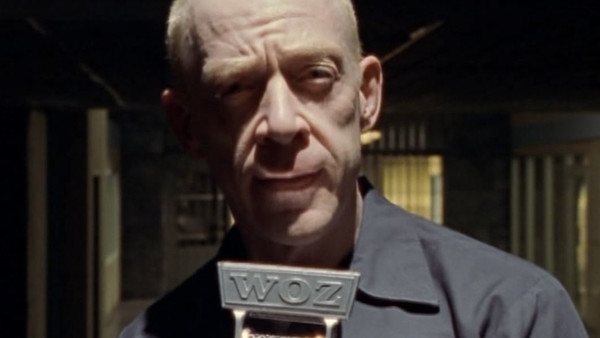
Being a drama set in a maximum security experimental prison, most of the characters in HBO’s seminal Oz are some shade of bad. Perhaps the worst of the bunch, and certainly the most sadistic, is neo-Nazi and all round prison heavyweight Vern Schillinger, whose plethora of foul deeds are one of the few areas of consistency in this ever shifting series.
Vern’s misdeeds include (but are not limited to) murder, assault sexual and otherwise, conspiracy to kidnap, and various hate crimes. An ardent racist, he leads the Aryan Brotherhood with an iron fist. In the hands of the ever-brilliant J K Simmons he’s undeniably charismatic, and even verges on sympathetic at times, as he experiences the odd moment of clarity and reflection. His villainy is forever at the forefront, though, and he perpetrates many of Oz’s most heinous crimes - which is really going some for this show.
Oz is, late on especially, a pretty insane show, but Simmons always keeps Schillinger grounded, making him far more frightening. The Oscar winner has since found a niche playing imposing figures, but he’s had few characters as awesomely terrifying as this one.
6. Mags Bennett (Justified)

The main antagonist from season two of much-missed crime drama Justified is about the nicest person you could hope to meet. Mags Bennett is matriarch not just to her tearaway kids, but to the folks she employs as part of her criminal empire. She’s reserved and professional, she makes a mean batch of moonshine, and she has a hell of a singing voice.
As portrayed by the brilliant Margo Martindale, she’s also nothing short of terrifying. With a lucrative marijuana farm to look after, she wants only to sell her wares and live a quiet life. She is beset on all sides, however, by the foolishness of her family, and the greed of her underlings. Early on, she poisons an employee for talking to the cops on an unrelated matter; the calm with which she talks him into, and then eases him through, his death tells us this is not the first time she’s done this.
She’s a caring soul and remains somewhat likeable throughout the season - but she is most certainly not to be trifled with. Justified was probably never better than in its stellar second season, and Mags - and Martindale - is the prime reason for this.
5. Lorne Malvo (Fargo)

Some men are made for villainy, and Billy Bob Thornton is one of them. Stealing a show with a cast as stellar as Fargo’s is no mean feat, but the former Mr Angelina Jolie is on scintillating form in the first season of the crime drama.
Lorne Malvo is an agent of chaos. Sent to Minnesota to carry out a hit, he meets hapless Lester Nygaard (Martin Freeman, showing villainous tendencies of his own) and ushers him into darkness for sheer enjoyment. Malvo pulls the strings for almost the full season, gleefully causing carnage and flaunting his ability to evade capture time and again. While he is ostensibly a career criminal, Thornton makes it patently obvious that Malvo would behave in no less dastardly a fashion if he worked for free. He’s utterly unrepentant, but blessed with such charisma that it’s not hard to root for him.
Fargo’s anthology approach means we saw the last of Lorne Malvo after season one. The writers have come up with many great baddies in the following years, but none have been quite so needlessly, cheerfully evil as its first grand antagonist.
4. Six (Battlestar Galactica)

It’s not difficult to see why Tricia Helfer became the face of the rebooted Battlestar Galactica. As the fatally alluring Number Six, she is a haunting and eerie character. She is responsible for setting off the plot in the pilot episode - which in this instance means murdering the majority of the human race.
One of a group of Cylons, eternal enemy to humankind, she is able to blend into and infiltrate regular society in readiness for a robot attack on civilization. Helfer, whose previous experience was in modelling, is given the heavy task of portraying a multitude of different Sixes, as copies of the beguiling ‘bot have been placed across the twelve colonies. In a show all about deception and shifting motives, Six is one of the lease predictable characters of the bunch.
She eventually becomes one of the more peaceable Cylons, regretting her role in the massacre and wishing to end interspecies hostilities. On Battlestar Galactica, though, the tension and paranoia is palpable at all times, and Helfer portrays Six, in all her forms, as a calculating and emotionless long term schemer, someone easily capable of turning on humanity once again.
3. Logan Roy (Succession)

Logan Roy doesn’t steal the show exactly - he IS the show - but his presence in HBO’s latest smash hit Succession is so great that he dominates every scene he’s in and every scene he isn’t in equally. Brian Cox’s towering performance has been rightly lauded, and between this and Jesse Armstrong’s scintillating writing, Logan Roy is the most frightening octogenarian in TV history.
Logan is an all consuming force of nature, driven by primal urges to accrue wealth and power, to consume and to dominate. His children are all petrified of him to varying degrees, and he takes a perverse glee in playing them off against one another. His rare moments of warmth are quickly undercut by his shark-like instincts to look out for number one at all costs. He controls his business and his family with the same iron fist - he is a King Lear type who has no intention of stepping down from the throne.
Succession is at its core a family comedy (albeit a family of billionaires), but the laughs tend to stop when it comes to the petrifying patriarch. In a show grounded in reality, Logan holds an almost supernatural level of power.
2. Spike (Buffy The Vampire Slayer)

Intended as a glorified villain of the week, Spike was meant to serve as a medium-scale antagonist to Buffy, a thorn in her side for a couple of episodes who’d eventually be bested. In a great example of hard work paying off, though, James Marsters’ performance was so brilliant that he ended up becoming part of the main cast within a couple of years.
An iconoclastic addition to Buffy’s underworld, Spike bucks vampire trends by preferring the shiny and modern to archaic traditionalism. With his Billy Idol-esque bleached barnet and quip-heavy dialogue, he’s the show’s coolest character, and if Marsters’ English accent isn’t great, the verve he puts into it lets him get away with it. Over time Spike ditched his dastardly ways and joined the Scooby gang full time; his story of redemption is one of the most textured arcs in the series.
Spike even shows up in the final season of Angel, where he quickly becomes an integral part of the LA crew. Capable of delivering drama, action, and ever reliable for snarky comedy, Spike is among Joss Whedon’s finest ever creations.
1. Gus Fring (Breaking Bad)

The real antagonist of Breaking Bad is the hero, Walter White, who evolves from a good man doing bad things to a bad man doing even worse things. Before the once-mild mannered chemist becomes truly corrupted, however, he locks horns with some of New Mexico’s most ruthless villains, and the best of these is Gus Fring.
Giancarlo Esposito plays the role with ice in his veins - Fring is a man who is in total control of his life and domain. As the proprietor of a successful fast food chain, he is held up as a pillar of the community, allowing him to operate his colossal drug ring with impunity. Polite and professional as a rule, Esposito slowly lets Gus’ mask slip, as the kingpin indulges in moments of brutality and savage revenge. The show is never better than when it pits Walt and Gus against one another, and while the former eventually triumphs, you could see it going either way at times.
Fring’s presence was so great that the show could never quite return to those heights following his thwarting. Real Gus heads needn’t fear, though, as they couldn’t resist bringing the big man back for prequel Better Call Saul, where he stole the show once again.