20 Best Sci-Fi TV Episodes Ever
A rundown of the finest reasons to strap on a spacesuit this side of TV...
 In the 1950s, as the medium exploded, producers realized there was a market for taking science fiction, long relegated to pulp magazines and Saturday morning movie series and transferring it to television. In making that move, the TV viewing experience was changed forever and sci-fi has maintained a broadcast presence ever since. Science fiction is one of the few genres that crosses national, religious, and ethnic lines with ease. For some its the hope of a better tomorrow, that human need to push boundaries, that makes sci-fi so compelling. For others its the visceral thrill of aliens and spaceships that pulls them in. And there are those who are hooked by the ability for sci-fi to speak to us as a species, commenting on the human condition and the emotions that drive us all. While there are literally thousands of examples to chose from, the following twenty offer a broad view of what makes science fiction the greatest genre in television history. And yes, spoilers will follow.
20. The Architects Of Fear (The Outer Limits , Season 1)
 While similar in design to The Twilight Zone, The Outer Limits generally focused more on straight science fiction as opposed to stories dealing with fantasy or the supernatural. The anthology format allowed for the series to present in-and-out stories, never falling prey to staleness, and so it wasnt opposed to telling tales that were designed to get under the viewers skin. The Architects of Fear concerns a group of scientists who look at the declining state of the Cold War-era Earth and deduce that nuclear annihilation is imminent. Concluding that the only way to pull back from the brink is for there to be a common enemy the planet can unite against, the scientists concoct a plan to fake an alien invasion. They chose one of their own to surgically alter into the appearance of an alien, who will then arrive at the United Nations to announce the aliens plans for world domination. The plot may seem familiar to those who have read Alan Moore and Dave Gibbons Watchmen, but the true power of the story lies in the emotional and psychological transformation the altered scientist goes through. To what degree are people defined by their appearance? How can the best qualities everyone keeps deep within come to light when people live in fear of each other? These remain classic questions of the genre to this day.
19. The Day The Sky Fell In (The Time Tunnel, Season 1)
 This mid-sixties series had a great premise and some of the most elaborate set designs of any sci-fi show. Two scientists, Tony Newman (James Darren) and Doug Phillips (Robert Colbert), work for a secret U.S. government program called Project Tic-Toc. Their facility houses the time tunnel, an experimental device that allows one to travel to any point in time. There is a malfunction and Tony and Doug are sucked in, continually being pulled backward and forward in time. This premise sets up their weekly adventures covering everything from pre-historic times, the eruption of Krakatoa, the sinking of the Titanic, and even the far distant future. In this episode, the pair jumps to Honolulu the day before the attack on Pearl Harbor. Tony grew up there with his father, an officer in the navy, who was presumably killed during the attack. Tony himself was playing at the house of his friend Billy Neal around the time of the strike. He locates his father and tries to warn him of the attack, but his father is understandably skeptical. Tony and Doug are able to convince Mrs. Neal to flee with young Tony and Billy before the attack happens, in effect saving future Tonys life. During the bombing, Tonys father is seriously injured while trying to warn the U.S. fleet. He arrives in time to help his father get the message out, but his fathers wounds are too severe and he dies in Tonys arms. The tone of this episode is another perfect example of how potent sci-fi can be when a great premise is married to some deep emotional moments.
18. Time Enough At Last (The Twilight Zone, Season 1)
 It doesnt contain a single alien, monster, or anything supernatural but Time Enough at Last is one of the most bizarre episodes of The Twilight Zone. It tells the story of Henry Bemis (Burgess Meredith), an obsessive lover of reading. His wife all but bans him from reading in their home; his bank manager boss berates him as somehow less manly for reading. So Henry sneaks down into the bank vault to read in private and while there, a nuclear holocaust occurs. Finding himself the lone survivor, Henry is despondent, suicidal even, until he stumbles upon the ruins of the public library. Just as he is rejoicing at the realization he now has all the time in the world to read, Henry breaks his glasses, leaving him all but blind. It may seem comical in moments, but what this episode really serves as is a morality play, an allegory dealing with the inability of some to make any real connections to the people around them. The unanswered question is why cant Henry bond with those in his life? Why is it that books are his only solace? These questions become more compelling if one views the whole episode as happening in Henrys head. Its a fantasy of the world Henry wishes for. Its a dark, yet fascinating perspective on one of the best episodes of the series.
17. Awakening (Buck Rogers In The 25th Century, Season 1)
 Most sci-fi fans know the story: a captain in the U.S. Air Force in 1987, Buck Rogers spacecraft suffers a life-support malfunction that freezes him in a state of suspended animation. It is not until 500 years later that Bucks ship is found and he is revived, discovering an Earth still dealing with the aftereffects of a nuclear war centuries earlier, as well as various threats from the intergalactic community. Not only does Buck have to navigate his way through this strange, new world, but he also must come to terms with the fact that everyone and everything that was ever important to him is long gone. Sounds like some pretty heavy stuff, but the series never took itself too seriously, instead allowing Buck (played perfectly with "nudge-nudge, wink-wink" charm by Gil Gerard) to relatively quickly find his footing in the 25th century. Consequently, the story could focus more on Buck showing these 25th century folks how to live a little. By combining all this into the feature-length first episode, the series informed the audience that as long as they continued to tune in, they would have just as much fun as Buck himself.
16. The Living Legend (Battlestar Galactica , Season 1)
 In contrast to its contemporary Buck Rogers in the 25th Century, Battlestar Galactica was a series that opted to take a more serious approach to its story telling. Any series that begins with the near annihilation of the human race would be hard pressed not to. In this episode Galactica comes across the Pegasus, another battlestar under the command of the legendary Commander Cain, portrayed by Lloyd Bridges. After initially rejoicing, the crew of the Galactica begins to realize that Cain is more focused on continuing to fight the Cylons than trying to protect what remains of the human race. Tensions mount between Cain and Adama over a proposed attack of an important Cylon base, the end result of which is the apparent destruction of the Pegasus during the attack. Combining great adventure and surprisingly deep commentary on the nature of fighting the losing fight, The Living Legend earns its inclusion here. When you have something this strong to work with it should come as no surprise that the reboot SyFy channel series of the mid 2000s chose to adapt this storyline for their own purposes.
15. Kiss (Defying Gravity, Season 1)
Defying Gravity had been all but abandoned by ABC before the first episode even aired. The network only broadcasted eight episodes leaving five unaired. Fans had to wait for a DVD release to see what ABC felt was so unworthy of their network. Any of this sound familiar Firefly fans? The year is 2052 and the crew of the Antares embark on a six year long grand tour of the solar system. Flashbacks are used to show how the crew came together and began their training 10 years prior. Relationships are made then broken. Loves and fears are shared then kept secret. And as the mission progresses, the crew comes to realize that there is a secret agenda to their voyage, one that involves an alien artifact found on Earth that appears to be signaling other objects spread throughout the solar system. Kiss was the last episode of the series and ends up serving as a coda to the story up to that point. Focusing mainly on the first manned landing on Venus, the episode uses the flashbacks to reveal the full extent of the relationship between Maddux (Ron Livingston) and Zoe (Laura Harris). It is Zoe, while on Venus, who nearly turns the mission into a one way ticket, determined to find the first alien artifact, believing it will provide insight into her life and the choices that have brought her to this fateful moment. Despite its brief run, Defying Gravity is well worth watching, as this episode proves. Its the perfect balance of sci-fi thrills and deep heartfelt moments. And for those seeking some closure: creator James Parriott conducted an online interview a year after the show was canceled in which he details where the story would have gone and how the entire series would have ultimately ended.14. Lee Harvey Oswald (Quantum Leap, Season 5)
 Quantum Leap had always been a fun show with a great hook, allowing Sam (Scott Bakula) to leap into the identity of different people week to week in an attempt to right some wrong. Aided by his faithful advisor Al (Dean Stockwell), every episode seemed rooted in Sam's unshakeable moral center. But that all changed when he found himself in the mind and body of Lee Harvey Oswald. The episode begins in 1957, six years before President Kennedys assassination, giving Sam literally years to try to stop the events of November 22, 1963. Yet as time progresses, Sam finds himself slipping deeper into the mindset of this man hellbent on making a name for himself in the annals of history. Much to Als horror, as the date in Dallas approaches, he discovers he is unable to break through to Sam, and it seems inevitable that events will unfold as history recorded them. But thats where the episode's hook comes in. After JFK is killed, a despondent Sam learns from Al that he did in fact correct the wrong that sent him into Oswald in the first place. As events were supposed to have unfolded, Jacqueline Kennedy was to have also died on that fateful day and Sams actions had saved her life. The episode is a great ride from start to finish that manages to play with the audiences expectations, resulting in arguably the best episode in Quantum Leaps run.
13. No More Good Days (FlashForward, Season 1)
 Just like Defying Gravity, FlashFoward was an ABC series that premiered in 2009 and was subsequently cancelled after one season, leaving one to ask What did ABC have against intelligent, well-written sci-fi back in 09? FlashForward was a sprawling, multi-layered series that deserved the time needed to tell its story. In the premiere episode, on a seemingly ordinary day, the entire worlds population blacks-out at exactly the same time for a total of 2 minutes and 17 seconds. During the black-outs, people have a flash-forward to a moment in their lives six months in the future. Two FBI agents played by Joseph Fiennes and John Cho try to determine what caused this event. As relationships are changed by the visions people experienced, the world struggles to make sense of whats occurred. And whats the significance of the fact that some people had no vision at all? FlashForward would have been better suited for the current trend of only twelve or so episodes per season. While the finale left fans with a draw-dropping cliffhanger, sadly never resolved, it was the premiere episode that grabbed viewers by the throat and heralded one of the wildest concepts for a sci-fi series ever.
12. In The Pale Moonlight (Star Trek Deep Space Nine, Season 6)
 Deep Space Nine proved early in its run that it was a series that wasnt afraid to take chances. What the series attempted to do, with great success, was present a more complex view of what makes us who we are, what motivates us. If that meant showing the characters in a less than flattering light, then so be it. In the Pale Moonlight is perhaps the greatest example of this. The choice to shoot the episode in the framework of Sisko talking directly to the camera was brilliant. It pulls the viewer in and makes the confessional nature of the story that much more effective. Sisko, overcome with guilt, relays the actions he has taken, the compromises with himself he has chosen to make, in order to bring the Romulans into the war against the Dominion. It's all the more striking that at the end of it all, Sisko realizes those choices are something he can live with. Ignoring what hes done is not an option for one simple fact: he knows, whatever values he had to turn away from, it was the wrong thing to do, but for all the right reasons. This is a powerful episode from one of the best sci-fi series to ever grace the screen.
11. Lay Down Your Burdens (Battlestar Galactica , Season 2)
 Arriving at what would ultimately be the mid-way point of the series, Lay Down Your Burdens serves as a true dividing line for the lives of all the characters, and the series Battlestar Galactica itself. Quite simply, from this point going forward, nothing would ever be the same again. The presidential election between Roslin and Baltar is looming, with Baltar pressing the issue of permanent settlement on New Caprica as a means to rise in the polls. Kara and Helo lead a rescue mission back to the Colonies to find Anders and his resistance group. Another Cylon skin-job is found to be living in the fleet. When Roslins plan to steal the election is uncovered, Baltar wins and as his first act as president, orders the people to make New Caprica their home. What occurs next was one of the most audacious decisions for a TV series ever. In the span of one long take, the series jumps ahead in time one year, showing how the lives of the characters have progressed (Hint: its not all that great). The audience watches the remaining twenty minutes all the while wondering how things got so bleak. What happened in that missing year? And then as those questions are being wrestled with, the Cylons show up, occupying the planet. Galactica and Pegasus are forced to jump away, abandoning the settlement. The events that follow during the New Caprica storyline would form the dark, tortured soul of the show, continuing to haunt the characters and drive the decisions they would make, for the remainder of the series.
10. Roswell That Ends Well (Futurama, Season 4)
 For some reason, science fiction and humor aren't often put together. Yet when it does happen, the results can be fantastic (Red Dwarf, Tripping the Rift). Futurama managed to do it on a week to week basis, never more so brilliantly than with this episode. The Planet Express crew gets transported back in time to 1947 where they end up becoming the alien contact fabled to have occurred near Roswell, New Mexico. Benders body is believed to be debris from an alien spacecraft, and is reassembled into a UFO, albeit one that is only about two feet in diameter. Zoidberg is taken captive and experimented on by Army doctors (Take my heart; Ive got four). Fry discovers that his grandfather is living there, which raises the question If you accidently kill your grandfather and unknowingly sleep with your grandmother, what does that make you? The dialogue here is priceless. The exchanges between President Truman and Zoidberg in particular (Are you trying to create some kind of alien/human hybrid? Are you trying to seduce me?) are hysterical. Futurama had always been a great half-hour of comedy but with this episode the series became the best blend of sci-fi and humor around.
9. Peter (Fringe, Season 2)
 Fringe was a true mind-bending series, pushing the limits of storytelling, yet always trusting that its audience would keep pace. It dared the viewer to keep investing in the series, finding new and thrilling ways to stretch the boundaries of the genre. Peter flung the door wide open on what Fringe was about and what it was hoping to be with the simple question: What wouldnt you do to save the life of your child? Yet the child isnt actually your child, but the child of your alternate-universe self. Answering questions the series had already laid out, Peter accomplished the task of fully realising the complex relationship between father Walter (an Emmy-caliber performance by John Noble) and son Peter (Joshua Jackson). The fact that his own son had died in the prime-universe drives Walter to save the life of the parallel-universe version of Peter. The realisation that the Peter viewers had been seeing up to this point wasn't the real Peter is stunning. It drives home the extent to which the characters were willing to break the rules and the risks the series would take in weaving a complex tale. From its 80s-style title sequence to its poignant final moments, Peter is a fantastic episode from an awesome series.
8. The City On The Edge Of Forever (Star Trek, Season 1)
 The plot of this classic episode deals with a hallucinogen-fueled McCoy traveling back in time to 1930s America where he inadvertently alters history. Kirk and Spock have to follow in an attempt to correct the damage and while in the past Kirk meets and falls in love with a woman named Edith Keeler. Much to Kirks horror, Spock discovers that it was McCoy saving the life of Edith that changed history, meaning that in order to restore events, Edith must die. At the critical moment, in maybe the hardest decision of his life, Kirk stops McCoy from saving Edith, restoring history, but at a tremendous cost for the captain. What makes this episode so remarkable are the emotions embedded in the choice Kirk has to make. The viewer was fully aware that true love was not something that seemed destined for the captain. For Kirk to find it so unexpectedly and then have it torn away from him is heartbreaking. It showed the audience that Star Trek was at its strongest when it was exploring what draws people together and the pain one feels when those ties are ripped apart. The shot of Kirks face, eyes closed, clutching McCoy to him, remains gut-wrenching to watch. Yet it served as the final step in elevating this episode into the realm of truly great science fiction.
7. Jose Chung's "From Outer Space" (The X-Files, Season 3)
 This episode is the best example of The X-Files displaying all its far-flung, thrilling sci-fi elements, while at the same time telling the viewer Hey, we dont take ourselves all that seriously. And you shouldnt either. Sci-Fi author Jose Chung (in an hysterical performance by Charles Nelson Reilly) interviews Mulder and Scully about a case in which two teens claim to have been abducted by aliens. What follows is a brilliant, farcical version of The X-Files utilising multiple points of view, many of which portray the intrepid pair of investigators as bumbling buffoons. By the end of the episode neither the characters, nor the viewer, are completely sure what has transpired, but it doesnt matter. This is an instance of the telling of the story being more important than the story itself. Whether its the strategic use of bleep to mask curse words, cigarette smoking grey-skin aliens, or the appearance of Alex Trebek as a mysterious man in black (that is not a misprint), Jose Chungs From Outer Space is one of the best examples of the fun that can be had when a heavy show like The X-Files is willing to make itself the punchline of a joke.
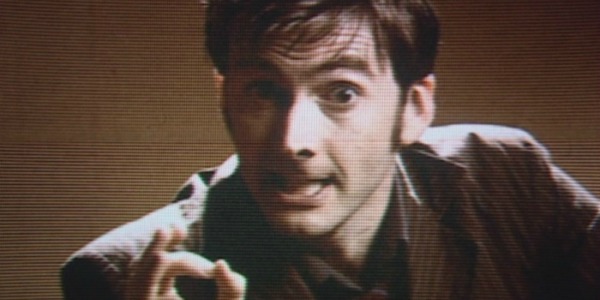
6. Blink (Doctor Who , Season 3)
5. Nightmare At 20,000 Feet (The Twilight Zone , Season 5)
 With a knowing eye turned toward the pulse of the world at any given moment, The Twilight Zone could comment on palpable fears of the day or turn around and create a white-knuckled thrill ride in the blink of an eye. That edge-of-your-seat experience can best be exemplified in Nightmare at 20,000 Feet. Bob Wilson (bravo performance, William Shatner) has just been released after a six-month sick leave in a sanitarium. He is traveling by plane back home on a storm-filled night, similar to the same night in which his nervous breakdown occurred. As the flight progresses, Bob becomes convinced there is a gremlin on the wing of the plane, tampering with the engine. His paranoia mounting, Bob takes a gun from a sleeping police man, opens the emergency hatch, and succeeds in shooting the gremlin, nearly killing himself in the process. When the plane lands, Bob is promptly taken away by doctors. But he is content knowing he was right, as the episodes closing shot of the damaged engine confirms. The Twilight Zone would often pit one person against the masses, firm in their conviction that whatever was transpiring they alone could stop it, despite being the only one who was aware of it. The viewer cant help but cheer Bob along, despite knowing what it will cost him. Its the every-man quality of Bob that makes him so identifiable and at the same time, so pathetic. This one's a classic for a reason.
4. Yesterday's Enterprise (Star Trek The Next Generation, Season 3)
 The Next Generation finally hit its stride in season 3 and this episode served as a blaring trumpet that the series had arrived. The Enterprise-C passes through a temporal anomaly, altering reality. Now Picard and the Enterprise-D crew are at war with the Klingons, with no memory of what their true lives are supposed to be. It is up to Guinan to determine that in order to set things right the Enterprise from the past must go back in time, an action that will result in its destruction. This episode never sits on contrivance. The ethical quandary of asking the crew of the previous Enterprise to sacrifice themselves for the greater good is mirrored by the knowledge that Tasha Yar, now alive due to the shift in history, will die as well. Its another example of Star Trek taking a larger sci-fi premise and an action packed hour and grounding both in the palpable sense of emotional loss, proof that Yesterday's Enterprise has earned its place as one of the best episodes of the series.
3. Out Of Gas (Firefly, Season 1)
 Science fiction is at its best when it serves as a reflection of all our flawed yet wonderful ways. Firefly managed to do that on several occasions, but none so better than the brilliant Out of Gas. The plot is fairly straightforward: With Serenity damaged and losing power, the crew is forced to abandon ship. Mal refuses to leave, believing he can repair the ship before life support runs out. It seems like a typical captain going down with his ship scenario, but theres much more at work here. A series of flashbacks shows this group of misfits, all with their own pasts that haunt them, all with their broken emotions, coming together. These people who have nowhere else to go turn to each other for the connections that define us as human beings. The final shot of Mal gazing at the beaten and broken Serenity in the distance is the purest definition of a lost soul realising he has finally come home. For anyone ever wondering what, at its core, Firefly was about, this is the episode to watch.
2. The Constant (Lost, Season 4)
 Its the trials and triumphs that characters experience that ultimately causes the audience to empathize with them. Lost was a series that was able to achieve that fairly early on in its run, culminating in one of the best examples of the marriage of fantasy and feeling with The Constant. Desmond (what a performance by Henry Ian Cusick) begins to experience shifts in time, with his consciousness jumping between 2004 and 1996. Realising what is happening, Faraday (Jeremy Davies) tells Desmond to seek his younger self out in Oxford during his next shift. With the help of 1996-Faraday, Desmond determines he is caught in a time-warp, his consciousness shifting between his older and younger-self. In order to break the cycle, Desmond must find someone, a constant that will serve to anchor him in both time periods. That someone is Desmonds love, Penny. What follows is a story unlike any other that measures the depths of true love and the lengths one will go to hold on to it. And the final lines of the episode, read by Faraday from his journal written in 1996, are as profound to the series as they are chilling for the viewer: If anything goes wrong, Desmond Hume will be my constant. Putting thought and emotion ahead of plot devices is what allows for an episode like The Constant to elevate from not just a great episode of the series, but one of the most heart rending yet ultimately uplifting hours of television ever.
1. 33 (Battlestar Galactica , Season 1)
 For now we see through a glass, darkly. The greatest virtue of science fiction is its ability to comment on the life and times of its particular era. Like no other genre sci-fi can show us our greatest strengths or the error of our ways, without being overbearing or preaching. No sci-fi show was a stronger reflection of its time and place in history than Battlestar Galactica. And it all started with its very first episode, 33. The series issued a clarion call with 33, making it abundantly clear that Battlestar Galactica would be unlike any other sci-fi show ever. The audience is plunged into the midst of a battle-worn, sleep-deprived group of people, already reaching their breaking point, forced to flee from Cylon attacks every thirty-three minutes. Instantly the viewer is invested in the well-being of the characters. In that single episode, everything the audience needs to know about the circumstances is laid out. The stakes are simple and yet never have been graver: the survival of the human race. The episode culminates with a horrific decision: whether or not to shoot down a civilian ship that is how the Cylons are tracking them, killing hundreds, for the safety of the fleet. When President Roslin makes the choice to have it shot down, the viewer feels her horror and sorrow. Even at this early stage in the series, the characters souls have begun to darken and rot from within. With 33, Battlestar Galactica had found a unique voice which it used to speak to us about the recklessness of the human condition and the propensity we have as a species to divide along ethnic, cultural, and religious lines. It was with that very first episode that the series threw the gauntlet down, informing the audience that what was to unfold would never fail to turn away from the greatest heights nor the deepest fears which drive humanity. The series had held a mirror up to the audience with 33, and its message was clear: this is who we are. So what do you think? Post a comment below and let the discussion begin.