20 Mind-Blowing Facts You Never Knew About Futurama
Lots of good news, everyone.

When Futurama aired its final episode, devoted fans had to sit through their favourite animated show ending for what is now the third time. And even though the series had certainly dipped in quality from its golden era on Fox, seeing Fry and Leela sort of end up together was still an incredibly satisfying (and emotional) ending, incredibly fitting for a show that had always been as much about the characters as space jokes.
I first saw Futurama on a pre-Simpsons Channel 4, but didn't truly appreciate until I got the DVDs how sharp the writing and affectionately drawn the characters (in both meanings of the the word) were. Watching it from the beginning hammers home how for the time it was an incredibly out there idea; despite having Matt Groening and David X. Cohen (respectively creator and writer on The Simpsons) at the helm, it was a completely fresh concept and more daring than the very traditional, American family set up of The Simpsons. We were promised the same polish, but in a niche genre that rarely works well alongside comedy.
Now, even with fans devotion to buying the DVDs helping bring it back a couple of times, Futurama's future is likely sealed in the land of reruns. In tribute to the show (and in the spirit of my similar list on The Simpsons) here are twenty facts about Futurama that will blow your mind open more than a tiny doomsday device.
Honourable Mention - Foreshadowing
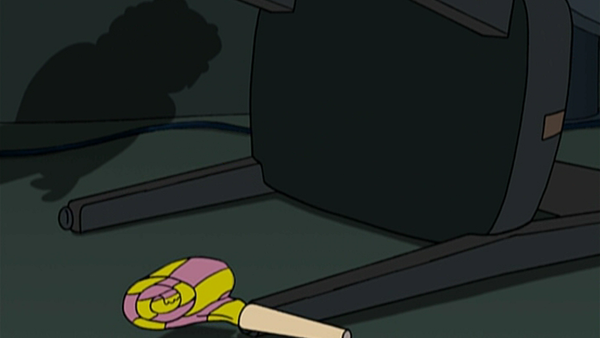
It's a pretty mind-blowing element of Futurama, but is sadly a little too ubiquitous to deserve a place on this list: many of Futurama's overarching threads were planned from the start and the creators put in extra effort to lay the groundwork as soon as possible.
Most obvious is the presences of Nibbler under Fry's chair when he travels to the future in the first episode, an event that was finally explained in Season 4's The Why Of Fry (as well as adding Fry to the shadow). There's also Leela's parents, seen in the background of sewer scenes over two years before their introduction, as well as the number 9 man, who went through a change of purpose. Originally intended to be part of a civilisation that uses numbers to showcase its hierarchy, he eventually became part of a fanatical cult in the DVD movie Into The Wild Green Yonder.
20. Jurassic Bark Was Almost About Fry's Mom

Jurassic Bark was one of the standout classics from the show's original run. Episodes featuring Fry's past are always an interesting set up, but this one knocked it out of the park with some great running gags and Bender sticking to the right side of offensive.
It's also most-certainly the episode with the most emotion, but if the original idea had been done, it could have been even more depressing. Before it was Fry's dog was fossilised, the episode was meant to focus on Fry's mother. That's right, instead of Seymour growing old missing Fry, it would be his mum (who was eventually written as distant and football obsessed).
Obviously, the writers realised that might push the depression a bit too far and decided to tone it back a little (not by much really though).
19. The Body Switching Has An Actual Mathematical Solution
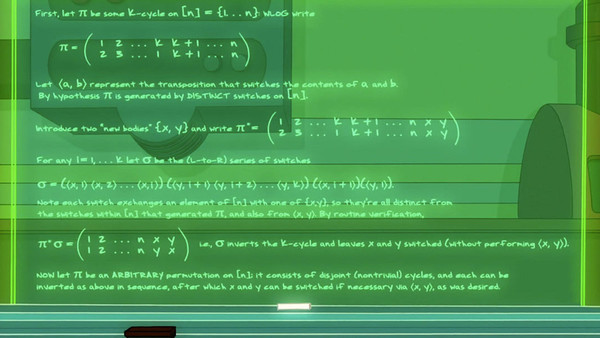
The solution to all the body swapping in The Prisoner Of Benda may seem painfully obvious (throw two people in and you can just cycle around until it's right) but with some pernickety fans the writers didn't want to take any chances, so created a mathematical theorem to prove it.
The Futurama Theorem (imaginative name there) was made by Ken Keeler, one of the show's writers (and a PhD in applied mathematics). You can see it on a screenshot of the episode above, but it's not as complicated as it seems; the maths is actually is pretty logical. The worrying thing is that the fans are so petty they'd have questioned this.
If only the writers had some way to highlight their ridiculousness. Actually they did, as you'll see next.
18. Cubert Was Always Intended (And Completely Different)

One character who's always grated on me and yet also been behind some of my favourite episodes is Cubert, the Professor's son/clone. Even though he doesn't appear until the second season, he was always intended to be part of the show, although not in the way he ended up.
Unable to find a way to properly introduce him until a whole Cubert-centric episode became available, the clone was originally meant to be a bratty know-it-all who pointed out the show's many flaws. Intended as a mirror of the show's fans, beyond his first episode Cubert was just too annoying so he was toned down, eventually settling as a typical child of the Professor.
17. Moon Pie Fight In Mars Bar

The opening credits of Futurama has even more background jokes in it than The Simpsons'. There's the main characters travelling in the transportation tubes, adverts for some of the shows fake products, a different opening message each time and, of course, a small clip of classic animation on a billboard before the Planet Express ship crashes into it.
One joke in the opening that isn't often commented is so blink-and-you'll-miss-it you actually can't see it at all without pausing the show. Just before the ship crashes, there's a guy reading a newspaper with the headline 'Moon Pie Fight In Mars Bar'. Bad pun, but a pretty cool find.
There's also a guy who appears in a couple of the tubes with a hooked hand. New New York is a dangerous place.
16. They Had No Idea Which Episode Would Be The End

With Matt Groening shopping Futurama around to yet another network after Comedy Central dropped it, it seems like we're doomed to live in a cycle of the show being constantly cancelled and picked back up again. At least they're prepped this time
Back in 2003 when first cancelled, the writers weren't sure what their last episode aired was going to be, leaving lots of possibilities for a finale. In an audio commentary the producers mused The Sting, where Leela has a poison induced hallucination that Fry dies, would be an interesting one to end on; to viewers it would look like they've killed off the main character.
Thankfully, Fox went with the sublime The Devil's Hands Are Idle Playthings, an episode that brought back the best of the show (the Robot Devil, Fry's obsession over Leela) and ended on an emotional note better than anything that could have been intended.
15. Bender's Apartment Number Is A Dollar Sign

There's lots of jokes hidden in the background of New New York that a whole other list could be dedicated to them. Today I'll just pick the one: Bender's door.
The apartment doors in Futurama are all little puns. Leela's is 1-I, but not only is that a little simplistic, it's incredibly obvious to even the casual viewer. Bender's at least requires a basic knowledge of programming (or the ability to do a Google search). 00100100 translates in binary as 36, which translates in ASCII (a method of coding symbols, as well as both cases of letters) to $. A hint at Bender's greed or geeky fans reading too much into the show? Who knows, but it is pretty cool.
14. Grover Cleveland Has Two Heads
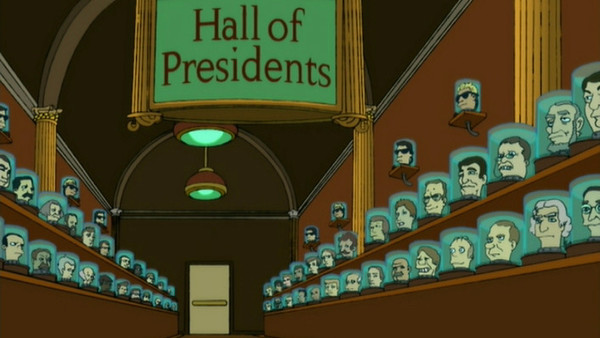
It's a background appearance that only the most eagle eyed fan would have noticed (and even then would have been chalked up as an animation mistake): when Fry and Bender hide in the Head Museum's Hall Of Presidents all the major POTUS get an head upgrade, but oddly enough Grover Cleveland pops up twice. You'd expect better from a show that just moments before went to effort to state the correct day of the week for 31st December 2999 (it's a Tuesday).
Turns out this isn't the animators slipping up, but the creators hiding a smart, non-sci-fi pun in the background. Cleveland served two, non-consecutive terms, so he has a head for each time he was in office. Seems legit.
13. Fry's Named After Troy McClure

Whereas The Simpsons' main characters have names of very simple origins (they're named after Matt Groening's family), Futurama's cast are, typical for the show, much less obvious (and a lot more cultural).
Bender is obviously a tribute to Judd Nelson's character in The Breakfast Club (although his last name, Rodriguez, is clearly just a joke). I can't find the origins of Fry's surname, but his first name is a loving tribute to Phil Hartman (the voice of Troy McClure in The Simpsons and intended to be Zapp Brannigan before his untimely death), while his middle name is a tribute to the Simpsons men (who all have J. as their middle name). Leela and The Professor's names have even more distant origins; Olivier Messiaen's Turangalîla-Symphonie and TV creator Philo Farnsworth.
12. Bender Has An 1038 Year Old Processor
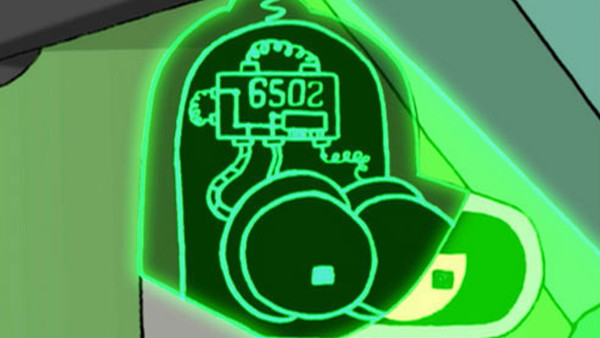
Despite being a pedestrian bending robot, Bender is certainly a brilliant machine. Throughout the series he's shown off over fifty different functions and a durability that compared to modern technology seems impossible. This has led to many fans theorising he's not a proper robot, but a structure of nanobots that adapt to plot contrivances.
While that's a theory, the show has given us some serious info on what makes Bender work. When he's observed with the F-Ray in Fry And The Slurm Factory we see he has a 6502 microprocessor, the same as used in the Apple II and Atari systems. Slower than the even the lowest grade machine today, it's more than a little outdated come the 31st century, even for a manual labour robot. Suddenly the nanobots make a lot more sense.