7 Ups & 1 Down From Star Trek: Strange New Worlds 3.1 — Hegemony, Part II
Star Trek: Strange New Worlds is back with a second half that largely rules.

The long wait is over. The long wait, through no fault of anyone involved, was chiefly worth it. Hegemony, Part II is an altogether admirable episode and a fine concluding half. It is also the first season-straddling two-parter with the same name since Star Trek: Enterprise's Shockwave and Shockwave, Part II. It is Star Trek: Strange New Worlds' first bona fide two-parter full stop.
Hegemony, Part II has all the hallmarks of great and classic Trek — alien threat, scientific solutions, engineering wizardry, space battles, phaser fights, dramatic scenes in sickbay and so on. Yet, in that, it falls short of something more extraordinary. It is a little too 'by the numbers,' moving from plot point to point, location to location, all too mechanically.
A certain lack of surprise was compounded by the fact that the opener was a re-watch of a New York Comic Con exclusive clip. Added to that were other teaser and trailer spoilers as to the survivors from Parnassus. Strange New Worlds is also forever condemned to hit a prequel wall of character expendability.
But then, those are minor criticisms in the grand scheme of things, and the grand scheme of things is now five seasons thanks to the powers that be. We'd better just enjoy it whilst we can.
9. UP — Arc Of The Camera Roll
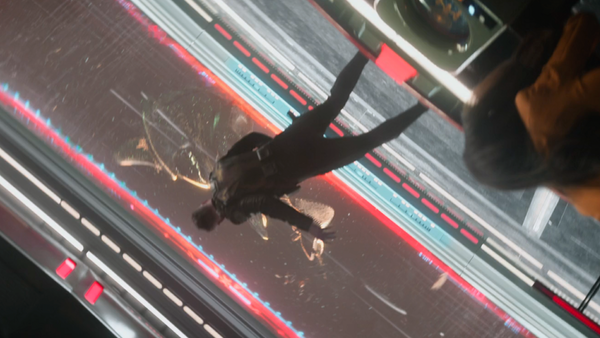
Hegemony, Part II wastes no time in returning to the action. The longest wait for any '… and now the conclusion' is quickly forgotten as camera pulls back from star to follow Gorn hunters back to the Enterprise. "Orders, Captain?" Spoilt though it was at NYCC, this opener is simply thrilling. We, the audience, are spoilt by some fantastic direction on the part of Chris Fisher.
As the shot makes its way towards the Enterprise, it rotates a full 360 degrees, matching the pirouettes of the Gorn hunters. Plunging into the bridge, the camera then turns another 360, this time with Pike as its focal point. At the cliffhanger of Hegemony, and now here, Pike's world was spinning out of control on a moment of indecision.
The camera lands the right way up, and so does Pike. Turning around to face the lens, he shakes his confusion almost as quickly as it had arisen. Those orders are forthcoming.
At the end of the episode, the camera goes back to space to face the Enterprise as it flies out from the centre of the binary stars. As the ship moves past, the camera rolls over one last time from ventral to aft. The Enterprise travels away and onwards, glowing in reflected light.
8. DOWN — No Credit Where Credits Are Due
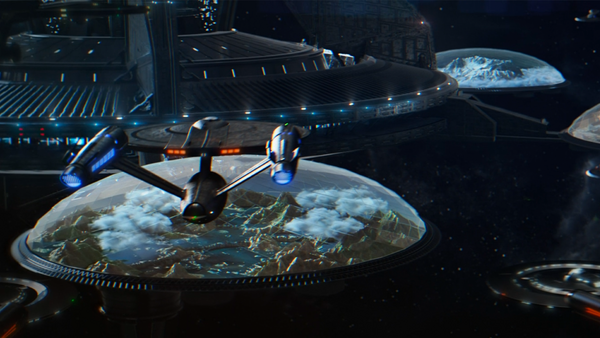
There are a lot of great things to say about the opening credits to Star Trek: Strange New Worlds through their various iterations. Anson Mount's opening monologue is an elegant re-addition. Jeff Russo's variations on the Alexander Courage theme are the perfect accompaniment to link one captain of the Enterprise to the next. The backgrounds are stunning.
The problem, and this applies to every (standard) version of the opening credits to Strange New Worlds, is the ships. The Enterprise looks too good, too clean. The attempt to make it look as 'real' as possible, as close to a filming model as CGI can be, has produced the opposite effect — a slight feeling of the uncanny. In the new opening credits for season three, the Klingon D7 battlecruiser, the Enterprise shuttle, and Starbase One (particularly the domes) also look oddly unpolished and more than a little strange in movement.
It is worth remembering that 'uncanny (un- / canny)' is more literally 'unknown' (un- / middle English 'kennen,' 'to make known,' modern English/Scots, 'ken'). The fault, therefore, is not to realise that spaceships and alien worlds (of the Star Trek kind) are always unknowable in the first place, i.e., that which is not real is already uncanny. In that sense, the hyper-real opening credits to Strange New Worlds aren't just uncanny, they aren't nearly uncanny enough.
7. UP — Great Scott!
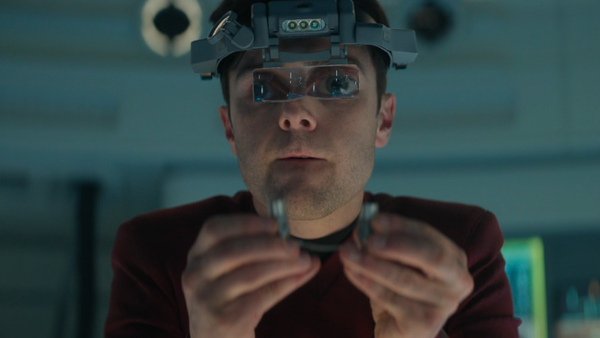
As Pelia pointed out, pressure befits the character of Montgomery Scott. Taking on a part made so iconic by James Doohan is equally a heavy burden. Only two others have tried before Hegemony, including Matthew Wolf (voice only) in A Quality of Mercy. If pressure there was for the latest actor in the role, and first Scot (from Paisely), Martin Quinn, then it most certainly didn't show on screen.
Quinn's performance as the young Scotty feels effortless. Watching, it is easy to forget that Hegemony, Part II is only the actor's second episode in the role. Quinn has the double responsibility of playing the part and of introducing the audience to a younger version of the character — a less experienced Scotty, lacking in self-confidence.
We are in safe hands, as is the Enterprise. Quinn's talent is undeniable. He brings all of the madcap energy and comedy timing required, switching between emotions at the drop of a hyperspanner — at one point from sheer panic to frustration to sorrow. Quinn plays off the multi-award winning, Oscar-nominated Carol Kane as Pelia with equal ease. He is one to watch. They are a duo to follow.
6. UP — Binary Star Duos
At the heart of the second half of Star Trek: Strange New Worlds' first two-parter lies a binary star. The symbolism is readily apparent.
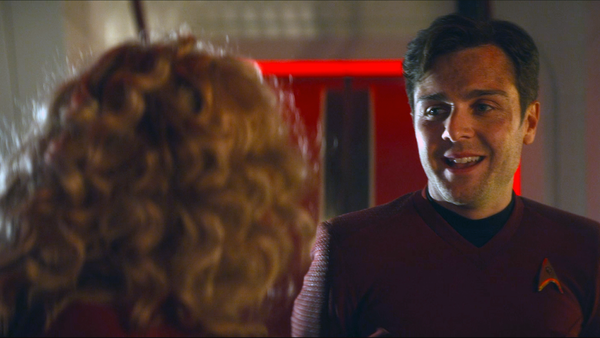
Mirroring that duality, stellar and episodic, in Hegemony, Part II, was a set of duos on the Enterprise — Scotty/Pelia, Una/Uhura, Spock/Chapel, Pike/Batel. In binary code, four bits is also a 'nibble' — almost too accurate a description for the crew stuck aboard the Gorn destroyer (more on that later).
Amongst the four twosomes, Scotty/Pelia were the winning pair — comedic, though far from exclusively so. Pelia alone is one of the best additions to Trek in recent years. The combination of her frank yet infectious demeanour with a fresh take on a legacy character was always going to be intriguing. The on-screen result is a delight.
Pelia's methods might be a little heavy-handed (metaphorical "phaser to the head"), but it seems Scotty may have learnt a few of his more famous traits from his old professor, like the art of the possible from the impossible.
As for Spock and Chapel, the 'time to talk about these things' was at least only the time of the computer simulation. More would have been too much. Less would have deprived us of some great acting. Mirroring Spock's "… just need a little faith" to Chapel were Pike's own religious convictions, or at least those transmitted via his father ("Okay, dad. You win."), in prayer at Batel's bedside.
5. UP — Dichotomies Of A Two-Parter
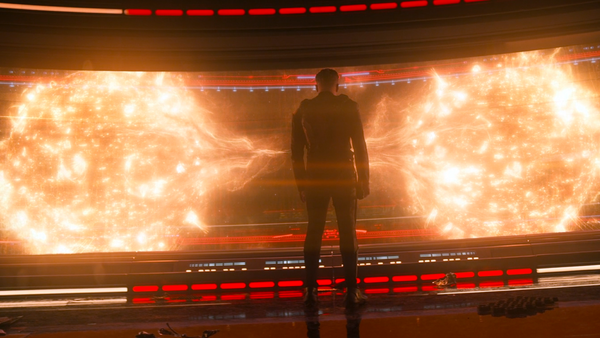
A two-parter is, by definition, a dichotomy, most often rendered as the split between 'to be continued' and '…now the conclusion'. In that gap between set-up and resolution lies the power imbalance inherent to the meaning of 'hegemony'.
Hegemony as a form of dominance, hegemony as the 'Gorn Hegemony,' must reduce the world to a set of dichotomies, or binary oppositions — power/powerless, us/them, civilised/uncivilised and so on — in order to maintain its existence. In Hegemony, the Gorn established a demarcation line — the inside versus April's "outside of our jurisdiction". Pike's "we are prey" in Part II designated the predator.
"Sometimes a monster's just a monster," said Pike in the first half. "Sometimes, hope is a choice."
Rules are made to be broken, or so said Spock. The line between official and unofficial orders, as well as between legal and illegal, is blurred. Inactivity (of the Gorn) is pitted against activity, invasion over salvation, as Hegemony looms over the Federation. 'Punching back' is the solution, though not as simple as turning it on/off. On the bridge, and in sickbay, science cohabits with "a little faith," and 'probabilities of survival' for Captain Batel. Prey becomes pray. The Lord's Prayer is interrupted, but not dismissed.
Aboard the Gorn destroyer, that utilitarian Vulcan proverb, schematised, is 'needs of the many / needs of the few'. By choosing to save everyone, La'an resists and disrupts the binary division, "even if we have to shoot our way out".
4. UP — More Gorn, More Gore, More Lore
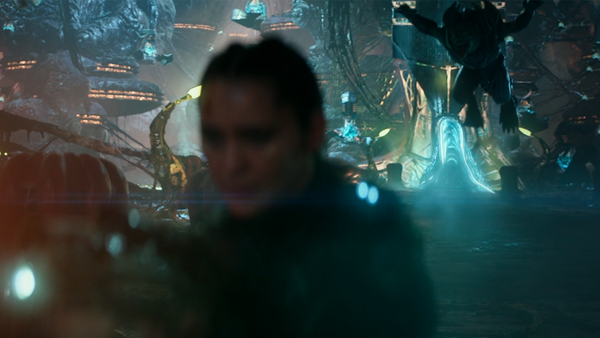
When it comes to the Gorn in particular, Star Trek: Strange New Worlds hasn't spared on the gruesome. All Those Who Wander, for example, was as chest-bustingly gory as it was terrifying. In Hegemony, blood painted the floors and the walls of the town on Parnassus Beta. Part II provided the most gloriously grim Gorn spectacle yet.
Through La'an, we already knew about the 'breeding planets'. There, a person was either live incubator or live sport for Gorn hatchlings. To those nightmares can now be added one "massive digestive chamber," in Sam Kirk's words, aboard the Gorn destroyer. The colonists and Enterprise crew beamed up from Parnassus were being slowly dissolved into nutriments. Let's just hope something else was on the menu at that Gorn wedding we saw in Star Trek: Lower Decks!
Fodder is also food for thought. In Hegemony, Part II, we learnt a few more things about the Gorn in terms of their table manners. In the first half, Scotty had already speculated that coronal mass ejections (CMEs) could start a 'feeding frenzy' in the Gorn. Now, Uhura had discovered that "X-class [solar] flares" and "supra-arcade downflows" (both equally real solar phenomena) were linked to periods of Gorn inactivity. Uhura just saved the Federation from a grisly fate.
3. UP — Two-Fingered Salute
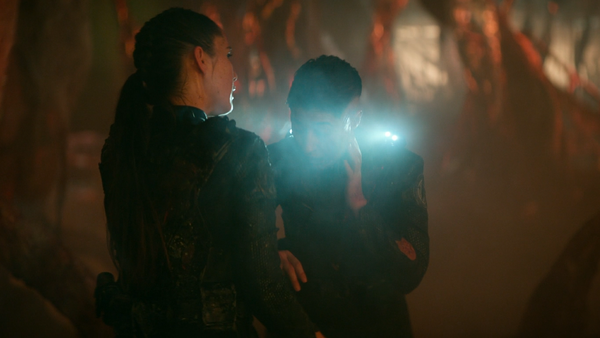
They certainly didn't make things easy for Erica Ortegas this episode. Her resilience in the face of the almost insurmountable was a sight to behold. Released from the digestion pod aboard the destroyer, she had already lost two fingers. With the help of Doctor M'Benga, she managed to shrug off that fact like it was just another Tuesday, cracking jokes with Sam Kirk.
For Ortegas, the rest of Hegemony, Part II was one big eff you to the Gorn. Or, in translation for her British colleague, it was a V-sign, palm facing inwards, with her remaining digits. Even after being pierced through the stomach and hoisted into the air at the end of a Gorn claw, Ortegas continued to do her duty, though at a heavy cost in blood. If there could be any doubt as to who flew the ship, it was dispelled.
La'an also got to stick two fingers up to the relentless lizards, using the knowledge she'd gleaned as a child on one of their breeding planets. The chief of security then provided one of the best lines of the episode in (not-yet-)deadpan reply to Doctor M'Benga's worthy attempt at reassurance — "Yeah, but here's not great either, is it?" Tough to argue with that logic!
2. UP — A Mirror, Brightly
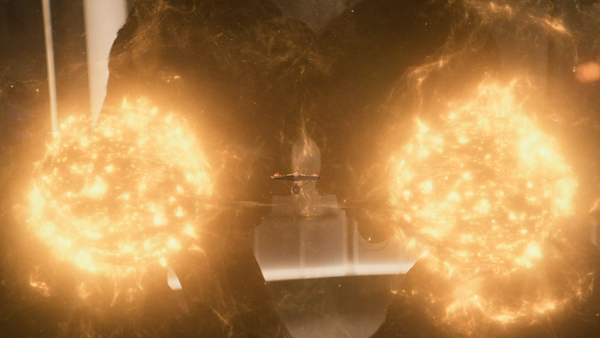
Hegemony ends on indecision as Pike turns to face the Gorn attack on the viewscreen. Hegemony, Part II culminates on a moment of decisiveness. Pike gets up from his chair, walks across the bridge to essentially the same spot, but this time turns to face his crew, backed equidistantly by stars. The two-parter becomes a mirror once more, reflecting back on itself, further breaking down its own (false) binary of first and second half.
For Pike himself, the visual comparison serves to underscore the false dichotomy that exists between strength and weakness when it comes to leadership. Hesitation doesn't make him a bad captain. Newfound confidence doesn't make him a great one either. Like his position between the stars, there's a space to be found in between, qualities to be found with the help of his crew that aren't the absolutes of either/or. Pike is a good captain because he finds his way through.
At its end, the episode redeploys this visual imagery to great effect. As Pike and Batel touch foreheads, the scene fades out to the binary stars. The space between the two becomes the space for the Enterprise. The divide between the secular (or temporal) and the spiritual, between "what might or might not happen," between now and the future, dissolves away so long as Pike and Batel can just hold each other.
1. Cetacean Observations
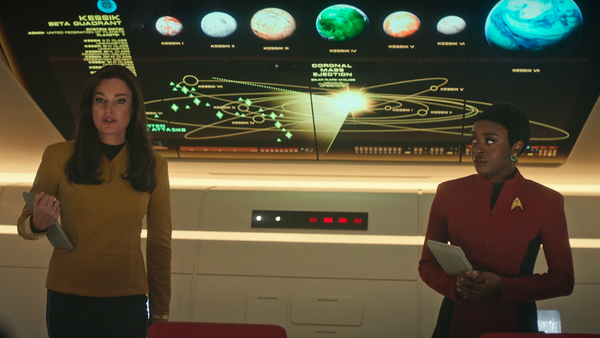
The biggest observation from Hegemony, Part II is, of course, the Gorn — in size and in number, mixing CGI and practical effects with more than just one suit. Speaking of, Pike's "problem for someone else to solve later" means, most likely, delaying down the line to Kirk, James T., about eight years later in Arena.
Speaking of Arena, on the map behind April in Pike's ready room, the Cestus system is shown just on the other side of the Gorn demarcation line. Cestus III is where Arena begins, "not warm-blooded […] not human".
From one star system to another — the Kessik system — this time on the display behind Una and Uhura as they report their findings on Gorn activity to Pike. Kessik IV (the green planet in the middle) is notably where B'Elanna Torres grew up — or, rather, WILL grow up — with mother Miral and (at least for a time) father John Torres.
The use of transporter codes as a handy workaround also has precedent. In Return to Grace, Kira knew "Klingon transporter codes" for a little switcheroo. In Kir'Shara, T'Pol's husband Koss provided Captain Archer and co. with Vulcan transporter codes to gain access to the capital. From two Vulcans to another, the EV or 'Special Environmental Protection' suits worn by Spock and Chapel were a nice touch, and a nice nod to The Naked Time.