8 Nuances That Made Mads Mikkelsen's Hannibal So Great
What makes one of the greatest on-screen monsters of all time tick?

By now it's a television truism that NBC missed a trick in cancelling Hannibal, Bryan Fuller's exotic, intellectual, daring and grotesque reinterpretation of Thomas Harris' seminal serial killer stories.
Ratings, schmatings, people: having the testicular fortitude to keep Hannibal on the air in order to make a kind of television history is just one of those things certain network executives could have been eating out on for years to come. And while it's true that Fuller himself (previously a middling showrunner on a whole lot of failed television shows) has now pretty much written his own ticket for anything else he may care to try, he owes a lot of that new cachet to his phenomenal cast, and none more so than Mads Mikkelsen as Doctor Hannibal Lecter.
Being the fourth person to essay a household name is no small thing, especially given that Hannibal The Cannibal has a rabid fanbase in both prose and film. Overcoming any pressure he might have been made to feel by simply ignoring it, Mikkelsen succeeded in making the character completely his own.
This isn't the Lecter you know and love from the novels or from the cinema while Mikkelsen keeps the charisma, the brilliance, the sense that Hannibal is somehow more than the other killers and freaks that crop up in the narrative, he delivers a completely different vibe to Cox avuncular irritability or Hopkins arch, reptilian insouciance: more antichrist than antihero. Here's how he did it (and remember, here be spoilers)
8. He's A Peerless, Pitiless Killer

Mikkelsen brings a visceral physicality to the role that's been missing until now. Part of that is because previous iterations have been behind bars from the word go: Fuller's Hannibal Lecter spends two seasons on the loose before the authorities come after him, killing according to his own idiosyncratic design.
Mikkelsen introduces the idea of Hannibal as epicure, as dandy, and as lightning fast predator. Everything about Hannibal screams elegance, and those occasions when he explodes into violence are no less graceful and adroit than his dinner parties and his impeccable wardrobe, all quick, controlled, powerful movements, economical and poised. That's Mikkelsen's background as a dancer and gymnast coming into play, a craft he spent almost a decade practicing professionally, before transitioning to acting at the age of thirty.
The already legendary fight scene between Lecter and Lawrence Fishburne's FBI boss, Jack Crawford, in season two is something we've never seen from a Hannibal Lecter before, as is the bloody, grim confrontation between all the parties at that season's climax. Mikkelsen introduces us to a Hannibal Lecter who moves like a striking snake, someone physically formidable and not to be taken lightly.
7. How to Play A Genius Psychopath (When You're Not One)

The sheer weight of the character of Hannibal Lecter makes him an intimidating prospect for an actor. In many respects, he's similar to The Joker: he's not just any murderer, not just any psychopath capable of being profiled and put in a convenient psychosexual box. Both the Lecter narrative and the Batman narrative posit their villains as almost super-insane, practically a different species. And Lecter's a genius, a man always three or more steps ahead of his pursuers, playing Machiavellian games with the lives of the people around him. How do you even begin to get into the head of such a man? Mikkelsen understands that, in storytelling terms, there's a danger involved in portraying the smartest b*stard in the room:
"If you're smarter than everybody else, there's a certain amount of drama that just disappears because there is no danger. You will never, ever f**k up. He's always ending on the good side, right? It's a little like, if you read a scene and it says you come in and you are extremely sexy, the thing is, you cannot play sexy yourself. You have to make sure that they find you sexy. It's the same with intelligence But I think also there are little holes. He falls in little holes once in a while, especially when it comes to his own vanity, and that's where Will Graham is getting him: on his own vanity, that he starts believing he's bigger than God himself." - IGN
Mikkelsen believes that Lecter's superior intelligence, his high-culture elegance and his status as a creature one step removed from the rest of us is his Achilles heel. His vanity is the way in for an actor, to be able to understand him and to play him. Specifically, Will Graham is Lecter's weakness, and he doesn't fully understand that relationship to be a weakness until the season two finale with catastrophic results.
6. About Cannibalism

The word cannibalism comes from a Spanish name for a tribe in the West Indies that ate human flesh: it literally means savage. That's how we see the cannibal, as someone bestial, barbaric, rending flesh with filed teeth. That's not Hannibal Lecter, of course yet previous iterations of the character havent delved much into why he might engage in such a gruesome practice. It's been described as a kind of fetishised trophy collection, and Lecter's back story in the novels and the films has been retrofitted to include childhood trauma that, in classic armchair psychological fashion, is blamed for his present psychopathy.
All of which is rather dull to Mikkelsen, who dislikes the idea that Lecter is the way he is because of some horrendous, seismic event that rewrote his brain as a young man. In a recent interview with shortlist.com, he points out that cannibalism is different. Cannibals think the only way to possess someone, to truly love someone, is to consume them, even though Hannibal tends to eat rude people."
Mikkelson believes that Hannibal tends to eat most of his victims dismissively, treating them as a lesser being his consumption of their flesh in his opulent, almost arcane gourmet meals is a way of elevating the rude, the uncultured, the boring or the venal, raising them to his level by transforming them into art, then consuming them. This doesn't hold true for everyone, however: with Will, the act of transformation isn't as important, because he already sees Will as a being on his level. No, in season three Lecter comes to believe that he needs to eat Will: ironically, to get him out of his system, to conquer him by consuming him.
5. A Man Of Few Words

Mads Mikkelsen is well known by his peers for his ability to convey important information to an audience without any form of dialogue at all. Again, it's a facet of the dancers art, which is all about articulating ideas and emotions without speech, through movement and expression alone.
"I try to eliminate words as much as possible. There is a tendency to underestimate the power of what we can do without words. Sometimes you can make a scene even more powerful and precise without dialogue." - Rolling Stone
One of Hannibal's directors, David Slade, points out that Mikkelsen has an incredible sense of what his face can do with micro-movements. He has the ability to do practically nothing and still scare the sh*t out of you. With the feel of the show having more in common with hyperreal grand guignol theatre like Shakespeares Titus Andronicus or Websters Duchess Of Malfi, having the actor at the beating heart of the drama capable of such nuance makes for some seriously compelling television.
4. Hannibal As Fallen Angel

"To Hannibal, psychopaths are banal, as they all have a reason for killing: a f*cked-up mum, a dad that hit them, whatever. For me, he's the fallen angel: Satan on Earth, a man who sees beauty where the rest of us see horror. Or, at least, that's what I based him on." - shortlist.com
Mikkelsen plays Hannibal Lecter as a different kind of monster: one removed from the human race, demonic. Where the FBI seek to profile psychopathic serial killers, placing them into convenient boxes that claim to understand their individual obsessions, their little madnesses, Mikkelsen believes that Lecter cannot be fully understood in this way.
That's why Will Graham is the only one who comes close, the only one who had a prayer of catching or stopping him. Graham empathises with the subjects he pursues, making instinctive intuitive leaps: where an intellectual, psycholanalytic approach would fail. Lets not forget, Doctor Hannibal Lecter is a renowned forensic psychiatrist and profiler himself, a man whos trained himself to identify and examine others like him and expunge their weaknesses from his modus operandi. To Mikkelsen, Lecter isn't just a sick man: he's not necessarily a person at all, anymore. He's something alien, inhuman fallen.
3. Hannibal As Romantic Hero

And then there's the flip side of that the aspects of Hannibal that make him so charismatic. His flair for the dramatic in the way he dresses, the way he decorates his offices, the way he prepares his food. He thinks of himself, not just as an artist, but as something quixotic: an adventurer. He despises the banal, and adores the refined. All previous interpretations of Hannibal Lecter have been after the fact of his capture and imprisonment. He's on display in his cell as what he is, pinned to a board like a moth: a psychopath in white hospital clothes, the bare bones of his crimes a matter of factual record. They're procedurals, and Lecter is their subject. Hannibal is a show about a villain who believes in romance: the old blood-and-thunder kind of romance, before Hallmark sentiment and expensive flowers co-opted the word, the kind of romance where the lovers end up beautifully dead. Beauty is actually the operative word Hannibal isn't a sadist, engaged in some sordid sexual fantasy-fulfilment exercise, and he's not a sad little boy like the Tooth Fairy, desperate to become something greater. When Hannibal kills, he creates art, and is fascinated by the crime scene and corpse as tableau, the elevation of death and meat into poetry.
"He is in a league of his own, and would probably find most other serial killers banal. Others have reasons to do what they do their childhood, something their mother did whatever, shrugs, dismissively. Hannibal is not like that. He finds the beauty of life right on the threshold of death. And that is not banal, in his mind." - Daily Telegraph
If there was any doubt, look at the bloody climax of season two: Hannibal is stalked and finally confronted by his enemies and friends, betrayed by the one closest to him, but leaves that forbidding house alone, covered in the blood of others, drenched in the rain, having killed or maimed everyone who stood against him. Its a heros ending yet Hannibal isn't supposed to be the hero, nor even the show's protagonist. Mikkelsen plays Hannibal Lecter as a creature intent on seizing the moment, making of it a flamboyant statement, refusing to accept the boring or the mundane. It's part of what makes his Lecter so captivating, so compelling.
2. The Central Relationship Is Genuine
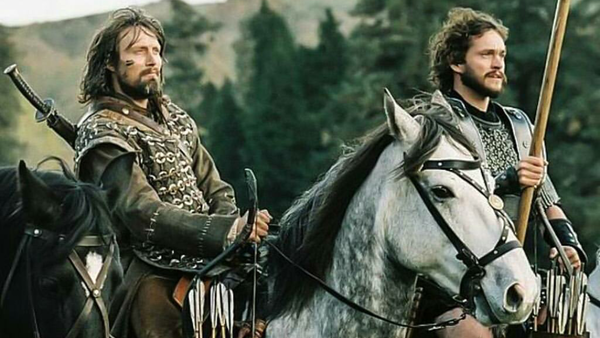
Since the central relationship of Hannibal, between Lecter and his patient and friend Will Graham is so important, it certainly helped that Mads Mikkelsen and Hugh Dancy had been friends for so many years before Bryan Fuller cast them together. They first met on the set of the film King Arthur, a supposedly historically revisionist interpretation of the myth that ended up being unintentionally hilarious. Both men played knights of legend: Mikkelsen took on Tristan, Dancy Galahad. From all reports, the main actors developed a very strong bond together (the cast reads like a heavyweight whos-who Mikkelsen, Dancy, Ray Stevenson, Clive Owen, Ray Winstone, Ioan Gruffudd, Joel Edgerton) and Mikkesens close friendship of a decade with the man who would be cast opposite him in Hannibal helped the two to create an onscreen relationship that was totally believable as a friendship and even a kind of romance:
"It was a great gift for both of us, that we were able to spend so much time together on the show. We were kind of in a boat of insecurity from the beginning, but it was nice to have a friend there, if you go down or you stay up." - ClashMusic.com
1. Hannibal As Love Story

By the climax of season three, there's no getting away from it: Hannibal is a love story, the bloody, romantic tale of the twisted, doomed connection between hunter and hunted, doctor and patient, hero and villain, Hannibal Lecter and Will Graham. Extrapolating and expanding on a few sentences in the Red Dragon novel that explain the capture of Lecter by Graham into two and a half seasons of narrative, the show builds Graham as Hannibal's nemesis, as well as the other way around. More than that though, the friendship between the two is completely genuine, despite the manipulation and deceit between them. Lecter is a lonely figure, isolated by the skewed way that he sees the world and humanity in general. Will is lonely too, ironically alienated from everyone around him by the very gift that allows him to feel exactly what they feel, his superhuman empathy. Both men yearn for companionship on their level, someone who might understand them, kindred spirits. It's not necessarily anything sexual, although that can play a role rather, it's achingly romantic (in a weird and twisted way, naturally). Mikkelsen is convinced that Lecter's feelings for Will are very real:
Not only a friend. He's the first person for many, many years that he has genuinely loved. He saw a mirror image of himself in Will; a younger version, not necessarily going down the right path yet, but potentially going down the right path with himself... So I think it is genuine what he saw, and for one weak moment he became vulnerable and was fooled - ClashMusic.com
By the middle of season two, the intricacies of the two characters and their individual mental states have begun to mesh, become inextricably entwined. At the climax of season two, Will doesn't go to Hannibal's home to confront and arrest him, as Jack Crawford does he goes to warn him, and to go with him, although he doesn't fully realise his own real intentions until some time later. For his own part, Hannibal sees Will's betrayal coming a mile off, yet it's no less painful when the moment actually arrives. Will actually breaks his heart. His disappointment manifests itself in typically bloody fashion, of course but then it's Hannibal, the man and the television show. It's exactly what we've come to expect.