9 TV Shows That Wrapped Up In Ridiculously Bizarre Ways

How do you solve a problem like finales? By completely losing your mind apparently.
Ending a TV show can be hard, especially when there are multiple long running plot lines involved, which is precisely why most of the time, we get a mediocre or outright disappointing ending, with satisfying endings only a rare occasion. And then there are the frustrating non-endings, like cliffhangers or shows that just stop before the end, like The Sopranos, leaving characters' fates in limbo, and fans forever dangling on a knife edge that will never see resolution. To be frank, that sort of disappointment is not particularly surprising: ending anything with a fanbase is a thankless task, and even if you manage to put together a perfect full-stop, someone, somewhere will be frustrated. Then there are times we get finales that are so out of touch with the rest of the show or common storytelling logic that they can only be called "bizarre" or "ridiculous," and are thus much less forgivable. There are of course also shows where the bizarre finale is just a culmination of an already surreal or mind twisting series: they aren't necessarily good or bad, but these endings confuse or tantalize us long after the episode (and the show) is over, as we try to fit all the parts together. To celebrate the weirdest and most wonderful of those endings, here are nine of the most memorable (naturally with a SPOILER WARNING...)

9. Star Trek: The Original Series

The first of two Star Trek finales on this list, Turnabout Intruder isn't a series finale in the sense most of us are used to, in that it neither wraps things up, nor does it set up a story that's never continued later. It's just an another TOS episode, except it's pretty much the most insane of all TOS episodes. Turnabout Intruder starts off with the unhinged Janice Lester body-swapping with Captain Kirk because Starfleet supposedly doesn't allow women to be captains. After nearly being caught strangling Kirk, Lester takes command of the Enterprise and makes many, many questionable decisions and chews the scenery to a hilarious degree. Eventually, she acts so crazy that everyone refuses to obey her orders, causing her to melt down and reverse the body-swap so Kirk can dump her off at a starbase. Season 3 of TOS was its weakest, but it still had some standout episodes, like The Enterprise Incident and The Tholian Web. Turnabout Intruder seems to have come from the same well that Spock's Brain did and both make you wonder what happened behind closed doors on the studio lot. The closest thing to a rational explanation for this episode's existence is Gene Roddenberry tossing a bone to Kirk/Spock slash fic writers. Whether or not the writers botched it on purpose is more debate than this episode deserves, but it at least provides entertainment as drinking game fodder.

8. Batman Beyond

Every once in a while, a dumb idea from a TV executive can result in a good show and Batman Beyond is one example. Executive producer Paul Dini had to make a show about Batman in high school, but instead of doing the predictable (making Bruce Wayne a teenage crime fighter), Dini made Bruce Wayne an old man mentoring a teenager named Terry McGinnis to be the new Batman. While the show had an open-ended finale when it ended, Justice League Unlimited's second season finale is really the proper finale to the Batman Beyond series. Taking place over a decade after Beyond ended, the appropriately titled Epilogue revolves around Terry discovering that he is Bruce Wayne's biological son and how it happened. In the end, it turns out that a conspiracy of ex-government employees used nanomachines to replace Mr. McGinnis's DNA in his sperm with Bruce Wayne's. This conspiracy was also about to kill Mr. and Mrs. McGinnis so Terry would go through the same trauma as Bruce and turn into Batman (somehow), which didn't happen because everyone involved agreed that Batman wouldn't do that. Epilogue is genuinely bizarre and ridiculous in the grand tradition of comic books. The whole scheme to create a new Batman in Terry is not only convoluted and ethically bankrupt, but it doesn't seem like it would've resulted in Terry becoming Batman anyway. Bruce Wayne being an embittered hermit and the McGinnises being solidly middle class people are two obvious road blocks to the plan. It seems like it would've been easier to just grab some kid orphaned by violence, train him to fight people, and give him a Batman costume. It does explain why Terry's hair is black instead of brown or orange, like his parents, and how the Joker came back in Return of the Joker, but those are minor moments of lucidity in this insanity. Then there's the creepy implication that the only good Batman is Bruce Wayne or someone directly descended from him. But let's face it, the comics do that too and it's just as ridiculous there, so we just have to deal with it.

7. Steins;Gate

Time travel stories automatically rank high up on the list of the bizarre and ridiculous, and so does anime, for good and for bad (honestly, I could've simply filled this list bizarre anime endings I remembered). But sometimes, two bizarre things come together and make something that is still bizarre and ridiculous, but which is pretty good. Steins;Gate revolves around a "mad scientist" college student who accidentally creates a time machine out of a microwave and discovers a CERN* conspiracy to rule the world through time travel after causing World War III. After getting stuck in a time loop trying to save his girlfriend and his childhood friend from being shot by CERN cronies, the hero teams up with his best friend's daughter (who is from the future) to go back to the first episode. He then causes most of the weird stuff from the first episode, stabs himself to make a blood pool around his unconscious girlfriend to fool himself and the universe into thinking she is dead, then manages to make it back to the present so he can get to a hospital. Surprisingly, despite how convoluted the story was (I dramatically simplified there), everything does fit together pretty well, with minimal logic and causality problems. It still doesn't make the events in the series or its finale any less ridiculous or bizarre, but it's nice to see creators think this stuff through, instead of toss weird stuff on the screen for the sake of being weird. * CERN in Steins;Gate is spelled with an S instead of a C, presumably to avoid getting everyone involved with its production sued.

6. Life On Mars (US)

America has a hit or miss track record when it comes to remaking foreign media. Sadly, Life On Mars is one of the misses, getting cancelled after one season and being forgotten except for how weird its ending was. In both versions, Sam Tyler, a detective in either 2008 (in the US version) or 2006, gets hit by a car and wakes up in 1973. In both cases, the mystery is whether Sam went back in time, died, or was in a coma. The main difference between the two shows (beyond quality) is that the US version decided to pick "none of the above" as the answer and replaced the original show's ending with one of their own making. Instead of something smarter, they revealed that Sam Tyler is an astronaut on a mission to Mars in 2035, having his mind stimulated by a virtual reality simulator that glitched and took him from 2008 to 1973. Unlike some of the others, it's pretty clear what happened here: someone suggested changing ending and making the ending relate to Mars to avoid people figuring out the ending from the UK version's Wikipedia page and to make the title a bit more sensible to people who didn't know about David Bowie's song Life On Mars. Unfortunately, what seemed like a good idea in the writers' room didn't work so well and probably demolished what little good will the US version had with viewers.

5. Star Trek: Enterprise

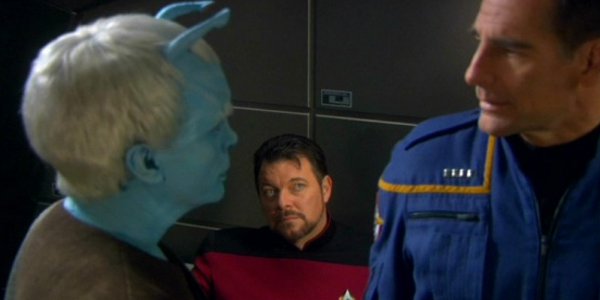
Like Life On Mars, it's pretty easy to see some of the ideas that were behind Enterprise's finale, These Are The Voyages. Everyone figured out this would be the end of 18 straight years of Star Trek on TV and someone clearly thought it would be nice to bring that era to a close with some The Next Generation character cameos. Unfortunately, Rick Berman and Brannon Braga insisted on doing it all themselves, instead of coming up with the idea and working with the existing writing staff to give Trek a proper sendoff. These Are The Voyages manages to do two impressively ridiculous things: trample all over the cast's character development over the past two seasons and steal the focus from those characters to place it on William Riker. The first is accomplished by writing the characters and plot like a season 1 script (aka when the show sucked and Archer was pretty racist against Vulcans) and the second is done by making the entire episode take place in a holodeck during TNG season 7. Ultimately, the bizarre decision to mash these two periods led to a story that seemed more like bad fan fiction than a celebration of the franchise. Riker played fry cook while trying to sort out whether to tell Picard about a black ops project he was on, Archer was racist against Vulcans again (after helping saved their civilization from a civil war), Andorian general Shran faked his death to avoid some thugs instead of getting everyone he knew to blow them to subatomic particles, and Tucker died inhaling superheated gas. It pretty much solidified fan opinion that Berman and Braga were idiots and hacks that killed the franchise up until the last three or four years, when more behind the scenes info about Enterprise's production troubles came to light. These days, Trekkies give Berman and Braga (mostly Braga, as he had interesting ideas) a bit more slack for putting up with UPN execs that wanted bands on the show, but few think this bizarre finale deserves anything more than being the worst Trek series finale to date.

4. St. Elsewhere

This one is so infamous that not including it would be ridiculous. St. Elsewhere was proto-ER and Chicago Hope: an urban medical drama that dealt with contemporary issues and jump started tons of people's Hollywood careers. This is literally the show that gave Helen Hunt, Ed Begley Jr., Howie Mandel, Mark Harmon, and Denzel Washington their big breaks. But it ends with the sting that the entire past six seasons of the show were all in an autistic kid's head. Unlike some of the other bizarre endings, which at least had their origins in good ideas, nothing about this ending makes any sense. If this was supposed to be something about the difficulty of raising an autistic child, it would've been better to have this be the beginning of an episode. The only other semi-coherent explanation for this ending is that everyone on the production staff hated the show and were glad to be done with it. That would not only explain the ending being a giant middle finger to the fans, but why the production company killed off their cat mascot after the credits.

3. Battlestar Galactica

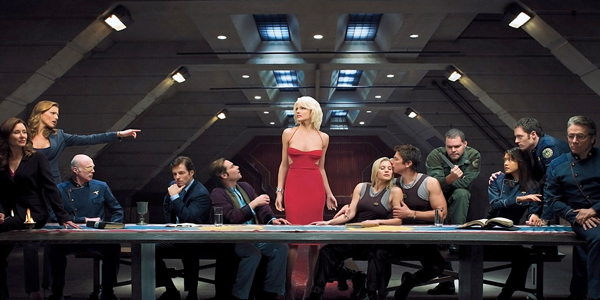
Back in 2004, the Battlestar Galactica miniseries was anti-Star Trek: no incredibly advanced technology beyond FTL drive, the only races involved were humans (Colonials) and cyborgs (Cylons), characters with natural sounding dialogue and conflicts, and unique action set pieces. Unfortunately, after a season and a half, the show started meandering and relying on the metaphysical aspects of the universe as a crutch as the writers struggled to make things up. After an abysmal third season with the dumbest Iraq War allegory ever, Sci-Fi gave Ron Moore and David Eick a final season to wrap things up. And while that final season was a lot better than season 3 as a whole, it make up for the finale ending with a truly bizarre of events. After a pretty long and great looking space battle near the event horizon of a black hole, Galactica does one final FTL jump and emerges near Earth (our Earth €“ there was ruined one earlier in the show). As it turns out, everything in BSG happened 150,000 years ago; the Colonials and Cylons decided to ditch all their technology and teach the primitive humans in order to break a cycle of humans making robots that rebelled and killed them. They send almost all of their ships into the sun, and at some point, the first Colonial/Cylon hybrid becomes the common female ancestor of our species, which is revealed through a Ron Moore cameo in New York, where he reads a National Geographic issue on the topic. Galactica's finale is pretty much what you get when no one does even a basic outline of the plot when they start the show. For a show that touted its close adherence to science at its beginning, Battlestar Galactica (and Ron Moore) made the fatal mistake of trying to warp scientific facts to fit its ridiculous plot points and themes. That extra bit of bizarreness at the end broke the backs of almost everyone still watching the show at that point, leaving a whole lot of bitter and disillusioned scifi fans out there.

2. Lost

2004's Lost is what happens when writers have no idea what to do and string things together with mysteries and twists. What started as a show about a bunch of people stranded on an island quickly had some extra mysteries (a polar bear and a malevolent black cloud) thrown in to keep the show interesting. Over the next six seasons, Lost would encompass everything from secret scientific cabals to time travel and the afterlife. Breaking down the Lost finale to its most basic parts reveals how ridiculous it is. The main part of it is a handful of main cast members trying to stop an evil spirit from destroying reality using the island's special electromagnetic properties. They ultimately defeat the spirit by removing the cork from the heart of the island, which destroys the island and makes the spirit mortal, so they kill it before the island totally disintegrates. Meanwhile, everyone who has ever been on the show is in a purgatory based on their lives if they had never crashed on the island, because being on the island was the most significant thing in their lives. Once the remaining cast members die, everyone gets ready to move on. There's a bit of irony in the fact that the entire cast wound up in purgatory, when one early fan theory was that the island itself was purgatory. But in all honesty, that theory still makes more sense than the sum total of Lost's labyrinthine mythology over its six seasons and numerous alternate reality games.

1. The Prisoner

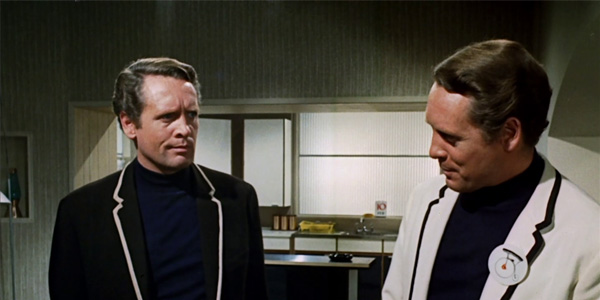
1967's The Prisoner is probably one of the most famous cases of surrealism in television. The show revolved around a British spy who resigns, only to find himself knocked out and dumped in an isolated seaside village, where everyone is assigned a number, but the main character (Number Six) decides to rebel. While Six tries to figure out what is going on and how he can escape, the Village's administrator (Number Two) tries all sorts of things to find out why Six resigned and pry out any information he gained while doing his job. The Prisoner's finale involves Number Six sitting through a trial where a hooded jury dances while someone sings "Dem Bones." Here Six meets Number One, the man controlling the Village's operations, who is wearing a monkey mask, but underneath that, he has Number Six's face. Of course. Six eventually gets chased by a bunch of people, frees some imprisoned allies, and launches a rocket under the Village, before eventually making it to London and driving off in his car. To make the whole thing even more bizarre, series star and creator Patrick McGoohan actually went the extra step of hiding from angry fans after the finale aired. While that doesn't seem that special in a day and age where anyone can get death threats for doing something others don't like, it's pretty impressive when you consider that this happened nearly fifty years ago, when it wasn't as easy to get large groups of people to rally together to express their anger. While The Prisoner has gone on to become a cult classic, no one is going to forget how nonsensical the ending is for a long, long time. Have your own nominees for this list? Think a show doesn't deserve its slot? Let us know in the comments below.

Contributor
Contributor

Living in Florida, enjoying the weather when its good, writing for a living. TV, Film, Animation, and Games are my life blood. Follow me on Twitter @xbsaint. Just try not to get too mad when I live tweet during Toonami.