Arrow: 10 Ways That Season 3 Went Wrong
Oliver always hits the target. Arrow...doesn't.

After eight months, twenty-three episodes, two big bads, and one defrocked superhero, the third season of The CW's Arrow has come to a close.
With the second season ending on a series of cliffhangers that left fans salivating over the summer hiatus, expectations were high for the Season 3 premiere back in October. When last seen, Oliver was flying high after defeating his annual supervillain and celebrating by sending some seriously swoony heart-eyes at Felicity, Sara went back to the League of Assassins, Thea absconded with Malcolm Merlyn, Diggle learned that he would be expecting a Digglet, and Flashback Ollie moved from Lian Yu to Hong Kong. Overall, everything was fairly awesome.
Still, the Season 2 finale left a lot of ground for the first few episodes of Season 3 to cover, and fans eagerly awaited resolutions.
Well, the third season opened by either rushing the characters past certain resolutions, or skipping over them entirely. Oliver and Felicity flirted, went on a date, almost died, and broke up. Diggle's daughter was born and Diggle was benched. Thea was absent. Sara died. Arrow hit the ground running, and everything was... dreary.
The next twenty-two episodes would see Arrow hit some pretty high highs and some pretty low lows. While the eventual happy ending was more than welcome, there were some problems that are difficult to overlook. So, here is a breakdown of ten ways that Arrow went wrong in its third season.
10. Marginalizing Oliver

From the very beginning, Arrow was sold as one man's journey from a vengeful serial killing vigilante into a hero. Oliver Queen returned from five years of hell with a list of names and a bow as his only companions. The scope of his mission expanded early on as Oliver was forced to bring others into his secret lair and his confidence. Former soldier John Diggle became his brother-in-arms to watch his back, and computer genius Felicity Smoak brought a high tech flair to his distinctly low-tech operation. Together, they became Team Arrow.
But the show was still called Arrow, and Oliver was still the protagonist. For two seasons, all of the other characters and plots were appropriately peripheral to his journey.
In Season 3, it all changed. The show was still called Arrow, but Oliver was marginalized more and more each week as other characters were shoved into the spotlight. He was even run through with a sword and kicked off of a mountain to clear the way. Unfortunately, the attempt to use his “death” as a springboard for secondary origin stories just created a vacuum in which it became clear just how much Stephen Amell did as lead actor to elevate the material. It's no coincidence that the quality picked up after he returned to prominence toward the end of the season.
9. Splitting Team Arrow

One of the early criticisms of Arrow is that it was basically a small screen adaptation of Batman Begins, complete with a Bruce Wayne in Oliver, a Rachel Dawes in Laurel, and an Alfred in Diggle.
Then, something happened. Diggle grew out of his role as Oliver's Alfred to become an equal partner, and the duo found an invaluable - if unwitting - ally in Felicity Smoak. Halfway through the season, Felicity was in on the secret and Team Arrow was born. Felicity brought fun into the lair, and Diggle was a guiding influence for Oliver when he strayed too far from the straight and narrow. With friends at his side to humanize him even as they challenged him, Oliver became a hero truly worth rooting for. Team Arrow was the heart of the show.
Which is why it was awful that the show chose to split the team for most of Season 3. Oliver insisting on pushing his closest friends away sent Felicity into the arms of Ray Palmer, Diggle onto a seat on the bench, and himself back into a glum brooder reminiscent of early Season 1. Team Arrow as a stabilizing force could have helped to sell many of the radical changes to the show in Season 3; their absence and separation just made the landscape of the series unpleasantly bleak.
8. Birth Of The Black Canary
For fans of the Green Arrow comics, the name Dinah Laurel Lance is immediately recognizable as an individual to wear the mask of the Black Canary. So, when a woman by that name was introduced on Arrow as the female lead, many such fans assumed that she would be hitting the streets as a vigilante in no time.
For everybody else, the idea that Laurel Lance, Esq. could ever become a vigilante on par with Oliver’s Arrow was absurd. The show’s incarnation of the character was a lawyer whose combat training consisted of self-defense classes. By Season 3, she was 30 years old. It was surely too late for Laurel Lance as Black Canary.
Or so it had seemed.
The first episode of Season 3 saw the death of Canary 1.0 Sara Lance. In the third, Laurel sought out the help of a boxer. By the end of the tenth, Laurel was bedecked in leather, wearing a mask, and delivering quips as she smacked thugs around. The tenth episode.
It should have taken longer than seven episodes for all of the custom buckles for her suit to arrive in the mail. Rushing Laurel into an effective Black Canary marginalized the journeys of Oliver and Sara as vigilantes, strained suspensions of disbelief to the breaking point, and made no sense within the narrative.
7. Palmer Island

Ray Palmer is a prime example of a character that could have worked wonderfully but was utterly failed by the writing. Clearly introduced as an impediment to the wildly popular Oliver/Felicity romance, he was already at a disadvantage with many viewers. Still, as proved with Sara Lance and Barry Allen back in Season 2, Arrow was capable of incorporating outside love interests without derailing the entire narrative.
Unfortunately, the writers insisted on isolating Ray Palmer from the main action for nearly the entire season. Given that he was still present for a sizable chunk of screentime, his scenes opposite only Felicity felt like bits from another show that were accidentally edited into Arrow.
Now, Ray still could have worked if he were written as peripheral to de facto female lead Felicity. Instead, the show used Felicity as a springboard for Ray’s journey toward the ATOM suit. Time was being taken from the established characters to support the fantastical origin story of a newcomer who did not fit within the relative realism of Arrow.
Interestingly, Ray began to work at the end of the season after he was finally allowed to interact with the rest of Team Arrow. His perky enthusiasm was a great foil to Oliver’s long-suffering stoicism, and contributing to the overall plot rather than sucking up time for himself did wonders for him.
6. Writing For The "Gotcha!"

Over the first two seasons, there were some wonderfully memorable moments. Moira shooting the Hood. The Undertaking destroying the Glades. Oliver killing Count Vertigo. Felicity stabbing Slade. The moments were surprising and spellbinding and spectacular…but they never felt designed for the sake of spectacle.
The third season saw a series so addicted to the shock and awe following a big “Gotcha!” moment that there ceased to be much effort put into setting the stage. Sensible rising action was forsaken in favor of a flashy climax that generally ended up not mattering much in the grand scheme. Ra’s al Ghul kidnapping Quentin made for a great visual, but it begged the question of why the Demon’s Head himself was jaunting around Starling City. Oliver wedding Nyssa was a twist, but there was no reason why the marriage would be valid outside of Nanda Parbat. Team Arrow and Co. dying in a dungeon was upsetting, but the show was not going to kill most of the cast in one go.
It’s one thing for the show to send viewers toppling off the edges of their seats after satisfying the suspense of a storyline; it’s another thing entirely for the show to smack viewers in the face with a baseball bat and expect them not to look back and wonder why they never saw the swing.
5. Sacrificing Characterization
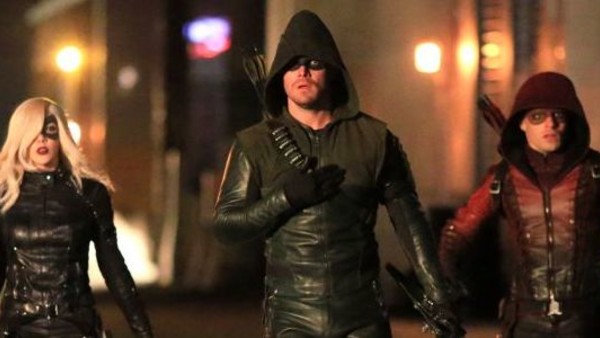
Arrow is rather notorious for the pace with which it churns through plot. Certain stories that would occupy other shows for entire seasons are played out within a handful of episodes. At times, the fast pace is positively refreshing as the series manages to keep the narrative exciting even outside of finale events.
Other times, the focus on fast-paced plot is positively ruinous to other aspects of the show that are sacrificed for the sake of cramming as much material as possible into 42 minutes of airtime. In Season 3, it was characterization that suffered.
Far too many of the major arcs were facilitated by creating characters du jour rather than writing them with any consistency. Laurel wanted to be Black Canary to quench the fire within her…and to honor her sister…and because she was always destined for the mask. Oliver had to face Ra’s al Ghul because Malcolm had video of Thea killing Sara as leverage…except he knew all along that Malcolm was bluffing…and he needed to save Malcolm from Nanda Parbat… except he really just wanted to face Ra’s again. Roy saw Malcolm as a monster who needed to stay away from Thea…except when Thea liked him…or when Malcolm wanted to join forces with Team Arrow.
Bad plot can be forgiven when characterization is solid; bad characterization can ruin an entire show.
4. Treatment Of The Ladies

Arrow has always somewhat fallen short with its female characters. The comic genre is frequently represented from a male-centric point of view that casts women as distressed damsels in need of rescue or guidance more often than capable of acts of heroism; with a male protagonist whose history demanded that he leave a string of women scorned in his wake, the first two seasons of the show were somewhat tough on all of the ladies.
Season 3 was just plain awful for them.
Superheroine extraordinaire Sara Lance was shot full of arrows, knocked off of a rooftop, banged into a dumpster on the way down, and landed in a dirty alley on her head. Laurel Lance was shoved into Sara’s vacant mask before the brain matter could be wiped off because apparently the Lance sisters are as interchangeable as vigilantes as they were bedmates to Oliver. Felicity was rewritten to facilitate the story of a man who stalked her, belittled her, and denied her credit that she was professionally due. Nyssa was forced by her father to marry Oliver with the understanding that she would bear him children ASAP, then forced to kneel before the man who had ordered the death of her beloved. Thea was violated by her father as he drugged her, brainwashed her, and forced her to murder Sara.
Huzzah for feminism.
3. Underwhelming Villains
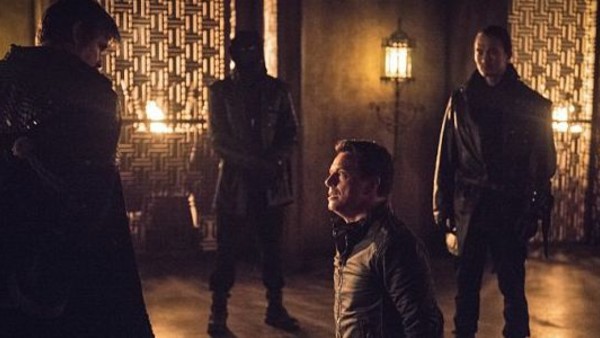
Season 3 started out promisingly enough on the villain front. John Barrowman as the twisted Malcolm Merlyn was a highlight of Season 1, and there was no way that Arrow would incorporate a bad guy like Ra’s al Ghul himself if he were not going to be so evil that Slade Wilson would seem positively cute in comparison. Two big bads in one season? It was going to be great.
Unfortunately, instead of embracing the dark side and letting the evil flag fly, Arrow watered down its main villains to the point that Oliver’s self-sabotaging was more generally irksome than their acts of violence. Ra’s scored some nice evil points by skewering first Oliver and then Thea, but he was mostly just a temperamental irritant who liked to have his way. Matt Nable did what he could with the role, but the writing wasn’t there for Ra’s to be properly scary.
For his part, Malcolm’s absurd redemption arc based upon his apparent endless love for the young woman whom he drugged into submission just didn’t work, and the contrivances necessary too justify why he could occupy the same city as any of the good guys without being shot, pummeled, impaled, cyber-destroyed, and/or decapitated managed to hamstring a whole cast of characters at once.
2. Meandering Flashbacks

The flashbacks of Season 3 had a lot of potential. The surprise cliffhanger at the end of Season 2 that saw Island Ollie wake up in a bed in Hong Kong was more than welcome after two seasons on Lian Yu, and it was about time that Oliver got a start on gaining some of those other souvenirs that he mysteriously accumulated over the five years after the shipwreck. At the very least, it was a clue that Oliver would be learning Mandarin and receiving his abdominal tattoos in the near future.
Sadly, the closest that Season 3 came to Ollie learning Mandarin was Ollie fumbling with a Mandarin-to-English dictionary while referring to the language as “Chinese,” and his tattoos are still absent. Of course, there are presumably not many viewers who sat down for Season 3 hoping for twenty episodes of Oliver memorizing rules of syntax while picking out images for his abs, but more needed to actually happen in the flashbacks. The Yamashiros made for a compelling family, and the duel between Tatsu and Maseo was one of the high points of the final few episodes, but the disconnect between past and present for the majority of the season took its toll.
1. Depressing
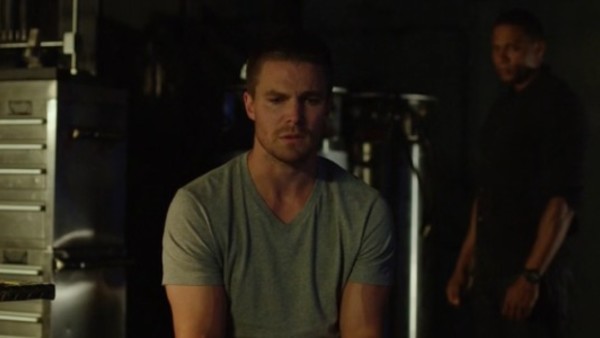
Neither Season 1 nor Season 2 of Arrow was perfect. There are even some areas in which Season 3 is better. The problem that has made it so difficult to look back at this past year of Arrow with much enthusiasm is that it was just so incredibly depressing.
For the longest time, literally nothing good happened. It was all yelling and crying and brooding. Every time that it seemed like Oliver had hit rock bottom and his life could get no worse, the show would toss him a shovel to dig himself deeper and make his entire existence all the more miserable. Past a certain point, it didn’t even feel constructive to critique Oliver’s more boneheaded decisions. By the end, the guy deserved credit just for getting up in the morning.
Luckily, the third season ended on a happy note for the hero with Oliver driving off into the sunset with his lady love and a proclamation of his own contentment on his lips. If Arrow hadn’t managed to pull itself out of its perpetual cycle of misery by the end of the finale, it might have found itself without much of an audience for its fourth season.