Black Mirror - Every Episode Ranked From Worst To Best
All 19 episodes ranked.

Charlie Brooker's delightfully twisted dark comedy series Black Mirror recently dropped its acclaimed fourth season direct to Netflix, and so what better time to pore over all 19 episodes and sort the wheat from the chaff?
Granted, the shockingly consistent quality of Brooker's output means there's very little in the way of duds or filler episodes, so while not everything is a home-run or an awards-winning classic, there are maybe only one or two episodes you might consider skipping when re-watching the entire series.
Perhaps the greatest thing about Black Mirror isn't the speculative, terrifying technology featured, but the firm bead Brooker fixes on humanity, ensuring a clear relatability between the current state of society and a potentially horrifying future that could await.
To that end, episodes have a tendency to polarise and connect wildly differently with people, ensuring that any ranked list such as this should invite a healthy amount of passionate debate. Get ready...
19. Men Against Fire

Men Against Fire is probably the most forgettable Black Mirror episode, a post-apocalyptic thriller of sorts, in which a soldier (Malachi Kirby) finds himself part of a unit hunting down so-called "roaches", mutated humans who, inevitably, turn out to be anything but.
Though it's well-made and solidly acted like any Black Mirror installment, it all feels a little too familiar, and even the featured tech - an implant called MASS which can manipulate what soldiers perceive as an enemy - isn't that interesting.
At an hour in length, it's a bit of a slog to sit through, the message is heavy-handed, and what passes for a twist is almost comically obvious. Watchable, yes, but one you'll probably want to skip on repeat viewings.
18. Metalhead

Metalhead is a vaguely intriguing, stylistically gorgeous little experiment, albeit one that doesn't really amount to much narratively.
Maxine Peake gives a solid performance as a woman on the run from a robotic "dog" and director David Slade makes good use of eye-popping monochrome cinematography, but this incredibly simple chase narrative fails to bring any interesting social commentary to the table whatsoever.
Clocking in at just 41 minutes, Metalhead doesn't outstay its welcome, benefits from some tense moments and the CGI dog is impressive, but the central idea doesn't feel fleshed-out enough for the show's high standards.
Furthermore, the final twist can be seen coming a mile off and it's not especially clever either, ending this installment on something of a shoulder shrug.
17. White Bear

Much like Metalhead, White Bear's brevity prevents it from ever becoming a bore, but it's nevertheless a rare episode that lets its schlockier sensibilities take precedent over any potentially clever insight into the world as we know it.
Beginning as a promisingly subtle slow-burn, it all builds to an inevitable rug-pull - that the woman being chased was complicit in a child's murder - that's not particularly smart or satisfying, serving as a fairly facile commentary on our collective thirst for "justice" as well as tabloid mob mentality.
Still, Lenora Crichlow gives an impressive lead performance and Tuppence Middleton and Michael Smiley provide entertaining support, leading to a suitably dark ending and some neat "behind the scenes" credits footage.
16. Arkangel

Though far from a series classic, director Jodie Foster and lead Rosemarie DeWitt do nevertheless make for a compelling pairing in this timely tale about an overprotective mother (DeWitt) who has a tracking device implanted inside her daughter, allowing her to keep close watch of her movements, actions and vitals.
It goes as horribly south as you'd expect from the show, and though some of the ideas here do feel cribbed from other, better episodes - namely the concept of one's experiences being persistently recorded and the idea of "blocking" content or people in real-life - as a satire of coddling parents in the technology age, it's undeniably trenchant stuff.
21-year-old Brenna Harding playing a 15-year-old is comically distracting and it lacks the subtlety or ingenuity of Black Mirror's better episodes, but it's a solid effort boosted by a great director-star pairing.
15. The Waldo Moment

One of the show's most pointedly political episodes, The Waldo Moment explores what would happen if a CGI bear comedian attempted to run for office on a wave of populism...which in the current age of Donald Trump lends the episode an eerily prescient quality on more recent viewings.
Though Brooker lays the satire on a little too thickly for its own good, his examination of the dangerous entanglement of entertainment and politics is potent enough, not to mention his indictment of disenfranchised voters looking more for a laugh than serious discourse.
It's an incredibly depressing episode that only feels more relevant in a post-Trump world, though the post-credits tag - where a dystopian Waldo-state has been established - is probably a bit much.
14. Crocodile

Unquestionably one of Black Mirror's bleakest episodes to date - and that's really saying something - Crocodile is an uneven but unremittingly grim episode mainly worth watching for Andrea Riseborough's fantastic lead performance.
Though almost the entire first half of Crocodile is bereft of much prospective technology at all, things pick up considerably when an insurance agent (an excellent Kiran Sonia Sawar) tracks down Riseborough's businesswoman Mia to investigate an incident from her past.
The "memory dredger" tech central to the investigation is neat and director John Hillcoat (The Road, Lawless) makes the most of the gorgeous Icelandic scenery, all the way up to the jaw-droppingly dark finale, which may understandably be too much for some tastes.
13. Playtest

Fans of Charlie Brooker will probably be aware of his affinity for video games, with Playtest serving as a sharp commentary on the potential perils of mind-expanding augmented-reality technology.
Ably helmed by 10 Cloverfield Lane director Dan Trachtenberg and touting a solid lead performance from Kurt Russell's son Wyatt, this isn't the most sophisticated episode, but as a fun homage to gaming culture - complete with references to Resident Evil and Bioshock - it's a breezy, suspenseful hoot.
The CGI spider is a little rough, but the avalanche of reality-bending twists in the final stretch is great, pulling the rug several times just when you think you've got things figured out. If you're not a gamer, though, mileage may vary.
12. Fifteen Million Merits

A riveting homage to Logan's Run with some of the series' best production design work to date, Fifteen Million Merits sees Get Out's Daniel Kaluuya and Jessica Brown Findlay deliver two of the show's strongest performances as a pair of low-class grunts who pedal endlessly on exercise bikes in order to earn "merits", this dystopian world's currency.
It's a disturbing metaphor for the way humans live their lives today, where entertainment is an opiate for the mundanity of the daily grind.
Brooker's critique of vapid reality TV doesn't have a scrap of subtlety - which might make it too much for some - and it's perhaps a little overlong, but Kaluuya in particular is fantastic, and the superb ending is the show at its most cynically, bleakly comedic.
11. Hated In The Nation

The final episode of Black Mirror's third series is the longest and most ambitious installment to date, a feature-length cop thriller in which Kelly Macdonald's detective investigates the murder of a controversial clickbait journalist.
With some gnarly gore, sharp pacing and an on-point critique of "outrage culture", Hated in the Nation makes the most of its horrifying concept, and despite the abundance of CGI elements, doesn't ever feel chintzy or goofy.
There's a fantastic balance here between the B-movie silliness of a robotic bee swarm and the legitimate tension of an unstoppable, crowd-sourced cloud of murderous justice. There are a number of expectation-defying twists, and it features one of the best quotes in the entire series: "the government's a c***."
10. Black Museum

The final episode of the latest series is an intriguing anthology of ideas wrapped around a deceptively simple frame narrative, leading to an entertainingly grim payoff.
Douglas Hodge and Letitia Wright make for a fine pairing, while the script, working from an original story conceived by magician Penn Jillette, is packed with demented twists and turns which build to a satisfying final "gotcha!"
Like any anthology the stories aren't created equal, but tied into one cohesive fabric, they're a wonderfully sinister mix, while a litany of Easter eggs within the museum hint at the wider context of Black Mirror's universe.
More memorable than legitimately brilliant perhaps, Black Museum nevertheless ended series four in gorgeously gnarly fashion.
9. Nosedive

This Joe Wright-directed (Atonement, Hanna) episode cannily casts Bryce Dallas Howard as a woman living in a world where every interaction, no matter how minor, can be rated by others, impacting a person's overall social ranking number, which can in turn affect the socio-economic opportunities made available to them.
It gets zero points for subtlety, but Nosedive is nevertheless a highly entertaining social media satire, noting how so many use Facebook, Twitter, Instagram and so on to project an inaccurate image of themselves, the validation of which directly accounts for their self-worth.
Sure, the episode presents a heightened reflection of reality, but it's easy to see some version of this coming to fruition years from now: don't be surprised if a retrospective article deems it "depressingly prescient" a decade from now.
Howard, Cherry Jones and Alice Eve are fantastic throughout, and the climactic wedding confrontation is a thing of hilarious, sad, f***ed up beauty.
8. U.S.S. Callister
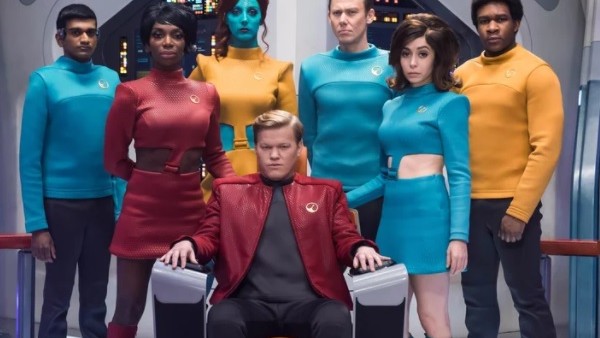
More than merely the shallow Star Trek parody it seems to be in its opening moments, U.S.S. Callister sees Charlie Brooker once again engaging with contemporary gaming trends, this time turning his attention towards VR technology.
Jesse Plemons and Cristin Milioti give two of the show's best-ever performances as the "God" of a Star Trek-skinned VR realm and an unwilling participant respectively, while Brooker combines a clear love for the style of classic Star Trek with a throughline that becomes increasingly more creepy and malevolent.
The end pulls no punches by ribbing both J.J. Abrams' lens flare-obsessed Star Trek movies and online gaming culture, and there are also plenty of small details for fans of Trek to keep their eyes peeled for.
7. Shut Up & Dance

Shut Up and Dance is probably the most controversial and polarising Black Mirror episode of all, largely due to its twist ending, which some deemed patronising and offputting, while others praised it for challenging social norms.
Though it initially seems like a half-baked retread of White Bear, things quickly get much better, with Alex Lawther and Jerome Flynn's characters desperately teaming up to avoid their respective personal secrets getting out.
While not one of the series' most stylistically showy episodes, it's raw and stripped down, which is all it needs to be. Lawther and Flynn are terrific as two men on the brink, all the way up to the marvelous final rug-pull, which upends the popular stereotype that all pedophiles are grotesque old men.
Furthermore, the big reveal makes rewatching the episode enormously rewarding, as there are a number of clues hidden throughout the episode. It's understandably not an episode for everyone, but that doesn't mean it's not one of the show's strongest efforts for those who can stomach it.
6. Be Right Back

Surely the most heartbreaking and haunting of all the Black Mirror episodes, Be Right Back follows a woman (Hayley Atwell) whose has her dead partner (Domhnall Gleeson) resurrected in a synthetic body, the personality of which is based on the man's social media accounts.
With social media being so inextricably tied into the way most of us live our lives, the episode makes a powerful case for how hollow a digital avatar is compared to the real thing, enlivened by Gleeson's incredibly offputting performance as the digital approximation of the real man.
Atwell is also fantastic as the bereaved partner, and the episode does an excellent job continually one-upping itself right up to an ending that's both heart-wrenching and thought-provoking for a number of reasons.
5. Hang The DJ

By far the best episode of the show's recent season has undeniable echoes of fan favourite San Junipero, but also makes waves in its own right as an affecting, unconventional romance.
TV vet Tim Van Patten (Game of Thrones, The Sopranos, The Wire) directs the hell out of this cautionary tale about the perils of contemporary dating rituals, albeit with a heavier technological weighting.
Brooker does a great job satirising the pressure people put upon themselves to grind through dud partners to finally reach "The One", while Joe Cole and Georgina Campbell turn in fine work as the focal couple fighting to stay together in a dystopia that seems dead set against it.
Some might argue it's a little too similar to the absurdist black comedy movie The Lobster, but it does enough to distinguish itself while flirting with the same ideas. Also, it dares to actually end on a somewhat happy, upbeat note, which is so incredibly rare for the series.
4. The Entire History Of You

At one time or another, we've probably all imagined what it would be like if our every moment was recorded for endless perusal at any time, and The Entire History of You is a riveting, devastating warning why any such technology would brutally overhaul human relationships.
Toby Kebbell and Jodie Whittaker are sublime as the central couple whose relationship is totally derailed by the tech. It's a surprisingly grounded treatment of a relatively out-there idea, keeping the stakes small-scale while providing plenty of food-for-thought about how such tech would transform most people into cerebral detectives.
Furthermore, the episode confronts the cloudy nature of memory and touts the most unsettling sex scene of the series. It's a masterpiece of cringe, totally horrifying and yet every character is at least somewhat relatable. Brutal stuff.
3. The National Anthem

The show's first-ever episode is destined to be remembered as "the one where the Prime Minister shags a pig", but it's far more intricate and densely-layered than that logline would suggest.
A timely examination of the public's maddening obsession with the Royals, the fleeting, erratic nature of public opinion, the government's relationship with the press and how it all ties into social media, The National Anthem is so brilliantly deadpan Brooker almost convinces that it could conceivably happen.
With an eye for technical details and some of the show's sharpest, most insidiously screwed-up gallows humour, it's a mind-boggling, unforgettable mission statement for every episode that follows.
With an excellent Rory Kinnear performance and one hell of an expectation-defying final twist, it's an undeniable instant classic of British TV.
2. San Junipero

The Emmy-winning San Junipero is without question the show's most generally acclaimed episode, benefiting from Gugu Mbatha-Raw and Mackenzie Davis's splendid performances as two people whose digital avatars meet in the idyllic, Heaven-like titular locale.
It's also driven by fantastic production design and world-building, an unexpectedly hopeful, romantic tone, and excellent use of period-appropriate music. The songs could so easily have just felt like cheap nostalgia bait primed to hook viewers, but it in fact dares to go deeper, especially with that closing musical selection.
Like the best episodes, San Junipero rewards repeat viewings, and though the ending might be a tad rushed - at a snappy 61 minutes, it definitely could've been longer - overall Brooker delivers a haunting, existential romance like nothing else out there.
1. White Christmas

Though some might disagree with the show's feature-length Christmas special nabbing our top spot, it's hard to deny the brilliance of Brooker's hellish anti-yuletide tale, powered by fantastic work from Jon Hamm and Rafe Spall in particular, with impressive support by Natalie Tena and Oona Chaplin.
Much like Black Museum, White Christmas wraps several disparate stories into one kicker of a frame narrative, the true nature of which isn't made entirely clear until the episode's final seconds.
Loaded with some of the series' most provocative and believable concepts - namely blocking offensive persons in real life - and unafraid to venture in more surreal directions (the cookie!), it all culminates in a deliciously twisted series of revelations that change everything we thought we knew.
Aptly, it's incredibly depressing viewing with no happy endings for anyone, which is exactly what a Black Mirror Christmas episode should be.
How would you rate Black Mirror's best and worst episodes? Shout it out in the comments!