Falcon And Winter Soldier Explained - Who Is Isaiah Bradley?
How Bradley Changes The Legacy Of Captain America Completely
Captain America: The First Avenger is a great film, but it also whitewashes much of the Second World War.
As HBO's Watchmen demonstrated powerfully the other year, race is at the centre of the narrative behind the United States. This means that, if you're going to comment on the idea of Captain America as an American symbol - one that transcends any government institution and cuts to the core idea of what the nation should be - then that necessitates a discussion on race as well.
Steve Rogers is in many ways the typical Übermensch, and, ironically, Hitler's ideal Aryan specimen. He has blond hair, blue eyes, and is well built, and whether or not Jack Kirby and Joe Simon intended a level of irony with his physical appearance, to have Hitler's ideal man be the one to stand up to his tyranny is some serious poetic justice.
But there's also another thing to consider with Steve Rogers. The character was created in 1940, a time when de facto and de jure segregation pervaded the United States, and Jim Crow laws were enforced. The US military was segregated, and would remain that way until President Truman enacted Executive Order 9981 in 1948, by which point Captain America as a character had transitioned into his awkward "commie smasher" phase during the second Red Scare.

The point is that, despite being a fairly revolutionary character, arriving on the scene to defy Adolf Hitler at a time where the US was gripped by isolationism, racial injustice in the United States eluded Captain America.
It also eluded The First Avenger's sanitised depiction of World War II, which on top of de-politicising the conflict altogether, doesn't mention segregation at all. It is clear now, however, that the MCU is now making tentative steps to address that in The Falcon and the Winter Soldier with the introduction of Isaiah Bradley.
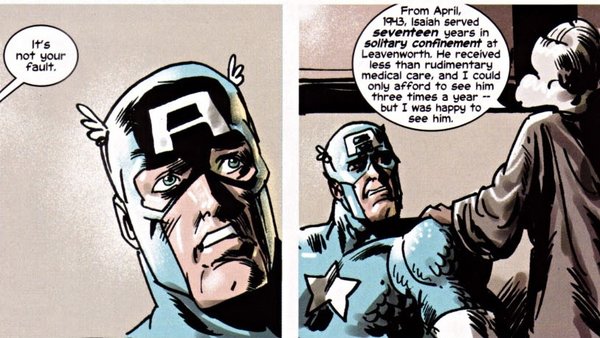
We can see that Isaiah was, like his comic book counterpart, struck from the history books in the MCU, and that he was also imprisoned but for much longer. The difference this time is that Steve never learned of the character's existence, and that Bradley himself isn't living the happy retirement he got in Truth: Red, White & Black.
The series is essentially inserting actual history back into the MCU, exploring how there's more to the legacy of Captain America than just Steve Rogers, and how race continues to inform the concept behind the character with John Walker now in the costume.