Sherlock: 5 Reasons Why The Next Villain Won't Be As Awesome As Moriarty

After all, how could anyone outdo the detective's Greatest Ever Foe?
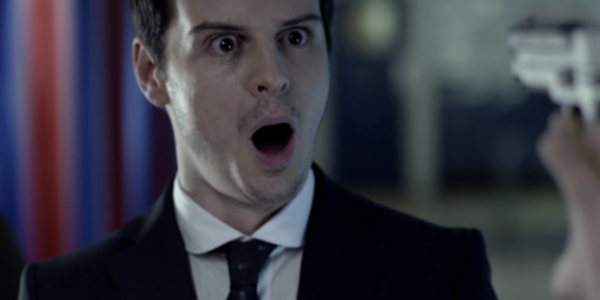
Ever since 1893, when the Sherlock Holmes short story "The Adventure of the Final Problem" was published by Sir Arthur Conan Doyle in Strand Magazine, James Moriarty has been Sherlock Holmes' ultimate archenemy. Since then, Moriarty has been portrayed in a variety of Sherlock Holmes films, television series, radio broadcasts and plays, with little variation in his foundations: he's always clever, always cunning, always nearly getting the best of the famous consulting detective. Then, in 2010, BBC's 'Sherlock' came to the screen, with a characterization of Moriarty the likes of which had never been seen. Andrew Scott's scene-stealing performance, and, of course, top-notch writing by Steven Moffat, Mark Gatiss, and Steve Thompson, created a character who is equally bizarre, hilarious, creepy, and fascinating. With Moffat and Gatiss seemingly denying a return, however improbable, for Moriarty in the upcoming third season of 'Sherlock,' the show will be hard-pressed to create another villain as fantastic as Moriarty. Looking back on seasons 1 and 2, here are a few reasons why Jim Moriarty cannot be outdone as the perfect adversary for Sherlock. SPOILERS abound; you've been warned.

6. His Deceptions

"Jim Moriarty. Hi."
With that one line we realize that this adorable little Irishman, Molly Hooper's boyfriend, "Jim from IT," is Sherlock Holmes' arch-nemesis and the greatest criminal mastermind the world has ever known.
"Jim? Jim from the hospital? Huh. Did I really make such a fleeting impression? But then I suppose that was rather the point."
In that moment Sherlock finds himself as bemused as the audience. In a rare moment of deductive blindness, he has looked the world's greatest criminal up and down and only come up with one deduction - "gay." How does Sherlock miss realizing that he is in the presence of the man responsible for the bombings, the murders, even the murder that set Sherlock on his path to becoming the world's only consulting detective? Because Moriarty is the king of disguises, and honey, you should see him in a crown. Moriarty takes on many roles throughout the series; it showcases his ultimate prowess at deception and manipulation. The first character he plays is Jim from IT, a ploy to show just how close he can get to Sherlock. His more obvious roles include the actor Richard Brook and the cab driver in 'The Reichenbach Fall,' but perhaps even more impressive are his roles as an ordinary civilian in 'A Scandal in Belgravia' when he sends Mycroft Holmes the text about the 007 flight and in 'Reichenbach' when he poses as a tourist visiting the Tower of London. The fact that he can masquerade so easily as an ordinary person is incredible and quite chilling, considering his disdain for "ordinary people." It is also this ability to blend in and become an ordinary person that leads to Sherlock's ultimate undoing, as the press swallows Richard Brook's story that Sherlock is a fake. Moriarty not only takes on new identities; he takes on new "voices" as well, as can be seen in 'The Great Game' when he forces other people to be his "voice" to speak to Sherlock over the phone. In the end he even steals John Watson's voice, forcing Sherlock into feeling betrayed, if only for a second, before the real Moriarty makes his grand entrance. Even the southern drawl Moriarty puts on during the rooftop scene in 'Reichenbach' - "Just trying to have some fun" - shows how readily he can switch between different characters and identities. In other words, he is "sooo changeable!" While Sherlock uses his fair share of disguises and false identities, no one can beat Moriarty for sheer flexibility in taking on whatever identity he needs to get what he wants.

5. His Childishness

In 'The Hounds of Baskerville,' Sherlock observes that Henry Knight is "psychologically still a child." While this psychological state may not be true for Moriarty, it may be that empathically he is still a child. He sees other people not as fellow human beings worthy of respect, but as pawns he can use within his criminal network. People are playing pieces within a game he can control, and when Sherlock fails him as the ultimate distraction from boredom, it's "back to playing with the ordinary people." Other child-like tendencies crop up throughout the series - for instance, his preoccupation with fairy tales in 'Reichenbach.' His eagerness to play the role of the "good old-fashioned villain" shows that, to him, this is just another opportunity to show off his versatility in playing what becomes a strange game of make believe , another tendency of children. His fondness for games and riddles, like I.O.U. and the Final Problem, bring forth the image of a child desperate for new entertainment, and Sherlock is just that. Even the fact that Moriarty resorts to calling Sherlock "DOOFUS!" when Sherlock seems to fail in figuring out the truth behind the computer code shows just how childish Moriarty can be. He controls a vast criminal network that stretches across the globe, yet his world is still so small; he can't see beyond himself. Compared to his own brilliance, other people seem like children to him, and so he mocks others for their seeming mediocrity - "'Aren't ordinary people adorable?" - when he is really the child. The contrast of his superior intellect and cunning with his child-like craving for entertainment creates a frightening portrait of a man ambitious enough to control the criminal underworld and apathetic enough to others not to care about the consequences. Even his mercurial temperament, which can shift from joking to deadly serious within seconds, illustrates the two extremes of his personality.

4. His Unpredictability

Moffat and Gatiss' original plans for the reveal of Moriarty in 'The Great Game' were for Sherlock to finally hear Moriarty's real voice but still never actually see him. While hearing Moriarty's voice after he had used so many different "voices" would have brought the episode full circle, I'm glad they changed their minds, because Andrew Scott's embodiment of Moriarty is fantastic. He has this energy about him of a loose cannon, just something that is completely and utterly unpredictable. He is able to catch even the great Sherlock Holmes off guard when he reveals himself. What's unnerving is his appearance shows no evidence of his identity as the world's greatest criminal; he is small and soft-spoken, with not the slightest hint of being threatening or imposing. Even when he speaks, he uses high-pitched inflections and a sing-song voice to lower expectations of himself as a threat. Then this exchange occurs:
Jim Moriarty: "I have loved this. This little game of ours. Playing Jim from IT; playing gay. Did you like the little touch with the underwear?" Sherlock Holmes: "People have died." JM: "That's what people DO!"
In that instant we see the villain behind the mask, the mastermind behind the murderous plots, the evil lurking behind the innocent front. The change is so sudden, it made me jump the first time I saw this episode. His chilling words still give me goosebumps when I watch it now. The key to Moriarty is this unpredictability. While the seeming randomness of his actions confuses others, in Moriarty's mind every piece of the plot fits together, no matter how seemingly bizarre or unrelated. This is why Sherlock is a worthy opponent for him: he can take those pieces and fit them together, deducing why Moriarty would let himself be imprisoned, why he would enter a plea of not guilty and give no defense, why he would become Richard Brook, etc.One of the last times that Moriarty lets his mask slip is in 221B after the verdict, when he and Sherlock are talking:
JM: "It's going to start very soon, Sherlock. The Fall. But don't worry. Falling's just like flying..."
And then his gentle voice morphs into a caustic, biting sneer.
JM: "...there's just a more permanent destination."
That dead-eyed, furious glare he gives after just says it all. Jim Moriarty is not a man; he is a creature bent on the destruction of anyone who gets in his way. And they will never see it coming. ...Unless they're Sherlock Holmes, of course. But that's for another article, another day!

3. His Quirks

Who doesn't love Jim Moriarty's priceless little quirks? He may be one of the most evil men to ever grace the small screen, but, frankly, he is also one of the most hilarious. I've said Moriarty has a reason for everything, no matter how random it may seem; however, he is at his best when he chooses to do certain things, not for any particular reason, but simply because he can. His 'Stayin' Alive' ringtone? In 'Reichenbach' we learn that the song reminds him of his boredom with existence, but he still doesn't need it. He has it because, with his own twisted sense of humor, the ringtone amuses him. A good thing, too, because we get to experience the ironic hilarity of that ringtone going off right before Sherlock is set to shoot the explosives that would blow him, John, and Moriarty to smithereens. Thank you, Steven Moffat, for that moment of absurd humor that completely captures Moriarty's character. And, who doesn't love Moriarty's dancing in the Tower of London as he dresses himself in the Crown Jewels? He could just smash the display case and wait for the police to come arrest him; he doesn't have to dance. But he does, and it is glorious. Even his creepier moments come off as awkwardly hilarious. When he asks the police officer to reach into his pocket and makes her put the stick of gum she finds there in his mouth - well, it's a moment so creepy and yet so very Moriarty that you just have to laugh even as you squirm. I'd like to see anyone else pull off what he manages to - even the sing-song delivery of lines like "No, you won't!" when Sherlock says "Catch. You. Later" is just fantastic for the fact that the tone is so odd and out of place. Overall, Moriarty is just odd and out of place and insane, which makes it believable when he is mad enough to kill a child for laughing at him or to commit suicide just to make sure that he wins and Sherlock loses. Yes, while he is completely insane, all his delightful quirkiness makes him a villain impossible to hate.

2. His Mirroring Of Sherlock

The brilliance of Moriarty as a character has always been his similarity to Sherlock. They both feel superior to the people around them and need distractions to keep them from becoming bored. They view people as disposable and manipulate and deceive them without feeling guilt. Their paths even started together, with the murder of Carl Powers. This crime led each of them to their chosen (and self-made) occupations: a consulting criminal and a consulting detective. What stops Sherlock from becoming like Moriarty? Sherlock himself says that he could easily become a criminal, yet he elects to be a detective. As Mycroft says, "What might we deduce about his heart?" The fact that Sherlock actually has a heart seems to be ultimately what separates him from Moriarty. Moriarty knows this, and mocks him for it on several occasions, with taunts like "We're just alike, you and I. Except you're boring." What's "boring" about Sherlock is the fact that his "weakness" lies in his love for the people close to him. Moriarty uses this knowledge against Sherlock whenever he can, most significantly in 'Reichenbach' when he threatens to kill John, Mrs. Hudson, and Lestrade unless Sherlock commits suicide. Unlike Sherlock, Moriarty doesn't seem to possess any emotional attachment to other people. Sentiment is where the fine line between Sherlock and Moriarty starts to waver. While there are a few people that Sherlock cares about, he still thinks of people in general as beneath him. However, he doesn't manipulate them out of malicious intent; he simply uses them in whatever way he needs to solve the crime at hand to gain the mental stimulation he craves. Moriarty, on the other hand, enjoys using his intellect and cunning to torment others. He has no heart; he has only himself, and prefers it that way. He sees Sherlock as his "good" counterpart who is "on the side of the angels" - a worthy opponent at first, but doomed to fail (and fall) because of his emotional attachment to other people. Moriarty is also careful to differentiate between himself and Sherlock. No matter how similar they may be, their attentions lie in different aspects. Though they both may be consulted, one is a detective, one is a criminal. One lives for mental stimulation, the other lives for the amusement of controlling other people. One plays the "good old-fashioned villain," the other is "the Reichenbach hero." Even in their sexuality they are at odds. Because of Sherlock's alleged abstinence from sex, Moriarty nicknames him "The Virgin." What does Moriarty nickname himself? "Mr. Sex." The simultaneous mirroring and collision of their character traits make their scenes together electric; their rivalry will be hard to beat for sheer intensity and spectacle.

1. He's Made The Writers Victims Of Their Own Success
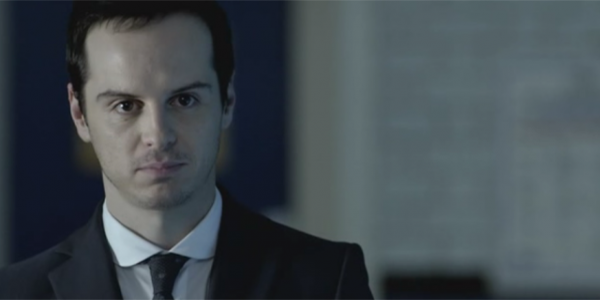
For only being in about forty minutes of the nine hours we currently have of 'Sherlock,' Jim Moriarty certainly leaves an impression. Any villain can be deceptive, childish, unpredictable, quirky, and/or a mirror of the hero, but in pulling all of these traits together, Moffat, Gatiss, Thompson, and Scott have created a character both fascinating and repulsive, repellent yet mesmerizing. In short, they have created the perfect villain. Unfortunately, this also means they have set their own trap: if they create a new villain who (obviously) must differ from Moriarty, he may be seen as a lesser villain compared to him, but if they make the new villain similar to Moriarty, then they are boring their audience by repeating themselves. All we can do is trust the writers; giving credit where credit's due, they've rarely failed us before. Sherlock and John will once again face their adversaries in season 3, airing on January 1 with "The Empty Hearse." While Moriarty will no longer be one of them, I think it's fair to say he will be sorely missed, and remembered as the best villain 'Sherlock' has ever had. Do you think Sherlock's new villain can hold their own against Moriarty? Share your thoughts below in the comments.

In this post: 
Sherlock
 
Posted On: 
Contributor
Contributor

She is a student at the Ohio State University with a major in English and a minor in Film Studies. She loves watching 'Sherlock' and 'Doctor Who' and is an aspiring author currently working on her first novel about the Paris catacombs. Follow her on Twitter @sherlocked1058 or email her via coane.1@osu.edu. View more of her musings on Sherlock and Doctor Who at 221bbc.blogspot.com.