Star Trek: 10 Times Starfleet Officers Crossed The Line
In the long history of Star Trek, what counts as crossing the line and where should it be drawn?
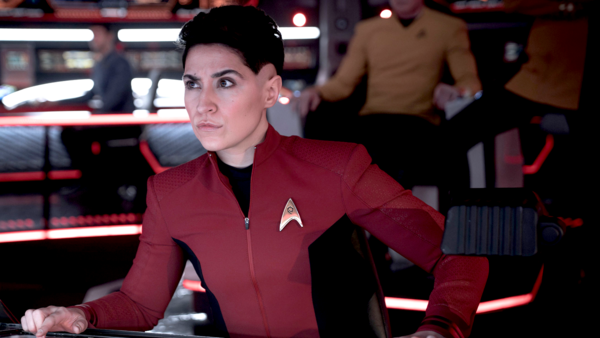
When one considers the rules that Starfleet officers must follow, one can hardly be surprised that there are dozens of cases of rule-breaking in the history books. How many times did Jim Kirk circumvent the chain of command for the greater good, or how many times did Tom Paris shout pepperoni in the face of consequences?
We must bear in mind that, sometimes, rules really do get in the way for no good reason. 'Because it was there' may be a good reason to climb a mountain, but hardly an excuse to avoid a difficult decision.
What then counts as crossing the line in Star Trek? Do we, the audience, feel the overstep, beyond any chance of understanding? Or do these following officers' actions leave us pondering their motives, their methods, and their means?
10. Seven Of Nine Condemns A Sentient Being To Death - Prey
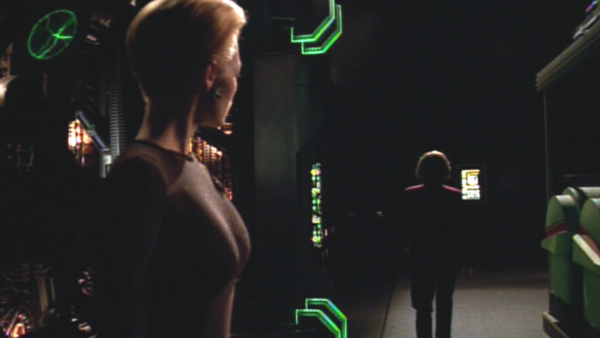
While her career in Starfleet may still have been several years away, there was little doubt that Seven Of Nine was an honourary officer aboard Voyager. She was assigned duties like any other officer, she contributed to the smooth running of the ship like any other officer, and she faced the music like one too.
When the ship was boarded by a member of Species 8472 in 2374, Seven found herself face to face with a being who, as part of the retaliatory war against the Borg, had most likely destroyed thousands of drones.
This being was hunted by the Hirogen - a fearsome Delta Quadrant species who would later capture the ship for their brutal war games - though it had largely managed to evade them. Despite some promising attempts at communication by Tuvok, Seven stepped around the rules and beamed both the creature, and the Hirogen hunting it, onto one of the latter's ships.
Though she attempted to argue her case, Seven was bluntly reprimanded by Captain Janeway. There was a time and place for expressing individuality - but that wasn't it.
9. Michael Eddington Betrays Starfleet For A Greater Good - For The Cause

Michael Eddington was a Starfleet officer, long before he ever switched his allegiances to the Maquis. He may have put Garak to shame when it came to spinning a lie, but from his point of view, he stepped over a line he had no choice in crossing.
The treaty between the Federation and the Cardassian Union left the quadrant with a demilitarised zone. This zone was a hotbed of political tumult, with several colony worlds finding themselves under new jurisdictions with the swish of a pen.
Hindsight may be a wonderful thing but there were many in the zone and beyond who knew that the Cardassians were never going to honour the treaty. Skirmishes and raids, as well as brutal attacks that were just small enough not to incur Starfleet reprisals, became the order of the day. The Maquis were born to combat the Cardassian threat and to many, including Eddington and others, they were last, best hope for those colonists' salvation.
Many officers, like Chakotay, resigned their comissions to join the Maquis. Eddington finds himself on this list as, rather than put down the combadge and leave the service, he used his Starfleet position to trick his way into possession of industrial replicators, stunning Major Kira, and embarking on a daring campaign of freedom fighting.
His intentions were pure, though his actions left little room for sympathy from a captain who felt betrayed more than twice over.
8. Admiral Dougherty Condemns The Enterprise-E To Destruction - Star Trek: Insurrection
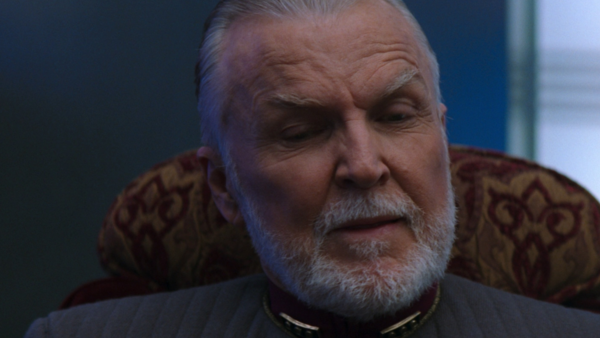
Just how far should a person go in their quest for the Fountain Of Youth? Star Trek: Insurrection is often unfairly maligned for its pacing and perceived lack of stakes following Star Trek: First Contact, though that does the film a disservice.
Admiral Dougherty commands the mission to move the Bak'u from their home in the Briar Patch, perched upon the lofty ideals of the 'greater good' of Starfleet and the Federation. The radiation from the planet's rings could end up helping billions of people - surely, a price worth paying, even if it costs a few hundred people their home, one might argue?
He does then lose the moral high ground when he orders Ru'afo to send Son'a ships to 'escort' the Enterprise back to Baku - knowing full well that he is ordering the destruction of the Enterprise, Riker, and the crew.
Whatever good intentions may have spurred the mission into motion are lost in the mire of 'evil sacrifice' here. Dougherty would pay the ultimate price for his decision, ending a distinguished career in disgrace.
7. Jonathan Archer Steals A Warp Coil - Damage
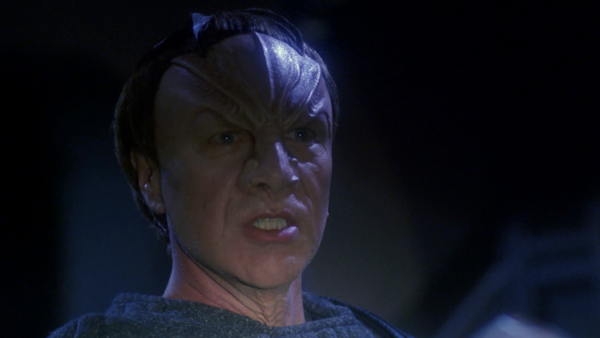
What must one do when it comes to saving, not just their crew, but the future of humanity? Is there any line a captain wouldn't cross? Jonathan Archer was forced to confront this dilemma in 2154 when stuck, sans working warp coil, inside the Delphic Expanse.
Though relations with the Ilyrians would somewhat improve in the century that followed, this first contact was devastating. Despite the newcomers' offers to help the stricken NX-01, Archer settles on piracy as the only course of action open to him. He needs their warp coil, despite knowing it will strand them three years from home.
Though a visibly emotional T'Pol argues with Archer, imploring him not to commit to this mission, he overrules her. Enterprise attacks the Ilyrian ship, securing their warp coil, resulting in their being successful in rendezvousing with sympathetic Xindi. While history may consider the decision worth the risk, Archer himself was forced to continually ask himself if he did the right thing.
6. Tim Waters Didn't Know When To Quit - Valiant

Cadet-turned-Captain Tim Waters may have seemed like the perfect candidate for command but his actions aboard the USS Valiant put paid to that. He rose to the big chair in the heat of battle and, for a time, kept his ship of cadets safe while behind enemy lines.
His sense of duty was gradually clouded by a rising need for stimulants, a need to prove himself, and an inability to accept defeat. When seemingly given the opportunity to deal a devastating blow to the Dominion, he gave an order that should never have materialised.
He orders the USS Valiant, a Defiant-class vessel of limited size, to attack a Dominion Battlecruiser - a ship described as twice the size of a Galaxy-class starship, and five times as powerful.
There is a time for seeking glory, or proving oneself, but that wasn't it. Waters not only gets himself killed, but all but one of his crew as well. Only Chief Petty Officer Collins, along with Jake Sisko and Nog, escape the doomed ship. As Nog sadly reflects after being rescued:
He may have been a hero. He may even have been a great man. But in the end, he was a bad captain.
For Waters, and for his crew, there was no opportunity to learn from this decision. At least, nearly a millennium later, several of the Valiant's crew's names would adorn a commemorative wall at Starfleet Academy.
5. Joseph M'Benga Commits Murder Behind The Wall - Under The Cloak Of War

One of the biggest questions surrounding Doctor Joseph M'Benga, following the climax of Under The Cloak Of War, was - did he do it deliberately, or was it an accident?
By it, we mean the death of General, later Ambassador, Dak'Rah. While audiences had seen some of the Klingon-Federation War in Star Trek: Discovery's first season, this episode delves into the trauma experienced by those surviving officers and soldiers who saw the worst that the war had to offer.
M'Benga, and Christine Chapel, had been stationed on J'Gal when Rah began his escape. This, before Rah's defection to Starfleet, still followed a brutal subjugation of the planet's people. M'Benga, while on the planet, had attempted to capture Rah before he left, earning the nickname 'The Butcher Of J'Gal.'
Reunited aboard the Enterprise, M'Benga and Rah came to blows - with M'Benga deliberately landing a killing blow. This, revealed later in Shuttle To Kenfori, was vengeance, pure and simple. In revealing that this was, in fact, a deliberate act on M'Benga's part, rather than self-defence, one must accept that he stepped so far over the line that there could be no coming back.
Thankfully for him, Pike refused to file a report (off-the-books missions are handy like that), which means M'Benga's career might be safe, even if his conscience carries the burden.
4. Miles O'Brien Warns Bilby - Honor Among Thieves
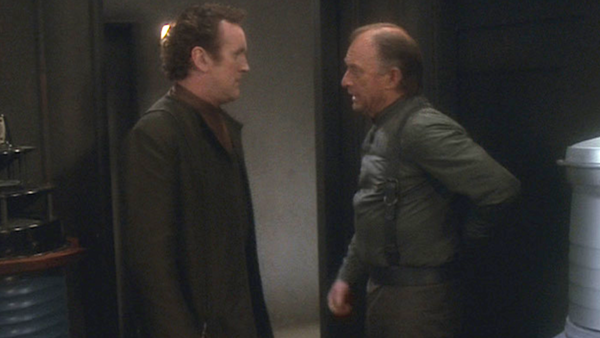
Honor Among Thieves gave a then-rare glance at the Orion Syndicate, the feared crime empire that dominated the underworld of the Alpha Quadrant. Miles O'Brien, recruited for his technical skills as much as his ability to blend into a bar, is sent by Starfleet Intelligence to Farius Prime, tasked with infiltrating the Syndicate.
After befriending a member named Bilby, O'Brien (posing as a man named Connelly) is horrified to learn that the Syndicate is doing business with the Dominion. Bilby is assigned a special mission: use Klingon disruptors (repaired by O'Brien) to assassinate the Klingon ambassador to Farius. This, the Dominion hopes, will look like a political killing, as said ambassador is strongly against the Klingon-Federation alliance.
O'Brien does his duty and passes this information back to his handler, only to have a change of heart. For Bilby, it's a suicide mission, though the man doesn't know it. O'Brien, having grown sympathetic to Bilby's position, warns him, though it has little impact - the man is dead either way, for the Syndicate will kill him, and his family, if he tries to run.
Chadwick, O'Brien's handler, is the only reason the non-com officer is able to return to Deep Space Nine, as he opts not to report his actions to Starfleet, understanding that emotion took control of the day. O'Brien, lucky in a certain respect, keeps his position and inherits Bilby's cat, Chester, as well.
3. Erica Ortegas Forces A Confrontation With The Klingons - Shuttle To Kenfori
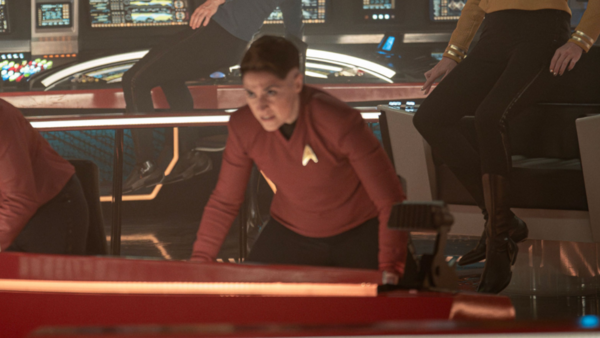
Erica Ortegas is one of the great unknowns from Star Trek: Strange New Worlds. Introduced in the pilot, she flies the ship, don't you know! Other than that, she received little character development until the third season - when it started to arrive in spades.
Her capture and assault by the Gorn clearly left her shaken, which only added to the trauma she felt after the Klingon war. While she had been cleared for return to service, questions began to arise about her fitness, particularly after the events of Shuttle To Kenfori.
Ready and raring to save Pike and M'Benga as she was, she let her emotions get the better of her while the Enterprise was playing hide and seek with a Klingon Battlecruiser. Despite the risks, she edged the speed of the ship up sufficiently so as to be noticed by the Klingons - thus giving her the excuse to mount the daring rescue plan she had proposed earlier.
A happy ending does not grant one immunity from repercussions and Number One was quick to relieve her of duty. While her actions resulted in Pike and M'Benga's safe return to the ship, they could just as easily have led to an armed conflict. Good intentions must be handled with care and for Ortegas this was a hard lesson to learn.
2. Tom Paris Does Time - 30 Days
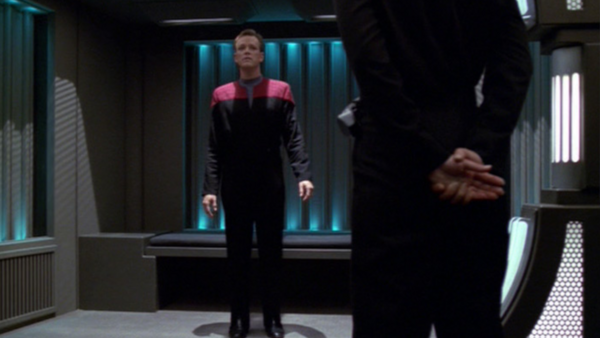
When Tom Paris boarded the USS Voyager, he was earning the trust that Captain Janeway placed in him. It was she who recommended his early release from a Federation detention centre, which in turn led to his position as helmsman of the ship.
By 2375, as a lieutenant junior grade, Paris had more than secured his position in the crew. He was respected and even though he had a reputation for certain passionate responses, he was a capable Starfleet officer. The events that followed Voyager's encounter with the Moneans and their 'water world' put all of that in jeopardy.
After discovering that this floating ocean was losing integrity, and that neither Janeway or the Monean council intended to do anything about it, Paris decided to act of his own accord. Fuelled by righteousness, and a childhood love of the ocean, he and a Monean named Riga stole the Delta Flyer, intending to use to it to force the Moneans at large to take action.
He was stopped in his tracks by a timely torpedo from Tuvok, then demoted and incarcerated by Janeway. He learned the hard way that an officer cannot simply act of their own accord when the Prime Directive is on the line.
1. Kirk Reveals The Enterprise And Then Lies About It - Star Trek Into Darkness
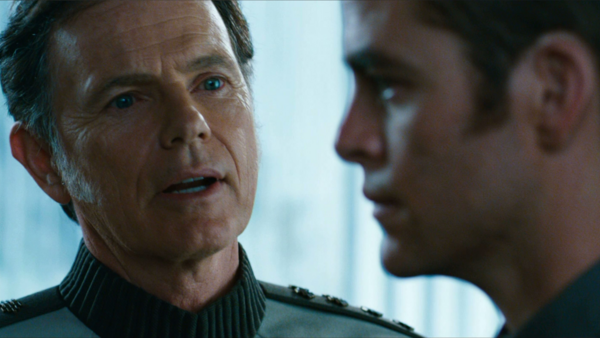
Star Trek was a story about James T. Kirk achieving command of the USS Enterprise. Star Trek Into Darkness is the story of how he earned it.
The film opens with the Enterprise submerged under the ocean on Nibiru, a planet with a pre-warp civilisation facing an extinction-level event. An enormous volcano is set to erupt, so Kirk decides to do something about it.
Initially, the plan looks solid. Spock will descend into the bowels of the volcano, detonate a cold fusion bomb, render it inert, and they can all nip back to the mess hall in time for supper. Naturally, things rarely go smoothly in the final frontier, and several unexpected twists later, Kirk orders the Enterprise risen from the depths. His plan may have been to save Spock, but the result is revealing a warp capable ship to a society that was thousands of years away from achieving anything of the sort.
That alone qualifies Kirk for this list but it is his decision to lie on the official report to Admiral Pike that solidifies it. In Star Trek, James T. Kirk often had a reputation for a devil-may-care approach to rules and regulations, but this was one of those times when, the love of Spock aside, Pike was completely justified in dressing down the brash, newly minted Captain.