Star Trek: 6 Historical Figures It Totally Made A Mockery Of

When Data met Sigmund Freud...
I was eight years old in second grade in America, and our history project was to make a puppet presentation of any historical figure we wanted. Some chose George Washington, some chose Abraham Lincoln, some chose Paul Revere, I think someone even chose Helen Keller too. Me? I chose none other than Sigmund Freud, of whom the majority in the class never heard. Of course, given Freud's infamous reputation as a psychologist and his not so secret love for the white powdery stuff, my parents and my teacher were concerned about what I might say during my presentation, and they just couldn't believe where I had heard of Dr. Freud: I first learned about him from Star Trek. With the limitless possibilities of science fiction, not excluding the invention of the Holodeck during the Next Generation era, historical figures are often used as comic relief in the Star Trek franchise. Of course, with many of these historical figures long since deceased at airtime, the writers didn't have much personality to work with so they had to improvise. As the old adage says, "history is written by the victors," and the same could be said for admirers of these historical figures because if some of these portrayals were accurate then history was far too kind. Some figures were portrayed as overbearing, some as villainous, and the one surviving historical figure who we'll get to later could surprisingly pull off one helluva poker face. After the jump we review the six most (in)famous portrayals in the franchise of the great minds read about in school textbooks for generations past, present and future.

6. Abraham Lincoln

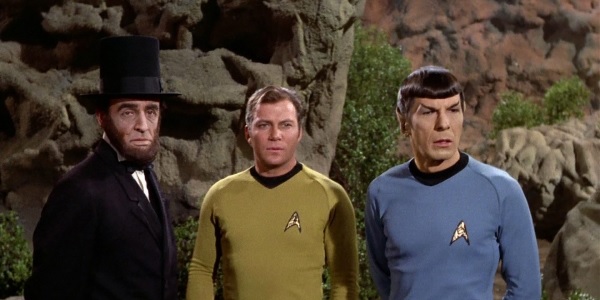
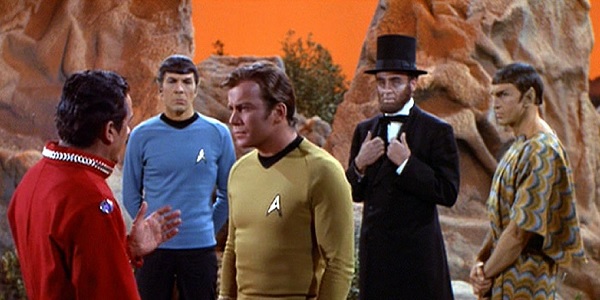
In what is arguably the most infamous, strangest and most often lampooned episode of Star Trek ever made (go watch the "Galaxy Boy Johnny" episode of Johnny Bravo and thank me later), unknown entities assume the form of Kirk and Spock's lifelong heroes, Abraham Lincoln and Surak. A rock monster known as Yarnek pits them in an Arena-esque battle of good vs. evil, only far more ridiculous than the original, against Genghis Khan, Colonel Green, a fictional human 21st century warlord, Emperor Kahless and a barbarian woman named Zora. The episode itself was an enjoyable piece of fluff writing in an otherwise difficult third season. Lee Bergere's portrayal of America's 16th president was a decent one, never wavering in character despite the 23rd century technology around him. Captain Kirk's idolization of an impostor was a bit of a head-scratcher though, extending high honors when the entity disguised as Lincoln beamed aboard the Enterprise in a rather foolish command decision by Kirk to begin with. Also, who knew that Worf's hero Emperor Kahless did such an uncanny Surak impersonation? So it's good we know that too. So all in all, having President Lincoln in an episode of Star Trek in general is a mockery, but that doesn't mean it was a poor performance by 1960's cheesy science fiction standards.

5. Mark Twain (Samuel L. Clemens)

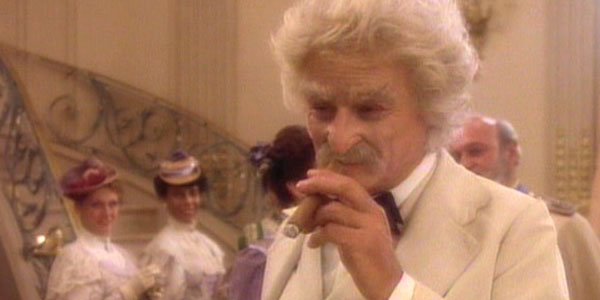
In the Next Generation's sole stint with time travel during the Next Generation TV era (at least of this proportion if you count Time Squared in that category), the fifth season finale and sixth season premiere introduced the Enterprise crew to none other than Samuel "Denial Ain't Just A River In Egypt" Clemens himself. A time displacement in an underground cavern on Devidia II sends Data back to 19th century San Francisco, with the crew going after him a short time later. In San Francisco, Data encounters Clemens at a reception with Guinan, whom Data thinks followed him into the past as well but it turns out is actually Guinan from the 19th century. Data, thinking Guinan is from the Enterprise in all his infamous cluelessness, warns her of an alien threat to 19th century Earth right in front of the historically quirky Clemens, leading Clemens to believe that the alien threat is present in the Enterprise crew. Jerry Hardin portrays Clemens as a suspicious and conniving secondary villain of the two parter. Suspicious of the motives and origin of the Enterprise crew, he even goes so far as to follow them underground and hold them at gunpoint in an underground cavern to prevent them from returning to the 24th century, only to be sent back with them and seeing the Enterprise himself, eventually becoming a reluctant ally in saving Picard and Guinan, who were left behind in the cavern. Hardin also portrayed Clemens, just as well known as a humorist as he was a writer, as quite the madman, walking through the streets of San Francisco yelling about aliens in San Francisco while spinning Data's allegations to use for his next work, which ultimately served as his primary motivation.

4. Isaac Newton

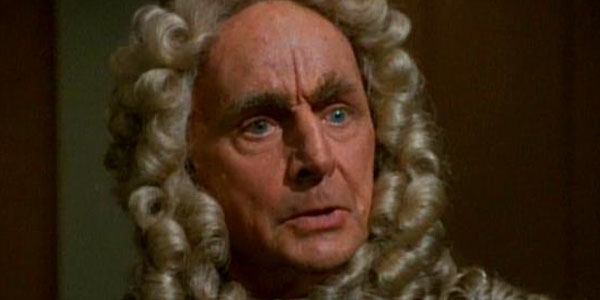
Sir Isaac Newton, the father of calculus and Newtonian physics and the bane of most high schoolers' existence, actually made two appearances in two separate series and was played by two separate actors. His first and most famous appearance came in season six of TNG when Data famously played poker with Newton as well as two other historical figures that made this list. Portrayed in TNG by John Neville, the holographic Newton was stuck up and pretentious, to say the least, taking great offense to Data's allegation that the apple falling on his head was nothing more than allegory. Newton's second appearance came as Peter Dennis in Voyager's second season episode "Death Wish," where Q transports Newton, Commander Riker and a Woodstock sound crew worker out of their respective timelines and aboard Voyager to make the case that one of the Q Continuum's greatest philosophers should not be allowed mortality in order to commit suicide. The Q in question had apparently jostled the apple tree that Newton sat underneath so that the apple would fall and usher in a new era of scientific discourse, made sure the sound crew worker made it to Woodstock in time to correct sound issues and saved one of Riker's ancestors who had been wounded during Sherman's March during the American Civil War. The Q we know and love added that if Q Too hadn't been under that tree, Newton would have died unknown in a Liverpool debtor's prison under suspicion of murdering several prostitutes. Q loves to be subtle.

3. Albert Einstein

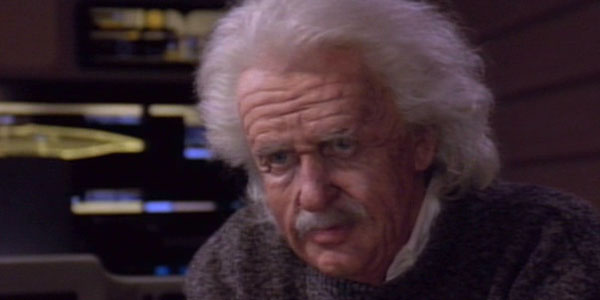
Albert Einstein also made two separate appearances in the Star Trek franchise, but unlike Newton he stuck with The Next Generation. He first appeared in the fourth season fluff piece The Nth Degree, where Barclay is given superhuman knowledge by an alien probe. Geordi walks in on a Holodeck simulation to find the usually shy and quirky Barclay arguing grand unification theories with Einstein himself (no I have no idea what that is, but apparently Geordi does and that's enough for me), which raises the last red flag that Barclay may have fallen under some sort of strange influence from the probe's attack on the Enterprise. Einstein's second appearance also came in the form of a Holodeck simulation, and also at the infamous poker table with Data, cracking jokes with the other facades about space time, prodding Sir Isaac about the apple story and calling a bluff on the winner of the game (whom we'll get to next)... and losing.

2. Professor Stephen Hawking

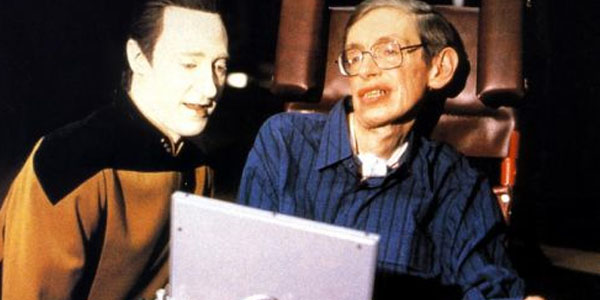
One of the favorite cameos in Star Trek history among the fans, the cast and the crew is the only surviving historical figure to make an appearance in The Next Generation is none other than Professor Stephen Hawking himself, and he has one hell of a poker face. Hawking emerges victorious in the infamous Holodeck poker game, all the while cracking jokes about the curvature of space time with Einstein and Data, much to the chagrin of Sir Isaac. While the idea of one of the most respected scientists of all time beating an android and two of the founding fathers of science at a poker table may seem rather silly, Hawking's performance was far from a mockery of himself; however, it would have been sinful of me to not at least mention this appearance especially considering the other two players at the table make an appearance on this list. Also as I said he is one of the most beloved cameos by the cast and crew; in fact, last I checked if you look up Rick Berman's Twitter account, his avi is of him directing Dr. Hawking for this scene.

1. Sigmund Freud

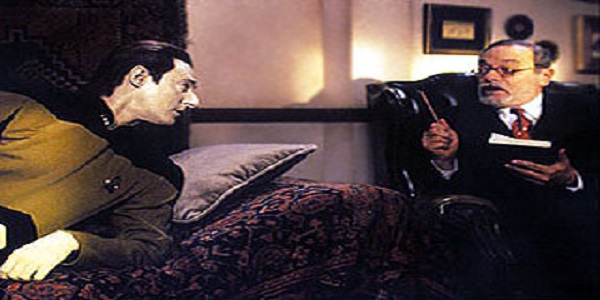
Alright, now most respectable psychologists and college professors will downplay Freud's contributions to the science because, quite frankly, the man was insane. So to say that Bernard Kates' portrayal of the infamous father of psychoanalysis was a mockery even by Freud's standards made this seventh season episode "Phantasms" just extraordinarily funny. Data discovers a dream program created for him by Dr. Soong, and when he starts to experience nightmares involving a knife, cutting into Counselor Troi like a cake and big burly workmen coming to take him apart he goes to none other than Dr. Freud himself which is basically just asking us Trekkies to make fun of him. Freud obviously interprets the knife cutting into Troi as Data's unconscious desire to have sex with his mother (because as a wise bar fly by the name of Cliff Clavin once said, "a Freudian slip is when you say one thing but you mean a mother") and the workmen were elements of a dismemberment dream out of animosity for Dr. Soong, his father. https://www.youtube.com/watch?v=mRq95IKBUtU Just when you think this hilarity can't get any worse, the episode ends with the fictional Freud calling a telephone inside Data's stomach to warn Picard and Geordi about the parasites attempting to feed off the crew, and also taking a slug from one of said workmen's old fashioned Ruger, this of course leading to one of the worst (and funniest) death scenes of all time. Did we miss your favorite historical cameo? Sound off below!

In this post: 
Star Trek
 
Posted On: 
Contributor
Contributor

Steve is an unrepentant nerd who enjoys all things Disney, Doctor Who, and Star Trek. He is currently finishing his undergraduate degree in political science at Temple University and divides his time between his homes in Philadelphia and Orlando.