Star Trek: Voyager - 10 Greatest Doctor Episodes
The Doctor was Star Trek Voyager's most beloved figure, but what were his best moments?

Star Trek Voyager gave fans some iconic and beloved characters, such as Seven of Nine, Captain Janeway, and Tom Paris. However, the Doctor is a character that is arguably THE most loved by Voyager fans and Star Trek fans in general. He started out as a piece of technology that turned into one of the most loved members of the crew.
He is one of the only characters who viewers see develop throughout the series, and the situations he found himself in throughout the show's run varied from hilarious to dangerous. He was always able to provide a laugh in any situation through a facial expression or sarcastic comment, and his friendship with Seven provided an excellent commentary on various issues.
While he hit many bumps in the road in his attempts to become more than a mere piece of technology, his determination and persistence meant he eventually did exceed his programming. His is a story of self-development that occurred before self-development was a buzzword, and took place in an area of space never before explored.
Like most of the other main characters, the Doctor got many storylines, but not episodes that seemed to feature him centrally. However, the ones that did, few though they may have been, were some of the best of the show's seven-season run.
10. Projections

The Doctor got his first major storyline in this season one episode, in which an increasingly complex situation turns into a life or death situation for him. It begins with him being activated after a red alert is issued. B'Elanna then enters sickbay injured and explains that the Kazon have attacked the ship.
He then goes to the mess hall to help Neelix defend against a stray Kazon, and during this encounter, he begins to bleed and feel pain, which as a hologram he shouldn't be able to do.
Enter Lieutenant Barclay who explains to him that he is actually Dr Zimmerman, the creator of the EMH, who is trapped in a simulation due to a radiation surge. The race is then on to end the simulation to prevent the Doctor from dying from radiation poisoning.
Another twist is thrown in when just before the Doctor is about to destroy the ship to end the simulation, Chakotay appears to tell him he IS the EMH and that destroying the ship will ensure his program is lost forever. This explanation ends up being true and a malfunctioning holodeck is found to be responsible.
The tension and twists in this episode keep viewers interested and questioning everything the whole time. It's the Doctor's first solo plot and it delivers, as he has something similar to an identity crisis, as he does not know for sure who he really is. The inclusion of fan favourite Barclay also gives this episode a boost.
9. Lifeline

Thanks to Barclay's efforts, the crew of Voyager got monthly contact with their loved ones, and the Doctor was no exception. After receiving a letter from Barclay informing him his creator, Lewis Zimmerman, is gravely ill and no Alpha Quadrant doctors can help him, he asks to be sent in the next communication to help him.
When he arrives expecting to be welcomed by his creator, the Doctor finds an unwilling patient intent on avoiding his care. So begins a battle of wits as the EMH attempts to trick Zimmerman into cooperating with him. Every attempt fails, and so Barclay turns to his friend, Deanna Troi.
When Troi's initial attempt to get Zimmerman to cooperate fails, she and Barclay devise a cunning plan to get the EMH and his creator to come together. They alter his program to make it seem like it's failing and Zimmerman is convinced to help fix him. Once he successfully helps the Doctor, he allows the EMH to treat him.
It's a brilliant episode that provides a growing experience for both creator and EMH, as they are forced to acknowledge their biases about each other. While Zimmerman is not a main character, his growth in this episode is heart-warming, and Robert Picardo does an excellent job of portraying both him and the Doctor.
8. Message In A Bottle

This episode is one of the few with the Doctor having a main storyline without any character development. Instead, it provides excellent tension throughout the entire episode with humour in spades.
It demonstrates how good Voyager's writing could be and gives both Picardo and Andy Dick, who played the Prometheus' EMH, the chance to flex their comedy muscles. And flex they did. The actors play off each other beautifully and their comedic timing is flawless. The development of the relationship between them is easy to follow and viewers are treated to some hilarious interactions as they work together.
Using a seemingly abandoned alien sensor network, he is sent to a Federation ship in the Alpha Quadrant. Once there, he finds out from the EMH on the ship that it has been taken over by Romulans. The Doctor decides to retake the ship, and so begins a laugh-filled attempt to do just that.
Between the facial expressions of both EMHs and their clumsy attempts to get the ship back into Federation hands, viewers are spoiled for moments of pure hilarity. The writing in this episode is brilliant, as tension and humour are expertly balanced to achieve simultaneous feelings of anxiety and glee.
While it may not be an episode of growth for the Doctor, it provides fans with an adventure showing the comedic side of him that they had glimpsed in earlier episodes.
7. Tinker, Tenor, Doctor, Spy
No list about episodes centred on the Doctor could be complete without this gem. It's similar to Message in a Bottle, as it provides no character development, but instead gives plenty of tension and laughs galore.
After asking Janeway to make him an Emergency Command Hologram in an emergency but having the request denied, the Doctor alters his program to allow himself to daydream. In so doing, he inadvertently provides a hidden ship belonging to the Hierarchy species with the ability to access his daydreams and "spy" on the crew. It goes undetected until the daydreams begin to happen when he doesn't want them to, prompting the crew to investigate.
Using the information they collected from the daydreams, the Hierarchy plan an attack on Voyager. When the alien responsible for accessing the Doctor's daydreams asks him for help, Janeway must indulge the request and make the EMH the ECH.
The Doctor has no meaningful character development, but Janeway's view of him does. She realises after watching one of his daydreams that he only wishes to become more than he is and just wants the capacity to do so. The story sets up this realisation and the consequence of it well, and the audience is treated to some hilarious scenes along the way.
This episode again handles the balance between humour and tension brilliantly and shows the comedic talents of the cast, particularly Picardo.
6. Virtuoso

The episode brilliantly shows that how you view yourself affects how you think others see you. The Doctor learns this lesson after his experience and also realises the crew love him for who he is, not what he can do.
The Doctor had expressed many times throughout the series that he wished to become and be seen as more than a piece of medical technology. In this episode, his singing abilities are recognised and idolised by an alien race who quickly make him a celebrity in their culture.
What the Doctor, who is blinded by the bright lights of fame doesn't realise until it's too late, is that the alien race are only interested in his singing abilities, not him. This realisation doesn't happen until after he resigns from his position on Voyager and burns some bridges between himself and his close friends.
He ends up coming back to Janeway with his tail between his legs knowing he has made a terrible mistake in choosing this alien race over the crew who have become his family. Mistakenly believing the crew do not appreciate his talents and only see him as technology demonstrated his own views of himself. Focusing on the fact he is technology has both held the Doctor back and pushed him forward.
While the growth he has in this episode is small compared to later entries in this list, it provides an excellent lesson that everyone can learn from.
5. Author, Author

Taking a leaf out of Next Generation's book, this episode of Voyager explored the Doctor's rights in a similar way that Next Gen did for Data.
This episode doesn't provide character development for the Doctor, but it provides a big step forward for the rights of holograms while giving audiences an interesting storyline. The subplot surrounding the interpretation of the holonovel by those who play it is fun and provides a lesson for the EMH.
After the Doctor writes said holonovel and sends a draft to a publisher in the now frequent communications with Earth, the question of his capacity to be considered a person arise. The publisher proceeds to circulate the novel without it being finished and, as an EMH, the Doctor has no rights over his work under Federation law.
So begins a hearing with the crew of Voyager and Barclay back on Earth arguing in an attempt to have the EMH recognised as a person. While it results in him not being considered a person, he is ruled to be an artist, allowing him control over his holonovel.
It provides an excellent commentary on what it means to be a person as the crew and Barclay explain their observations and feelings about the Doctor to the arbiter. Hearing the different interpretations of what a "person" is gives viewers food for thought around their own ideas on the topic.
4. Lifesigns

The messages about love in this episode are heart-warming, and seeing the EMH develop his romantic relationship is enjoyable. It provides him with his first experience of love and shows viewers he is capable of such emotions.
Falling in love is something everyone does at one point in their lives. Unfortunately for the Doctor he falls in love with a Vidiian doctor suffering from the phage.
It begins with a distress call and the Vidiian being beamed to sickbay for the EMH to treat. After creating a holographic body of her, he begins to slowly develop feelings for her as they work to find a cure. He even takes her on a date on the holodeck using one of Paris' programs.
It soon becomes apparent that the only way to help her is to use some of B'Elanna's DNA as Klingons are immune to the phage. She is reluctant to help after her previous experience with Vidiians, but relents and the treatment is provided.
Danara has reservations about going back to being the woman with the phage, as she is "ugly". The Doctor proves to her he loves her not for her looks, but for her personality and their final scene together is beautiful.
3. Critical Care
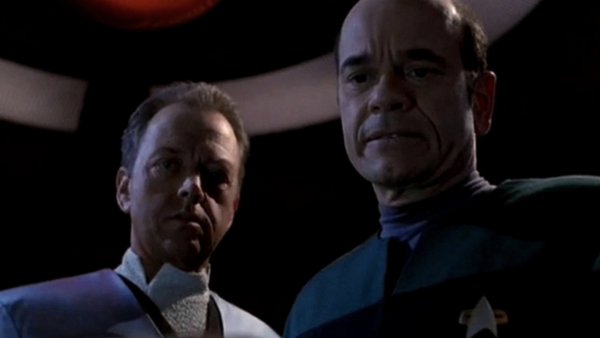
Providing medical care to anyone who needs it regardless of who they are is what the Doctor is programmed to do. But when he is forced to leave seriously ill people to suffer and die, he cannot stand by and let it happen. He takes matters into his own hands and finds he is capable of doing things he never imagined.
After being stolen from Voyager and sold to a society who provide medical care based on a predetermined value to society, he finds himself in a difficult situation. He is forced to provide preventative care for patients who aren't sick while people gravely ill are left with limited medication.
When the Doctor forms an attachment to a patient who is later killed, he resorts to behaviour he later questions.
He deliberately infects the supervisor responsible for the patients with a deadly disease and withholds treatment until he agrees to change the system. When he returns to Voyager, the Doctor has his program checked to ensure his ethics routines are functioning properly, and they are.
He then realises that his actions were a conscious decision that he made based on his emotions. This is a massive moment of self-growth for him, as it is clear he is now becoming more human than technology.
It's an excellent storyline for the Doctor which also provides commentary on medical care in society today.
2. Real Life

The Doctor faced his biggest emotional storyline and gut punch up until that point in this season 3 episode. While using a holodeck program to experience a "normal" family life, he soon finds himself in a situation that cuts him to his very core.
This episode sets up the natural progression of the Doctor's growth well, as his "perfect" family is changed by B'Elanna to resemble a real family in real situations. He goes through situations every parent has and learns that he cannot organise and control things the way he would like.
When his holographic daughter is injured in an accident and given very little time to live, the Doctor is forced to face a situation that no-one wants to. As his daughter dies in front of him with his wife and son by his side, the EMH experiences grief for the first time.
This episode makes it clear that the Doctor has evolved from when he was first activated. The fact he stops the program and refuses to go back once his daughter is injured demonstrates how his emotions are developing.
Its a heart-breaking episode that provides an excellent storyline for the EMH and allows viewers to see him in a "real life" situation.
1. Latent Image

This episode beautifully explored and portrayed the level of sentience the Doctor had developed, and the emotional aspect to the storyline gave viewers a more rounded character who had clearly become more than a piece of technology.
When the Doctor finds evidence of a surgery he doesn't remember performing, he investigates and learns his memory has been erased. Turns out he was forced to choose to save either Ensign Jetal or Ensign Kim and he chose Harry, resulting in him having a breakdown.
When he requests the memories be reinstalled and Janeway obliges, he goes through the breakdown again, only this time the crew help him through it instead of erasing his memory. Seeing him go over the situation again and again shows how he has developed throughout the series.
The final scene is particularly brilliant, as Janeway is seen sitting in a chair on the holodeck reading a book as the Doctor sits voicing his thoughts. The audience find out from the captain's log that the crew are taking shifts sitting with the EMH as a sounding board for his thoughts and just to ensure he's ok.
The Doctor's storyline in this episode is heart-breaking, but provides an excellent episode that is definitely his best in the series.