The Simpsons: 10 Hidden Jokes Everybody Missed
After so many years, there are still secrets to be found in The Simpsons.
After 26 years and 27 seasons, The Simpsons is currently America's longest running sitcom and will soon hit the 600 episode mark. It's probably safe to say that with any joke, cultural reference, visual gag, or quotable line you can think off from the top of your head, The Simpsons probably had something to do with it.
But despite the show being in its third decade, there are still some secrets to be found.
The beauty of The Simpsons, and one of the reasons why it has stood the test of time, is the hilarious jokes and the brilliant writing staff behind all your favourite one-liners and visual gags. The writing staff are also amongst the smartest people in television, and they have made a habit out of hiding deeply elaborate, and incredibly obscure jokes and pop-culture references in the show.
Each episode is filled to the brim with so many funny things that it is generally impossible to catch them all in one sitting. Even when you think you've caught them all, there is usually one joke that slips through the cracks.
So here are ten Simpsons jokes that are so well hidden that you, and a majority of fans, would've probably missed them the first time around.
10. Theres An Actual McBain Movie Hidden Throughout The Show

A well-known running gag is the random movie appearances of Rainier Wolfcastle, the Simpsons' answer to Arnold Schwarzenegger. Wolfcastle is generally shown portraying his most famous character, McBain, in various clips that are sprinkled out in various Simpsons episodes. On the surface, it's a simple and fun little joke. What you may not know is that there is a lot more to this running gag than just a funny spoof of testosterone and pun-filled action films.
If you take all the various McBain clips and rearrange them in order, you'll find that they form a mini-movie complete with a coherent plot and a three-act structure.
First there's McBain arguing with his Captain about being unable to go after the big bad, Mendoza. McBain and his partner then banter in a bar before an assassin murders the partner and escapes. Outraged, McBain tells his Captain that he's going after Mendoza regardless of the consequences. After infiltrating Mendoza's dinner party, McBain murders everyone but Mendoza and somehow gets himself captured.
Finally, just as Mendoza is about to enact his evil plan, and being reassured that McBain is dead by his numerous henchmen, the hero makes an unexpected return and this time manages to murder everyone, including Mendoza.
As well-hidden as this joke is, the writers barely broke a sweat for this gag, unlike the next few entries...
9. The Numbers Up On The Jumbo Vision Screen Actually Mean Something (Marge And Homer Turn A Couple Play)
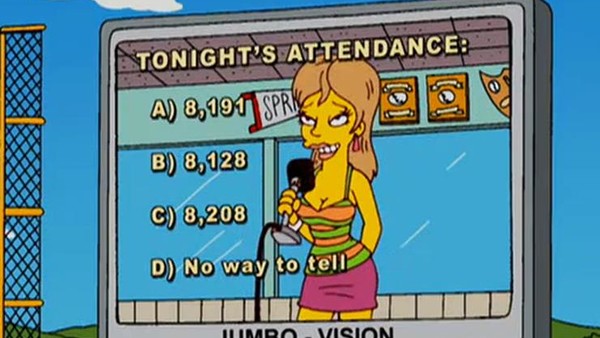
In the episode, 'Marge and Homer Turn a Couple Play', there's a short sequence in which a poll is taken at Springfield Stadium about the attendance numbers and the answers are displayed on the massive Jumbo-Vision screen. At first glance, the three numbers displayed (8191, 8128, 8208) seem arbitrary with no real meaning behind them. As it turns out, these numbers are not random at all and in fact represent a perfect number, a narcissistic number, and a Mersenne prime respectively.
For those who don't like maths, maybe skip to the next entry. For those who do, read on.
A perfect number is one in which its divisors add up to itself. A narcissistic number is one where the number is the sum of its own digits each raised to the power of the number of digits. Finally, a Mersenne prime number is one in which there are no positive divisors other than 1 and itself. Okay, maths lesson over.
You probably should know that Al Jean, the long-time showrunner for The Simpsons, had actually studied mathematics at Harvard before going to write jokes for a living and the Simpsons writers room is also filled with over-qualified math geniuses.
8. Mr Burns Telephone Greeting Is Actually The Original Hello

Amongst Mr Burns' many peculiarities, one of his most well-known quirks is his weird greeting whenever he answers the phone. Instead of the usual 'hello' or 'who the hell is this?', Mr Burns always uses 'ahoy hoy' as an opening greeting. This odd little greeting actually carries some interesting history behind it.
When Alexander Graham Bell (allegedly) invented the telephone, he recommended that 'ahoy hoy' should be the greeting in which people should use when answering a call. Thomas Edison thought it as kind of stupid and proposed 'hello' as a better alternative. You can guess which one stuck and which one didn't.
But the joke runs deeper still. Not only is Mr Burns' trademark greeting a reference to a small piece of history, but it is also a clever backhanded dig on how old Mr Burns actually is (short answer: very).
7. The Writer Who Uncovered The Truth About Whacking Day Also Uncovered The Truth About Watergate (Whacking Day)

Whacking Day is probably one of the weirder Simpsons episodes during its supposed 'golden era'. Taking influence from real-life festivals in which townsfolk actually round up snakes and beat them with a stick, the writers decided to convey some sort of animal-conscious message by parodying these weird festivals for 'Whacking Day'. As the writers developed the rich history of Springfield's whacking day, they couldn't resist slipping in a few digs at former President Nixon.
First there was the 'file footage' of Nixon utterly failing at whacking a snake and the crowd booing at his pitiful effort. Most people would've thought that was it for Nixon jokes, but eagle-eyed fans noticed that there was one final inside dig at Nixon.
The episode's sub-plot involves Bart getting home-schooled and getting really into history books. In the episode, Bart is seen reading a book titled 'The Truth About Whacking Day', which was written by Bob Woodward. For those who don't know, Bob Woodward was one of the journalists who uncovered the Watergate scandal and wrote an entire book about it.
Of course, this joke probably flew over the heads of most fans, who probably found the sequence of Homer channelling his inner ninja and practicing his snake killing moves much more memorable.
6. A Split-Second Dig At Former V.P Dan Quayle (Two Bad Neighbours)
During the first few years of The Simpsons being on air, there was quite a long-standing feud between the Bushes and The Simpsons writers. First Barbara Bush dissed the show before subsequently apologising when the writers sent her a letter in the style of Marge Simpson.
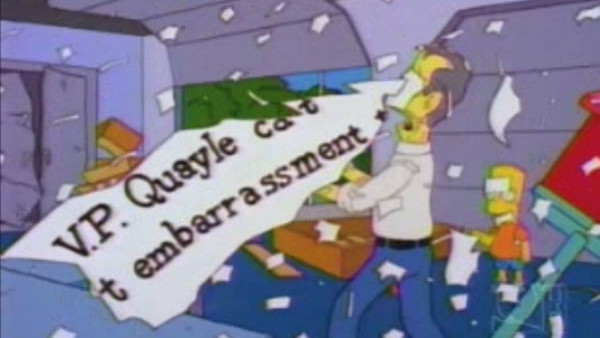
President George H. W. Bush then proceeded to diss The Simpsons during one of his campaign speeches, which ultimately became the inspiration for the episode, 'Two Bad Neighbours'. The writers didn't pull any punches for that episode, and after all the jokes about Bush, they managed to put a cherry on top of it all with a split-second dig at Bush's Vice-President, Dan Quayle.
During the scene where Bart accidentally shreds Bush's memoirs, a piece of paper flies across the screen with the words: 'V.P. Quayle Embarrassment'. Dan Quayle was considered by most Americans to be a useless V.P who was intellectually incompetent at anything he did in that position. Unable to resist, the writers inserted that quick-fire gag as a reminder to everyone of the low opinion they held of Bush and his administration.
In fact, this wasn't the last Simpsons gag involving Quayle. In the Treehouse of Horror X episode, Quayle was one of the passengers who was on-board the rocket headed to the sun.
5. Homer Channels Johnny Carson When He Eats Some Prized Potato Chips (Selmas Choice)
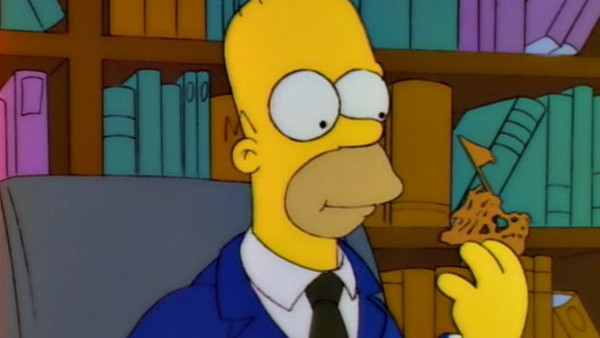
Selma's choice was a great episode that placed Selma in the spotlight and one of the first episodes that relegated the Simpsons to a secondary role. To make up for the lack of Simpsons antics, the writers make every moment count, none more so than Homer's chip eating gag.
During the Great Aunt Gladys' will video, she leaves Marge a series of potato chips that look like celebrities and other famous people, only for Homer to nonchalantly munch through them all whilst the video is still going.
As funny as the gag is, it's not the first time the chip joke was seen on TV and it actually references a hilarious gag Johnny Carson pulled on a guest.
During an episode of The Tonight Show in the 80's, a wacky chip lady was a guest and her shtick was her collection of potato chips that were shaped like random things such as numbers and animals. Carson obviously thought she was a bit weird, so he decided to mess with her a bit. When the chip lady turned her head for a second, Carson reached for a hidden bowl of chips and loudly ate one, to the absolute horror of the chip lady (and the absolute hilarity of everyone else).
4. Seymour Skinner Is Really Jean Valjean (Homers Barbershop Quartet/The Principal and The Pauper)
Everyone knows the story of Principal Seymour Skinner; he's a bit of a push-over, he's a Vietnam vet, and he's a pretty lousy principal. As it turns out, Seymour Skinner is actually the Simpsons' equivalent of Jean Valjean from Les Miserables.
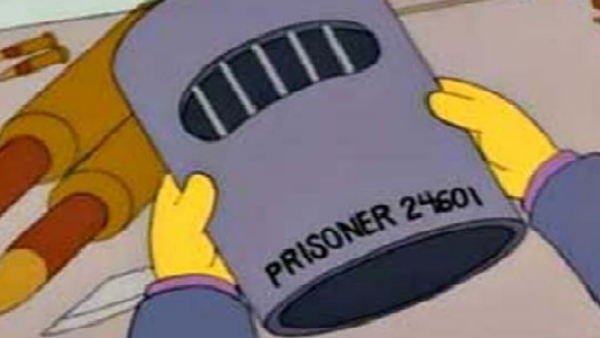
The seeds are planted in the episode 'Homer's Barbershop Quartet' when Skinner finds his old POW helmet and it is revealed that his prisoner number is 24601. As it so happens, Skinner's prisoner's number is the same as Jean Valjean's prisoner number but the payoff of the joke comes during a later episode, 'The Principal and the Pauper'.
Skinner's true identity is revealed in that episode: he was in fact a former lowlife who stole the real Seymour Skinner's identity before working his way up to a respectable position in society. Skinner's identity-stealing backstory is very similar to Jean Valjean's story; Valjean was a criminal who took on a new identity and became a wealthy person of considerable influence before eventually dying after reuniting with his long-lost daughter.
Okay, so Skinner isn't dead and he doesn't have a long-lost daughter. Maybe everyone's favourite whimsical principal still has some elements of his backstory that's yet to be told?
3. The Location Of The Simpsons Most Famous Writer Is Revealed (Hurricane Neddy)
Many fan-favourite episodes such as 'Homer's Enemy', 'You Only Move Twice', 'Brother, Can You Spare Two Dimes?', and 'Krusty Gets Kancelled' have one thing in common; they were all written by John Swartzwelder.
With a total of 59 episodes, Swartzwelder is the most prolific Simpsons writer to have worked on the show. Swartzwelder also happens to be a notorious recluse who has rarely been seen or photographed and has turned down any media appearance asked of him, including recording commentaries for the show's DVD's. In fact, Swartzwelder's reclusiveness even had fans debating whether or not he actually existed and that 'John Swartzwelder' was probably just a pseudonym for writers who didn't want to take credit for writing an episode.
Due to the mythology that had been built up, the other Simpsons writers decided to lampshade Swartzwelder's existence and whereabouts in the episode 'Hurricane Neddy'.
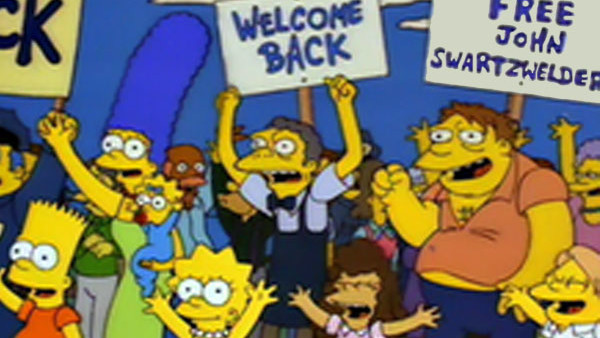
When the Simpsons visit Ned Flanders at a mental institution, a paranoid man with long-hair and a mustache is briefly seen. For everyone who has been wondering who this man is, this is the animated likeness of Swartzwelder. To cap the joke off, at the end of the episode when Flanders is released to an adoring crowd, someone is holding a 'Free John Swartzwelder' sign.
2. Maths Jokes Are Everywhere In 3D Land (Treehouse Of Horror VI)
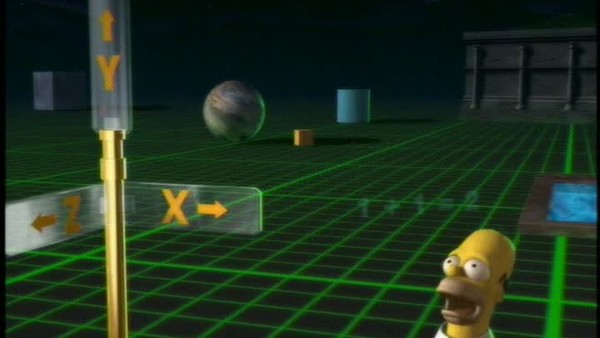
One of best Treehouse of Horror bits is the ambitious 3D generated segment where Homer somehow finds himself in a whole new dimension. As you might expect from a room filled with mathematics nerds, the writers decided to stuff as many math jokes in this new 3D environment as possible. Some jokes were particularly well-hidden and required some actual hands-on work from fans in order to reveal it. Just a warning, more mathematics will occur from this point forward.
As Homer is exploring his new surroundings, he walks past a string of hexidecimal numbers: 46 72 69 6E 6B 20 72 75 6C 65 73 21. When this is converted to ASCII, the random series of numbers and letters spell out 'Frink Rules!'.
Still, Frink's boast is nothing compared to what the writers slipped in as a reference to Fermat's Final Theorem (where no three positive integers a, b, and c can satisfy the equation an + bn = cn for any integer value of n greater than two). When Homer is walking around, an equation passes behind him that appears to disprove Fermat's theorem. But should that equation be put into a scientific calculator, you'll find that the theorem still holds and that the equation is off by a minuscule 0.00000004.
But this still wasn't the last reference to Fermat's theorem...
1. Homer (Nearly) Solves Fermats Last Theorem (The Wizard Of Evergreen Terrace)

In 'The Wizard of Evergreen Terrace', Homer realises that he's done nothing great in his life so far and goes through a mid-life crisis. But rather than do the usual mid-life crisis stuff like drinking his sorrows away (which he does anyway) or splashing out on a super expensive sports car, Homer decides to take inspiration from Thomas Edison and become an inventor.
During the montage where Homer is 'inventing' away in his basement, you would've noticed a heap of random numbers, letters, and symbols scribbled on a blackboard. You would've also noticed that Homer had written an equation: 3,98712 + 4,36512 = 4,47212.
Look familiar?
That's right, it's the return of Fermat's Last Theorem. If you plug that equation into a scientific calculator, you'll find that the left side of the equation is only 0.000000002 percent larger than the right side, which is even smaller than the answer in the previous entry.
That's right, despite the crayon in his head, his excessive drinking, and the numerous blows to the head, Homer Simpson nearly solved a 400+ year old mathematics theorem.
Watch the video version of the article -
Which other obscure jokes have you spotted in The Simpsons? Share yours below in the comments thread.