The Walking Dead: 5 Points On How They Botched The Finale
The Walking Dead had a chance at a legendary finale. Instead, they chose to insult the audience.

It’s fairly rare that a television show will receive both high critical praise and be tremendously popular. Those two things typically don’t go hand-in-hand, but somehow, The Walking Dead managed to do both. It transcended a genre, and became more than just a zombie horror show, it's managed to make the people still living more interesting than the zombies that now inherited their world.
They explored themes not typical with other shows: The struggle to keep one’s humanity in a world where everything tries to take it away, the moral choices of survival in an apocalypse, the will to fight against odds real and perceived, what killing does to people, and so on. The Walking Dead reached a tremendous height.
It is sad, now, to see the nadir so quickly approaching.
On Sunday night, The Walking Dead committed television-suicide right before our very eyes. To be fair, this has been coming for a long while. Most of Season 6 has been an abomination. Entire plot lines make no sense, deaths were crowd-sourced and needlessly teased (re: Glenn), and characters were either not developed at all, or behaved in such erratic ways, we wonder whether we missed several episodes in-between.
A certain suspension of belief is required for any show during an apocalyptic era, but the show has taken so many liberties with the plausible, we’re left to wonder if the writers view the audience as zombies themselves.
Yet Sunday, that should all have changed. This entire season has been one needlessly long lead-in to a moment of shocking brutality. All may not have been forgiven, but the show would have itself a legendary “where were you when” moment. It would have left viewers uneasy, sick, heartbroken, sad, angry. It would have made them feel something.
Good art makes you feel something.
But this? This wasn’t art. This was a cash-grab, and a blatant one at that. This was a 93-minute episode that good editing could have pared down to half that. This was promising the arrival of an iconic character who is known for a defining, seminal moment that changed the entire series—and then taking the moment away in favor of a six-month hiatus in order to drive ratings. Instead of sating the appetites of millions of fans, the creators and producers decided that your time simply doesn’t matter. They told everyone, “You’ll tune in six months from now, so what’s the difference?”
It's not so much that they got the episode wrong, it's that they knew it was filled with cheap gimmicks and unpalatable tricks that haven't worked in the past, and continued to use them anyway. Which leads us to just how they botched this finale so badly...
5. Roadblocks - Literal And Otherwise

If one was to draw a line from event to event in the finale, it might look something like this: Roadblock---Roadblock---Trap---Roadblock---Trap---Cliffhanger. That was the gist of the finale, and it took them 93 minutes to tell it (64 if you subtract the time allotted to commercials, which tells you all you need to know about the real purpose of this episode being so needlessly long).
Rick’s group ran into roadblock after roadblock, in an attempt to illustrate just how badly they underestimated the strength and breadth of the Saviors. But it didn't work, mainly because up until that point, the Saviors were portrayed as a hapless bunch who were cool with getting killed in their sleep, and couldn't tell that Carol was hiding a semi-automatic gun in her sleeve, and couldn't pull off a fairly simple prisoner exchange, and... you get the point.
The Saviors weren't exactly the nasty villains the Wolves were depicted to be, and they were nowhere close to the cadre of militarized people working for the Governor. No, up until that series of roadblocks, viewers were left to believe the Saviors were fairly tame in comparison.
Now, the argument is that's what we're supposed to believe because that's what Rick and his group believed. Okay. That's fine. But it seems pretty implausible that a group would allow many multiples of their own to die—be it via rocket launcher or knives to the head while asleep—just so they can set up an absurdly elaborate trap for Rick's group.
It seems unlikely that one of their own would behave so foolishly as to chase after Carol while bleeding to death instead of just taking the car left behind by Rick and Morgan. And it seems downright moronic to go through so much effort into setting chained-up-walker traps, a log trap, and a couple other roadblocks instead of just grabbing the group straight away.
You have to suspend some belief—we get it—but you don't have to insult the audience's intelligence by doing so. This didn't work, and it felt like the roadblocks were there more for the commercials than for effect on the overall story.
4. Don't Believe The Hype

There were posters made of Negan with Lucille. There was foreshadowing, such as Glenn seeing pictures of Negan's previous victims, their heads all bashed in. There was name-dropping—how many Saviors used the name "Negan" in context? There were even interviews where it was confirmed that Negan would appear in the finale.
This was the most hyped moment of the entire show to date, and enough people who read the comics understood what was coming. More importantly, what that moment would mean for the show as a whole.
So let's be clear: This was not a surprise moment. Everyone from AMC to Kirkman to Gimple and beyond said this was happening. While it's true they never said someone would die in the finale, I think they can all forgive us if we assumed that's how it would end, because that's how the comics handled it.
Sure, this isn't a straight adaptation of the comics. That's understood. But what's also understood is that you don't mess with groundbreaking moments. They define a series. To hype a character's arrival who is known for this series-defining moment, and then to pull the rug out from under us is dishonesty at its worst.
This reeks of a ratings ploy fueled by an inordinate amount of commercial revenue. If, somewhere down the road, we learn that the decision to cliffhang the episode came from the top of AMC, it would not be surprising. But when a show does something like this, it makes it very difficult to trust handling of any future material the comics may hold.
3. Characters Out Of Character

What’s going on with Abraham and Rosita and Sasha? Why is Carol crying all the time? Why is she unexpectedly reticent to kill? Why did Morgan kill that guy? (Side note: On Talking Dead, Scott Gimple said Morgan “had no choice” but to kill the Savior who was about to off Carol. Yet all season, we’ve been convinced that Morgan no longer kills. So of course he had a choice. How Gimple doesn’t understand his own characters is remarkable.)
There were so many odd and abrupt character changes that the audience was left to wonder if we’d missed several episodes worth of content.
Only we hadn’t.
Characters like Carol made swift and unforeseen changes to their persona that made no sense given the context we were presented. All that led to the finale’s odd and drawn-out segment with Morgan tracking Carol, begging her to come back because even he couldn’t understand why she left in the first place.
At a base level, this was bad for the finale, but zoom out and it’s apparent this is bad for the series as a whole. When characters start to behave in ways that are either unexplainable, or just downright strange, we start to lose interest and instead focus on how these sudden changes took place. The characters themselves get lost in the absurdity of their actions, and as a result moments that were designed to be a culmination of sorts all fall very short.
Abraham’s speech in the truck about what he would have to do in this new world felt odd and out of place. Carol crying on the ground after being shot was supposed to be far more emotional, but instead it was just confusing—we couldn’t get past what drove her to this. These failed motifs pervaded the finale, and only made the season as a whole much, much worse.
2. The Cliffhanger
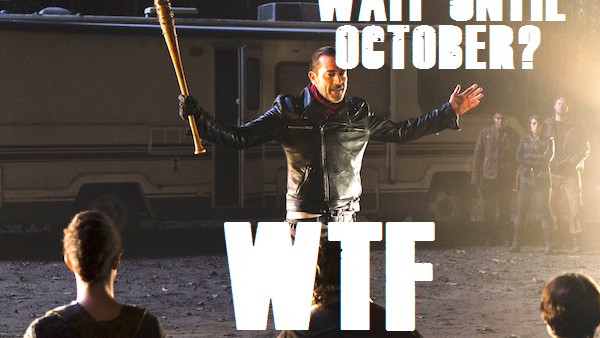
Before the finale aired, the general consensus was that, while there were rumors they’d end with a cliffhanger, most didn't buy it because there was simply no way the show's writers and producers could be so stupid. They couldn't tease the biggest moment of the entire series all season long, only to end it with a big fat question mark. They wouldn't throw away their one shot at a "Red Wedding" moment, a la Game of Thrones.
All they had to do was do the one thing that had been predetermined for years. All they had to do was give the audience the most visceral, disturbing, gut-wrenching moment they'd waited months, maybe years for.
And then, they didn't.
This was the biggest crime, and it was committed against the audience. When they basically crowd-sourced the death of Glenn, leaving the audience hanging for four episodes (and thereby detracting from Here’s Not Here, one of the best episodes the show has ever done), only to find him hiding under a dumpster, they were hammered for it by critics. And rightfully so.
It's a lazy tactic to cover for bad writing. But the main takeaway is that The Walking Dead as a whole either didn't learn from their mistakes, or didn’t care to. Either scenario is equally disturbing.
How can we ever trust The Walking Dead again? What faith equity did the finale build? At this point, they can say whatever they want about the premiere of Season 7. It doesn't matter. The moment is gone, and when Lucille eventually does come down on someone's head, it won't have nearly the emotional impact it was originally intended to have. The focus will shift from a truly terrifying moment to one of pure desire to get a question answered.
Good writing will propel the audience for six months to ask, "What's next?" Not, "Okay, so who's gonna die?"
The rest of the episode was a non-starter. You didn't need to watch it. Nothing of major importance happened that couldn't be explained in a few quick minutes of montage. The vast majority of people tuned in to experience a moment. And when that moment was taken away, what remained was only a realization that we'd all been duped.
That's how you insult an audience. That's how you show them you don't value their time or investment. That’s how you lose credibility.
1. The Aftermath
The following people said the following things about the finale, both on Talking Dead and elsewhere. Comments follow.
Greg Nicotero, Director: "One of the best episodes we've produced in six years."
No. It wasn't. It wasn't one of the best this season. It wasn't even one of the best this half-season. It was among the worst episodes the show has ever produced. The episode, in its entirety, is completely skippable. The viewer would miss out on next to nothing, and have everything explained during the premiere of season seven (or so we've been told).
Scott Gimple, Showrunner: "This was the end of one story, and season seven will start another."
Absolutely not. How do you end a story with a cliffhanger? Also, how did no one in the writer's room not raise their hand and say, "Hey, I'm just throwing this out there, but does anyone else think this is a really, really bad idea?" To be fair, the look on Gimple's face when he realized what a trainwreck the finale was indicated to me that he either realized they made a huge mistake, or had to cover up for AMC, who may have told him to delay the killing of a character. At that point, he'd say anything on the Talking Dead dais just to sound like someone who could string together a few coherent sentences, and not appear like the bumbling idiot the finale made him out to be.
Not to be overlooked, he also compared this finale to the end of season one of Lost, where they didn't find out who was in the hatch—which, by most counts is regarded as one of the worst season finales in television history. Bad comparison. He went on to compare it to the Star Trek: The Next Generation classic Best of Both Worlds, where there is a cliffhanger at the end. This is more reasonable, but still, in that episode, Captain Picard (the main protagonist) gets captured and turned into a cyborg (emphasis on the "borg" part...little inside joke, there). If Rick turned into a walker midway through the finale, and then they ended it on a cliffhanger, I think we'd all forgive it because, well, RICK TURNED INTO A WALKER. But the finale was completely devoid of any major moments, and thus couldn't hang its proverbial hat on anything of substance.
Robert Kirkman, Creator: "Most of the comics end in cliffhangers."
That's true. Of course, what Kirkman doesn't tell you is that the one Walking Dead comic that doesn't end in a cliffhanger is #100. (Spoilers ahead) In it, Rick's group is out on the road, they're captured by the Saviors, taken to Negan, there's the ensuing Negan diatribe, and then Negan proceeds to crush Glenn's skull in with Lucille and walk away. Sound somewhat familiar? It's because that's what Sunday's finale was supposed to be. And the one person who realized that it needed to be impactful was the same guy who wrote it that way in the comics. Even he acquiesced to the terrible idea of a cliffhanger. It makes no sense.
Chris Hardwick, Host of Talking Dead (paraphrased): "This isn't the series finale...it's a relationship."
We get that. What we don't get is how this being a relationship somehow makes it immune to criticism. In this relationship, we understand that at times, we’ll be deceived and tricked. But there is a level of trust that the tricks will never overwhelm the story. That trust was broken on Sunday. As viewers, it became abundantly clear that AMC didn't care about the extra time we invested in it. Time is the currency of the audience, and to pack it with two-thirds content and one-third commercials would only have been mildly acceptable had they paid homage to the moment that was due. Yes it would have been grisly and terrifying, but we would've felt something. We would've had the payoff for an otherwise lousy season. But when that one thing was taken away, and when the rest of the episode was largely bloated filler, how is it not apparent why the internet community revolted? Even if you disagree because your paychecks come from AMC—which, at least in my mind is somewhat acceptable—how can you say with a straight face that the finale was “exceptional storytelling?” Those words expose the disconnect between those receiving paychecks from AMC, and those who don’t. This wasn’t just about the killing of a character. It was about the gravity of the defining moment of the series.
There is real creative trouble in misunderstanding manipulative schemes for exceptional storytelling.
What do you think? Agree? Disagree? Feel free to comment!