The X-Files: 10 Reasons Why It Ruled Our TV Screens
 This September marks the 20th anniversary of the much beloved sci-fi drama, The X-Files; a show which not only has one of the largest cult followings of any show, but changed the television landscape for several years. The influence The X-Files has had continues to be felt today, inspiring shows such as Lost, Supernatural, Warehouse 13 among others. The way X-Files treated its mythology was also quite groundbreaking for television; very few shows prior to this created such a rich history which unravelled a large and evolving mystery over the course of its run. It's incredible to also think that we're talking about a show made in the 90s. Not to say television shows weren't great before the 90s, but when living in a golden age of Breaking Bad, Mad Men, The Sopranos and Game of Thrones to name a few, it is easy to take for granted the achievements of an older show. To celebrate this amazing milestone here are ten reasons why X-Files was, and still is, one of the best television shows ever aired.
10. Playing Against Stereotype
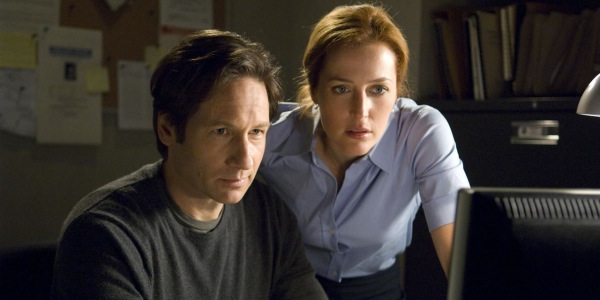 During this time, both film and television were undergoing a change in how they presented their female characters. In many cases they were no longer presented as ditzy women who relied too much on a man to rescue them, but were becoming strong, independent women capable of doing a man's job. Special Agent Dana Scully is one such woman who was a strong investigator in her own right. Chris Carter, the creator of X-Files was influenced by Jodie Foster's role as Clarice Starling when coming up with Scully and it's easy to see the influence here. What is more about Scully though is the role reversal between her and Mulder. Generally in this type of science fiction it was the woman who was the believer in the fantastical and the man the skeptic, but it is flipped around in the show. Mulder is the firm believer in the extraterrestrial and paranormal while Scully remains skeptical, making futile attempts to bring Mulder's beliefs back down to Earth (no pun intended). This forces most viewers to relate to her more as many, like herself, would not be so willing to indulge Mulder's way of thinking.
9. Its Continued Influence
 The influence The X-Files has had on television is undeniable. Several shows, specifically science fiction dramas, have followed its stellar storytelling format even over ten years after its end. Lost, for example, developed its own complex mythology and plot based off of X-Files. Supernatural involves two brothers hunting monsters and demons, each season providing an overarching storyline and several monster-of-the week episodes. Cult hit Fringe similarly based itself off X-Files with FBI agents and specialists solving scientific and paranormal mysteries which also developed a rich mythology. Its influence has reached beyond science fiction dramas as well. Regular mystery dramas, such as Elementary, Bones or Castle, often use a male and female investigator as their lead characters, weaving in case-of-the-week episodes with a central storyline that expands over the course of a season or the entire series. X-Files set the foundation for these shows and they've kept building on top of it ever since.
8. The X-Philes
 Before becoming a hit show, early fans of this series were nicknamed 'X-Philes' a term derived from the Greek word 'phil' which means love or obsession due to their intense passion and discussions over the Internet regarding the series. The X-Files was the first show to gain such a devoted fanbase through the Internet, setting a standard which has become quite regular now. After watching a new episode of anything, fans today flock to forums to discuss it with others and it is largely due to X-Files (though they didn't have trolls or flame wars back in the 90s). Once it became a hit within the mainstream audience, its popularity exploded. 'The Truth Is Out There', the theme song and parodies of a shadowy smoking man in the background were everywhere. Even non-sci-fi fans began tuning into the show. Perhaps to further prove what a pop culture hit it became with fans, the writers of The Simpsons made one of their best episodes with 'The Springfield Files', going so far as to get David Duchovny and Gillian Anderson to voice their respective characters. Even Star Trek: Deep Space Nine alluded to X-Files with the Temporal Investigations agents Dulmer and Lucsly, anagrams for Mulder and Scully, in the episode 'Trials and Tribbleations'. And if that's not enough to prove how much of a pop culture hit it was, the classic series ReBoot had two characters named Fax Modem and Data Nully from the CGI in its second season episode 'Trust No One', with Anderson voicing the Scully-like character.
7. The Writing
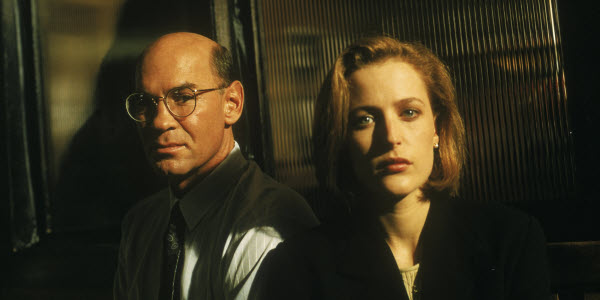 The writing on The X-Files was a large step-up from several shows before it. It delivered a level of quality that hadn't really been seen on dramas for some time, especially a drama which dealt with science fiction. Not to say every single episode of X-Files was stellar, but I believe much of the show's success had to do with the writing. Several episodes, especially ones dealing with the mythology, had excellent emotional beats which pulled viewers in even more. Take this excerpt from the second season episode 'One Breath' where Mulder attempts to give his resignation to Deputy Director Skinner:
"When I was eighteen, I, uh... I went to Vietnam. I wasn't drafted, Mulder, I... I enlisted in the Marine Corps the day of my eighteenth birthday. I did it on a blind faith. I did it because I believed it was the right thing to do. I don't know, maybe I still do. "Three weeks into my tour, a ten-year-old North Vietnamese boy walked into camp covered with grenades and I, uh... I blew his head off from a distance of ten yards. I lost my faith. Not in my country or in myself, but in everything. "There was just no point to anything anymore. One night on patrol, we were, uh... caught... and everyone... everyone fell. I mean, everyone. "I looked down... at my body... from outside of it. I didn't recognize it at first. I watched the V.C. strip my uniform, take my weapon and I remained... in this thick jungle... peaceful... unafraid... watching my... my dead friends. Watching myself. "In the morning, the corpsmen arrived and put me in a bodybag until... I guess they found a pulse. I woke in a Saigon hospital two weeks later. I'm afraid to look any further beyond that experience. You? You are not. Your resignation is unacceptable.""This monologue was written and performed with such a level of seriousness that really surprised me when I first watched it. It seemed like such a natural conversation and real story which tugged at both your attention and heartstrings. It goes without saying X-Files did this on a number of occasions.
6. The Truth Is Out There
 By the time X-Files first aired, television shows were primarily made strictly for entertainment purposes. Gone were the days of The Twilight Zone or Night Gallery where it produced programs which not only entertained, but engaged viewers in thought provoking content as well. Though not all dramas at the time were made just for entertainment, many had lost that quality of giving the viewers a deep topic to discuss. The X-Files was more than a show about aliens, but about many types of philosophy. Several episodes dealt with pre-destination, the meaning of death, faith, religion and many other topics which could be considered controversial. Nearly every episode ends leaves you questioning what you just saw and how you should think about it. To reference Skinner's monologue from the last page, in a situation like his how many people really would want to look beyond that experience? It makes you think about the power of both belief and faith. Not many shows at the time ever attempted to delve into major philosophical issues, but X-Files was never afraid to challenge viewers perceptions of the world.
5. Fight the Future
 Several television shows have been adapted to film, most often being loosely based off the source material, but The X-Files is one of the few shows to have a feature film hit theaters while it is still on the air. Not only that, but The X-Files film actually fed into the show's mythology, building off of the plot previously established in the series' first 5 seasons. What was very notable about the film, though, is you did not need much prior knowledge of X-Files' complex story. When I first watched it I was young and hadn't watched every single episode every single night it was on, yet that didn't cause me to become confused at any point during the film and I know it was the same for others who never watched the show. Carter and all involved made the X-Files film as accessible as possible so as not to bog down the viewers with details of the show's history, while at the same time advancing the series' main story. Not an easy feat to accomplish, but one which worked out quite well.
4) The Monster-of-the-Week Format
 Though the Monster-of-the-Week format was nothing new to television by that point (several mystery shows used this concept prior), The X-Files somewhat changed this up. The Monster-of-the-Week provided viewers who never regularly watched the show a chance to experience it without getting caught up in the storyline. However, whereas shows utilized this format as one-off stories never to really be referenced again, many of the X-Files Monster-of-the-Week episodes had important character interactions which strengthened the relationship between Mulder and Scully. It somewhat fed into the ongoing storyline without needing to fully know it. Several of the monsters and standalone episodes have been quite memorable as well. I think I'll always remember how scared I was when I watched the first season episode 'Tooms' for the first time with the fan-favourite Eugene Tooms, one of the only monsters to appear twice in the series. Another monster, Donald Pfaster, may have not been a monster at all, but a very real and dangerous person, playing on our fears of the unknown lurking in reality. Numerous episodes have gone on to be fan favourites as well, such as "Jose Chung's From Outer Space" or "Clyde Bruckman's Final Repose", an episode which earned Emmy Awards for Writing and Outstanding Guest Actor.
3. The Villain
 A few weeks ago I heard Barenaked Ladies' hit 'One Week' on the radio, a song I hadn't heard in at least a couple of years and forgot many of the lyrics to. There's one part where Steven Page sings "Watchin' X-Files with no lights on, We're dans la maison, I hope the Smoking Man's in this one" and I nodded my head in agreement because I completely understood what he meant. Cigarette Smoking Man, Smoking Man, Cancer Man, whatever you want to call him (personally I like Cancer Man the best), this guy was clouded in mystery as well as smoke. Whenever I watched an episode, whether it was on television or years later on DVD, I always hoped he would be in it. Aside from Mulder and Scully, he's the only other X-Files character to appear in the series pilot and finale. Cancer Man was an evil man, but was also one who largely believed everything he did was for the greater good. This never stopped him from being a smug (insert whatever you wish) though. Cancer Man usually remained confident and always on top of the game. One of the things I always found so appealing about him was how he seemed to be a dark reflection of Mulder. Mulder was always after the truth, but Cancer Man knew the truth of nearly everything and had nothing to show for it aside from being a vile, lonely, bitter and evil man. Who's to say Mulder wouldn't have become Cancer Man in another life, let alone if he knew the full truth? It would also be a crime not to mention William B. Davis' performance, largely the reason Cancer Man is so endearing to many of the fans.
2. The Characters
Characters from Skinner to The Lone Gunmen trio all made an impact on the show, but I think we can all agree we always tuned in to watch Mulder and Scully together. These two had a fantastic relationship which was great to see evolve over the course of nine (technically eight since David Duchovny was not in most of eight and only appeared in nine's finale) seasons. Scully's grounded beliefs provided a great counter to Mulder's beliefs in the fantastical, but seeing her gradually turn from a skeptic to a believer was well paid off. The evolution of both their characters was great to see and it was due in no small part to the chemistry David Duchovny and Gillian Anderson shared. Right from the start these two bantered with an entertaining vigor as they debated over their beliefs, making it quite easy to see how a romance could blossom between them when it was never Carter's intent for them to be romantically involved. Duchovny was never afraid to add humour to Mulder and I was very surprised to learn Gillian Anderson was only 24 when she got the role as she seemed so much more grown-up as Scully. I really gained a new-found respect for her skills as an actress.
1. The Mythology
 Without a doubt, I think what made The X-Files such an everlasting series is the mythology it created. It has a very complex storyline which is very compelling when started from the very beginning. Multiple viewings have offered new glimpses and hints that I otherwise did not catch on my first viewing, allowing things to make more sense as they take on new meaning. The X-Files was a drastically different show for the 90s with a very deep serialized plot. No one ever really expected a sci-fi show to have such a rich story filled with aliens and government conspiracies. It remains one of the reasons the show is remembered so much today because of how compelling they made it. Some plot points may have faltered toward the end or have been prolonged for too long which perhaps hindered some fans enjoyment of the final seasons, but overall the mythology broke new ground for the television industry. As I said when discussing the influence X-Files has had on the television industry, we never would have gotten many of the great dramas of the past decade without X-Files. It not only pushed the envelope, but elevated what both a science fiction and drama show can accomplish.