The X-Files: 15 Best Mythology Episodes

A look at the episodes that formed the backbone of the paranormal classic.

Seen any little green men recently? The show that popularised the terms €˜shipping€™ (relationship), mythology (as it relates to episodic television), and MOTW (Monster of the Week) has had an undeniable impact on all the genre television series that followed it - enough so that a series like Fringe outright included a reference to The X-Files within the canon of their show. Enough so that Fox is now in talks to bring The X-Files back to the small screen after more than a decade off the air. Yet somewhere along the way during the show's original run, its own mythology, a running tale of conspiracy and alien invasion, became so hard to follow that many fans simply threw up their hands and gave up on it, focusing instead on the relatively simple to follow Monster of the Week episodes. For a show with such an undeniable impact on television history, it's frankly shocking to see a core element become so overlooked. It's a shame, because when you look back at it, the mythology outings of The X-Files were some of the best of the series, featuring many superb acting performances, well-crafted scripts, and nail-biting endings. Woven into the series as it was, it's the mythology that really held the show together. It drove character arcs, kept viewers guessing, and spurred the series to reach new heights to the point that many episodes had movie quality stunts and special effects (at least for the time). These are the episodes that are both creepy and intriguing, the ones that made you believe the government might really be in on a massive conspiracy against its people - something all the more believable today in the age of NSA snooping and cablegate. Episodes like Deep Throat, which introduced Mulder's original, shadowy informant, the Pilot, E.B.E., and others set the stage, then later episodes expanded on the concept, creating a tale of a vast, overreaching conspiracy with the central idea that aliens were plotting to colonise earth. With nine seasons and roughly a half dozen mythology episodes each year (not to mention two movies), The X-Files had a lot of conspiracy to deal with. Let's look at fifteen of the best mythology episodes, all of which were integral to the success of this iconic franchise.

15. The Erlenmeyer Flask

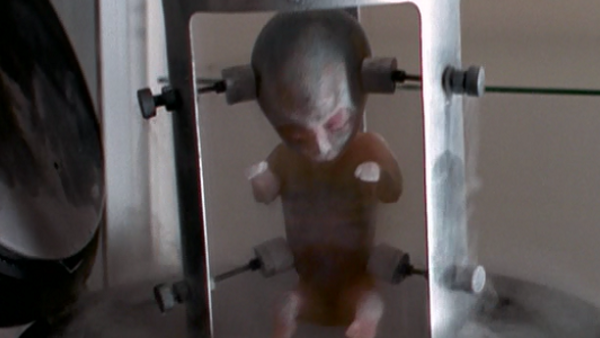
After The X-Files received a full season order from Fox back in its first year, the show's first season finale became a key episode, a moment that could make or break the series. Entitled The Erlenmeyer Flask, it's the episode that took the idea that there was a vast government conspiracy about the existence of extraterrestrials, something for which seeds had been planted earlier in the year, and expanded it on a level never before seen. In essence it sparked the over-all mythology of the show: prior to this episode, events were connected only in the flimsiest of ways. Where the episode really excelled, however, was not at the vast, over-reaching conspiracy, but at the minutiae. It's this episode that introduced the idea that alien DNA was being worked with, it's this episode that sparked the idea of alien-human hybrids (under a project dubbed "Purity Control"), and it's this episode that showed alien blood was toxic, possibly fatal, to humans. Had this episode failed, the overall conspiracy arc would have been very different - if it existed at all. It was an extremely successful finale however, and from this point forward, the mythology was in full swing.

14. Little Green Men

Kicking off season two, Little Green Men built on what The Erlenmeyer Flask started. It was intense, riveting, and gave viewers a feeling of claustrophobia as Mulder was trapped in an equipment shed at the base of a radio telescope/observatory used in the SETI (Search for Extraterrestrial Intelligence) project - one which had supposedly made contact with another life form. As far as the overall mythology goes, it's not the most connected episode, but it does introduce Senator Matheson, who would appear in just a handful of episodes, but still be around in season six. It is also an episode specifically constructed to have Mulder question his beliefs and then regain his faith (something which would be mimicked later in the series for the better part of a season). What it does best, however, is mix the mythology of the show and the its roots as a horror anthology (Kolchak: The Night Stalker was an inspiration for The X-Files), creating some truly terrifying moments, such as the sudden death of the only other human to be found near the observatory, a local unable to speak English, but who has clearly seen something that has scared him to his core. The expression of sheer terror on the face of his newly dead body will give you goosebumps.

13. Duane Barry/Ascension

If you're talking about mythology episodes that really put the series on the map, you have to include early favourites Duane Barry and Ascension, a two-parter that gave viewers the abduction of Dana Scully (in part to address Gillian Anderson's real life pregnancy), an Emmy-award nominated guest star appearance by CCH Pounder, and a fantastic performance as well by Steve Railsback in the titular role of alien abductee and former FBI agent Duane Barry. On top of that, the episodes featured one of the craziest stunts of the series, involving Mulder (obviously with a stuntman standing in for David Duchovny) dangling from a cable car. With little in the way of even half-convincing CGI available for television at the time the episode filmed, the stunt was done live, and Entertainment Tonight actually featured a behind the scenes clip to promote the episode prior to its airing. What really pushes this episode over the top, however, is the final villainous turn for Alex Krycek, the double agent, and the opening abduction scene of Barry himself, one of the most terrifying alien scenes of the entire series.

12. One Breath

One Breath is, as far as X-Files mythology is concerned, the episode immediately following Ascension (3, a vampire tale, takes place between the two, but is a standalone story, though it does address the absence of Dana Scully). It sees the return of Scully following her abduction, albeit in a vegetative state, which leads to her family and Mulder reaching an impasse about whether to take her off life support (something put to rest by the terms of her living will). It also sees one of the most emotional scenes in X-Files history: Mulder placing a gun to the head of the Cigarette Smoking Man, his shadowy antagonist, after being tipped off to his location by his immediate superior, Assistant Director Skinner. Their exchange is one of the best of the series, and the Smoking Man's warning of "Don't threaten me, Mulder - I've watched presidents die" is one of the most chilling lines in the entirety of the show's history. This sort of tight writing made One Breath a standout in the season.

11. Piper Maru/Apocrypha

A lost fighter squadron. A submarine adrift. A downed UFO. All part of the greater government conspiracy to keep secret the existence of extraterrestrial life on planet Earth, at least according to this two-part episode in season three of The X-Files. This is the episode that really developed the idea of the "black oil" - an oil-like substance that carries a virus which, when infecting a human (or humanoid, as it is later implied other species can be infected as well) leaves them as virtual slaves, like a particularly controlling parasite and its host. The virus in effect carries alien consciousness, though it is eventually discovered (in the first X-Files movie) that the virus mutates, and a corporeal alien will form inside the human host. Piper Maru also has the return of Alex Krycek, and his eventual infection by the oil and stranding at a secret military installation housing a UFC - to which the oil/virus/substance within him returns in a particularly chilling scene. A little bit of trivia: the Piper Maru (submarine) was named after Gillian Anderson's daughter.

10. Paper Clip

"A lie is most conveniently hidden between two truths," Deep Throat once informed Mulder back in the first season of the show. The X-Files was often at its best when its conspiracy theories were grounded in reality, and the second half of the two-part season three opener, Paper Clip, in which Mulder is discovered alive after being left for dead in a New Mexico desert, is a prime example. It's what really ramps up the season (the first half, The Blessing Way, was a little too centred on visions and mysticism), and that, plus its intertwining of a real conspiracy of sorts, makes it a great mythology episode. The episode's premise is that Nazi scientists worked for the U.S. government after the war, under Operation Paper Clip, and joined in on the alien conspiracy, contributing to the cloning of an alien-human hybrid. Part of this is actually true: the OSS (precursor to the CIA) really did bring over some of the "less evil" Nazi scientists in order to keep them out of Soviet hands. In all, over 1,500 Germans were recruited under the program, including Werner von Braun and Hubertus Strughold (coincidentally or not, one of the members of the Syndicate working with the alien colonists is named Conrad Strughold in the X-Files movie). Paper Clip also features the discovery by Mulder and Scully that the U.S. government is keeping records on its own populace involving smallbox vaccines, that Scully's name is in said files, and features a close encounter for the agents - which of course Mulder sees more of than Scully.

9. Tunguska/Terma

You can't mine a virus, Scully says. Not so fast there, skeptical agent Scully. Apparently, you can. Season four's two-parter Tunguska and Terma centred around the idea that the alien black oil was being mined by the Russians, who were competing with the Americans to perfect a vaccine against the virus. An interesting concept, and one that ties in with the famous real-life Tunguska blast. On top of that, it also featured the return of Alex Krycek yet again - though by the end of it all, he may have wished he'd never returned at all. Taking Mulder all the way to Russia with his nemesis Krycek in tow, the story finds the pair captured, Mulder betrayed, and infected with the black oil to test the alien vaccine. Eventually Mulder escapes, but not before gaining a new awareness of the global scale of the world he has become entangled in, and how devious Krycek really is. The highlight of the episode, however, was without question Krycek losing a hand, thanks to a clan of former prisoners who are of the belief that cutting off one's limb protects them from the oil and the experiments.

8. Fallen Angel

Season one's Fallen Angel, along with the show's pilot (titled simply Pilot), Deep Throat and E.B.E., set the stage for the mythology of the show that would later develop. In essence, however, these were standalone episodes that carried a common theme: aliens were among us. Only Fallen Angel really strayed from this - unlike the others, it would link into further episodes in the series (though the pilot was revisited in the seventh season as well), in season four's Tempus Fugit and Max. Fallen Angel introduced the beloved Max Fenig, a member of the UFO tracking group NICAP and fellow UFO believer. Eccentric, leading a nomadic lifestyle out of an RV, suffering from epilepsy, and an alien abductee himself, Fenig was adopted by X-Files fans as one of their own (meaning they were none too happy when the upbeat, but tragic character was killed off in the fourth season). What makes this a great early mythology episode? The idea of the alien at large being able to cause radiation burns as part of its offensive abilities (revisited in later episodes), Scott Bellis as Max (probably one of the best early season guest stars, along with Brad Dourif - and that's saying something), and the ending, in which Mulder confronts his superiors, stating that they would not be able to contain the truth much longer.

7. Talitha Cumi

With the return of the Alien Bounty Hunter and the introduction of Jeremiah Smith, an alien living among humans with an incredible healing ability, and one whose public healing of a wounded man has caught the eye of the media, Talitha Cumi takes a different approach to the mythology of The X-Files. Smith has become a potential saviour. The public has seen something that they shouldn't. That, of course, means Smith must be eliminated. The Christ comparisons in this episode (and those that follow it, as this third season finale stretches into the next season after a cliff-hanger) are obvious, as is the role of the Cigarette Smoking Man as Judas Iscariot, betraying not only a possible saviour in Smith but the human race. Or maybe it's Pilot, set to judge him. Talitha Cumi itself is bibical as well, meaning damsel, as is the name Jeremiah, who was a prophet. Because it didn't stray too far into the realm of religion, however, Talitha Cumi managed to be a success where later episodes with similar themes failed. For mythology fans, however, the big reveal of this outing was that Teena Mulder, Fox's mother, had a history with the Cigarette Smoking Man.

6. The End

The End marked a literal end for the series: the final episode filmed in Vancouver, British Columbia, Canada. Although the movie (and its sequel) was also filmed in B.C., this would be the last television episode filmed there, and henceforth the production was housed in L.A. The plot centred around chess-playing prodigy Gibson Praise, who was actually reading his opponent's minds when he beat them - a trick aided by the fact that he had alien DNA in him. This thread in the mythology would be returned to in both season six and season eight's openers. This episode is notably the first appearance of Mimi Roger's Agent Diana Fowley. More importantly, it was a huge moment in the mythology, and, if you'd like, the "end" of the first chapter of The X-Files, complete with the burning of Mulder's office. Next would come the movie, which can be seen as the peak of the series; afterwards it would begin its slow decline, though it still had many moments of brilliance.

5. Two Fathers/One Son

For all intents and purposes, this season six two-part episode was the end of the mythology storyline that was embarked upon at the end of the first season. If The End was the line between the first half and second half of the series (if you think of them as chapters), Two Fathers and especially One Son was the line between the conspiracy as it was originally portrayed, and a new direction the show opted to take, with less emphasis on shadowy government agents and more on alien replacements. In One Son, a large part of the Syndicate, the secretive group of doctors and government figures involved in aiding the alien plan for colonisation (while surreptitiously creating a vaccine to combat it), were killed off - burned alive alongside their families by alien rebels working to expose their enterprise and stop colonisation. Several were characters recognisable to viewers even if their names weren't known (like the Hispanic Man, for example). It was a shock to viewers - but even more so was the final scene in which the Cigarette Smoking Man shoots his own son, apparently killing him. From that point forward, the mythology went in a different direction with the aforementioned alien replacement plot, though not before detouring a few times and trying to link the alien colonists to the origin of man.

4. End Game

If you're talking about X-Files mythology episodes with fantastic set pieces, then End Game is one of the best. Featuring a submarine trapped in Arctic ice, the entire set was built on a giant sound stage to allow the submarine to actually breach the "ice" then sink back down. It also heavily featured the ABH - Alien Bounty Hunter played by cult legend Brian Thompson. Revolving around the supposed return of Mulder's abducted sister Samantha (this turns out to be a clone, one of several), End Game is the second half of a two-part episode, along with Colony, but it's the one that pulls out all the stops. Towards the end of the episode, Mulder is exposed to the toxic blood of the ABH, but is saved by Scully, who recognises that cold can suppress the retrovirus in him. Keen eyed fans will recognise the importance of this fact when Mulder is again infected by an alien virus and is thought dead in season eight's DeadAlive.

3. Vienen

Vienen was a fantastic eighth season episode which proved that even in later seasons, the show could knock one out of the park when it tried. In fact, the reality is that although fans weren't happy with the reduced role of David Duchovny, who signed on for a half-season's worth of episodes in season eight and almost none in season nine, the quality of the stories actually went up in the final two years (compared to what came immediately before). That was in large part due to the show going back to its darker, scary roots, from which it strayed in the sixth and the seventh seasons. Vienen had Mulder and his occasional replacement John Dogget (the better-than-he-was-given-credit-for Robert Patrick of Terminator 2 fame) teaming up (reluctantly) to investigate the death of a worker on an oil rig - which turns out, of course, to be home to some of the "black oil". The fact that the two leads play off each other so well makes a fan wonder what the show would have been like had Duchovny stuck around a little longer, or at least turned up for more of seasons eight and nine. At least viewers got one last great mythology episode.

2. Nisei/731

A pair of episodes which can be seen as the opposite side of the coin on which Paper Clip (and to a lesser extent, The Blessing Way) fell, Nisei and 731 takes a look at experiments done in train cars by Japanese doctors, possibly on aliens, possibly to further work on alien-human hybrids (though that wasn't expanded on until later), and features a plot that rivals that of a major action film (think Speed): Mulder is trapped with an assassin in a train car with a locked door that can be opened only by keycode, and the wrong entry could set off a bomb wired to the car. In the end, X (sometimes referred to as Mr. X), Deep Throat's replacement played by Steven Williams, saves the day, but not before what is believed to be an alien locked away on the train car is incinerated when it finally detonates. Straight action doesn't make a great mythology episode, but the level of suspense throughout Nisei and 731 is impressive, and there are a ton of memorable moments, including the reveal that Mulder now carries a second gun in an ankle holster. His explanation? "I got tired of losing my gun."

1. Anasazi

"Burn it!" The callous, hateful words of the Cigarette Smoking Man uttered at the end of season two's finale, Anasazi, ring in the viewer's ears long after they've been uttered. If nothing else (and this episode did a lot of things right), that one scene alone cemented just how evil the Smoking Man really was, as if fans didn't already know. The point was hit home again, however, as CSM was willing to burn Fox Mulder alive. Anasazi was the best season finale The X-Files ever had, and it's a shame that the show peaked so early in that regard (season five's The End was probably the next best). Beyond the evil that was CSM, what else did Anasazi have to offer? An encrypted file full of government secrets, the fourth member of The Lone Gunmen (The Thinker), a Navaho Code Talker, the murder of Fox Mulder's father by Alex Krycek, Mulder being drugged, a train car buried in the desert full of alien bodies that look almost childlike, and the best cliffhanger the series ever saw. This is the episode that really proved the show was here to stay, and it was the best mythology episode to boot. What's your favourite mythology episode of The X-Files? And what's your favourite overall episode? Share your thoughts down below.

In this post: 
The X-Files
 
Posted On: 
Contributor
Contributor

Primarily covering the sport of MMA from Ontario, Canada, Jay Anderson has been writing for various publications covering sports, technology, and pop culture since 2001. Jay holds an Honours Bachelor of Arts degree in English from the University of Guelph, and a Certificate in Leadership Skills from Humber College.