The Walking Dead: 6 Reasons Carol Should Replace Rick As Leader
 All too often it seems in both reality and fiction, whenever and wherever there is a threat and a group of otherwise disparate individuals form a posse to combat the existential terror, it's frequently if not always led by a man. This isn't to say male leadership does not have its merits. Look at the Presidency of the United States, all forty-four of the leaders of the free world have all had the Y-chromosome, which is great for testosterone-fueled activities like war and conquest, but leaves room to be desired in areas of care and compassion. AMC's Walking Dead crew have also been led by its own rugged gentleman, Rick. For four seasons the rag-tag bunch of survivors have followed Rick in their search for life, Hershel's farm for sustenance and a dilapidated prison for protection. Rick has wavered in the type of leadership he has provided for the group, switching from democracy to dictatorship at the helm. While Rick has been successful at keeping his son and a rotating cast of a handful of characters safe lo these last several years, he has also left a long body count of friends and family in their wake. As of late, Rick has struggled with his own stability, seeing visions of his late-wife, Lori and trying to come to terms with a plague-like epidemic in their ranks. These questions of mental health and leadership capabilities have arisen just as the cornerstone of the group, Carol, once submissive and abused, but now proactive and assertive, seems to be openly challenging Rick for leadership of the crew in Walking Dead. This leadership challenge of Rick against Carol was the focal point of "Indifference," so be warned, there are SPOILERS ahead.
6. Carol Kills Karen & David And Burns Bodies
 With the new enemy this season being invisible and unknown in how it is contracted, Rick has resorted to using certain prison blocks as quarantine areas. When this proves to not stop the spread of violent illness, Carol takes it upon herself to kill Karen and David, two infected peers, and douse the bodies in gasoline and burn them in an attempt to quell the contagion. This shows a previously unseen show of force and brute decision-making by Carol that even Rick may have been too kind-hearted to conduct. Yes, it is cold-blooded murder and Carol took it upon herself to commit such heinous acts solo, but it does show a forward-thinking and protectiveness of the group, albeit with death, that Rick may not have been able to come to. So just in the stakes of sheer awful decisiveness, Carol certainly has an edge on Rick with prison-related matters.
5. Medical Knowledge
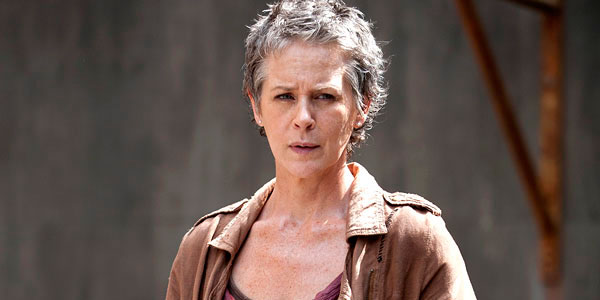 Beyond her protection of the group and her desire to keep them safe no matter the cost, Carol showed how versatile she is when she was able to reset a stranger's dislocated shoulder. What with Doctor S being incapacitated and Hershel prone to maverick decision-making concerning the virus, this leaves her in a very valuable position. Obviously the Carol we met at the start of the series and now has grown by leaps and bounds, transforming from victim, to bystander to can-do survivor on her path to becoming the multi-faceted team player she seems to be. The ability to single-handedly slay a room-full of walkers is obviously a prized ability in anyone, but pretty much every one of the show's leading cast members can do that now. It's when the survivors begin to put down roots that other things come to the ofre, and it's having compassion and the know-how to provide medical aid makes Carol a top candidate of anyone's Walking Dead fantasy draft, if such a thing exists.
4. Questions Efficacy Of Rick's Plan
 When Rick goes searching for medicine to potentially help stop the viral epidemic at the prison, he makes the decision to bring Carol with him. From a character perspective this might appear strange, yet what at first seems to be an odd pairing begins to crank up the drama as the episode goes on. Basically, Carol and Rick's wanderings on the other side of the fence gives us a damning verdict on Rick's leadership decisions. The longer we spend with the post-apocalypse odd couple, the differences in their basic ideologies and leadership styles become more and more stark. Rick continues searching for medical aid in the hope of uncovering something that could assuage the blight upon the prison, whereas Carol takes the pragmatic view that this mission is futile, not comprehending how an over-the-counter drug could remedy a disease this savage. This brings both Carol and Rick at odds in terms of realism and being idealistic, and in the situation we're given, it's hard not to see Carol's point.
3. Carol Confronts Rick Over Burning Bodies
 That ten-thousand pound elephant looming throughout Rick and Carol's medicine-hunting excursion those charred bodies of fellow survivors Karen and David went unsaid but added a thick air of tension to their usually close relationship and friendly interactions. Rick seems to avoid asking Carol directly about the deaths, shifting topics while clearly knowing its on both their minds. This shows Rick to be torn, somewhat indecisive and quite indirect when confronted with a rather obvious challenge to his leadership. This becomes even more apparent when Carol is first to bring this tough subject up to Rick, even going so far as to ask Rick to his face why he hadn't questioned her or brought up Karen and David's deaths already. Carol makes a bold move, steps up and not only assumes responsibility for killing them but also a sense of ownership and protectiveness for her clan that seems to fall outside of Rick's somewhat altruistic captaining. If this is papa-bear Rick versus mama-cub Carol, it would seem that the mother's instincts to protect her pack bring with them a different set of morals and perspectives on doing what's right. Rick is still holding into his old code, his way if doing things and abiding by a law as Sheriff, but Carol has experienced too much and been too hardened by this brutal world to go back to conforming to how things were. She's lost her daughter, so she'll go to great lengths to protect anything she feels it's her duty to protect. From Carol's view, she has a family kin to protect from an unknown internal entity, but to Rick, who still carries with him his pre-walker set of ethics, Carol has become a liability. Of course, it's all very morally grey, but as abnomnable as Carol's actions were concerning Karen and David, there's a very understandable reason behind her actions that go beyond the wholeheartedly evil approach of the Governor or the more insane branch of survivalism expounded by Shane.
2. Character Growth
 Mentally, Carol's a hardy sort she's not haunted by ghosts of her (admittedly awful) dead husband or seeing spirits of her zombified daughter, and she appears a whole lot more put together than the Grimes paterfamilias, who's been known to jump off the deep-end when it comes to familial hardship. Carol beats down her demons and refuses to live in the past while Rick still pines for Lori and her awful pancakes to the extent where he hallucinates and can easily be identified as a crazy person. If there is any character on Walking Dead that has shown the most character growth above all others, it's Carol. When we first meet Carol she was too busy using her face as her hubby's punching bag to be at all self-reliant. We traverse over many lands, seeing many people, yet despite critics carping on about there being little in the way of organic character development on this show, we find Carol to be a truly changed individual. Having lost practically everyone close enough to shed tears over, it seems Carol has not only dried out of tears but also any semblance of her previous self. She's not free of compassion and doesn't believe in the same survival-of-the-fittest philosophy as Shane, but she believes that occasionally, a line must be drawn regardless of the heinous actions required to draw it. Leaders make horrible decisions in horrible circumstances all the time, and being fair to Carol, you can hardly say she isn't decisive when she wants to be.
1. Left Behind
 Carol also showed her decisiveness as a potential leader when she made the call to move on after Rick wanted to wait or go back for an injured couple they had met. It's once again a moment where Rick's idealism and perhaps misplaced hope put people in potentially easily avoidable danger, and it's this moment where Carol herself makes the call that it's time to move on. While it may seem cold on the surface, it shows Carol is at all times thinking of the safety of her tribe, and while she offers the newfound couple in despair a spot on their neighborhood watch assignment perhaps out-of-turn as the offer catches Rick by surprise she won't let herself or anyone in the group get held back trying to lend a helping hand. She's too forward-thinking for this Carol has lent one hand too many to know the consequences of Rick's ill-conceived idealistic heroism, and has paid in spadefuls for it. Carol has lost husbands and daughters, friends and lovers, yet has taken it in stride, each a lesson in making her a stronger woman, a fiercer provider and a more attentive caregiver. Rick has dealt with the loss of his wife and best friend, battled with internal and external crises, and each battle has been a personal and emotional struggle, bringing him to his knees, wracking his psyche, and more than once nearly tearing the group apart. The episode concluded with Rick making the ultimate leadership call by dismissing the rogue Carol, leaving her behind in his shamelessly product-placed Hyundai dust. Rick seemed to even struggle with this ending decision, looking back both literally in the rearview mirror and figuratively into the past, yet again questioning his own decision to toss Carol, and calling into account his own ability to lead. Is Rick's form of starry-eyed leadership set to spell the end for the group, or is Carol and/or her protect-at-all cost den mentality the only path to salvation for the crew of Walking Dead? With this in mind, wouldn't they all be much safer under Carol's watch? What do you think? Feel free to comment?