10 Behind The Scenes Stories From WWE King Of The Ring 1998
"Sorry we forgot the thumbtacks..."

As he looked down from atop the Cell onto a group of concerned referees, doctors and other staff checking Mick Foley even had a pulse, The Undertaker must have been wondering if he and his co-worker had succeeded in going too far.
Behind the curtain, others were flapping around, trying to make sense of Foley's potentially fatal bumps. A worried Vince McMahon dashed out from his seat at the Gorilla Position to check on Mick himself after the first, and show producer Bruce Prichard angrily shouted at passers by to find him Pat Patterson.
It must have been quite the scene, both in front of the live crowd and buried away out of sight backstage, and there were genuine fears Foley might be dead. If that sounds hyperbolic, then consider that every single wrestler knew how stiff WWF rings were before the subsequent policy change; bumping off the top rope was bad enough, but this was another level entirely.
On his Something To Wrestle With podcast, Prichard's examination of the build up towards (and day of) the King Of The Ring 1998 pay-per-view is fascinating. Stories from behind the scenes were often more dramatic than what happened in front of the cameras.
That's saying something...
10. Vince McMahon Demanded More Entertainment Before The Show

In the weeks preceding King Of The Ring, a focused Vince McMahon sat his creative troops down and told them he wanted pay-per-views to be more like episodes of Raw. At first, the writers were baffled. Weren't monthly specials supposed to be all about the actual matches themselves?
Not in Vince's mind.
McMahon wanted more entertainment on the bigger events, and that's why he booked an in-ring promo for himself shortly after the card's first match; incidentally, that Headbangers and Taka Michinoku vs. Kaientai six-man only happened because the WWF were stalling for time due to injuries both The Undertaker (broken foot) and Steve Austin (staph infection) had suffered.
Those problems fit snugly with Vince's vision for more of a loose feel to the shows overall. It's why the company started running more backstage segments on supershows over the next couple of years. Suddenly, pay-per-views became longer episodes of regular television, only they had marquee matches to make them must-see.
9. Dan Severn's Internet Comments Infuriated The WWF

Ex-UFC hardman Dan Severn was eliminated from the KOTR tournament at the semi-final stage in less than five minutes by The Rock. Maybe that was the plan all along, but it makes sense to believe that ol' Dan's comments in the lead up to the pay-per-view had some bearing on his limited role.
Shortly before the event, Severn had agreed to an online interview in which he questioned Ken Shamrock's physique and appeared to hint that everyone in the WWF was on steroids. It's worth keeping in mind that his comments came just four/five years after the federal government investigated drug and steroid use in the WWF.
Sh*t was always going to hit the fan after Dan nonsensically picked away at old wounds.
Shamrock was naturally enraged by Severn's finger-pointing, and Jim Ross also found the remarks very disappointing. Dan had created nuclear heat for himself backstage, and there didn't seem to be any particular reason for throwing everybody under a bus.
8. The WWF Held A Pre-Show Party To Get The Crowd In Early
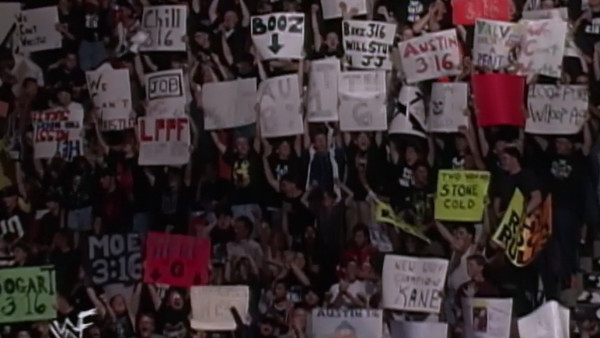
In the summer of 1998, the WWF were "struggling" (Prichard's words) to get bums in seats for the first match on the card at pay-per-view events, and that's why they decided to hold a mini-festival the day of King Of The Ring. Selling tickets wasn't an issue, but actually getting those folks to the arena on time was an ongoing problem.
That's why the company held a special pre-show party outside the building.
A DJ played some tunes, various members of the roster appeared in front of the fans and there were even special autograph signing booths set up solely so the WWF could get people excited and, more importantly, there early. It was a genius move, one that fixed the problem without going to extreme lengths.
By the time the show started, the WWF had long-since filed everybody into the arena and to their seats. The gaps that had popped up on recent pay-per-view broadcasts were filled, and the place looked jam-packed as the show went on the air.
7. The Original Plan Was Mankind Vs. Steve Austin

That legendary Hell In A Cell match between The Undertaker and Mankind may be the show's legacy, but it almost never happened at all. As shocking as it is, the hard-hitting bump-fest wasn't the original plan when creative sat down to write King Of The Ring '98's format.
A blowoff Cell match between Mankind and Steve Austin was supposed to be the headliner instead.
Mick Foley and Austin had already worked together at both Unforgiven and Over The Edge in April and May, and it struck Vince McMahon that fans might not buy a third rematch at KOTR. At the 11th hour, McMahon decided to scrap Mankind vs. Austin, pivot to Kane's challenge for the WWF Title instead and put Foley up against 'Taker.
When Vince Russo then caught wind of Foley planning his match without the Cell, he was the one who told Mick that his match would still use the structure. Meanwhile, Kane and Austin would work a "First Blood" stipulation.
That worried Foley.
6. Mick Foley Was Concerned About Topping The Original Hell In A Cell

Citing a practically nonexistent build, The Undertaker's broken foot, the lack of any title to add sparkle and the fact the original Shawn Michaels vs. 'Taker HIAC match had been so good, Mick Foley aired his concerns to both his opponent and Bruce Prichard pre-King Of The Ring.
In Mick's mind, topping what 'Taker had achieved with Michaels at the previous October's Badd Blood: In Your House would be virtually impossible.
That feeling of helplessness only worsened when Foley sat down to watch the first Cell encounter with old pal Terry Funk again. Funk, looking to ease his friend's torment, pitched the idea that Mick and The Undertaker start their match on top of the Cell. Foley liked it, but he had quite the job convincing 'Taker (who, don't forget, was nursing a broken foot) that it was wise.
Not content to phone it in and have people denounce his match as a poor follow up to the original, Foley reasoned with The Undertaker that they had to base their match around dangerous bumps to create the illusion of brilliance.
5. It Was Pat Patterson's Idea To Bring The Cell Back Down

If you've ever wondered why the Hell In A Cell structure started coming down during the Steve Austin vs. Kane main event at KOTR '98, then wonder no longer. It turns out that the WWF didn't plan this before the show started.
No, it was a call made on the day after Pat Patterson said, "What if?".
Patterson's logic was that people would be thrilled at the prospect of a second consecutive Cell match right after Mankind vs. The Undertaker. Even though he was right and people were electrified by the visual of the cage almost crushing Austin on its way down, it did feel a tad strange at the time.
Prichard didn't go into detail on what Jim Ross and Jerry Lawler were told to say on his podcast either. Though the announcers made sure to keep their wording fairly vague on commentary, they did sell the structure lowering again like it might be a conspiracy against Austin.
4. Patterson Was Dealing With A Personal Tragedy Backstage
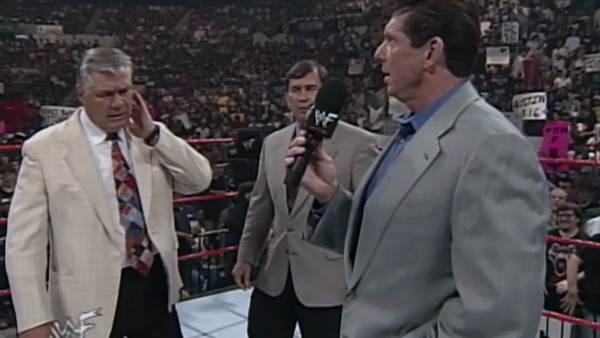
Bruce Prichard panicked backstage when Vince McMahon decided to up sticks and check on Foley after he crashed through the announce desk. Prichard was left with quite the quandary. Did the WWF keep cameras on Mick? Did they cut away? How much of this could they show?
Failing to come up with any answers, he started shouting at passers by to find him Pat Patterson. A trusty McMahon lieutenant like Pat would surely know what to do. Rather depressingly, Patterson was going through some mental torture of his own.
When Prichard finally got hold of Gerald Brisco, he again asked where Pat was. That's when Brisco informed him that Patterson had just received terrible news: his longtime partner of 30+ years, Louis, had passed away suddenly.
Immediately, Bruce stopped caring about the show and tried to help his grieving friend.
3. McMahon Coming Out Wasn't In The Script
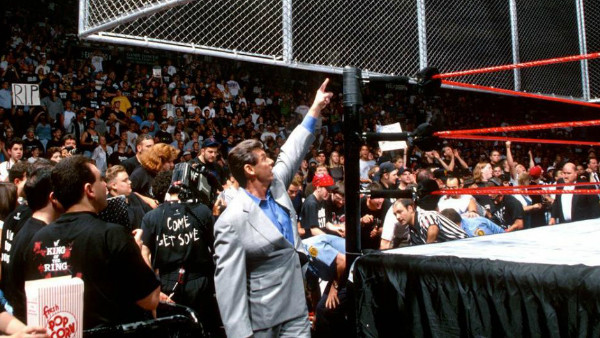
Vince McMahon raced from his seat behind the curtain after witnessing Mick Foley fall from atop the Cell and through a ringside announce table. He wanted to check for himself that one of his workers wasn't seriously injured, or (worse) dead.
Showing genuine concern for Foley's well-being, Vince temporarily lost all care for his own characterisation in front of the fans. His run-in wasn't part of the script; truthfully, it worked out, because McMahon and Mick had been linked on television for months. To the crowd, it just looked like Vince, in character, was selling the stunt.
In reality, he wasn't. Vinnie Mac, just like everyone else, was legit freaked out by the severity of the bump.
It must have been hard for him not to sprint back out when Mick later returned to the Cell and performed his next death-defying fall. That one wasn't meant to happen the way it did either, and the WWF had taken serious precautions to protect Foley as much as possible.
2. The Cell Roof Wasn't Supposed To Break So Suddenly

To the wrestlers watching backstage on monitors, the second major bump Mick Foley took was way worse than the first one. Poor Mick landed with a splat in what Bruce called "one of those old WWF rings" after being Chokeslammed through the Cell's roof by The Undertaker. That was never the plan.
The structure was supposed to cushion (as much as a metal grate can cushion anything) at least two Chokeslams before giving way. Then, come bump time, Mick would hang off the Cell panel and effectively back bump from the same height as the top rope.
Foley's body was certainly not supposed to crash through the panel or smash to the rock hard canvas from the height it did, and he wasn't booked to be cruelly hit in the face with a steel chair on the way down.
The Cell was rigged to fall in stages. This would limit the bump's height, and it'd also (hopefully) give the impression that Mick had taken another comeback-killing bump. It wasn't meant to look like The Undertaker had tried to murder him.
1. Foley Apologised To Prichard For "Forgetting" A Thumbtack Spot

By his own admission, Mick Foley doesn't remember much of the Cell match at all after that second bump through the structure's ceiling. Visibly out of it, he somehow wobbled his way through some more painful spots and even took a horrific back bump on thumbtacks.
This is something Prichard and McMahon knew about beforehand, and they were left stunned when Foley apologised to Bruce for "forgetting" to use them.
It's true. Post-match, as Vince thanked Mick for his efforts and famously cautioned him for being so reckless, Foley stumbled up to Prichard and said sorry. Bruce couldn't believe it. Here was a man who had almost killed himself to entertain, and he was sad for missing out a spot when he hadn't at all.
When Prichard told Foley he and 'Taker had used the tacks after all, Mick was so out of it he didn't seem aware he'd even apologised. That's downright scary.
What do you make of these backstage stories from WWE's King Of The Ring 1998? Let us know your thoughts down in the comments section below!