10 Failed Concepts WWE Needs To Revise And Revisit
"Mistakes are the portals of discovery."

The history of professional wrestling is riddled with phenomenal failures.
The Kennel From Hell match was never going to work; if Hollywood can barely manage children and animals, Vince Russo had no chance. The Gobbledy Gooker was an actual, anthropomorphic giant turkey, and WWE still didn't consider the irony. Similarly, Duke 'The Dumpster' Droese was a waste collector - a garbage man. Those were the insane manifestations of Vince McMahon's mind, the motives behind which were inscrutable.
If you were of a kind disposition, you could understand what he was playing at with Pirate Paul Burchill. Somebody clearly told Vince about Jack Sparrow, and Vince tried to monetise it. Unfortunately, it never occurred to him that it had already been monetised in the correct medium, and the once-promising career of Burchill, excavated hidden British treasure, walked the plank.
The Reverse Battle Royal was similarly irredeemable. Ditto the great (read: dreadful) loophole of 1996; you can't just find the two nearest tall lads and call them Diesel and Razor Ramon. Neither for that matter can you dress an oaf up as mummy and call him a bloody Yeti.
Other failures, however...
10. The Ambrose Asylum

WWE doesn't do the best pure wrestling in the world. It can't; the crazy touring schedule necessitates phoned-in TV performances, company guidelines prohibit the neck-shattering drama of a New Japan masterpiece, and the matches are invariably over-produced and often formulaic.
WWE also doesn't want to do the best pure wrestling in the world. It is above pure wrestling; it presents "larger than life" characters as part of grand storylines "like Shakespeare, opera or ballet," per Stephanie McMahon.
The Ambrose Asylum was a dud sequel experiment to the Casket Match or the Boiler Room Brawl - a bespoke gimmick match designed to project and market individual characters to the "WWE Universe". The Asylum match itself is redeemable - replacing the cage with a Cell would negate the overwhelming anti-climactic drama, and hanging actual weapons from it would negate the lame, forced comedy aspect - but the essence behind the match is what requires development.
A Bar Boom Brawl mastered by the The Bar; a Hollywood Backlot Brawl as the preserve of The Miz; a No Fly Zone Match for Drew Gulak, in which climbing the turnbuckle is outlawed - this is the character-driven storytelling we expect of WWE, and what WWE expects of themselves.
9. The 21st Century 1% Heel

Alberto Del Rio worked so damn well on paper. The character was an aloof aristocrat predestined for greatness - the complete antithesis of what drives us to support a pro wrestler. Unfortunately, he was never able to project the personality of spiritual antecedent Ted DiBiase.
The mega-rich heel isn't inimitable; Del Rio was different enough from DiBiase to dissuade accusations of plagiarism. It's also an IRL constant. The gulf between rich and poor is grotesque; this, by definition, is an almost universal feeling worth tapping into. We don't watch pro wrestling to watch dry administrative power plays play out onscreen; we watch it to live vicariously through the lens of our heroes. Austin humiliating McMahon; Batista levelling up to Triple H; CM Punk raging against the WWE machine; Daniel Bryan smashing it. This is the stuff of which legends are made, and the 1% is the target of ire in 2018.
"It's the old adage that you like to hear somebody's doing pretty good, but you don't wanna hear they're doing better than you" - so sayeth Ric Flair during his seminal "golden spoon" promo, a contender for the greatest ever.
EC3 is the next in line to play the role. A bit of a shame that his TakeOver match was so God-awful.
8. The 21st Century Intellectual Blowhard

Wrestling fans, like most people, despise being insulted. There is nothing more profoundly irritating than Paul Joseph Watson, or a know-it-all liberal equivalent, imposing his will via Twitter with such arrogant, patronising conviction - especially when they deal almost exclusively in the logical fallacy.
Transposed to the wrestling arena, the blowhard is a guaranteed heat generator. The problem, when it was transposed to the wrestling arena, is that the men behind the gimmick undermined it. Lanny 'The Genius' Poffo was a florid, unique promo, but it was difficult to accept his preaching, given his limitations in the squared circle. Damien Sandow was his spiritual successor; unfortunately, that extended to his in-ring game.
That's not a slight on Sandow. His "SILENCE!" schtick was solid midcard gold - but surely, such an act requires a genius technician-cum-swindler to truly draw the ire of crowds to a main event level that has thus far eluded wrestling's genii.
Think Mr. Perfect fused with PJW, and you're close to the platonic ideal of an über-certain wrestling heel in this age of mass anxiety and confusion.
7. Wrestling Isn't Wrestling

WWE has experimented with wrestling beyond the ring over the last 18 months, as either a half-a*sed attempt to imitate the BROKEN Universe or a misguided attempt to throw any supernatural sh*t at the Bray Wyatt wall.
The genius of wrestling is in its theatrical collaboration; strip that element away, and it's the results tend to alienate the fandom. WCW's Junkyard Invitational was a disaster because even the magic of the camera wasn't enough to bring the action to us; the company's blundering production staff failed to capture the action in the pitch-black setting.
That said, the fact that those matches firmly imprinted themselves on the wrestling psyche prove, if nothing else, that they are unforgettable - and if the line between genius and insanity is membranous, there is surely a means of revisiting wrestling outside of the ropes. In fact, there definitely is; received either as a disgrace or a revolution, Matt Hardy nonetheless BROKE the internet by devising a completely new genre of the wrestling art form in 2016.
WWE is either great, terrible, or painfully average. So-bad-it's-good territory remains elusive - but the odd bit of b*llocks banter would surely alleviate the tedium.
Can't Samoa Joe next challenge AJ Styles in Wendy's?
6. Feast Or Fired

The TNA/Impact Wrestling 'Feast Or Fired' match was a particularly bad failure of a concept, for it boasted plot holes deeper than Vince McMahon's hatred of his audience. Despite a universal panning, we have seen six iterations of it. That's four more than Reverse Battle Royal.
#LOLTNA.
Why would a top TNA management official risk losing a major star with the wattage of a Samoa Joe or a Christopher Daniels or an Austin Aries, all of whom appeared in the match near or at the peak of their powers? Why would such major stars themselves risk being fired, and not simply wait for a title shot via less daft means? Squint, though, and there is something in it - a potential storyline method of writing a stale performer off television ahead of a repackage (Bray Wyatt), a brand switch (Asuka), or a demotion back to developmental (Dana Brooke). Adding some form of life to a dead act via sudden death stakes at least provides the audience with one last reason to care about them.
Repurposed as a sort of Last Chance match, a Feast Or Fired affair between two jobbers or also-rans would go some way towards alleviating the nothingness that is a Curt Hawkins appearance - a dramatic method of cycling through a floating undercard roster in this age of clutter filler.
5. The Losing Streak

The losing streak trope, in WWE's hands, is a transposed onscreen punishment - a stick with which to beat a performer over what is usually a minor indiscretion.
Montel Vontavius Porter's gimmick was that of a winner; a coveted free agent furnished with so much potential that Teddy Long broke the bank just to secure his signature. After a promising start, propelled by genuine improvement between the ropes, MVP triggered the office by accusing a Wellness Policy tester of getting the gig as an excuse to peer at the penes of athletes. In order to send a message to the boys, MVP was stigmatised as a loser forevermore.
In the hands of the legendary Shohei 'Giant' Baba, it was used to legitimise the great Kenta Kobashi as a fiery upstart in the late 1980s. Kobashi earned his way into the hearts of the AJPW fandom as their proxy. Their increasingly vocal support fuelled Kobashi as he came closer and closer to his first singles win. They were part of the story, and thus were unable to put the book down.
Used correctly - as opposed to the unfunny running gag that is Curt Hawkins - the losing streak is an ironic win/win, a guaranteed sympathy-generator, the first act in the story of a legend - and a means of getting heels over in the meantime.
4. The Lion's Den
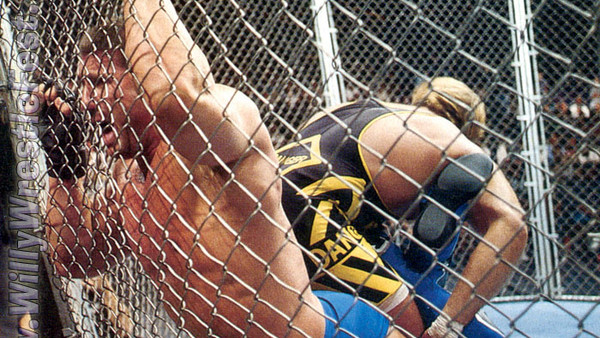
More curio than failure, the Lion's Den gimmick of the Attitude Era was an underrated vehicle for Ken Shamrock that left the landscape as quietly as the man himself.
In an age in which content content content generates apathy apathy apathy, it's difficult to process so much of what happens on flagship programming. Constable Corbin and Finn Bálor are still feuding.
Those matches didn't matter, because the deadening expanse of content is largely meaningless by virtue of existing. The over-saturation of the gimmick bout is as to blame, admittedly - but perhaps an easy answer is to look farther afield.
Exhumed as a gimmick match for submission specialists with the ability to fly within enclosed spaces - an AJ Styles, maybe - the Lion's Den is a fun relic ripe for repurpose in the post-MMA age.
Many lapsed fans cite the Attitude Era as the last unmissable period of WWE. "Bringing back" a safer element of it might represent an easy, sponsor-friendly lure to a more talented but lesser known talent roster.
3. Prime Time Wrestling
PrimeTimeWrestlingWasn'tAFailedConcept.
Just getting that out of the way quickly, in order to avoid getting pitchforked in the face by a legion of fans with cherished memories of the G.O.A.T banter shared between Gorilla Monsoon and Bobby Heenan.
WWE considers Prime Time Wrestling, if not a failure, then an anachronism; a model rendered extinct by the apparent requirement for live in-ring action. That is the real anachronism; trends indicate that tape delay doesn't affect ratings, and it's not as if Eric Bischoff is there to give away match results. The internet is, but regardless: the in-studio context is a mainstay of other sports. In the UK in particular, Match of the Day is a bonafide, irreplaceable institution. Fans enjoy being involved in the wider conversation. It's comforting.
Led by a pair of presenters with natural chemistry - Renee Young and Corey Graves - a Prime Time reboot would make extinct the dire, overly-verbose RAW formula, allow fans to share in that wider conversation, and repurpose the cult classic Talking Smack as a loose framework with which to share WWE's shattered universe by way of connecting fans to the product and the performers.
2. Championship Scramble

WWE almost had it.
The Championship Scramble, the brainchild of Pat Patterson, suffered because it was convoluted and psychologically lacking. There was no reason why the performers who started the match started the match; unlike Patterson's Royal Rumble or the Chamber, there were no eliminations, and therefore no immediate advantage. And, with the personnel known in advance, the countdown suspense just wasn't there for the remaining field. The concept of "Interim Champions" was just odd, too - unnecessary paper prestige. There were no Interim Champions in the first fall of a Two Out of Three Falls Title bout because there didn't have to be.
Live up to the premise promised by the name, and the new Scramble match - in which all five/six/whatever stars begin and fight to the sudden death over 30 minutes - possesses limitless scope for unpredictable drama, unseen falls, pin break-ups, double pins and mass confusion, ridiculous multi-man sequences...
There's an element of contrivance to this revision - we'd see far more falls than we'd usually see in a Fatal 4/5 Way affairs - but the 30 minute time limit and extra damage meters should help suspend disbelief.
1. The Invasion

For the first time since 2001 - or you momentarily forgot that Vince Russo booked TNA - there is a faint glimmer of competition lurking behind the giant shoulders of WWE. Neville split recently. Cody challenged its dominance in the 10,000 seater arena with the triumph that was ALL IN. Chris Jericho opted for an upgrade by joining forces with New Japan Pro Wrestling.
To stave off the growing competition, WWE would do well to create the illusion of it.
An NXT Invasion onto the main roster is the elusive major angle WWE could pull off without the need for expensive part-time reinforcements. And, unlike last year's nonsensical #UnderSiege, there is a genuine thread of logic behind the motive - a potential main roster call-up and the higher earnings that come with it, chiefly. Despite the laboured and sudden nature of it all, #UnderSiege went over well. Imagine the impact of an Invasion that isn't a glorified Bragging Rights retread - one with the potential to alter the very complexion of WWE.
There is massive scope for storytelling here. You could easily buy the initial premise. You could also buy defections from the damaged likes of Bayley and Sasha Banks, and the elixir of TV star ambition turning the heads of their peers.
What an awesome platform for Triple H's actual ascension to the throne it would be, too...