10 Iconic Wrestling Storylines Summed Up In A Single Frame
In which beer is used as a metaphor three times.

WWE is a carny pro wrestling racket dressed up as a corporate entertainment conglomerate. It is a work that lies to itself, in addition to the outside world, and so of course those at the helm are going to bullsh*t us.
There are endless examples of hypocrisy and mendacity, and they're often informed by a certain arrogance. They know what's best. They are so successful that it's automatic. And they will tell the talent that they must learn how to work for the camera when they join WWE.
This arcane process can take years, it's so complex. The local indy can't help, sorry, and nor can checks notes the instincts evolved for years and years of a life captured, at the reach of pocket, by everybody with a smartphone. Everybody is a performer now, on some level.
On this week's Dynamite, MJF sh*t a brick when he heard Jon Moxley's music hit. He conveyed this fear - and put Mox over as a badass - by shooting a panicked look to the camera. He knew his chirping had landed him in bother, and he let the mask of hubris slip. He didn't need five years of Performance Center training to accomplish this.
Obviously, nothing from modern WWE can appear on this list - how can you play to their camera without working like a coked-up DVD screensaver? - but they knew what they were doing, once upon a time...
10. Austin Vs. McMahon

WWE isn't fun anymore.
It's not a lot of things anymore, but there's such a portentous and "gritty" vibe about everything. It's all steeped in personal failures and the all-forgiving brand that rehabs a Randy Orton or redeems a Drew McIntyre. Everything takes itself so seriously, and is so punishingly dull - remember when Edge was a laugh? - and yet it also extracts eyeballs and has ninjas running about an empty gym.
The tragic postscript of Austin Vs. McMahon is that McMahon won: he effectively subdued the talent that followed Austin, and slathered WWE in a slick corporate ethos that punishes defiance and expression.
But it was, when in full effect, one of the greatest storylines in professional wrestling history. Austin was an hilarious badass megastar, McMahon the exquisite, hammy ar*ehole corporate overlord. That irresistible dynamic, powered by as much charisma as talent, was explored in a tremendously entertaining and wildly unpredictable shared universe under a superb, reliable and logical formula. McMahon was an ar*ehole. Austin outsmarted him. Rinse, repeat, ratings. The tonal balance was magnificent. The comedy never once compromised the drama; it only accentuated it.
This image, from the beer bath, is the greatest summation of it; Austin, every week, provided an eruption of catharsis.
9. The Undertaker's WrestleMania Streak

The Undertaker, at WrestleMania VII, did not deviate from his one facial expression.
Like the corpses he embalmed, it was fixed in rigor mortis to convey his chilling, inevitable, impervious threat. As the years and so many WrestleMania victories wore on, 'Taker's face changed in a reflection of his newfound range, but he drew from the same, narrow brush. There was anger, in the blood feud with Kane. There was menace, in his psychotic take-down of Ric Flair. There was vengeance, in his retribution against Edge.
Almost decades later from the one-dimensional cartoon character that put Jimmy Snuka away (pause), he wore a very different expression at WrestleMania 25. When Shawn Michaels kicked out of the Tombstone, at the apex of a classic match, it felt like the end.
Imitated now to farcical parody, it worked so magnificently for the Undertaker because he captured a legendary career, and the full pathos of its metamorphosis, in a second. The undead zombie mortician had become a mere mortal, and wore - to incredible effect earned over decades - the weary and almost pitiful shock of an ageing soldier.
8. Chris Jericho Vs. Cody

Cody Vs. Chris Jericho was the last time a wrestling match will feel as gigantic and as important as it did. You suspect the same would be true even if the world hadn't taken a turn into unchartered grimness.
It was a great premise and a great dynamic: the two dons of AEW's early pay-per-view cycle were scheduled to face off for Jericho's AEW World Title. Cody was the heart of AEW: a genuine saviour figure beloved by his fans for making expressive, great wrestling big time again. Jericho was, in Cody's fiery, now iconic words, the "succubus" who used the platform to reimagine it in his own, egotistical image. The new hero and the desperate (but formidable) jackass sold this as a super fight through incredible babyface promos, skits that were hilarious, but deep enough to hurt, and fantastic tweaks on old wrestling classics. One was a tense subversion of the contract signing, the other a super entertaining concessions stand brawl.
At its climax, Jericho, the irresistible jackass that he is, insisted that he couldn't be thrown out. He had a ticket, and to be a real jackass about it, he licked his head and stuck it to it. The imagery, if intended, was on the nose - but no less potent or earned.
This feud was the hottest ticket in wrestling in years.
7. Bret Hart Vs. Owen Hart
Watch the last frame of the GIF.
It isn't just a reaction to a heel move. It isn't just a means of building heat. There is a lifetime - and a metafictional story just as rich - contained within it.
The Bret Vs. Owen Hart conflict was incredible and relatable human drama. Bret, the WWF Champion-calibre star, willingly reverted back to the tag ranks to give his brother an "in" to championship glory. The gold didn't materialise; Owen, feeling patronised, also felt that Bret was motivated by selfishness. In a storytelling masterclass of a chapter, in a damn tome of a wrestling feud, Bret couldn't make the tag to brother Owen in their quest against the Quebecers at the 1994 Royal Rumble. Owen inferred that he wouldn't, and the sequence was arranged with such immense craft that the mystery was interpretative.
In WrestleMania X's classic opener, following a gorgeous flexing exchange of handspring elbow counters, Owen scraped Bret's head. Bret with, a point of the finger, all but called Owen a little bastard.
In that moment of phenomenal, pure in-ring storytelling, the hallowed, big-time ground of Madison Square Garden was Stu Hart's dungeon. It was the most nuanced feud the WWF had ever promoted between two men, but they were also, drenching the thing in pathos, two little boys navigating what was "fair" for the first time.
If only Owen was to know that luminaries such as Heidenreich, Deuce, and Kenzo Suzuki would capture the gold he believed Bret had selfishly deprived him of.
Would have saved a lot of heartbreak.
6. The Mega Powers Explode

The most stark illustration of WWE's profoundly broken creative process lies in the contrast between how it fails spectacularly to function now and how it flourished so spectacularly then.
Now, with a horde of clueless and browbeaten writing staff imported from the "legitimate" corners of the entertainment industry, WWE struggles to tell stories because those writers don't know anything about the booking form, nor how to please a wildly impulsive 74 year-old man.
Back then in 1988, that man was on fire, effortlessly plotting his greatest story by the relaxed confines of his mansion pool alongside a small inner circle of genius collaborators. There, he booked the deft, long-term Mega Powers Explode saga: a nuanced, human drama that was emblematic of the beautiful outsize cartoon its grand heft also bled through. After the friendship mutated into hatred and violence through both jealousy and a layered, just because you're paranoid series of misunderstandings, the Hulk Hogan Vs. Randy Savage WWF Championship grudge match was set for WrestleMania V.
Savage is so intense in this promo that you can see, even through VHS grain and black sunglasses, the whites of his eyes peeled in fury.
And, by the end, he is in tears. "I hate you. I hate your guts, and that's what's gonna be left all over the mat at WrestleMania V" he wails, with harrowing anguish and intensity, his psyche utterly battered by the events of the saga.
5. The Elite Civil War
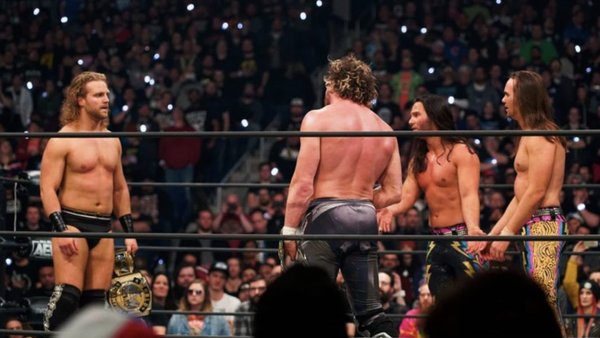
What's genius, about the Elite Civil War storyline, is that every player in it holds an understandable position.
Hangman Page is a beer-drinking southern boy who failed to capture the AEW World Title last August. He felt like an embarrassment to the name of an Elite stable he wasn't compatible with. He isn't an affected teetotaller like the men he once called friends.
The Young Bucks believe in him - they did at his lowest moment, minutes after his All Out introspection - but there was always a sense that they were too keen to share in his later celebrations, as if they were a part of it. But they sort of were. They recruited him as a raw prospect in Ring Of Honor, but - and there's always another, beautifully woven layer in the fabric - they cruelly and patronisingly reminded him of this on the Revolution go-home Dynamite.
Kenny Omega changed the wrestling world with the Young Bucks, and reached its pinnacle as they returned to his side. In the reality and fiction of pro wrestling, he tells pioneering stories of friendship and love dating back to his Golden Lovers team with Kota Ibushi. He senses a connection with Hangman Page, but the glorious tension that underpins it - and makes it soar so spectacularly in the ring - is that it's purely professional.
After an incredible, emotive classic at Revolution, in which every one of these emotional beats manifested with state-of-the-art physicality, the line was divided. Page, the loner, retreated, unwilling to celebrate with the men he insists are his former friends. Omega, through a deeper friendship - and, in another phenomenal layer, a deeper sense of respect - sided with the Bucks.
Page teased the Buckshot. Subtly.
The Elite teased a stereo superkick. Subtly.
This was instantly seminal episodic pro wrestling, and somehow, it has taken an even more compelling turn...
4. FTR Cut The Team In Half
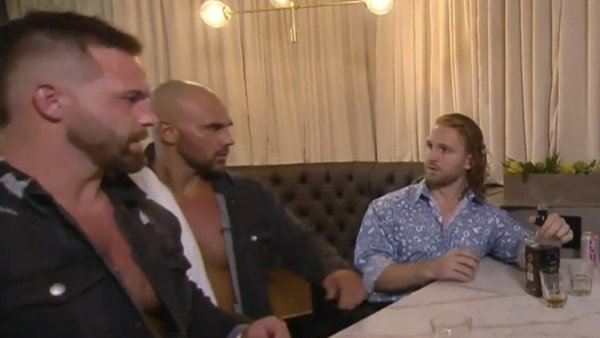
FTR's storyline introduction is so goddamn brilliant, organic, everything - a just perfect meeting of happenstance and tremendous booking.
They are beer-drinking southern boys. They are, in an inspired storyline development, compatible with Hangman Page. They have sensed this, and sensed also that they can, much like they do with the ring, exploit the budding friendship to cut his team with Kenny Omega in half. AEW used the beer glass as a visual metaphor for the philosophical difference between Page and the Bucks in January and February, and have since used it, in a sumptuous parallel, to tether FTR and Page together.
In the meantime, FTR have a stylistic beef with the Young Bucks stemming back years - held back in AEW by a sense of professional respect - that bleeds so naturally, via the ongoing tension within the Elite, into the most organic and intricate triangle feud ever booked.
This is so deft. It is exquisite episodic booking.
On June 24, Kenny Omega gently chastised Hangman Page for having no drinking buddies. On July 15, FTR joined Page at the bar with a sinister motivation Page received, because he's more F*ck The Bucks than F*ck The Revival, in earnest.
FTR are cutting the Elite in half in a tremendous psychological extension of their entire M.O. as professional wrestlers.
One day, Kenny Omega and Hangman Page are going to smash into each other with a V-Trigger and Buckshot lariat, and it will mark a new, transcendent chapter of this thing we are obsessed with.
3. Kenta Kobashi Ascends

There's selling, and there's Kenta Kobashi selling.
This was a moment so earned, and fought for with such fire and struggle, that it encompassed two wrestling companies: All Japan Pro Wrestling, and the Pro Wrestling NOAH league that broke away from it amid shockingly tumultuous circumstances. Kobashi's fire and his popularity was so inexorable that it carried him through several years to reach its pinnacle.
The singularly genius Mitsuharu Misawa had to be overcome for sentimental favourite Kenta Kobashi to ascend to Ace status. There was perhaps no wrestler ever, beyond Kazuchika Okada, at being the best wrestler ever.
Misawa was a fiendishly difficult puzzle box - the ultimate chess player - with an in-ring arsenal deep in its strategic minutiae. Kobashi was relentless in the spirit that has for decades enchanted the Japanese wrestling public. Their AJPW Triple Crown Title matches, all of which Misawa won, were the greatest of the 20th century. Brutal and awesome, performed with a sense of unrivalled depth and immersion, this epic war of intelligence versus instinct came to a dramatic, euphoric end on March 1, 2003.
Kobashi had spent so long with fire in his eyes, unleashing so many chop barrages, that when it finally happened, he could only collapse in an exhausted crumple, those eyes now shut in agonised triumph.
2. Kazuchika Okada's Fourth Reign Ends
Kazuchika Okada's fourth reign with the IWGP Heavyweight Title was legendary.
Spanning 720 days and a record 12 defences, it incorporated the greatest series of pro wrestling matches ever (versus Kenny Omega), some of the most heavily anticipated (Omega, Naito), the best thing the term "strong style" was ever applied to, and Okada doesn't even work that style (versus Katsuyori Shibata) and a record-breaking match against prior holder Hiroshi Tanahashi. Its blow-away genius and bittersweet heft were arrived at through history and mathematics. It was the seminal and precise crescendo of the best long-term storyline in wrestling history.
Okada was so goddamn genius in this period of his career that he pulled off golden flared trousers. He isn't getting them over in 2013, and he was fantastic then. Between 2016-18, his work - the slow-burn into the most incandescent of eruptions - merited the most histrionic of praise.
Genius. Transcendent. Unparalleled.
But everybody still waited for the payoff, often impatiently. If it wasn't Shibata, it had to be Naito. If it wasn't Naito, then definitely Omega.
Omega was the man to do it, after the most incredible professional wrestling match ever. The celebrations were euphoric babyface fare earned after Omega's own, immaculate arc.
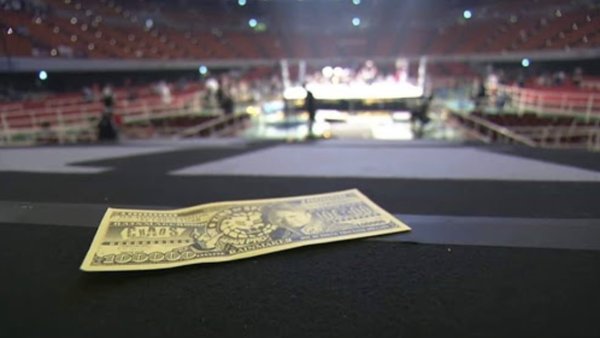
But the closing shot of Dominion 2018 was pure pathos.
An errant Okada gimmick bill occupied the foreground as the hall emptied - an acute visual metaphor an old adage.
1. Steve Austin Vs. The Rock

If you believe Bruce Prichard, the rise of the Rock put Steve Austin out. It's one of Prichard's more believable tidbits, which isn't difficult, since he is infamous for his "We meant "WCW guy" by "people like you"" b*llocks defence of the Triple K business.
Prichard claims that whenever a young stud emerges as real player, the jealousy manifests as defensive, tacit burial tactics from the established order. In the case of Austin, he is apocryphally said to have given the following verdict of the Rock in 1998:
"I don’t think lifting his eyebrow and a couple of cute sayings is really going to get you over."
That professional jealousy was always in reality a profound respect, even if Austin could not or would not articulate it at the time.
It's why the feud was good and so even and so dramatic and so bereft of the political bullsh*t that undermined, say, Bret Hart Vs. Shawn Michaels in the ring. These were two men, secure in their spot, confident in their own ability and in admiration of one another's. The real-life competitive edge was adapted to thrilling effect in the ring, and it ended with a show of that which they had overtly denied to one another onscreen.
After Austin finally did the job, in a fittingly badass last stand in which he worked through a terrifying health scare, Rock leaned over and told him he loved him.